What Tools Do Ethical Hackers Use?
Written by Matthew Hale
- What Are Ethical Hacking Tools?
- Kali Linux Is a Popular Starting Point
- Famous Tools That Ethical Hackers Use
- Which Tools Should an Ethical Hacker Learn First?
- When Ethical Hacking a Network, Which of the Following Can Be Breached?
- Tools Do Not Replace Ethical Judgment
- Choosing an Ethical Hacking Certification
- Conclusion
Ethical hackers legally think like attackers to help organizations become harder to attack. They discover weaknesses, validate risk, and document what needs fixing. But what tools do ethical hackers use to do that safely? If you wonder what tools do hackers use to hack, this guide separates legitimate testing from misuse.
There is no single “magic” hacking program. Ethical hackers use a toolkit that changes according to the target, testing scope, technology stack, and assessment objective. A network assessment may require discovery tools, while a web application test may depend on an interception proxy and scanner.
This guide explores widely used ethical hacking tools and how they fit into a professional testing workflow.
What Are Ethical Hacking Tools?
Ethical hacking tools are software platforms, utilities, frameworks, and operating systems that help authorized security professionals identify, investigate, validate, and report security weaknesses.
They can support activities such as reconnaissance, network discovery, vulnerability assessment, web application testing, password-security testing, wireless assessment, exploitation validation, and forensic analysis.
A useful distinction is important: the same technology can be used for legitimate security testing or malicious activity. Authorization, defined scope, controlled environments, and responsible reporting are what make ethical hacking ethical.
Kali Linux Is a Popular Starting Point
When people search for an ethical hacking tools list, Kali Linux is often one of the first names they encounter. Strictly speaking, Kali Linux is not a single hacking tool. It is a Debian-based testing and security-auditing distribution containing hundreds of tools and utilities.
Kali organizes tools into categories covering information gathering, vulnerability assessment, web applications, passwords, wireless security, exploitation, reverse engineering, forensics, sniffing and spoofing, post-exploitation, and reporting.
Kali is useful for learners and professionals because it provides a ready-made environment instead of requiring testers to assemble every utility separately.
A professional workflow usually follows a logic: understand the target, discover the attack surface, assess weaknesses, validate important findings, document evidence, and recommend remediation. A scanner can produce findings, but a tester must determine which are real, relevant, and worth prioritizing.
Tool selection also depends on the engagement. An API assessment may emphasize Burp Suite, while a network review may rely on Nmap and Wireshark. Wireless assessments require specialized tools. There is no universal combination that works best for every environment.
Modern security testing is also becoming more integrated with development and cloud environments. Automated scanners can support pipelines, while manual testing remains important for complex attack paths.
Famous Tools That Ethical Hackers Use
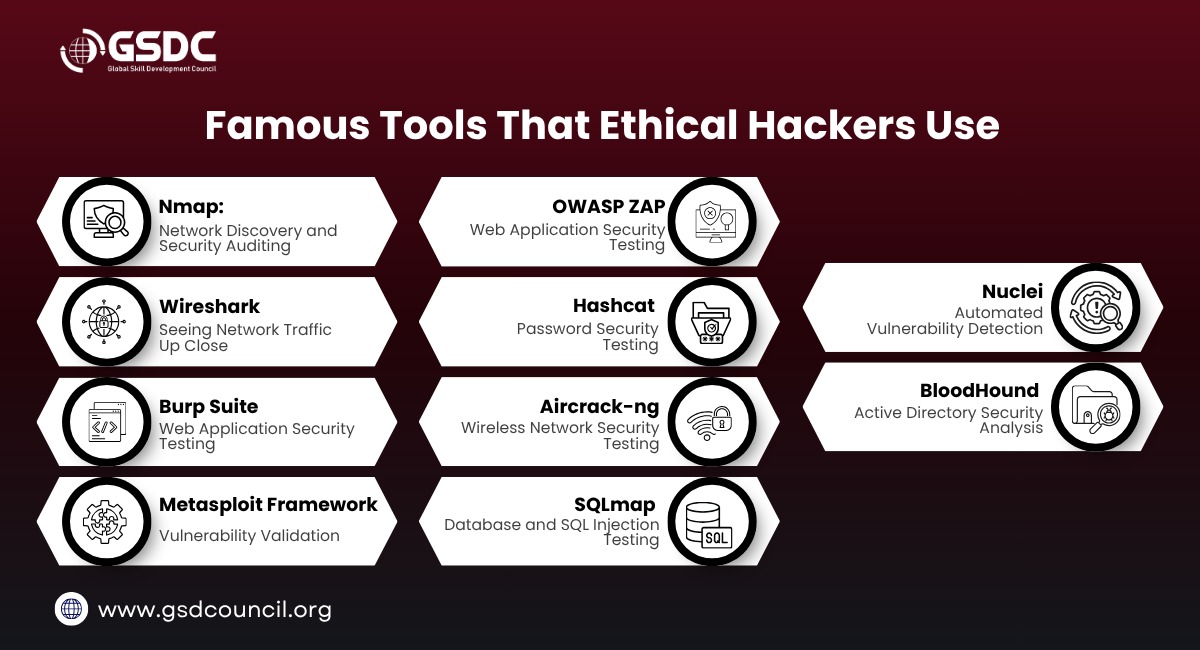
Ethical hackers use different tools depending on whether they are assessing a network, web application, wireless environment, credentials, or software. Here are some of the most widely recognized ethical hacking tools and what they are used for.
1. Nmap – Network Discovery and Security Auditing
Nmap (Network Mapper) is one of the most widely used tools for network discovery and security auditing. It helps ethical hackers identify active hosts, open ports, running services, service versions, operating systems, and other characteristics of a target environment.
During an authorized test, Nmap can help security professionals understand an organization's attack surface before moving into deeper assessment. It is also useful for network inventory and security monitoring.
Best for: Network discovery, port scanning, service identification, and security auditing.
2. Wireshark – Network Traffic Analysis
Wireshark is a free, open-source network protocol analyzer that allows security professionals to capture and examine network traffic in detail. It can inspect hundreds of protocols and supports both live traffic capture and analysis of previously captured traffic.
Ethical hackers can use Wireshark to understand how systems communicate, investigate suspicious traffic, troubleshoot network behavior, and identify potential security weaknesses in network communications.
Best for: Packet analysis, protocol inspection, network troubleshooting, and traffic investigation.
3. Burp Suite – Web Application Security Testing
Burp Suite, developed by PortSwigger, is a popular platform for testing the security of web applications and APIs. It allows ethical hackers to intercept and analyze HTTP/HTTPS requests, examine application behavior, and identify potential security weaknesses.
It is commonly used for testing areas such as authentication, session management, access control, input validation, and other web application security issues.
Burp Suite is particularly valuable because it supports both manual testing and automated security assessment workflows.
Best for: Web application and API security testing.
4. Metasploit Framework – Vulnerability Validation
Metasploit Framework is a testing platform used by security professionals to research and validate vulnerabilities in controlled environments.
Rather than simply identifying a potential weakness, ethical hackers can use Metasploit to determine whether a vulnerability can actually be exploited and what security impact it could have. This helps organizations prioritize vulnerabilities based on real-world risk.
Because Metasploit can perform powerful security-testing actions, it should only be used against systems where explicit authorization has been provided.
Best for: Testing, exploit validation, and controlled security assessments.
5. OWASP ZAP – Web Application Security Testing
OWASP ZAP (Zed Attack Proxy) is an open-source web application security testing tool. OWASP describes ZAP as an integrated testing tool that can be used by security professionals as well as developers and testers who are new to testing.
ZAP can intercept web traffic, assist with application discovery, perform automated scanning, and support manual security testing.
For organizations looking for an open-source alternative for web security testing, ZAP can be a practical addition to an ethical hacker's toolkit.
Best for: Web application vulnerability testing and security testing automation.
6. Hashcat – Password Security Testing
Hashcat is a password-recovery and password-security testing tool commonly used by security professionals to evaluate the strength of password hashes in authorized environments.
Ethical hackers can use it to determine whether weak or poorly chosen passwords could be recovered from compromised password hashes. This can help organizations strengthen password policies and encourage stronger authentication practices.
Best for: Password security auditing and authorized hash recovery.
7. Aircrack-ng – Wireless Network Security Testing
Aircrack-ng is a suite of tools designed for assessing Wi-Fi network security. It can help ethical hackers analyze wireless networks and evaluate the effectiveness of their security configurations.
During an authorized wireless security assessment, professionals can use specialized wireless tools to identify weaknesses in authentication, encryption, configuration, and network exposure.
Best for: Wi-Fi security auditing and wireless testing.
8. SQLmap – Database and SQL Injection Testing
SQLmap is an open-source testing tool designed to help security professionals detect and test SQL injection vulnerabilities in web applications.
When used within an authorized testing environment, it can help determine whether application inputs are improperly interacting with backend databases. This makes it useful for validating a potentially serious application-security weakness.
Best for: Authorized SQL injection testing and database security assessment.
9. Nuclei – Automated Vulnerability Detection
Nuclei is a fast, template-based vulnerability scanner used by security teams to automate the detection of known security issues and misconfigurations.
Instead of relying entirely on manual testing, security professionals can use Nuclei to perform repeatable checks across approved targets. This makes it particularly useful when assessing larger environments or incorporating security checks into recurring workflows.
Best for: Automated vulnerability detection, misconfiguration checks, and repeatable security assessments.
10. BloodHound – Active Directory Security Analysis
BloodHound is a security analysis tool used to visualize relationships and permissions within Active Directory environments.
Ethical hackers and defenders can use it to understand how users, groups, computers, permissions, and relationships connect inside an organization's Windows environment. This can reveal potentially dangerous privilege paths that may otherwise be difficult to identify.
Best for: Active Directory analysis, privilege-path discovery, and identity-security assessments.
Which Tools Should an Ethical Hacker Learn First?
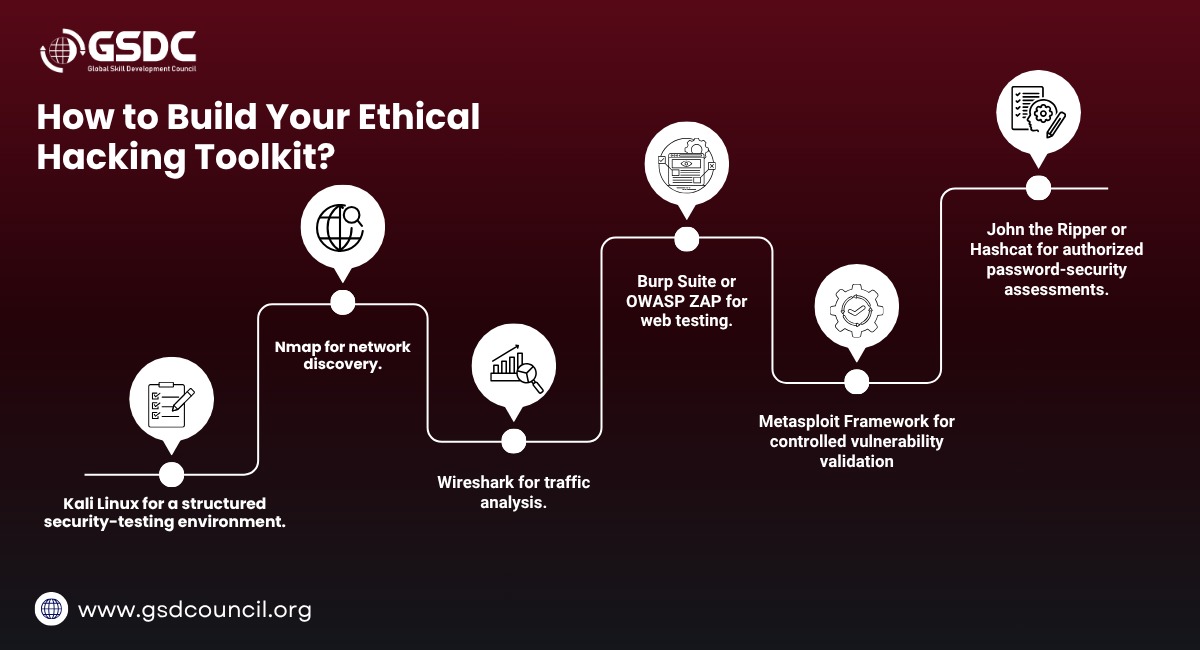
You do not need to learn every tool at once. A practical starting point is Nmap for networking, Wireshark for traffic analysis, Burp Suite or OWASP ZAP for web applications, and Metasploit for controlled vulnerability validation.
Once you understand the fundamentals, you can add specialized tools such as Hashcat, Aircrack-ng, SQLmap, Nuclei, and BloodHound based on the type of security testing you want to perform.
The important thing is to understand the security concept behind each tool rather than simply memorizing commands. Tools change, but the fundamentals of networking, authentication, vulnerabilities, risk assessment, and secure system design remain essential.
When Ethical Hacking a Network, Which of the Following Can Be Breached?
The answer depends entirely on the agreed scope.
Potential targets may include servers, endpoints, network devices, wireless infrastructure, web applications, APIs, cloud resources, databases, authentication systems, and sometimes human processes. However, a tester should never assume that everything connected to an organization is fair game.
A professional engagement defines in-scope assets, prohibited activities, testing windows, escalation contacts, data-handling requirements, and acceptable levels of impact before testing begins. Testing guidance similarly emphasizes defining scope before discovery and exploitation.
Tools Do Not Replace Ethical Judgment
It can be tempting to think that learning the best hacking tools is the fastest route into cybersecurity. In reality, tools are only part of the skill set.
A strong ethical hacker needs networking fundamentals, Linux knowledge, operating-system concepts, web technologies, authentication concepts, scripting, vulnerability analysis, documentation skills, and an understanding of security principles.
More importantly, professionals need judgment. Knowing when not to run a test can be just as important as knowing how a tool works.
Choosing an Ethical Hacking Certification
Tools become much more valuable when you understand the methodology behind them. If you are considering an ethical hacking certification, GSDC’s Certified Ethical Hacking Foundation can help build a structured understanding of ethical hacking concepts, security assessment, vulnerabilities, and practical cybersecurity practices. The certification is designed to strengthen foundational knowledge while helping learners connect security concepts with real-world scenarios.

Certified Ethical Hacking Foundation comes with benefits that include building a stronger understanding of ethical hacking methodologies, improving cybersecurity awareness, developing practical security-testing knowledge, and adding a recognized credential to your professional profile. It can be useful for cybersecurity beginners, IT professionals, and individuals looking to strengthen their security skill set.
The best ethical hacking certification is not necessarily the one with the longest tool list. It should help you understand why a test is performed, how findings are validated, how evidence is collected, and how remediation is communicated.
While ethical hacking certification salary varies by experience, location, role, and industry, certification can demonstrate structured cybersecurity knowledge and support your professional growth.
Conclusion
So, what tools do ethical hackers use? They use different tools for different stages of a security assessment: Kali Linux provides the environment; Nmap maps networks; Wireshark analyzes traffic; Burp Suite and OWASP ZAP examine web applications; Metasploit validates vulnerabilities; and password and wireless tools assess specialized security controls.
The most effective ethical hackers, however, are not defined by how many tools they know. They are defined by how well they understand systems, identify meaningful risk, test responsibly, and turn technical findings into practical security improvements.
Tools may open the door to ethical hacking, but knowledge, authorization, and professional judgment are what make the work valuable.

Related Certifications
Stay up-to-date with the latest news, trends, and resources in GSDC
If you like this read then make sure to check out our previous blogs: Cracking Onboarding Challenges: Fresher Success Unveiled
Not sure which certification to pursue? Our advisors will help you decide!