Generative AI In Healthcare Certification
The Generative AI In Healthcare Certification program is globally designed to develop expertise in applying generative AI technologies to healthcare systems, enabling innovations in medical diagnostics, clinical decision support, and patient care optimization.
Learn directly from global practitioners, healthcare AI experts, and industry leaders who are shaping the future of AI-driven healthcare innovation, digital health transformation, and intelligent medical systems.
What Sets Our Program Apart?
- Globally Recognized Certification with Self-Paced Learning
- 8+ Hours of Complimentary Instructor-Led Training
- Hands-On Learning with Learn by Doing
- 1-on-1 SME Guidance + Capstone & Job Support
- Daily Live Sessions via GSDC Studio
100% Money Back Guarantee on One-Click









About Generative AI In Healthcare Certification
Objective Of Generative AI in Healthcare Certification
- Validate expertise in Generative AI in healthcare applications
- Learn from practical use case studies in healthcare
- Demonstrate knowledge of Gen AI in Healthcare workflows
- Apply AI in healthcare certificate concepts to real scenarios
- Access and utilize ready-to-implement templates for healthcare projects
- Showcase ability to optimize clinical decision-making using AI
- Understand ethical considerations and compliance in healthcare AI
- Strengthen career with recognized AI in healthcare credentials
Benefits of Of AI In Healthcare Certification
- Apply Generative AI in healthcare workflows
- Access expert-crafted, ready-to-use templates
- Solve real-world clinical AI challenges
- Enhance patient care using AI insights
- Strengthen resume with healthcare AI expertise
- Implement practical case studies immediately
- Boost decision-making with AI-driven analytics
- Lead Gen AI healthcare initiatives confidently
- Improve operational efficiency in medical teams
- Gain credibility in emerging healthcare technology
Exam Syllabus of Generative AI in Healthcare Certificate
1 Introduction to Generative AI in Healthcare+
•What is Generative AI? Concepts and principles explained in a healthcare context
•Key differences between traditional AI and generative AI
•Application in Personalized medicine
•Application using Predictive analytics for disease prevention
•Application in Drug discovery and development
•Application in Virtual patient simulations
2 Deep Generative Models Healthcare Perspective+
•High-level overview of deep generative models (VAEs, GANs, diffusion models)
•Focus on what they do rather than coding how they work
•Use Case: GANs in medical imaging (denoising, image synthesis)
•Use Case: VAEs for data augmentation in small datasets
•Diffusion models for medical research (brief overview)
•Use Case: Match the right model type to clinical use cases
3 Clinical Applications of Generative AI+
•Personalized treatment recommendations (examples from oncology, pharmacology)
•Disease prediction and prevention with AI-enhanced analytics
•Medical imaging analysis and augmentation
•Drug discovery and molecule design with AI
•Case study: Early detection of diseases using AI-generated data
•Case study: Pharma applications in drug pipeline acceleration
•Exercise: Interpreting AI outputs for a diagnostic support scenario
4 Generative AI for Medical Image Analysis+
•Why medical image analysis matters in clinical settings
•AI’s role in improving diagnostic accuracy and workflow efficiency
•How synthetic medical images are generated and applied
•Use Cases: Radiology, pathology, CT/MRI/X-ray support
5 Patient Data Privacy and Ethical Considerations+
•Privacy concerns in healthcare data (anonymization, encryption, HIPAA/GDPR basics)
•Ethical issues: bias, fairness, transparency, and accountability
•Risks of incorrect or misleading AI-generated outputs
•Case Study: Consequences of biased AI in patient outcomes
•Use Case: Spotting ethical red flags in AI use cases
6 Clinical Validation and Workflow Integration+
•Why validation and clinical trials are critical for AI adoption
•Evaluating safety, accuracy, and generalizability of AI solutions
•Integrating AI into hospital/clinic workflows
•Red flags: situations where AI could mislead clinicians
7 Advanced but Accessible Topics+
•Transfer learning for healthcare: reusing existing AI to save time and resources
•Interpretability and explainability in clinical AI
•Use Case: Using simple explainability tools (e.g., SHAP visuals) to interpret AI model outputs
•Brief introduction to adversarial risks (kept high-level, no coding)
8 Deploying Generative AI in Healthcare Practice+
•Practical challenges of deploying AI in hospitals and clinics
•Scalability, reliability, and integration with electronic health records
•Regulatory requirements (FDA approval process, CE marking, HIPAA/GDPR compliance)
•Continuous monitoring, retraining, and safe use in clinical environments
•Case Study: Example of a hospital deploying AI for imaging support
9 Prompt Engineering for Healthcare Professionals+
•Introduction to prompt engineering (explained simply)
•How prompts improve AI-generated responses in clinical contexts
•Practical Applications in summarizing clinical notes
•Generating patient-friendly explanations using Generative AI
•How Generative AI in supporting virtual consultations
•Use Case: Writing effective prompts for medical chatbots or documentation support
•Hands-On : Building better AI queries to get safer, more reliable medical outputs
10 Personalized 1-1 & Daily Group Live session+
•Personalized 1-on-1 Trainer/SME Connect Session - Receive a 1-on-1 connect session from Trainer/SME to resolve all types of queries.
•Daily Live Session with Lifelong Learning - Participate in a daily live session with industry experts where professionals from around the world connect with SMEs and have a brainstorming session.
Learn from Experts
Learn from experienced practitioners and industry leaders who bring real-world expertise and practical insights to the program.

Maxim Salnikov
MICROSOFT
DIGITAL AND APP INNOVATION BUSINESS LEAD, WESTERN EUROPE

Hayk Hakobyan
INSIGHTGENIE
CO-FOUNDER

Artus Phee
AGILEASIA
CHIEF OPERATING OFFICER

Suvarsha Rai
AMAZON
SR. TECHNICAL PRODUCT MANAGER

Ziggy Rafiq
CAPGEMINI
SOFTWARE ENGINEERING LEAD

Trevor Wiseman
THE CIRCUIT
VP OF TECHNOLOGY & AI GOVERNANCE
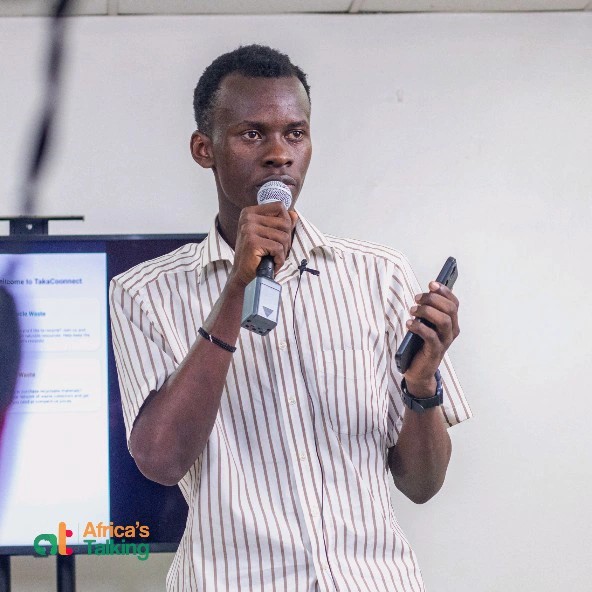
Caleb Jephunneh
BRICKLABSAI
CEO | GLOBAL AI SPEAKER

Swathi Adimulam
ORACLE
OCI CLOUD & AI ARCHITECT

Leela VenkataSatish Kolla
LTIMINDTREE
DIRECTOR PROGRAM PROJECT MANAGEMENT

Baris Dirim
CULTUREASY
HUMAN SYSTEMS ARCHITECT
GSDC AI Studio
100+ Live Monthly Sessions with
Global Experts
Experience hands-on AI learning every day with 45-minute expert-led sessions. Practice in real time, get your doubts resolved instantly, and gain certification-aligned skills. Build practical, job-ready AI expertise with guidance from global AI leaders.
Session Highlights
4 Daily Sessions
45-minute expert-led learning.
Global Experts
Learn from worldwide leaders.
Real-time Practice
Apply concepts instantly.
Certification Ready
Industry-aligned skills.
Interactive Reporting with Google AI Studio
Build Your First AI Agent in 30 mins

Improving Software Requirements with GenAI

Safe and Ethical AI Conversations

Search Smarter with Perplexity AI

Iterative AI Processes and Productivity Tips

Learn by Doing
Don't just watch — apply what you learn immediately.
How it works?
Step 1
Watch the Video: Learn each tool through expert-led tutorials.
Step 2
Practice with AI-powered challenges.
Lifetime Access: Revisit videos and challenges anytime.
Enrollment Options
Single Access
Gain full access to our complete resource library and earn a globally recognized certification.
1 Certificate Programs
Bundle Access
Unlock exclusive bundle savings on premium resources and earn globally recognized credentials.
3 Certificate Programs
For Teams
Enable teams with GSDC certification pathways and customized learning journeys aligned with business priorities.

7 Day Money-Back Guarantee

Target Audience of AI In Healthcare Certificate
Pre-Requsites of AI In Healthcare Certification
Prior work experience or knowledge in healthcare or AI is recommended but not mandatory.
Exam Details of Gen AI in Healthcare Certification
Exam Questions
40
Exam Format
Multiple choice
Language
English
Passing Score
65%
Duration
90 min
Open Book
No
Certification Validity
5 Years
Complimentary Retake
Yes
Sample Certification
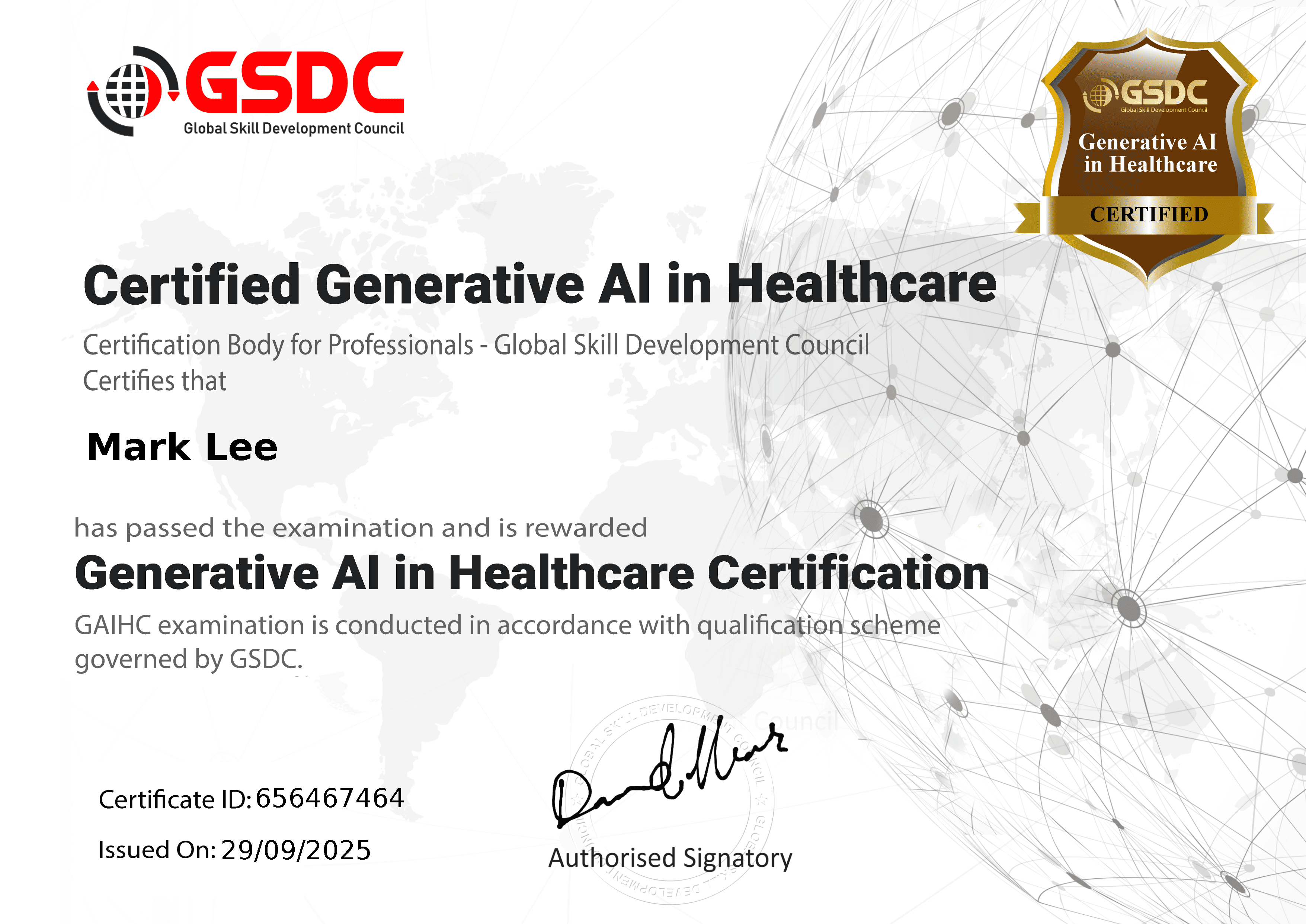
About Generative AI in Healthcare Certification
The GSDC Generative AI in Healthcare Certification validates your expertise in applying Generative AI in healthcare to solve real-world problems and drive innovation.
With the rapid adoption of Gen AI in Healthcare, professionals who understand this technology are uniquely positioned to improve patient outcomes, optimize clinical workflows, and support data-driven decision making.
This AI in healthcare certificate equips you with the knowledge to navigate the evolving healthcare confidently. As part of the certification, you will also gain access to ready-to-implement hands-on resources, templates, and tools that accelerate your learning and practical application.
By earning this AI in healthcare certificate, you demonstrate your proficiency in Gen AI in Healthcare, enhancing your career opportunities and positioning yourself at the forefront of one of the most transformative technologies in modern medicine.