Certified Context Engineer
The Context Engineering Certification program is designed to equip professionals with the skills to effectively design, structure, manage, and optimize context for advanced AI systems and large language models. It enables learners to build context-aware AI applications, improve model accuracy, orchestrate intelligent workflows, and maximize the performance of generative AI across real-world business use cases.
Learn directly from context engineering specialists, AI practitioners, and technology leaders who are shaping the future of AI systems through effective context design, prompt orchestration, and intelligent workflows.
What Sets Our Program Apart?
- Globally Recognized Certification with Self-Paced Learning
- 100+ Live Monthly Sessions via GSDC Studio
- Hands-On Learning with Learn by Doing
- 1-on-1 SME Connect Sessions with Industry Experts
- Career-Ready Support: Capstone project and Job support
100% Money Back Guarantee on One-Click









About Context Engineering Certification
Objectives of Context Engineering Certification
Validate your Context Engineering skills for the AI-driven future.
- Understand the fundamentals of context engineering and its role in enterprise AI systems.
- Differentiate Context Engineering from Prompt Engineering and optimize context for LLM performance.
- Design effective context architectures using instructions, memory, retrieved knowledge, tools, and metadata.
- Build production-ready RAG pipelines with embeddings, vector databases, retrieval, and source attribution.
- Develop short-term and long-term memory systems for personalized, stateful AI applications.
- Implement Context Engineering using tool calling, function calling, and the Model Context Protocol (MCP).
- Design reliable AI agent and multi-agent workflows powered by robust context management.
- Evaluate and optimize context quality using relevance, groundedness, safety, observability, and performance metrics.
Benefits of Context Engineering Certificate
Strengthen your ability to build smarter, context-aware AI systems with Context Engineering.
- Earn a globally recognized context engineering certification that proves your ability to design production-grade AI systems beyond prompt engineering
- Get a 20-60% salary hike and access growing context engineering jobs by validating one of the most in-demand and least formally credentialed skills in AI today
- Get free access to the Job Support Program to help you land the right role after earning your certification
- Get 3 personal SME Connect sessions with industry experts who actively work in AI context engineering, RAG systems, and agentic AI design
- Get free access to GSDC Studio with 100+ live monthly sessions to stay current with how context engineering LLM practices and tools are evolving
- Get the best study materials, including e-books, toolkits, lab guides, and practice resources covering all 14 modules of the context engineering syllabus
- Strengthen your LinkedIn profile and resume with a recognized context engineering certification that helps AI engineering recruiters and hiring managers find you faster
- Join the GSDC Membership community and stay connected with a global network of context engineers and AI system designers working across industries worldwide
Exam Syllabus Of Context Engineering Certification
1 Foundations of Context Engineering+
•What context engineering in AI means in modern AI systems
•Prompt engineering vs context engineering vs AI application architecture
•The LLM application stack: model, prompt, context, tools, data, and workflow
•The six context inputs: instructions, user intent, history, retrieved knowledge, tools, and metadata
•The LLM-as-operating-system analogy: model as reasoning engine, context window as working memory
•Typical business use cases: assistants, copilots, RAG systems, agents, and enterprise automation
2 LLM Context Anatomy, Tokens, and Attention Behavior+
•Tokens, context windows, and model input limits
•Instruction hierarchy: system, developer, user, retrieved, and tool messages
•Attention, recency bias, and position sensitivity
•Context overload, distraction, and context rot
•Latency, cost, and quality trade-offs in long-context applications
•Designing context for clarity, sufficiency, relevance, and economy
3 Prompt-to-Context Design Patterns+
•Role, task, context, format, and constraint patterns
•Few-shot, example-driven, and counter-example prompting
•Chain-of-thought alternatives: reasoning scaffolds, rubrics, and structured deliberation
•Step-back, self-check, and critique-revision patterns
•Reusable prompt templates and prompt versioning
•Designing context blocks for different personas, domains, and tasks
4 Context Architecture and Information Hierarchy+
•Context layers: policy, task, domain knowledge, user state, tools, and output rules
•Instruction priority and conflict resolution
•Context mapping: identifying what the model must know, may know, and must not access
•Context isolation and quarantine for untrusted content
•Metadata-driven context assembly
•Context portability across models, teams, and workflows
5 Structured Context and Output Control+
•Using structured context blocks with headings, XML-like tags, and markdown sections
•JSON schema, function schemas, and typed outputs
•Format enforcement, validation, and retry loops
•Separating instructions, evidence, examples, and user data
•Designing context for APIs, workflows, and downstream systems
•Handling ambiguity, missing information, and escalation behavior
6 Retrieval-Augmented Context and RAG Fundamentals+
•RAG as context construction rather than simple document search
•Document ingestion, cleaning, and normalization
•Chunking strategies: fixed-size, semantic, hierarchical, and sliding-window chunks
•Embeddings, vector search, and semantic similarity
•Vector databases and indexes: Pinecone, Weaviate, pgvector, FAISS, and similar tools
•Grounded response generation with citations and source traceability
7 Advanced Retrieval, Ranking, and Context Assembly+
•Hybrid search: keyword, semantic, and metadata filtering
•Query transformation, expansion, and decomposition
•Re-ranking, relevance scoring, and evidence selection
•Context assembly pipelines and retrieval orchestration
•Handling noisy, duplicated, and contradictory sources
•Knowledge freshness, provenance, and confidence scoring
8 Memory Systems for AI Applications+
•Conversation memory and session state
•Short-term vs long-term memory design
•Episodic, semantic, and procedural memory
•User preference stores and enterprise knowledge stores
•Memory write, update, retrieval, and deletion rules
•Privacy, consent, and safe handling of remembered information
9 Context Compression and Token Optimization+
•Token budgeting and context cost estimation
•Sliding windows, rolling summaries, and state compaction
•Selective inclusion, truncation, and prioritization strategies
•Compression methods including summarization, extractive compression, and learned compression
•Preventing loss of critical facts during summarization
•Measuring quality impact after compression
10 Tool Use, Function Calling, and Model Context Protocol+
•Function calling and tool schemas
•Tool descriptions, argument design, and result handling
•Model Context Protocol concepts and use cases
•Building and consuming MCP servers for data, files, APIs, and developer tools
•Tool selection, tool routing, and tool execution constraints
•Securing tool access with authentication, authorization, and audit trails
11 Agentic Workflows and Multi-Agent Context Orchestration+
•Agent loops: plan, act, observe, reflect, and revise
•Context routing for task-specific agents and sub-agents
•Multi-agent collaboration, delegation, and handoff patterns
•Workflow orchestration using frameworks such as LangGraph, AutoGen, and similar tools
•State management, checkpoints, and recovery in agent workflows
•Human-in-the-loop review for high-risk actions
12 Security, Guardrails, and Context Governance+
•Prompt injection, jailbreaks, and indirect injection attacks
•Data leakage risks in RAG, memory, and tool-enabled systems
•Context isolation, input sanitization, and policy enforcement
•Guardrails for content, actions, tools, and data access
•Enterprise governance: ownership, approvals, change control, and auditability
•Responsible AI considerations for transparency, fairness, and compliance
13 Context Evaluation, Observability, and Quality Metrics+
•Evaluation dimensions: relevance, sufficiency, faithfulness, provenance, safety, and usability
•Hallucination detection and groundedness testing
•Retrieval evaluation: precision, recall, MRR, and hit rate
•LLM-as-judge, rubric-based testing, and human review
•A/B testing for prompt and context versions
•Observability tools such as LangSmith, tracing, logs, and feedback loops
14 Capstone — Production Context Engineering Blueprint+
•Define a business problem and context engineering scope
•Design context architecture, RAG pipeline, memory policy, and tool interfaces
•Create security, governance, and human-review controls
•Build an evaluation plan with measurable quality criteria
•Prepare a deployment-ready solution blueprint and demo
•Present trade-offs around cost, latency, risk, and user experience
What Comes with a GSDC Certification?
GSDC's Context Engineering Certification equips professionals with advanced methodologies for designing, managing, and optimizing AI context to enhance the performance of large language models and intelligent applications. The program develops expertise in context-aware AI systems, prompt orchestration, retrieval-augmented generation (RAG), memory management, and scalable AI workflows, enabling learners to build accurate, reliable, and enterprise-ready AI solutions aligned with real-world business requirements.
Learn from Experts
Learn from experienced practitioners and industry leaders who bring real-world expertise and practical insights to the program.

Maxim Salnikov
MICROSOFT
DIGITAL AND APP INNOVATION BUSINESS LEAD, WESTERN EUROPE

Hayk Hakobyan
INSIGHTGENIE
CO-FOUNDER

Artus Phee
AGILEASIA
CHIEF OPERATING OFFICER

Suvarsha Rai
AMAZON
SR. TECHNICAL PRODUCT MANAGER

Ziggy Rafiq
CAPGEMINI
SOFTWARE ENGINEERING LEAD

Trevor Wiseman
THE CIRCUIT
VP OF TECHNOLOGY & AI GOVERNANCE

Caleb Jephunneh
BRICKLABSAI
CEO | GLOBAL AI SPEAKER

Swathi Adimulam
ORACLE
OCI CLOUD & AI ARCHITECT

Leela VenkataSatish Kolla
LTIMINDTREE
DIRECTOR PROGRAM PROJECT MANAGEMENT

Baris Dirim
CULTUREASY
HUMAN SYSTEMS ARCHITECT
Enrollment Options
Single Access
Gain full access to our complete resource library and earn a globally recognized certification.
1 Certificate Programs
Bundle Access
Unlock exclusive bundle savings on premium resources and earn globally recognized credentials.
3 Certificate Programs
For Teams
Enable teams with GSDC certification pathways and customized learning journeys aligned with business priorities.

7 Day Money-Back Guarantee

Target Audience of Context Engineering Certification
Pre-Requisites for Context Engineering Certificate
There are no mandatory prerequisites for this context engineering certification. However, the program is designed for professionals who already have a basic understanding of generative AI, LLMs, and prompt engineering. Familiarity with APIs, JSON, and basic software workflows will be helpful. Some experience with beginner-level Python or JavaScript and awareness of cloud environments, databases, or enterprise application architecture will make the content easier to follow but are not required to get started.
Exam Details of Context Engineering Certification
Exam Questions
40
Exam Format
Multiple choice
Language
English
Passing Score
65%
Duration
90 min
Open Book
No
Certification Validity
5 Years
Complimentary Retake
Yes
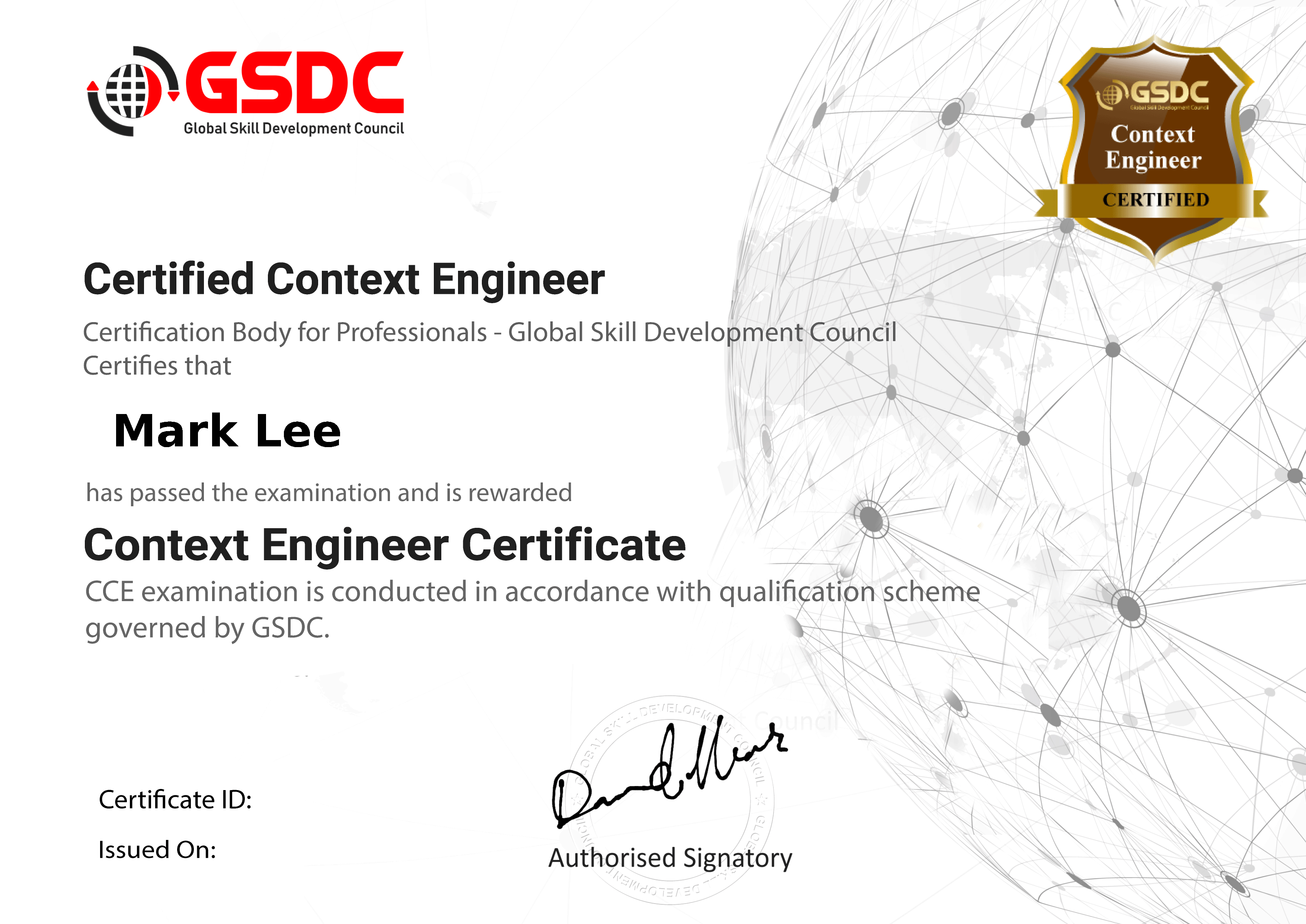
Sample Certification
About Context Engineering Certificate
The GSDC Context Engineering Certification is a professional-level credential for AI engineers, developers, and solution architects who want to move beyond prompt writing into production-grade AI system design. This is not a beginner-level certification. It is built for professionals who are already working with AI and want to formalize and deepen their ability to design the complete information environment that makes AI systems reliable, safe, and scalable. GSDC is a vendor-neutral international professional certification body. This context engineering certification is not tied to any single model, platform, or vendor. It gives you knowledge and skills that apply across LLM platforms, RAG frameworks, and agentic AI systems.
Context engineering in AI is rapidly emerging as the defining skill for AI practitioners who want to build systems that actually work in production. As Anthropic and other leading AI organizations have noted, the discipline goes far beyond wording a prompt well. It involves managing instructions, retrieved knowledge, memory, tool outputs, metadata, compression, and security as a unified system that guides the model at every step. The context engineering vs RAG conversation, the context engineering vs. prompt engineering debate, and the rise of the Model Context Protocol all point to the same shift: AI engineering is maturing, and the professionals who understand how to architect the full context system are the ones who will build the AI-powered products and workflows that organizations depend on.
When you enroll, you get everything you need to go from understanding to production. This includes 14 modules of structured content, hands-on labs for every core skill area, a production-ready capstone project, 3 personal SME Connect sessions with working AI engineers, free access to GSDC Studio with 100+ live monthly sessions from global AI practitioners, a LinkedIn Enhancer and Resume Builder, the Job Support Program, and a free GSDC Membership worth $109. Everything is included in one enrollment so you can focus on building skills that translate directly into real AI engineering work.