Certified LLM Ops Professional
The Certified LLM Ops Professional Certification equips technology and AI professionals with the knowledge to deploy, manage, monitor, and optimize Large Language Model (LLM) applications. The program empowers professionals to build reliable LLM workflows, streamline AI model operations, automate deployment processes, manage performance and scalability, and drive efficient AI innovation across modern technology environments.
Learn directly from LLM Ops experts, AI engineering leaders, and industry professionals who are deploying, managing, monitoring, and optimizing large language model applications and next-generation AI systems.
What Sets Our Program Apart?
- Globally Recognized Certification with Self-Paced Learning
- 100+ Live Monthly Sessions via GSDC Studio
- Hands-On Learning with Learn by Doing
- 1-on-1 SME Connect Sessions with Industry Experts
- Career-Ready Support: Capstone project and Job support
100% Money Back Guarantee on One-Click






About LLM Ops Professional certification
Objectives of Certified LLM Ops Professional
- Understand the LLMOps lifecycle and operational challenges of production LLM applications.
- Select, serve, and optimize LLMs based on performance, cost, latency, and scalability requirements.
- Design production-ready prompts, context strategies, structured outputs, and tool-calling workflows.
- Build and optimize Retrieval-Augmented Generation (RAG) systems for enterprise applications.
- Apply fine-tuning techniques such as SFT, PEFT, LoRA, and QLoRA for practical LLM use cases.
- Evaluate LLM applications using quality metrics, testing frameworks, benchmarks, and continuous evaluation.
- Implement LLM infrastructure, observability, monitoring, security, governance, and cost optimization practices.
- Build reliable and scalable LLM applications using multi-model routing, resilience strategies, and production operations.
Benefits of LLM Ops Professional Certification
- Build LLMOps Expertise: Develop practical skills to manage the complete lifecycle of production LLM applications.
- Self-Paced Learning: Learn at your own pace and revisit the learning material whenever required.
- 3x 1-on-1 SME Connect: Get personalized guidance from industry subject matter experts.
- Unlimited Practice Exams: Strengthen your preparation with unlimited access to practice assessments.
- 2 Exam Attempts + 1 Free Retake: Get additional opportunities to demonstrate your knowledge through the LLMOps exam.
- Globally Recognized Certificate: Earn an LLMOps certificate that validates your professional knowledge and practical capabilities.
- Lifetime GSDC Studio Access: Join 100+ live monthly expert-led sessions covering emerging technologies, frameworks, and industry practices.
- Career-Ready Support: Benefit from Learn by Doing, capstone work, Job Support, Resume Builder, LinkedIn Enhancer, and complimentary GSDC Membership.
Exam Syllabus of Certified LLM Ops Professional
1 Foundations of LLMOps+
•Introduction to LLMOps and its evolution from MLOps
•Characteristics of LLM systems: non-determinism, prompt sensitivity, and token economics
•LLMOps lifecycle and operational workflows
•Key roles and responsibilities in LLMOps
•Build vs. buy decisions for LLM solutions
•Challenges in operationalizing LLM applications
2 Model Selection & Serving Architecture+
•Proprietary vs. open-weight LLMs and licensing considerations
•LLM model selection criteria
•Inference serving architectures and frameworks
•vLLM, TGI, Triton, and Ray Serve
•GPU sizing and resource optimization
•Model quantization: INT8, INT4, GPTQ, and AWQ
•Latency, throughput, batching, and inference optimization
3 Prompt & Context Engineering+
•Production-grade prompt engineering
•Prompt templates, versioning, and management
•System prompt design
•Structured outputs and JSON mode
•Function calling and tool use
•Context window management and optimization
•Chunking and context compression strategies
•Prompt testing and regression management
4 Retrieval-Augmented Generation (RAG)+
•RAG architecture and core concepts
•Embedding models and vector representations
•Vector database selection and architecture
•pgvector, Pinecone, Weaviate, and Qdrant
•Document ingestion, chunking, and indexing
•Semantic, keyword, and hybrid search
•Re-ranking and retrieval optimization
•Data freshness and access control
•Common RAG challenges and failure modes
5 Fine-Tuning & Model Customization+
•Prompting vs. RAG vs. fine-tuning
•Fine-tuning strategies and use cases
•Supervised Fine-Tuning (SFT)
•Parameter-Efficient Fine-Tuning (PEFT)
•LoRA and QLoRA
•Dataset curation and preparation
•Synthetic data generation
•RLHF and DPO fundamentals
•Fine-tuning evaluation and production considerations
6 Evaluation & Quality Assurance+
•LLM evaluation principles and methodologies
•Golden datasets and evaluation harnesses
•Rubric-based evaluation
•LLM-as-a-Judge
•Measuring accuracy, relevance, and task success
•Hallucination and toxicity evaluation
•Offline and online evaluation
•A/B testing and shadow deployments
•Regression testing and continuous evaluation
•Automated quality gates for production deployments
7 Production Infrastructure & MLOps Integration+
•Production architecture for LLM applications
•CI/CD for prompts, models, and RAG indexes
•Docker and containerization
•Kubernetes for LLM workloads
•KServe and Seldon
•Model registries and version management
•Deployment strategies for LLM applications
•Caching and performance optimization
•Integration of LLMOps with MLOps workflows
8 Observability, Monitoring & Cost Management+
•LLM application observability fundamentals
•Logging and distributed tracing
•OpenTelemetry for LLM systems
•Monitoring latency, errors, throughput, and token usage
•Input and output quality monitoring
•Model and data drift detection
•Cost tracking and token-level cost analysis
•Model routing and cost optimization
•Alerting and incident management
•LLM performance optimization
9 Security, Safety & Governance+
•LLM security fundamentals and threat landscape
•Prompt injection and jailbreak attacks
•Data leakage and insecure tool use
•PII detection and redaction
•Privacy and compliance considerations
•GDPR and SOC 2 requirements
•LLM guardrails and safety controls
•Access control and authentication
•Audit logging and secure context handling
•LLM red-teaming and security testing
•AI governance and risk management
10 Scaling, Multi-Model Systems & Capstone+
•Scaling LLM applications for production
•Multi-model architecture and model routing
•Model fallback and resilience strategies
•Cost-aware model selection
•Agentic systems and production considerations
•Tool-calling reliability and orchestration
•Failure recovery and retry mechanisms
•Disaster recovery and high availability
•Platform team patterns for LLMOps
•End-to-end production readiness
•Capstone: Design and build a production-ready LLM application
What Comes with a GSDC Certification?
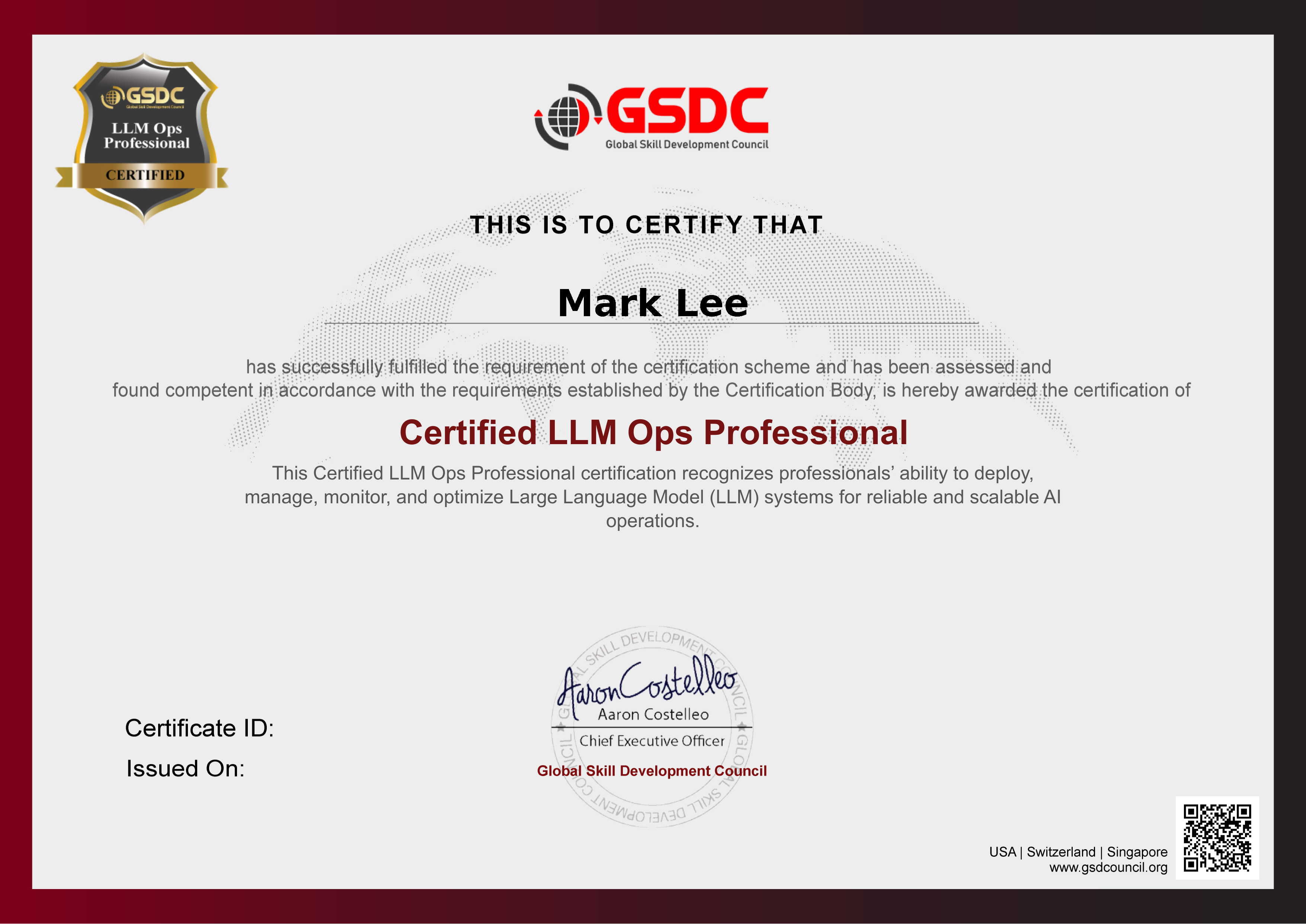
You will receive a globally recognized GSDC LLM Ops Professional certificate that validates your ability to operate and optimize production LLM applications. The credential demonstrates knowledge across LLM serving, prompt and context engineering, RAG, fine-tuning, evaluation, MLOps integration, infrastructure, observability, security, governance, scalability, and cost optimization.
Learn from Experts
Learn from experienced practitioners and industry leaders who bring real-world expertise and practical insights to the program.

Maxim Salnikov
MICROSOFT
DIGITAL AND APP INNOVATION BUSINESS LEAD, WESTERN EUROPE

Hayk Hakobyan
INSIGHTGENIE
CO-FOUNDER

Artus Phee
AGILEASIA
CHIEF OPERATING OFFICER

Suvarsha Rai
AMAZON
SR. TECHNICAL PRODUCT MANAGER

Ziggy Rafiq
CAPGEMINI
SOFTWARE ENGINEERING LEAD

Trevor Wiseman
THE CIRCUIT
VP OF TECHNOLOGY & AI GOVERNANCE

Caleb Jephunneh
BRICKLABSAI
CEO | GLOBAL AI SPEAKER

Swathi Adimulam
ORACLE
OCI CLOUD & AI ARCHITECT

Leela VenkataSatish Kolla
LTIMINDTREE
DIRECTOR PROGRAM PROJECT MANAGEMENT

Baris Dirim
CULTUREASY
HUMAN SYSTEMS ARCHITECT
Enrollment Options
Single Access
Gain full access to our complete resource library and earn a globally recognized certification.
1 Certificate Programs
Bundle Access
Unlock exclusive bundle savings on premium resources and earn globally recognized credentials.
3 Certificate Programs
For Teams
Enable teams with GSDC certification pathways and customized learning journeys aligned with business priorities.

7 Day Money-Back Guarantee

Target Audience for Certified LLM Ops Professional
Pre-Requsities for LLM Ops Professional Certification
There are no mandatory prerequisites for the Certified LLM Ops Professional certification. A basic understanding of artificial intelligence, machine learning, software development, cloud computing, or DevOps concepts is beneficial, but no formal LLM Ops or technical background is required. The program builds from LLM and AI fundamentals and focuses on practical LLM operations, model deployment, monitoring, optimization, automation, scalability, and production-ready LLM application management.
Exam Details Of Certified LLM Ops Professional
Exam Questions
40
Exam Format
Multiple choice
Language
English
Passing Score
65%
Duration
90 min
Open Book
No
Certification Validity
5 Years
Complimentary Retake
Yes
Sample Certification
About LLM Ops Professional Certification
The GSDC Certified LLM Ops Professional program is designed for professionals who want to build the skills required to operate, evaluate, secure, and optimize large language model applications in production environments. This LLMOps professional certification covers the complete LLM application lifecycle, including model selection and serving, prompt and context engineering, RAG, fine-tuning, evaluation, infrastructure, observability, security, governance, scaling, and cost optimization.
The program focuses on the practical challenges involved in moving LLM applications from experimentation to reliable production use. You will learn how to work with model-serving frameworks, GPU resources, quantization, vector databases, deployment platforms, evaluation systems, monitoring tools, and production architectures. The curriculum also covers multi-model routing, agentic systems, tool calling, failure recovery, security testing, and governance, helping you develop capabilities expected from an LLMOps professional, LLMOps engineer, or modern AI operations specialist.
When you enroll, you receive self-paced learning resources, practical Learn by Doing activities, 3x 1-on-1 SME Connect sessions, unlimited practice exams, 2 exam attempts with 1 free retake, and a globally recognized LLMOps certificate. You also receive lifetime access to GSDC Studio with 100+ live monthly expert-led sessions, along with career-focused support through the Job Support Program, Resume Builder, LinkedIn Enhancer, capstone work, and complimentary GSDC Membership.