The Role of Emotional Intelligence in Conversational AI
Written by Matthew Hale
- What Is Emotional Intelligence and Why Is It Important?
- The Role of Emotional Intelligence in Conversational AI
- Benefits of Emotional Intelligence in Conversational AI
- Emotional AI Examples in Action
- How Conversational AI Emotional Intelligence Works
- The Future of AI Emotional Intelligence
- The Growing Demand for Emotional Intelligence Skills
- Conclusion
A customer contacts the chatbot because their last transaction did not go through. They are upset. Instead of getting a standard response, the chatbot recognizes their frustration and responds appropriately.
This is not the future; this is the present.
Today, conversational AI is moving beyond basic responses. It is becoming smarter by using conversational AI emotional intelligence. This helps machines understand human emotions and respond in a more natural way.
According to MarketsandMarkets, the AI emotional intelligence market is expected to grow from $2.74 billion in 2024 to $9.01 billion by 2030. This shows how quickly businesses are adopting this technology.
The chart clearly shows the rapid growth of the AI emotional intelligence market, driven by the need for more human-like and emotionally aware AI systems.
This shift is changing how companies talk to customers and employees. It makes conversations feel more human and meaningful.

What Is Emotional Intelligence and Why Is It Important?
In order to answer the above questions, let’s first define what is emotional intelligence and why is it important?
Emotional intelligence is the ability to understand and control your own and other people’s emotions. Emotional intelligence comprises the main emotional intelligence skills, such as self-awareness, empathy, emotional control, and social skills.
The main goal of emotional intelligence is to enable people to communicate more effectively, make more intelligent decisions, and develop successful interpersonal relationships. Emotional intelligence in the digital age is not only necessary for people but also for machines.
The Role of Emotional Intelligence in Conversational AI
Let’s first know what is conversational AI. Simply put, conversational AI are those chatbots or virtual assistants that can talk to users either in text or voice.
So, what is the role of emotional intelligence here?
The role of emotional intelligence in conversational AI is to make conversations more natural and human-like. Instead of pre-programmed answers, these AI systems can sense how users feel and can reply accordingly.
With AI emotional intelligence, users can:
Know how users feel
AI can sense how users feel just by looking at the text or listening to their voices.
Adjust tone
It can change its tone according to the situation.
Show empathy
Users can feel that the AI is more empathetic and caring.
Personalize interactions
Conversations can be more relevant to users.
All these are important features of conversational AI. These features highlight the importance of emotional intelligence at work. This is especially important for those in customer service professions.
Professionals interested in developing these skills can look for a Certified Emotional Intelligence Professional or an emotional intelligence certification program to know more about how emotional intelligence can be applied in AI or in real life.
Benefits of Emotional Intelligence in Conversational AI
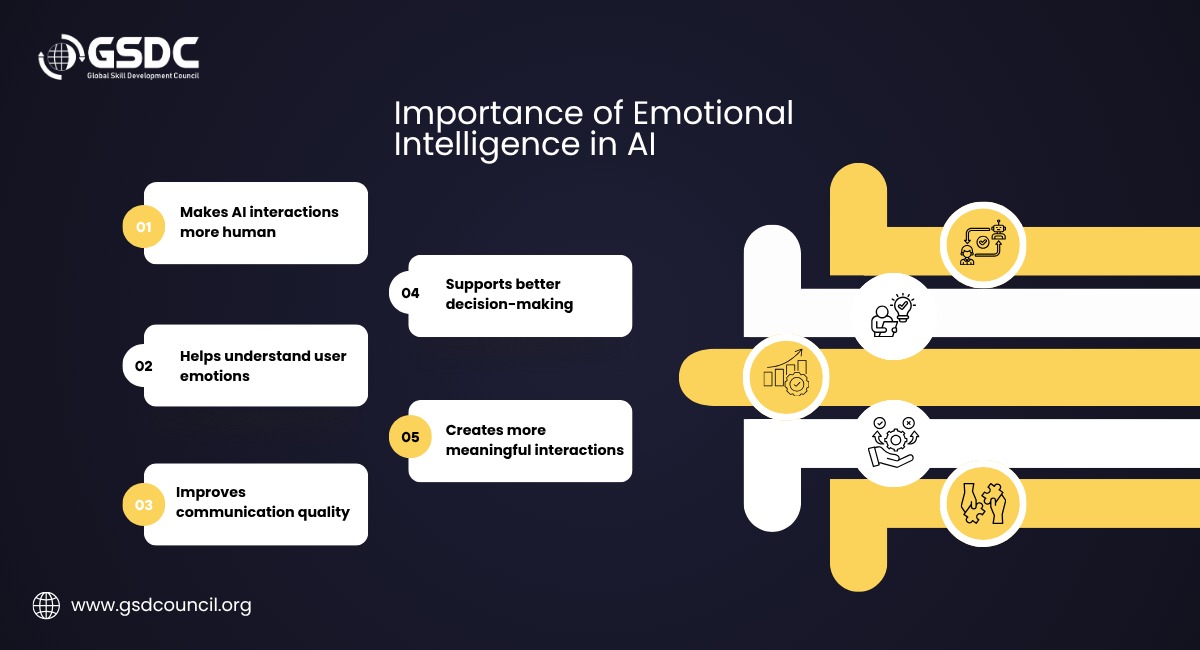
The benefits of emotional intelligence in conversational AI are obvious and practical:
Enhanced Customer Experience
The response will feel more human and engaging, thus increasing the overall user experience.
Faster problem solving
The AI will understand the problem and the emotion attached to it, thus helping solve it more efficiently.
Enhanced Personalization
The response will be able to change according to the user’s mood.
Enhanced Relationship Building
When the user feels supported, it will lead to a stronger relationship.
Better workplace tools
The importance of emotional intelligence at work can be seen in tools like HR bots and employee support systems.
Many organizations are already using AI emotional intelligence to improve customer experience and build long-term loyalty.
Emotional AI Examples in Action
Here are some emotional AI examples:
Customer support bots
Emotional AI can sense the frustration and respond accordingly to be more helpful to the customers.
Virtual assistants
Emotional AI changes the tone according to the emotional state of the user, making it more engaging and interactive.
Healthcare systems
Emotional AI can provide empathetic responses to patients, making it easier to provide better support to the patients.
E-learning platforms
Such systems respond to the learners’ behaviors and emotions in order to increase the learners’ engagement.
These emotional AI examples show how AI emotional intelligence is improving real-world interactions and creating better user experiences.
Organizations such as the Global Skill Development Council (GSDC) emphasize the significance of emotional intelligence in contemporary technologies and professional life as AI becomes more human-centric.
How Conversational AI Emotional Intelligence Works
There are various technology tools that facilitate emotional comprehension, collectively known as conversational Emotional Intelligence.
Here are the ways through which the emotional intelligence of a conversational AI is achieved.
Natural Language Processing (NLP)
This is a technology tool that allows Conversational AI to understand the meaning and context of user input.
Sentiment analysis
This technology tool analyses the sentiment of user input to determine if the user has provided the AI with a positive, negative, or neutral tone.
Voice emotion detection
This technology tool evaluates the tone, pitch, and speech patterns of the user so that the AI can accurately detect the user's emotion.
Machine learning
This technology allows Conversational AI to learn from user interactions so that the AI can improve its responses over time.
These four technology tools, utilized collectively, ensure that conversing with AI is as emotionally intelligent and as human-like as possible.
The Future of AI Emotional Intelligence
The future of AI emotional intelligence appears very bright. This is because, with the increasing rate of its adoption, more organizations are investing in technology with the capability to recognize and understand human emotions.
The future of AI will see more natural conversations and digital experiences with emotion intelligence. It will also see the application of AI in various sectors like healthcare, education, and customer relations.
The purpose of emotional intelligence in AI will keep increasing with the advancement of technology.
The Growing Demand for Emotional Intelligence Skills
As AI continues to evolve and expand the human aspect of its design, so does the need for emotional intelligence (EI) skills in the workforce. Therefore, today’s EI skills will include:
- Understanding human emotion and behavior
- Creating processes that allow for more human and meaningful responses
- Designing AI ethically so that these systems are developed with accountability and a user-centered focus
- Providing a good user experience by developing easy-to-understand, engaging, and effective interfaces.
This growing demand for Emotional Intelligence skills has led to increased interest in courses like Certified Emotional Intelligence Professional, which enables professionals to develop the skills they need.
This has also led organizations like the Global Skill Development Council to introduce formal learning in the area of Emotional Intelligence in relation to Artificial Intelligence.

Conclusion
In conclusion, conversational artificial intelligence has developed from being merely an automated solution to being a connection tool. The use of conversational AI with an emotional intelligent perspective will enable an organization to develop a conversational AI platform that understands how to respond in a more human-like manner. This results in a better end-user experience and ultimately establishes trust between the organization and its users.
In order to be successful in today's fast-paced digital world, it is important for firms to understand the meaning of emotional intelligence and understand how it will impact their organization moving forward.

Related Certifications
Frequently Asked Questions
Stay up-to-date with the latest news, trends, and resources in GSDC
If you like this read then make sure to check out our previous blogs: Cracking Onboarding Challenges: Fresher Success Unveiled
Not sure which certification to pursue? Our advisors will help you decide!