Key Tools and Technologies Every Data Scientist Should Know
Written by Emily Hilton
- Programming Languages for Data Science
- Data Management Tools: Handling Data Efficiently
- Data Visualization Tools: Turning Data Into Insight
- Machine Learning Libraries and Frameworks
- Big Data Technologies: Handling Large-Scale Data
- Analytics Platforms Used in Modern Workflows
- Data Version Control for Reproducibility
- Data Science Collaboration Tools
- GSDC Data Science Certification: Boosting Career Growth for Professionals
- Conclusion
In an era where data drives every business decision, the role of a data scientist has evolved into a critical engine for innovation and strategy. As organizations increasingly rely on data for insights, automation, and decision-making, the data scientist tools and technologies that professionals use also keep expanding. Modern data scientists must be comfortable working across the entire data science technology stack, from data ingestion to modeling, deployment, and monitoring.
To excel in this dynamic field, professionals must build a strong data science toolkit that includes data visualization tools, data management tools, machine learning libraries, analytics platforms, programming languages for data science, and even data version control systems.
This blog will help you explore the essential tools and technologies every data scientist should know today and why mastering them is critical for career success.
Programming Languages for Data Science
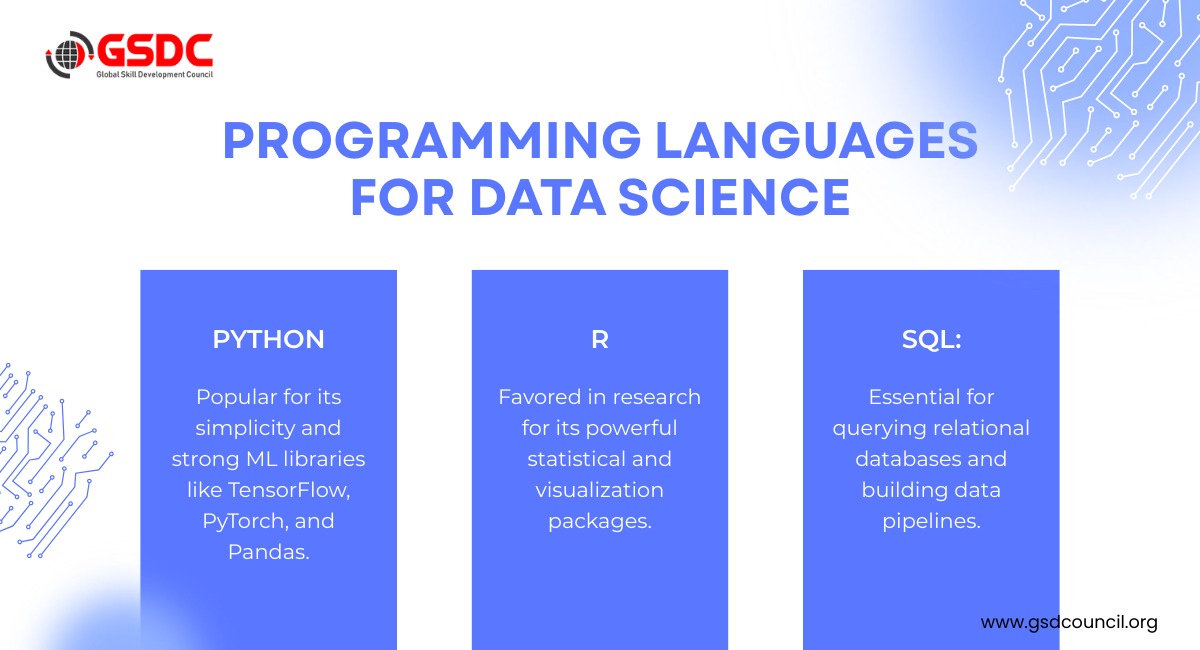
At the core of any data scientist’s workflow are the primary programming languages for data science. These languages form the foundation of the entire data science technology stack and influence how efficiently a data scientist can analyze data, build models, and automate processes.
Python: Python remains the most widely adopted language due to its simplicity, readability, and rich ecosystem of machine learning libraries. Tools like TensorFlow, PyTorch, Scikit-Learn, and Pandas make Python essential for everything from data wrangling to advanced modeling.
R: R is especially preferred in academic, research, and statistical environments. It offers specialized packages for visualization, forecasting, and statistical modeling, making it valuable for data-centric roles.
SQL: Though often overlooked, SQL is still among the most critical programming languages for data science, especially when working with relational databases or building pipelines.
Together, these languages remain fundamental components of the modern data science toolkit.Data Management Tools: Handling Data Efficiently
Before any analysis or modeling begins, data must be collected, cleaned, transformed, and stored. This is where data management tools play a vital role.
Relational Databases: Tools like MySQL, PostgreSQL, and MS SQL Server help data scientists manage structured datasets efficiently.
NoSQL Databases: Platforms like MongoDB, Cassandra, and Couchbase handle unstructured and semi-structured datasets crucial in today’s big-data ecosystem.
Data Lakes and Warehouses: Modern enterprises rely on platforms like Snowflake, Google BigQuery, Amazon Redshift, and Databricks Lakehouse. These tools enable real-time access, scalable storage, and advanced analytics.
Efficient use of data management tools ensures smooth collaboration, integration, and accessibility across teams working with data scientist tools and technologies.Data Visualization Tools: Turning Data Into Insight
Visualization remains one of the most essential skills for data professionals. Effective storytelling through charts and dashboards helps stakeholders understand trends quickly and make data-driven decisions.
Popular data visualization tools include:
- Tableau: Intuitive dashboards and strong BI capabilities.
- Power BI: Seamless integration with the Microsoft ecosystem and enterprise reporting.
- Matplotlib, Seaborn & Plotly: Essential Python-based visualization libraries for custom visualizations.
- Looker & Qlik Sense: Cloud-native solutions for scalable analytics and visualization.
🚀 Plan Your Data Science Career Path
Machine Learning Libraries and Frameworks
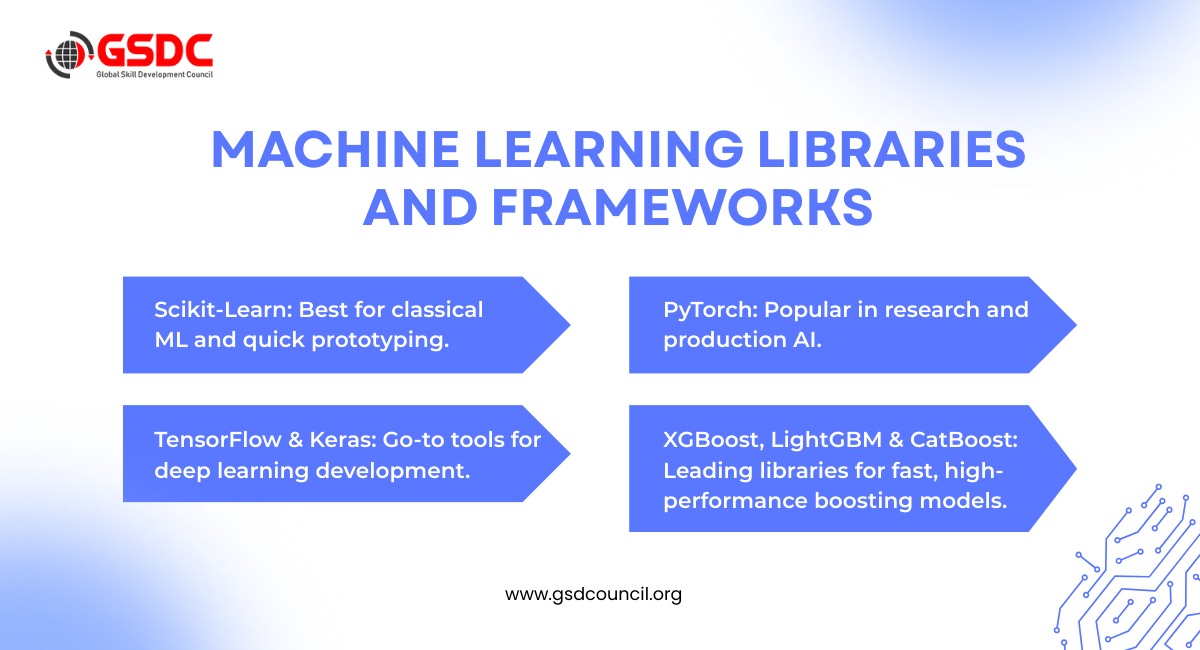
Machine learning is at the heart of the data science profession. Modern machine learning libraries simplify model development, experimentation, and deployment.
Popular Libraries
- Scikit-Learn: Ideal for classical ML algorithms and quick prototyping.
- TensorFlow and Keras: Widely used in deep learning and AI model development.
- PyTorch: A favorite in research and production AI systems.
- XGBoost, LightGBM & CatBoost: Known for high-performance gradient boosting models.
Model Deployment Tools
- MLflow, Kubeflow, and SageMaker help manage production workflows, hyperparameter tuning, and scalable deployment.
Big Data Technologies: Handling Large-Scale Data
As organizations gather more data every year, the need for robust big data technologies grows stronger. Data scientists must understand these systems to process, analyze, and store massive datasets.
Key Big Data Tools
- Hadoop: A distributed computing framework for large datasets.
- Spark: Fast, in-memory data processing and ML capabilities.
- Kafka: Real-time data streaming and event-driven systems.
- Flink: Advanced stream-processing engine for low-latency systems.
Analytics Platforms Used in Modern Workflows
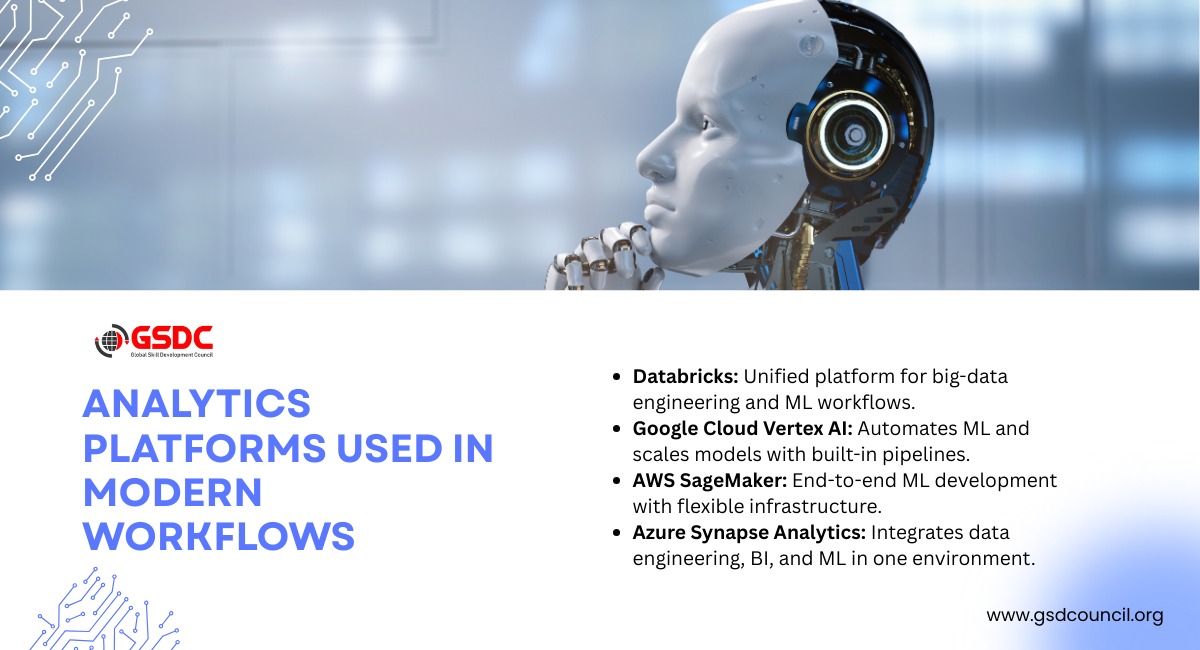
Enterprises today rely heavily on analytics platforms that streamline collaboration, automation, and data exploration.
Common Platforms
- Databricks: A unified analytics platform for big-data engineering and ML workflows.
- Google Cloud Vertex AI: Automated ML, scalable models, and built-in pipeline tools.
- AWS SageMaker: End-to-end ML operations with flexible infrastructure.
- Azure Synapse Analytics: Integrated data engineering, BI, and ML environment.
Data Version Control for Reproducibility
As projects grow more complex, maintaining version history for datasets, models, and experiments becomes essential. This is where data version control tools come into play.
Popular Data Versioning Tools
- DVC (Data Version Control): Git-like tracking for datasets and models.
- MLflow Tracking: Records experiments, metrics, and parameters.
- Weights & Biases: Comprehensive experiment tracking and model monitoring.
Data Science Collaboration Tools
Collaboration is vital in today’s distributed work environments. The rise of cloud-based ecosystems has led to powerful data science collaboration tools that help teams share models, notebooks, code, and insights seamlessly.
Popular tools include:
- GitHub & GitLab: Essential for code collaboration and version control.
- JupyterHub & Google Colab: Shared environments for research and experimentation.
- Notion, Confluence & Slack: Productivity platforms used for project documentation and communication.
GSDC Data Science Certification: Boosting Career Growth for Professionals
To stay competitive in the industry, professionals often pursue a data science certification or a data science professional certification. Among the most respected options globally is the GSDC Certified Data Science Professional.
Why GSDC’s CDSP Certification Matters
The data science professional certificate offered by GSDC helps individuals validate their skills in programming, data management, analytics, and machine learning. It covers real-world case studies, hands-on exercises, and practical assessments to prepare professionals for industry challenges.
Benefits for Professionals
- Industry Recognition: Becoming a certified data science professional enhances credibility and employability.
- Career Acceleration: The data scientist certification validates your expertise and opens doors to advanced roles.
- Skill Enhancement: Exposure to modern data scientist tools and technologies ensures learners stay up-to-date with market needs.
- Global Acceptance: GSDC’s data science certifications are recognized by companies across industries worldwide.
For professionals aiming to upgrade their expertise, the CDSP certification is a powerful pathway to stand out in a competitive job market.

Conclusion
The field of data science is evolving faster than ever, and the data science toolkit that professionals rely on must continue to expand. From data visualization tools and data management tools to machine learning libraries, analytics platforms, big data technologies, data version control, and data science collaboration tools, modern data scientists must remain adaptable and skilled across the entire workflow.
Building expertise across the complete data science technology stack not only makes professionals more effective but also opens up a wider range of opportunities in the global workforce. Whether you're an aspiring analyst or an experienced professional, staying updated with the latest data scientist tools and technologies and validating your skills through a data science certification like GSDC’s CDSP can significantly strengthen your career growth.
Related Certifications
Stay up-to-date with the latest news, trends, and resources in GSDC
If you like this read then make sure to check out our previous blogs: Cracking Onboarding Challenges: Fresher Success Unveiled
Not sure which certification to pursue? Our advisors will help you decide!