Data Breach Response Plan: What Should Organizations Do in the First 24 Hours?
Written by Matthew Hale
A data breach can expose sensitive information, disrupt business operations, and compromise the security of an organisation's systems. It may result from a phishing attack, compromised credentials, an exposed database, ransomware, or an error in cloud configuration.
When a breach is discovered, the organisation must act quickly. Attackers may still have access to compromised systems, sensitive information may be exposed, and business services may be at risk. Delayed decisions can allow the incident to spread and make investigation and recovery more difficult.
The first 24 hours are therefore critical. Security teams must identify the incident, contain the threat, investigate what happened, preserve digital evidence, and begin planning recovery. These activities require coordination between IT, cybersecurity, management, legal, and other relevant teams.
A structured data breach response plan helps organisations manage these actions in the right order. It establishes who is responsible, what decisions must be made, and which technical steps should be taken to limit the impact of a breach.
This blog explains the incident response steps organisations should follow during the first 24 hours, including the technical methods used to contain a breach, investigate its impact, and restore affected systems.
What Is a Data Breach Response Plan?
A data breach response plan is a documented procedure that guides an organisation through the identification, containment, investigation, and recovery of a data breach.
It defines the responsibilities of the incident response team and explains how technical and business teams should coordinate during an incident.
A data breach incident response plan should include:
- Procedures for reporting and confirming a suspected breach.
- Incident classification and escalation requirements.
- Technical steps for containing unauthorised access.
- Investigation and evidence preservation procedures.
- Data exposure and business impact assessment.
- Recovery procedures for affected systems.
- Communication and regulatory notification responsibilities.
- Post-incident review and corrective actions.
The plan should be specific enough for teams to follow during an actual incident. For example, it should identify who can isolate a production server, who approves emergency access restrictions, and who coordinates communication with management.
What Should Organizations Do in the First 24 Hours After a Data Breach?
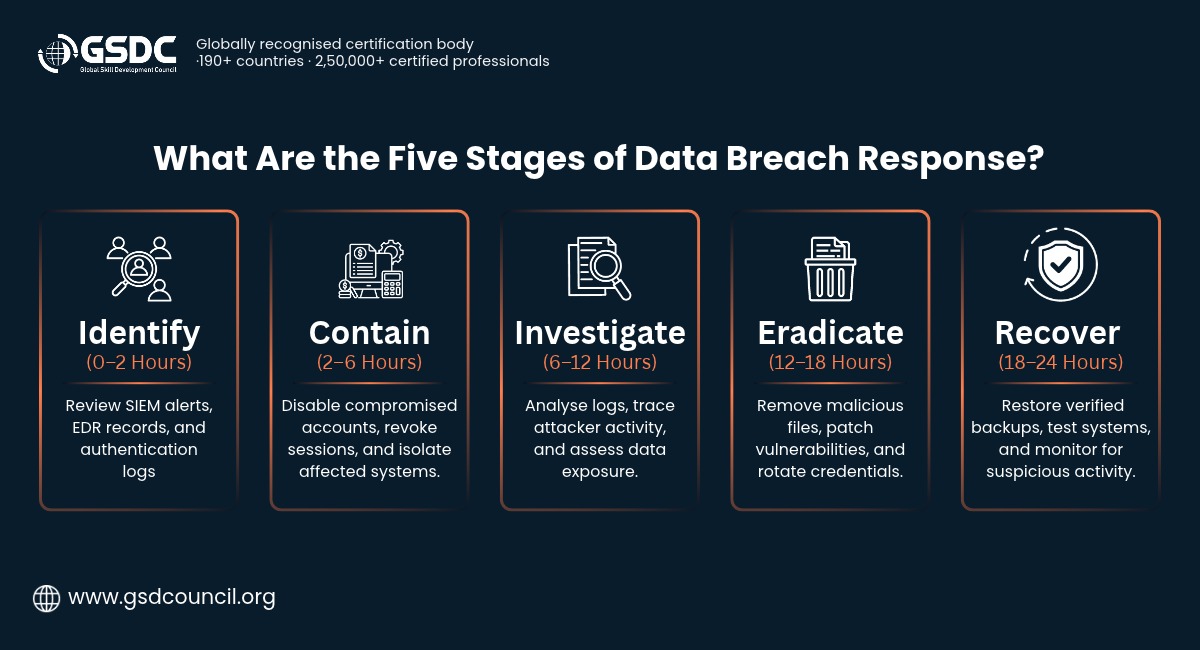
The first 24 hours can be divided into four response windows. These are practical planning stages, not rigid deadlines. Depending on the severity of the incident, some activities may happen simultaneously or continue beyond the first day.
<AsyncImageGroup query={["cybersecurity incident response team monitoring security operations center screens","cybersecurity analyst investigating endpoint security incident","IT security team recovering enterprise servers"]} aspectRatio="5:4" layout="carousel" />
First 0–2 Hours: Identify and Confirm the Breach
The first step is to determine whether a security incident has occurred and identify the systems involved.
An unusual login, unexpected file download, or malware alert may indicate a potential breach. However, security teams must examine the available evidence to determine whether unauthorised access or data exposure has actually occurred.
What should the organisation do?
- Record when the incident was detected and who reported it.
- Identify the affected systems, accounts, applications, and business services.
- Review security alerts and unusual system activity.
- Determine whether the incident involves unauthorised access, data exposure, modification, or deletion.
- Assign an incident owner and activate the response team.
- Classify the incident based on severity and business impact.
Technical investigation
Security teams should examine:
- SIEM alerts and correlated security events.
- EDR records showing suspicious processes and endpoint activity.
- Authentication logs showing unusual logins or failed attempts.
- Firewall and network logs showing suspicious connections.
- Cloud audit logs showing changes to accounts or storage permissions.
- Database logs showing unusual queries or bulk data exports.
For example, an unusual login followed by privilege escalation and a large database export may indicate that an account has been compromised. At this stage, teams should maintain an incident timeline and distinguish confirmed facts from unverified findings.
First 2–6 Hours: Contain the Breach
Once the incident is confirmed, the organisation must prevent further unauthorised access and reduce the risk of additional damage.
This stage is known as incident containment. The objective is to restrict the attacker's access while keeping unaffected business services operational where possible.
What should the organisation do?
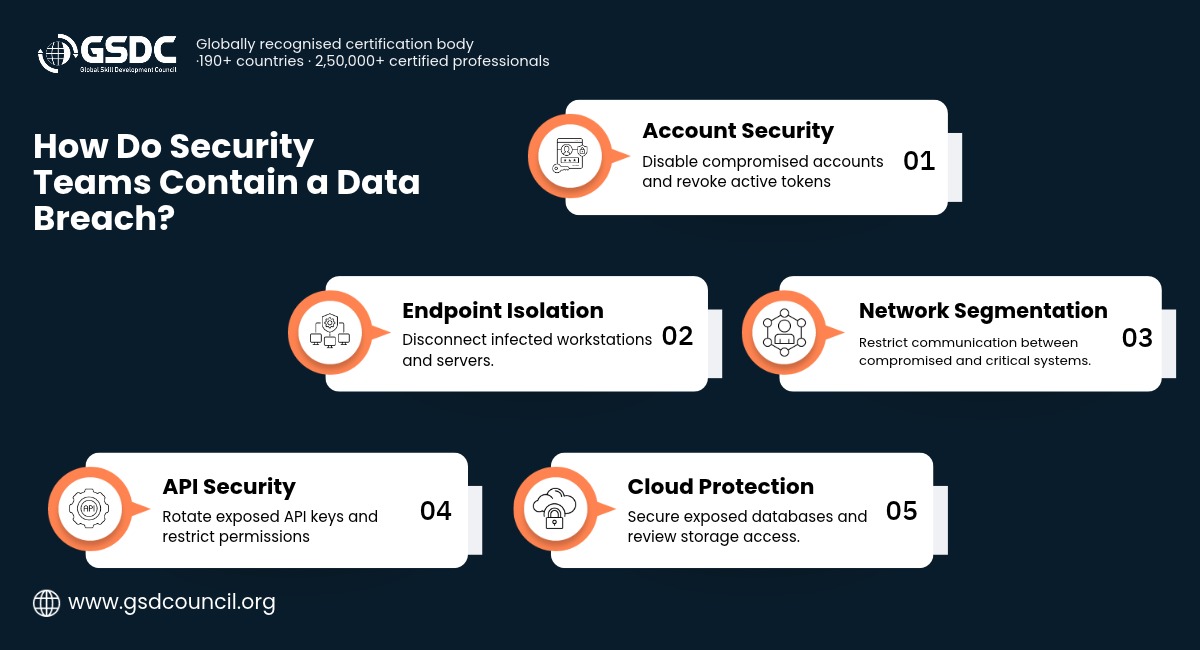
- Disable or restrict compromised accounts.
- Revoke active sessions and suspicious authentication tokens.
- Rotate exposed passwords, API keys, and service credentials.
- Isolate affected endpoints or servers where necessary.
- Block confirmed malicious IP addresses and network connections.
- Restrict access to exposed databases and cloud storage.
- Review privileged accounts for unauthorised changes.
Why is revoking access tokens important?
Changing a password may not be sufficient if an attacker has already obtained an active session token. The attacker may continue accessing the application until the session is revoked.
Security teams should therefore review active sessions, refresh tokens, API credentials, and application permissions. They should also check for newly created accounts or other mechanisms that may allow the attacker to maintain access.
Network containment
Network segmentation can limit an attacker's ability to move between systems.
For example, if a compromised workstation is connected to a finance network, the security team may restrict its communication with financial databases and administrative servers. This reduces the possibility of lateral movement while the investigation continues.
Containment decisions should be made carefully. Shutting down every affected system may interrupt critical services or destroy volatile evidence. The response team should select the appropriate isolation method based on the incident.
First 6–12 Hours: Investigate the Breach and Assess Its Impact
After restricting the attacker's access, the organisation must determine how the breach occurred, what the attacker did, and which information may have been affected.
This requires a combination of security log analysis, digital forensics, and data exposure assessment.
What should the organisation investigate?
1. Initial access
Determine how the attacker entered the environment. Common entry points include phishing emails, stolen credentials, vulnerable applications, exposed remote access services, and compromised third-party accounts.
2. Attacker activity
Examine endpoint, identity, and network records to identify suspicious processes, privilege escalation, and movement between systems.
3. Data access and exposure
Review database queries, file access records, cloud storage activity, and outbound network traffic to determine whether information was viewed, copied, modified, or deleted.
4. Affected systems
Identify whether the incident is limited to one device or has spread to servers, databases, cloud platforms, and other connected systems.
5. Business impact
Determine which services are disrupted, what information is unavailable, and whether critical business operations are affected.
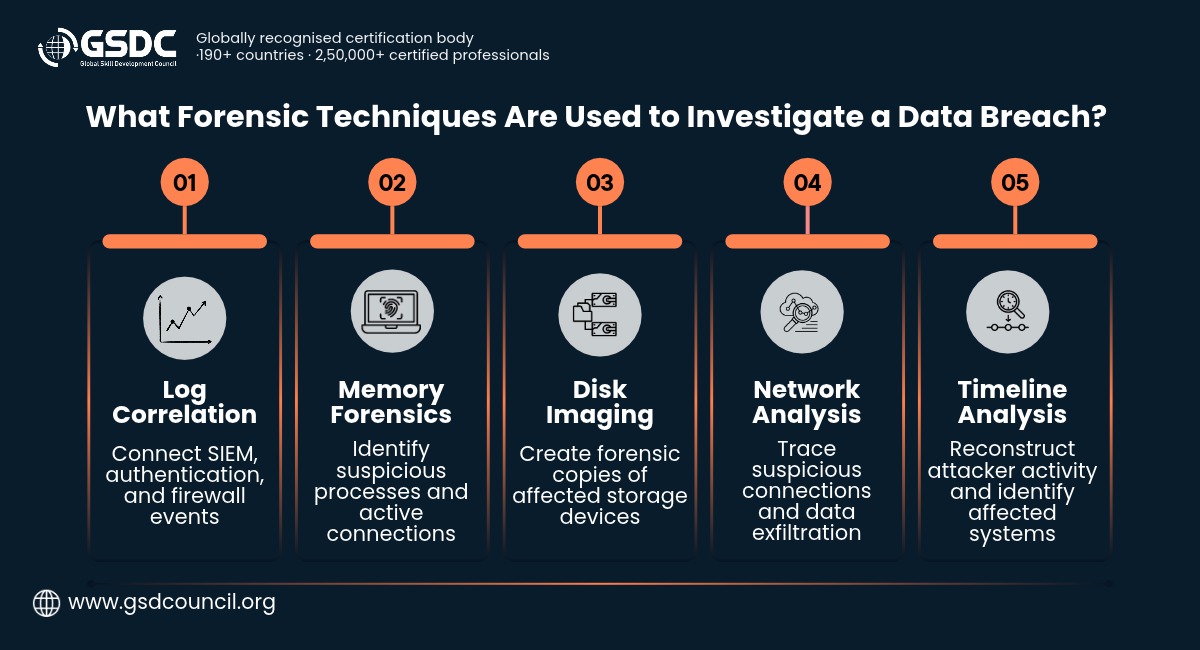
Technical Methods Used During the Investigation
Investigation method | Purpose |
| Log correlation | Combines events from different systems to reconstruct the incident. |
| Memory forensics | Examines volatile memory for suspicious processes, injected code, and active connections. |
| Disk imaging | Creates a forensic copy of a storage device for investigation. |
| Timeline analysis | Establishes the sequence of attacker activity. |
| File integrity analysis | Uses cryptographic hashes to identify changes and verify evidence. |
| Network analysis | Identifies suspicious connections and possible data exfiltration. |
Evidence should be collected and stored in a controlled manner. Teams should record who collected it, when it was collected, and where it is stored. This helps maintain the chain of custody and supports further investigation.
Assessing the data involved
The organisation should identify whether the breach involved customer information, employee records, financial details, credentials, or other sensitive data.
It should also determine whether the information was encrypted and whether the attacker obtained access to the encryption keys.
This assessment helps the organisation understand the potential impact on individuals and determine whether legal, regulatory, or contractual notification requirements apply.
First 12–18 Hours: Remove the Threat and Prepare Recovery
Once the organisation has identified the likely scope of the breach, it should remove the attacker's access and address the weaknesses that allowed the incident to occur.
This process is known as eradication. Deleting a suspicious file is not enough if the attacker has created additional accounts, modified system configurations, or established other access mechanisms.
What should the organisation do?
- Remove malicious files, scripts, and unauthorised software.
- Disable attacker-created accounts and access mechanisms.
- Remove unauthorised scheduled tasks and persistence configurations.
- Patch exploited vulnerabilities.
- Replace compromised credentials and secrets.
- Review privileged access and service accounts.
- Check connected systems for additional compromise.
- Verify that security controls are functioning correctly.
For example, if an attacker entered through a vulnerable application, the organisation must fix the vulnerability and check whether other systems are affected. Otherwise, the attacker may regain access even after the original malicious files have been removed.
Prepare for recovery
Before restoring systems, the organisation should identify:
- Which business services must be restored first.
- Which backups are available and whether they are clean.
- Whether affected systems need to be rebuilt.
- Which credentials and access permissions must be changed.
- How restored systems will be monitored.
This preparation helps avoid restoring compromised systems or reintroducing malicious files into the environment.
First 18–24 Hours: Restore Critical Systems and Verify Security
The final stage of the first 24 hours focuses on recovery and stabilisation.
Data breach recovery involves restoring affected systems and services while ensuring that the attacker no longer has access.
What should the organisation do?
- Select verified backups created before the compromise.
- Rebuild or restore affected systems using trusted configurations.
- Apply security patches and updated configurations.
- Reset compromised credentials and review access permissions.
- Test system functionality and data integrity.
- Reconnect systems gradually.
- Monitor restored systems for suspicious activity.
- Document recovery decisions and remaining risks.
Why should backups be verified before restoration?
Attackers may attempt to encrypt or modify backups during a breach. Restoring an infected backup can reintroduce malicious files or compromised configurations.
Organisations should verify backup integrity and, where possible, test restoration in an isolated environment before reconnecting systems to production networks.
Prioritise recovery
Systems should be restored according to business criticality.
For example, an organisation may prioritise identity services, core network infrastructure, critical databases, and essential business applications before restoring less critical systems.
The recovery sequence should align with the organisation's business continuity and disaster recovery requirements.
The first 24 hours do not necessarily mark the end of the incident. Investigation, recovery, monitoring, and communication may continue for several days or longer.
How Can Organizations Improve Their Data Breach Response Plan?
A response plan should be tested before an incident occurs. Organisations can improve their readiness through regular exercises and technical validation.
Conduct tabletop exercises: Simulate a breach and ask each team to explain its responsibilities. This helps identify unclear escalation procedures and decision-making delays.
Test containment procedures: Verify that security teams can isolate endpoints, revoke sessions, and restrict access without unnecessarily disrupting critical services.
Maintain accurate asset inventories: Identify where sensitive information is stored and which systems communicate with each other.
Test backup recovery: Verify backup integrity and test restoration procedures. Recovery time objectives (RTOs) and recovery point objectives (RPOs) should be realistic and regularly reviewed.
Review third-party access: Understand how cloud providers, software vendors, and business partners access organisational data.
Conduct post-incident reviews: Document the cause of the breach, the effectiveness of the response, and the corrective actions required.
Develop Your Data Protection Knowledge with GSDC Certification
Managing a data breach requires an understanding of data protection principles, incident reporting, privacy risks, and regulatory responsibilities. Professionals involved in security and compliance must know how to assess the impact of exposed personal information and support organisations in meeting their data protection obligations.
The GSDC Data Protection Officer Certification is designed for professionals who want to develop knowledge of data protection, privacy management, and regulatory compliance.

Through this certification, professionals can develop knowledge of:
- Personal data protection principles, privacy regulations, and GDPR requirements.
- Data breach management, incident response, and reporting responsibilities.
- Data classification, access controls, and information security practices.
- Privacy risk assessments, data governance, and compliance management.
Explore the GSDC Data Protection Officer Certification to learn more about developing your data protection and privacy management knowledge.
Conclusion
The first 24 hours after a data breach require a coordinated response. Organisations must identify the incident, contain unauthorised access, investigate the affected systems, preserve evidence, and begin recovery.
A structured data breach response plan helps security teams perform these activities in a controlled manner. It also helps organisations make informed decisions about business disruption, data exposure, and communication.
The response should not end when affected systems are restored. Organisations must verify that the attacker has been removed, address the weaknesses that caused the breach, and monitor systems for signs of continued compromise.
A tested data breach response checklist, clear responsibilities, reliable backups, and effective security monitoring can help organisations respond more confidently and reduce the impact of future incidents.

Related Certifications
Stay up-to-date with the latest news, trends, and resources in GSDC
If you like this read then make sure to check out our previous blogs: Cracking Onboarding Challenges: Fresher Success Unveiled
Not sure which certification to pursue? Our advisors will help you decide!