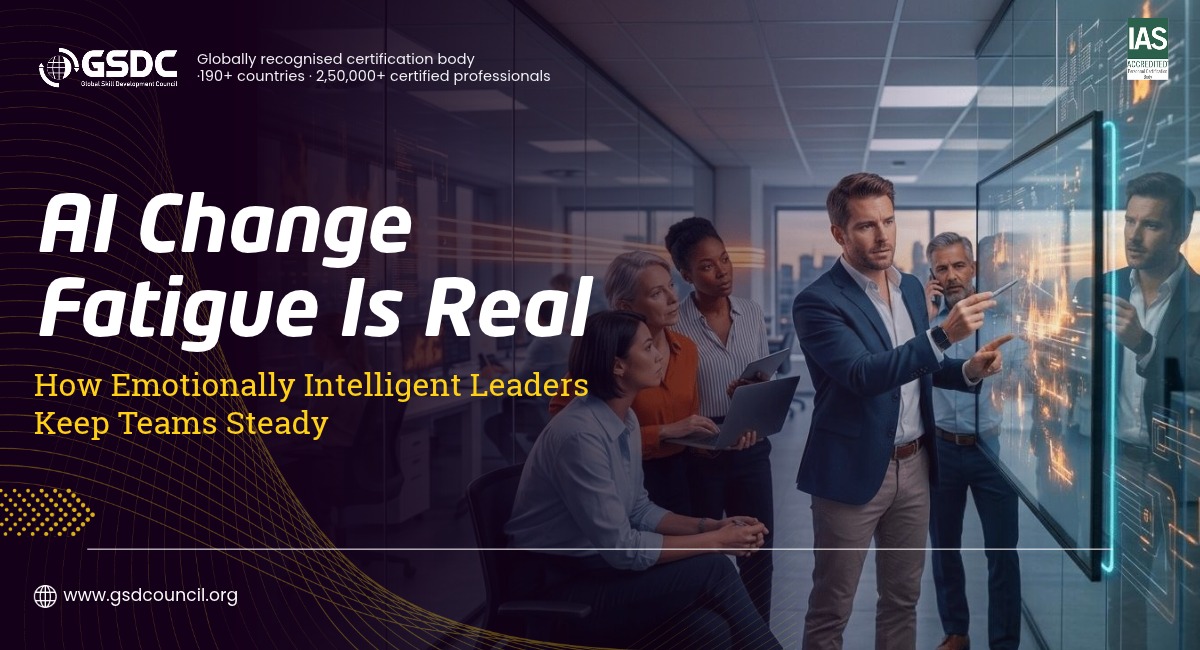
AI Change Fatigue Is Real: How Emotionally Intelligent Leaders Keep Teams Steady
Written by Emily Hilton
- Understanding Change Fatigue in the Age of AI
- Why AI Fatigue Is Becoming a Workplace Challenge
- Understanding the Difference Between AI Fatigue, AI Burnout, and Change Saturation
- How Emotionally Intelligent Leadership Helps Reduce AI Change Fatigue
- How to Overcome Change Fatigue: A Practical Leadership Framework
- Building Emotionally Intelligent Leadership for Continuous AI Transformation
- Conclusion
Imagine starting your Monday with a new AI tool to learn, a revised workflow to follow, and another announcement about an upcoming organisational transformation. Before employees have fully adjusted to one change, another one arrives. A few weeks later, they are expected to adopt yet another system while maintaining the same productivity levels.
For many employees, this is becoming a familiar workplace experience.
Artificial intelligence is changing how organisations operate, communicate, make decisions, and deliver work. While these developments create opportunities for innovation, they also introduce continuous learning demands and uncertainty. Employees are expected to adapt quickly, understand new technologies, and adjust their responsibilities without necessarily having enough time to process each change.
This is where AI change fatigue becomes a real concern.
The problem is not always resistance to technology. Sometimes, employees are simply overwhelmed by the speed and frequency of transformation. They may struggle to keep up, lose confidence in their abilities, or feel disconnected from the purpose behind new initiatives.
For leaders, managing this situation requires more than announcing new tools or organising training sessions. It requires emotional intelligence, empathy, communication, and an understanding of how people experience change
Understanding Change Fatigue in the Age of AI
Change fatigue refers to the mental, emotional, and physical exhaustion employees experience when frequent organisational changes occur without enough time or support to adapt.
With growing AI adoption, employees must continuously learn new tools, adjust workflows, and develop technical skills alongside their regular responsibilities.
For example, a content marketing team may introduce an AI writing assistant, followed by AI analytics and automated content distribution tools. Although each offers benefits, constantly adapting to new systems can overwhelm employees.
Over time, this change fatigue in the workplace can lead to lower engagement, reduced motivation, and frustration towards organisational initiatives.
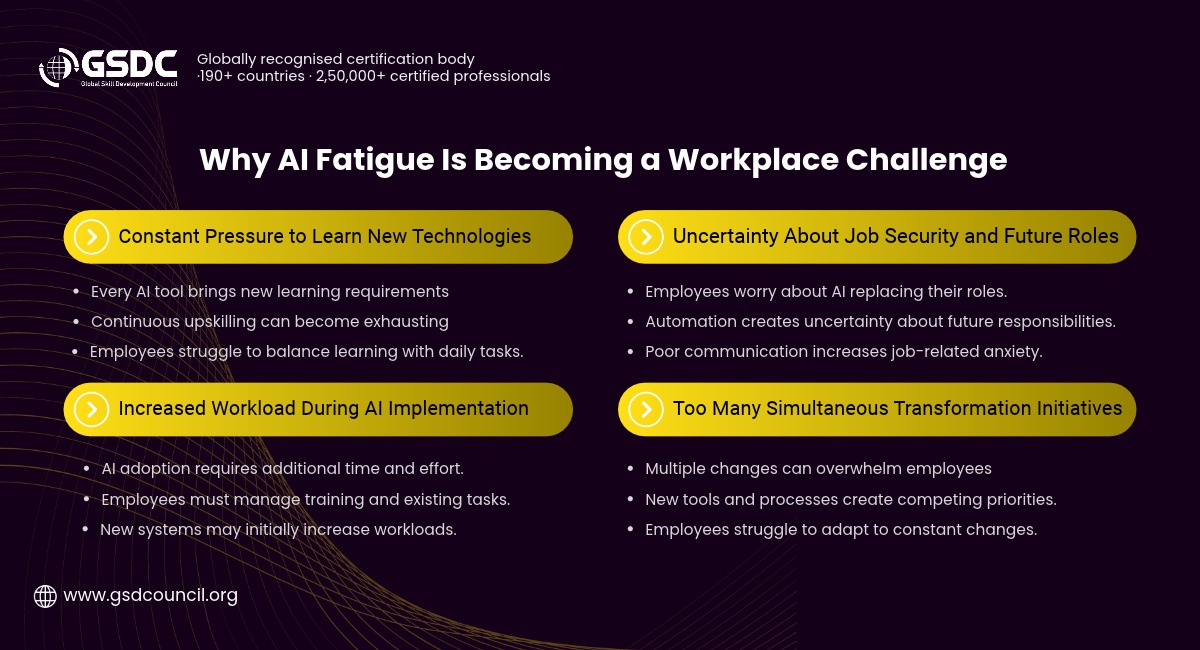
Why AI Fatigue Is Becoming a Workplace Challenge
AI adoption is no longer limited to technology departments. It is influencing marketing, finance, human resources, customer service, operations, project management, and other business functions.
As AI in the workplace becomes more common, employees are experiencing several changes simultaneously.
1. Constant Pressure to Learn New Technologies
Every new AI platform introduces another learning requirement.
Employees may need to understand how to write effective prompts, evaluate AI-generated outputs, use automated workflows, and identify potential errors.
While these skills are valuable, continuous learning can become exhausting when organisations do not provide sufficient time or structured support.
For example, an HR professional may already be responsible for recruitment, employee engagement, and performance management. Introducing AI-powered screening and analytics tools adds new responsibilities to an already demanding role.
Without proper training and workload adjustments, employees may feel that technology adoption is becoming an additional burden rather than a productivity improvement.
2. Uncertainty About Job Security and Future Roles
One of the biggest concerns surrounding AI transformation is the possibility of changing job responsibilities.
Employees may worry that automation will reduce the need for certain skills or eliminate parts of their existing roles.
Even when an organisation introduces AI to support employees rather than replace them, unclear communication can create unnecessary anxiety.
For example, when a customer service company introduces AI agents to handle routine enquiries, employees may wonder whether their positions will remain relevant.
This uncertainty can affect confidence, motivation, and willingness to participate in new initiatives.
3. Increased Workload During AI Implementation
AI tools are often introduced with the expectation that they will improve productivity. However, implementation itself requires time and effort.
Employees may need to attend training sessions, test new platforms, transfer information, report technical problems, and maintain existing workflows during the transition.
In some cases, the new system may initially create more work before delivering efficiency improvements.
If managers fail to recognise this adjustment period, employees may experience AI fatigue and frustration.
4. Too Many Simultaneous Transformation Initiatives
Another major contributor to change saturation is the number of initiatives organisations attempt to introduce at the same time.
A company might simultaneously implement an AI-powered CRM, automate reporting, restructure departments, introduce new performance metrics, and revise its communication processes.
Even if these initiatives are individually useful, employees may struggle to manage all of them together.
When every department is undergoing transformation, employees can lose clarity about priorities and expectations.
The result is not necessarily a lack of willingness to change. It may simply be a lack of capacity to absorb more change.
Understanding the Difference Between AI Fatigue, AI Burnout, and Change Saturation
These terms are related, but they describe different workplace challenges.
Term | What It Means | Workplace Example |
AI fatigue | Mental exhaustion or frustration caused by frequent AI-related demands | Employees feel overwhelmed by learning multiple AI tools |
AI burnout | A more serious state of work-related exhaustion associated with sustained pressure involving AI-enabled work | Employees experience prolonged stress from constant AI monitoring, productivity expectations, and workload pressure |
Change fatigue | Exhaustion caused by repeated organisational changes | Employees struggle to adjust to continuous process and structural changes |
Change saturation | A situation where an organisation introduces more changes than its people and resources can effectively absorb | Multiple transformation projects compete for employee attention |
Transformation fatigue | Reduced enthusiasm and engagement after prolonged exposure to major transformation initiatives | Employees become less responsive to another company-wide transformation announcement |
Understanding these differences helps managers identify the actual problem rather than assuming that employees simply need more motivation.
For instance, an employee struggling with change saturation may benefit more from reduced competing priorities than another training session.
Similarly, an employee experiencing AI burnout may need workload adjustments, clearer expectations, and adequate recovery time.
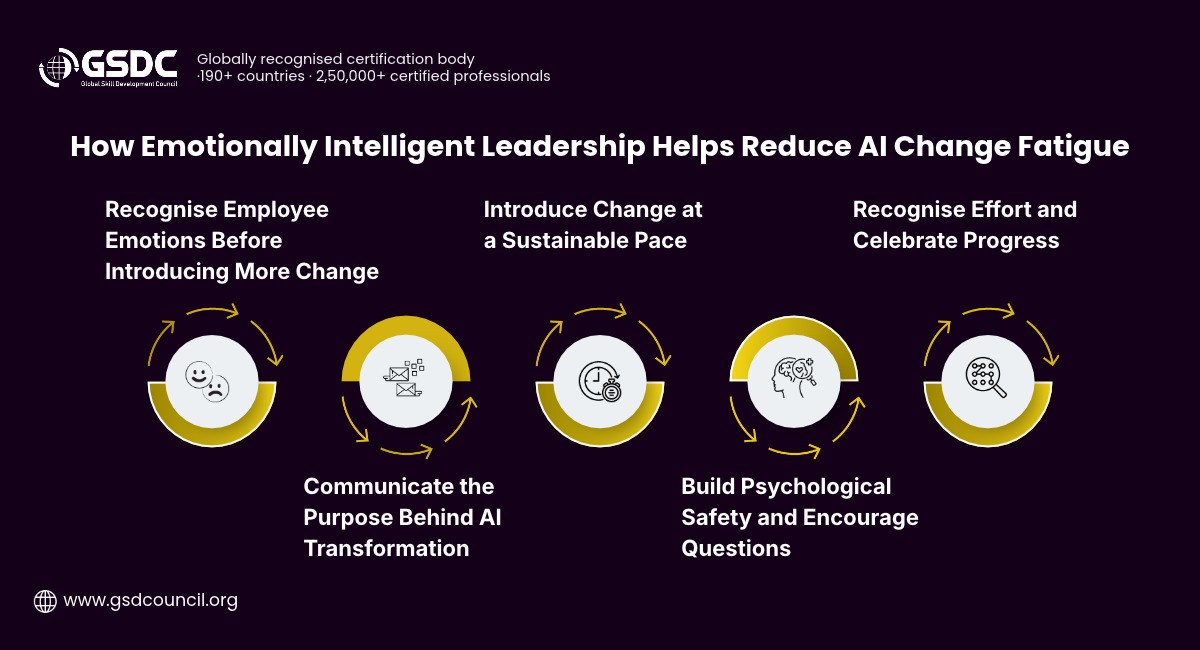
How Emotionally Intelligent Leadership Helps Reduce AI Change Fatigue
Technology implementation is often treated as a process involving tools, budgets, systems, and performance targets.
However, successful AI transformation also depends on how employees experience the process.
Emotionally intelligent leadership helps managers recognise emotional responses, understand employee concerns, and make decisions that support both business objectives and workforce well-being.
Here are five ways leaders can apply emotional intelligence during organisational change.
1. Recognise Employee Emotions Before Introducing More Change
Employees do not always communicate when they are overwhelmed.
Some may continue completing their responsibilities while privately experiencing frustration, anxiety, or uncertainty.
Emotionally intelligent leaders pay attention to these signals instead of assuming that everything is going well because project deadlines are being met.
Managers should regularly speak with employees, ask about their experiences, and create opportunities for honest feedback.
For example, before introducing another AI platform, a manager could ask:
- Are employees comfortable using the existing AI tools?
- Which parts of the current workflow are still difficult?
- Do employees have enough time to complete their training?
- Are there concerns about changing responsibilities?
- What additional support would make the transition easier?
These conversations help leaders understand whether the organisation is ready for another initiative.
2. Communicate the Purpose Behind AI Transformation
Employees are more likely to engage with change when they understand why it is happening.
Simply announcing that a company is adopting AI does not explain how the technology will improve everyday work.
Leaders should communicate the business problem, expected benefits, potential limitations, and impact on employee responsibilities.
For example, instead of telling a marketing team that an AI platform will automate content production, managers can explain that the tool will support research, organise content ideas, and reduce repetitive administrative work.
They should also clarify which responsibilities will continue to require human expertise, such as brand strategy, creative judgement, and content quality evaluation.
Clear communication reduces uncertainty and helps employees understand where they fit into the transformation.
3. Introduce Change at a Sustainable Pace
One of the most effective ways to address change fatigue is to avoid introducing too many initiatives simultaneously.
Organisations should evaluate their employees' capacity before launching additional transformation projects.
For example, if a department is still learning a new AI workflow, management may delay introducing another platform until employees become comfortable with the existing system.
A phased approach can make managing change in the workplace more effective.
Leaders can:
- Prioritise initiatives based on business value.
- Introduce new tools through smaller pilot programmes.
- Provide adequate learning and adjustment periods.
- Review employee feedback before expanding implementation.
- Remove outdated processes when introducing new ones.
The objective is not to slow down innovation unnecessarily. It is to ensure that employees can adopt changes successfully rather than becoming overwhelmed by their frequency.
4. Build Psychological Safety and Encourage Questions
Employees may hesitate to admit that they do not understand an AI tool or are struggling with a new process.
They may worry that asking questions will make them appear less capable or resistant to innovation.
Emotionally intelligent leaders create an environment where employees can express concerns without fear of judgement.
For example, a manager introducing an AI-powered analytics system should encourage employees to report incorrect outputs, discuss limitations, and request additional training.
Mistakes during implementation should be treated as opportunities to improve the process rather than reasons to blame individuals.
Psychological safety helps employees participate more confidently and supports better collaboration during transformation.
5. Recognise Effort and Celebrate Progress
During major organisational changes, leaders often focus heavily on implementation milestones and productivity improvements.
However, they may overlook the effort employees invest in learning new systems and adjusting their responsibilities.
Recognition is important because it helps employees understand that their contributions matter.
Managers can acknowledge employees who help colleagues learn new tools, identify workflow improvements, or provide constructive feedback during implementation.
Small achievements, such as completing training, successfully adopting a new process, or improving a workflow, should also be recognised.
This is one practical way to understand how to boost team morale during periods of continuous transformation.
How to Overcome Change Fatigue: A Practical Leadership Framework
Reducing change fatigue requires a structured approach that considers employee readiness, organisational priorities, and the long-term impact of AI adoption.
The following framework can help managers create a more sustainable transformation environment.
Step | Leadership Action | Expected Outcome |
1. Assess | Understand employee workload, concerns, and readiness | Identify early signs of fatigue |
2. Prioritise | Evaluate which AI initiatives are genuinely necessary | Reduce competing demands |
3. Communicate | Explain the purpose and expected impact of each change | Improve clarity and confidence |
4. Support | Provide training, resources, and time to adapt | Improve employee readiness |
5. Implement | Introduce changes through manageable stages | Reduce disruption |
6. Evaluate | Collect feedback and measure adoption | Identify areas requiring improvement |
7. Recognise | Appreciate employee effort and progress | Maintain motivation and engagement |
This approach makes transformation more manageable because employees become active participants rather than simply receiving instructions from management.
Building Emotionally Intelligent Leadership for Continuous AI Transformation
As AI transformation becomes an ongoing part of business strategy, leadership capabilities must evolve alongside technology. Successful transformation requires more than introducing advanced systems; it also depends on employees who can adapt, collaborate, and navigate change confidently. Here, GSDC brings the certification that helps professionals to adopt all these capabilities.
Pursuing GSDC's Certified Emotional Intelligence Professional certification can help professionals develop essential skills in emotional awareness, self-regulation, empathy, and interpersonal effectiveness. It provides a structured understanding of how emotional intelligence can be applied to workplace relationships, decision-making, and leadership challenges.
These capabilities are particularly valuable for professionals working in AI leadership, change management, human resources, and digital transformation.
Combining emotional intelligence with AI literacy and change management skills can help leaders balance technological innovation with employee well-being and build more adaptable, confident teams.
Conclusion
AI transformation is changing how organisations operate, but it is also changing how employees experience work. Constant technology updates, changing responsibilities, and increasing learning demands can create AI fatigue, change fatigue, and long-term disengagement.
Organisations cannot address these challenges simply by introducing more tools or expecting employees to adapt faster.
They need leaders who understand the human side of transformation.
Emotionally intelligent leadership provides a practical way forward. By recognising employee concerns, communicating clearly, introducing changes at a sustainable pace, and celebrating progress, managers can help teams navigate uncertainty with greater confidence.
Ultimately, successful AI transformation is not measured only by how quickly an organisation adopts new technology. It is also measured by how effectively its people adapt, grow, and remain engaged throughout the journey.

Related Certifications
Stay up-to-date with the latest news, trends, and resources in GSDC
If you like this read then make sure to check out our previous blogs: Cracking Onboarding Challenges: Fresher Success Unveiled
Not sure which certification to pursue? Our advisors will help you decide!