How to Design a Resilient Data Centre Network for Enterprise Operations
Written by Matthew Hale
- 1. Choose the Right Data Centre Network Topology
- 2. Build Redundancy into Critical Network Components
- 3. Design for Network High Availability and Fault Tolerance
- 4. Identify and Remove Single Points of Failure
- 5. Strengthen Data Centre Network Security
- 6. Use Software-Defined Networking for Greater Flexibility
- 7. Plan Network Capacity for Enterprise and AI Workloads
- 8. Monitor Network Performance and Test Recovery
- Common Mistakes in Data Centre Network Design
- How to Assess an Enterprise Data Centre Network Design
- Develop Your Data Centre Knowledge with GSDC Certification
- Conclusion
Enterprise applications depend on continuous communication between servers, storage systems, databases, users, and external services. A network failure can interrupt these connections, making applications unavailable and affecting business operations.
As organisations expand their data centre infrastructure, network requirements also become more complex. More applications, virtual machines, cloud connections, and AI workloads increase the demand for reliable and scalable connectivity. A network that works well under normal conditions may struggle when traffic increases or a switch, link, or other component fails.
A resilient data centre network is designed to handle these situations without allowing a single failure to disrupt critical services. It combines suitable network topology, redundant connections, fault-tolerant architecture, security controls, and continuous monitoring.
This blog explains how to design a resilient data centre network that supports enterprise operations, maintains availability, and accommodates changing business requirements.
1. Choose the Right Data Centre Network Topology
Network topology defines how switches, servers, routers, and other network components connect. It affects traffic movement, network performance, scalability, and the ability to recover from failures.
The right data center network design depends on the size of the facility, application requirements, traffic patterns, and future expansion plans.
Common network topologies include:
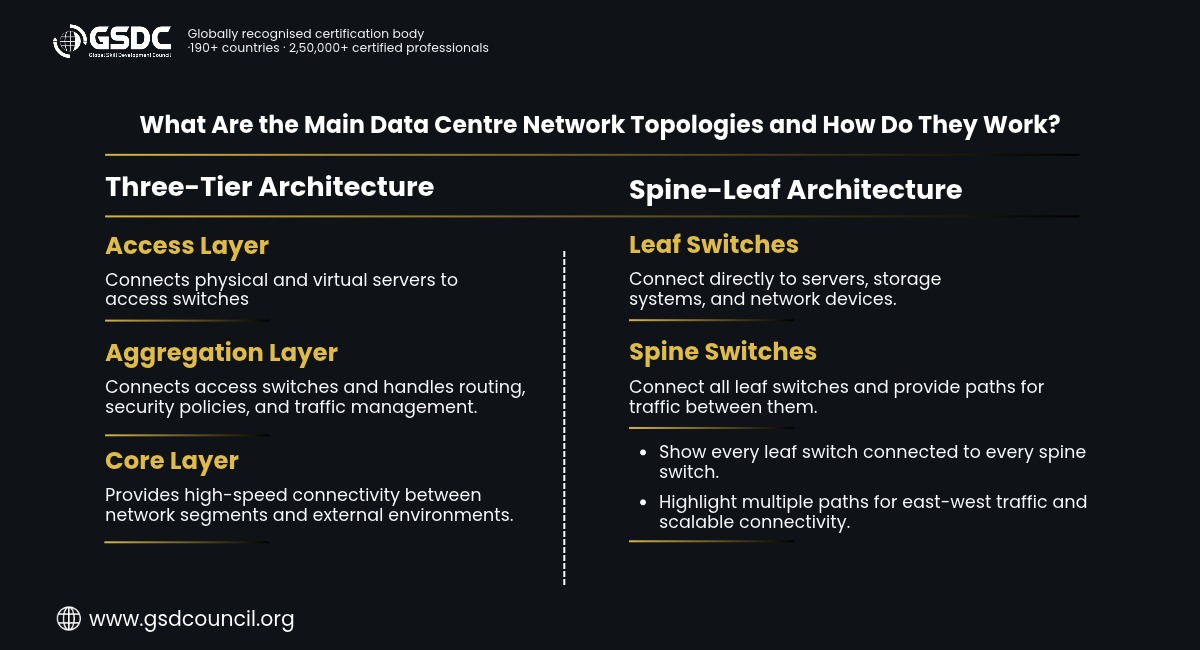
Three-Tier Architecture
A traditional three-tier architecture consists of three layers:
- Access layer: Connects physical and virtual servers to the network.
- Aggregation layer: Connects access switches and provides services such as routing, security policies, and traffic management.
- Core layer: Provides high-speed connectivity between the data centre network, other network segments, and external environments.
Each layer has a defined role, making the architecture suitable for structured enterprise environments. Redundant switches and connections can be deployed at each layer to reduce single points of failure.
Spine-Leaf Architecture
Spine-leaf architecture is commonly used in modern data centres that require predictable connectivity between servers and support for increasing east-west traffic.
It consists of two main layers:
- Leaf switches: Connect directly to servers, storage systems, and other network devices.
- Spine switches: Connect all leaf switches and provide paths for traffic moving between them.
In this design, every leaf switch connects to every spine switch. This creates multiple paths between connected devices and supports traffic distribution across the network.
Spine-leaf is particularly useful for virtualised environments, cloud infrastructure, and high-density data centres. It can also support large-scale enterprise networks where applications exchange significant amounts of data.
The choice between three-tier and spine-leaf architecture should be based on actual workload and operational requirements. A smaller enterprise environment may not need the complexity of a large spine-leaf fabric.
2. Build Redundancy into Critical Network Components
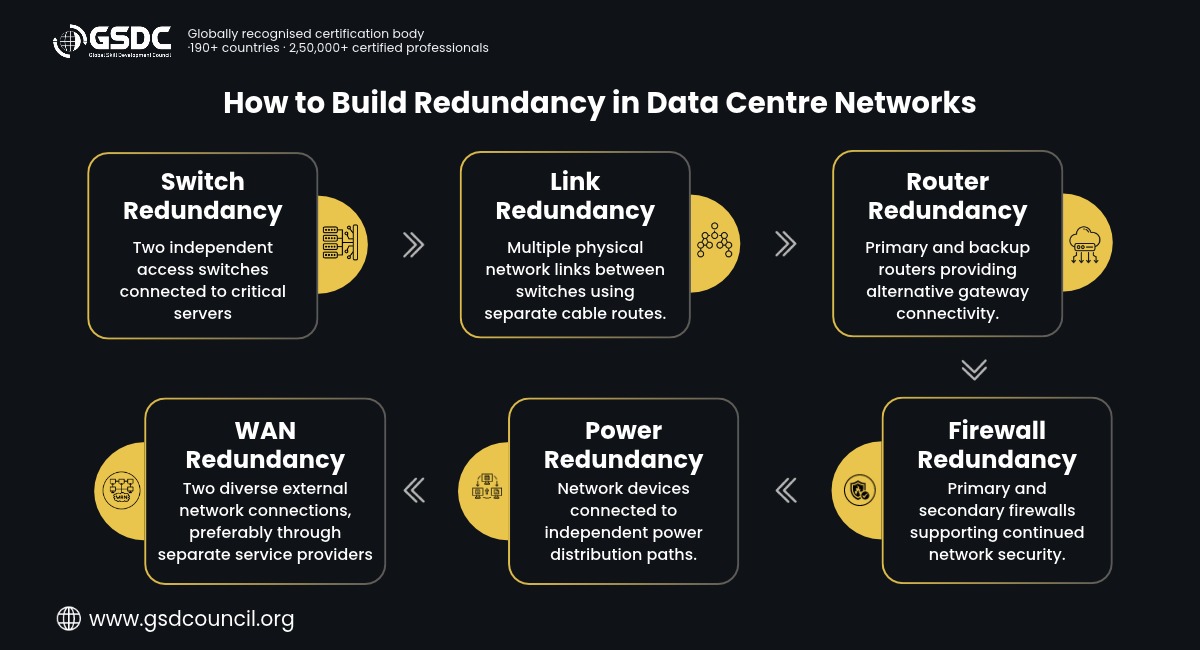
Redundancy is one of the most important elements of resilient data centre network design. It ensures that another device or connection can support network operations when the primary component becomes unavailable. A redundant network design should cover more than switches. It should consider the complete communication path between servers, network devices, and external connections.
Important areas include:
- Switch redundancy: Deploy additional switches so that a single switch failure does not disconnect critical servers.
- Link redundancy: Provide multiple physical connections between network devices to maintain connectivity if one link fails.
- Router redundancy: Use alternative routers or gateways to maintain communication with external networks.
- Power redundancy: Connect critical network equipment to independent power sources or protected power distribution paths.
- WAN redundancy: Use diverse external network connections to reduce dependence on a single service provider or circuit.
For example, an enterprise server connected to only one access switch may lose network connectivity if that switch fails. Connecting the server to two independent switches through separate network interfaces can provide an alternative path.
However, redundancy must be designed carefully. Two links routed through the same physical cable tray or dependent on the same upstream device may still share a common failure point.
3. Design for Network High Availability and Fault Tolerance
Network high availability focuses on keeping services accessible, while network fault tolerance focuses on maintaining operation when a component fails. Both are necessary for enterprise environments where network interruptions can affect business applications, customer services, and internal systems.
A high availability network should include:
Multiple network paths: Critical systems should have alternative routes through the network. Routing protocols and equal-cost multipath routing can help distribute traffic across available paths.
Automatic failover: When a device or connection becomes unavailable, traffic should move to a working path without requiring manual intervention.
Gateway redundancy: Redundant gateway configurations help maintain access to other network segments if the primary gateway fails.
Fast failure detection: Monitoring and network protocols should identify failed links or devices quickly so that traffic can be redirected.
Controlled maintenance: Network upgrades and equipment replacements should be planned so that one component can be maintained while another continues supporting traffic.
Failover should also be tested. A network may appear redundant in its architecture diagram but still experience service interruptions because of incorrect routing, configuration errors, or dependencies between components.
4. Identify and Remove Single Points of Failure
A single point of failure is a component whose failure can interrupt an entire service or communication path. It may exist in the physical network, power infrastructure, software configuration, or management systems.
Consider an enterprise environment where two access switches are installed for redundancy, but both connect to the same upstream switch. If that upstream switch fails, both access paths may become unavailable.
Other common examples include:
- A server connected to only one network switch.
- Multiple network links sharing one physical cable route.
- Redundant routers depending on the same external connection.
- Network equipment connected to a common power distribution unit.
- A shared firewall or load balancer without a backup.
- A management system that cannot be accessed when the production network fails.
To identify these risks, network teams should map critical communication paths and examine the dependencies between components.
They should also review physical routes, power sources, device configurations, and external service connections. The objective is to ensure that backup components do not depend on the same infrastructure they are intended to protect.
5. Strengthen Data Centre Network Security
A resilient network must remain protected while maintaining availability. Security incidents such as unauthorised access, malware, and denial-of-service attacks can disrupt network operations even when the physical infrastructure is functioning correctly. Data centre network security should be included in the initial architecture rather than added after deployment.
Important security practices include:
- Network segmentation: Separate applications, servers, storage systems, and management traffic into controlled network segments.
- Firewalls and access controls: Restrict communication between network zones according to business and application requirements.
- Secure management access: Protect administrative interfaces through strong authentication and restricted access.
- Traffic monitoring: Monitor unusual traffic patterns, unauthorised connections, and suspicious network activity.
- Configuration management: Maintain controlled network configurations and review changes to prevent accidental exposure or disruption.
- Encryption: Protect sensitive information while it moves across networks, particularly between data centres and external environments.
Management traffic should also be separated from normal production traffic wherever possible. An independent out-of-band management network can help administrators access and troubleshoot network equipment even when the production network is unavailable.
6. Use Software-Defined Networking for Greater Flexibility
Software-defined networking (SDN) separates network control functions from the underlying forwarding hardware. It allows administrators to manage network behaviour through software-based controllers and centralised policies.
In traditional networking environments, configuring individual devices can require significant manual effort. SDN provides a more centralised approach to network configuration and management.
In a data centre, SDN can support:
- Centralised network configuration and policy management.
- Automated provisioning of network resources.
- Dynamic traffic management.
- Network segmentation across virtualised environments.
- Faster deployment of new applications and services.
- Consistent configuration across multiple network devices.
SDN can also support network automation, reducing repetitive configuration tasks and helping teams manage large infrastructure environments.
However, the SDN control plane itself needs to be designed for resilience. Controllers, management interfaces, and supporting services should have appropriate redundancy and recovery arrangements.
7. Plan Network Capacity for Enterprise and AI Workloads
Network design must account for both current traffic and future workload requirements. A network that has sufficient capacity today may become a bottleneck as an organisation adds servers, storage, applications, and new computing environments.
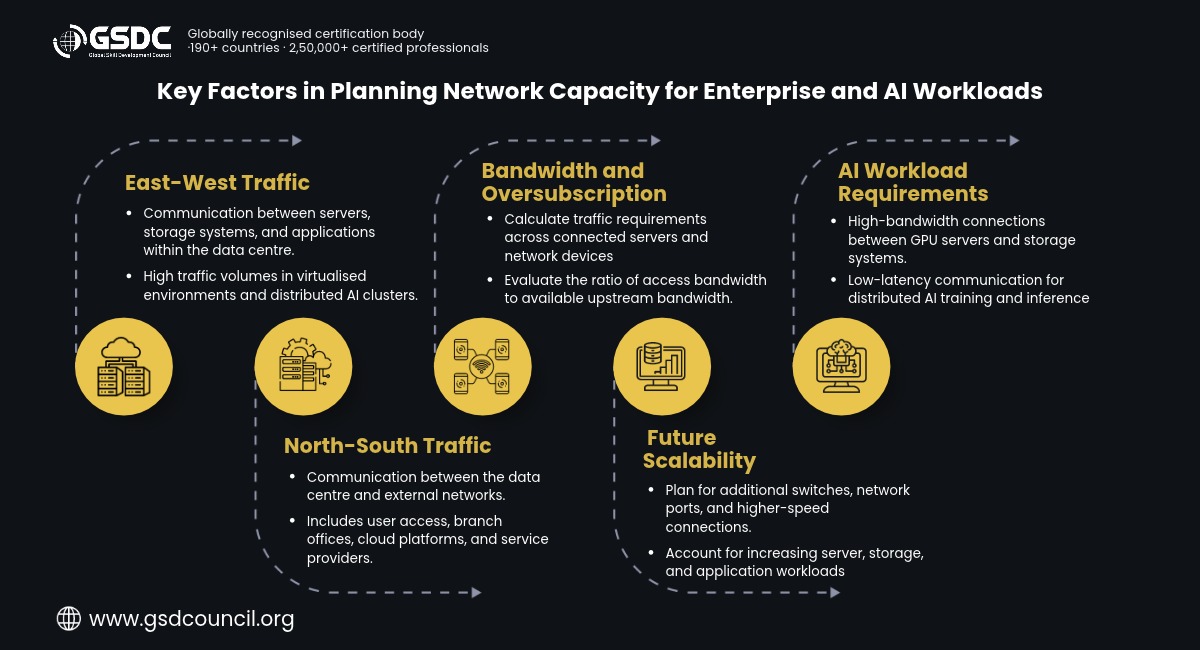
Capacity planning should consider:
Bandwidth requirements: Estimate the traffic generated by applications, database operations, storage systems, backups, and user access.
East-west traffic: Account for communication between servers and applications within the data centre. Virtualised and distributed environments can generate significant internal traffic.
North-south traffic: Plan for communication between the data centre and external networks, including users, branch offices, cloud platforms, and service providers.
Oversubscription: Review the ratio between available upstream bandwidth and the combined bandwidth of connected devices. High oversubscription can create congestion when many systems transmit data simultaneously.
Future expansion: Allow room for additional switches, network ports, higher-speed connections, and new workloads.
AI data centre networking introduces additional requirements. Distributed AI training and inference can involve large volumes of data moving between GPU servers, storage systems, and compute nodes. These workloads may require high-bandwidth, low-latency connections and careful management of congestion.
Network teams may need to evaluate high-speed Ethernet fabrics, specialised interconnects, and traffic management capabilities according to the AI workload. The requirements of a large distributed training cluster are different from those of a typical enterprise application environment.
8. Monitor Network Performance and Test Recovery
Even a well-designed network needs continuous monitoring. Performance issues, hardware degradation, configuration changes, and unexpected traffic patterns can affect availability over time. Network monitoring helps teams identify problems before they develop into larger service interruptions.
Important areas to monitor include:
- Link utilisation and bandwidth consumption.
- Packet loss, latency, and network jitter.
- Switch and router health.
- Interface errors and connection failures.
- Routing changes and failover events.
- Unusual traffic patterns and security alerts.
Network teams should also maintain an incident response and testing process. This includes checking whether redundant paths work as expected, testing device failover, reviewing recovery procedures, and documenting the results.
A practical resilience test could involve taking one network link out of service during a controlled maintenance window. The team can then verify whether traffic moves through the alternative path, whether applications remain accessible, and whether monitoring systems report the event correctly.
Testing should cover different failure scenarios, including device outages, link failures, configuration errors, and loss of external connectivity.
Common Mistakes in Data Centre Network Design
Even when organisations invest in modern network equipment, certain design and operational mistakes can weaken resilience.
Common mistake | Why it creates a problem |
| Depending on a single network path | A link or device failure can interrupt connectivity. |
| Treating redundancy as device duplication | Backup devices may still share the same power, cabling, or upstream dependency. |
| Ignoring east-west traffic | Internal application communication can create congestion. |
| Overlooking network security | Unauthorised access or attacks can affect critical services. |
| Underestimating future capacity | Additional workloads can exceed available bandwidth. |
| Not testing failover | Backup paths may not work as expected during an actual incident. |
| Poor configuration management | Inconsistent changes can cause outages and troubleshooting difficulties. |
A resilient design requires regular reviews of both the architecture and its actual operating conditions.
How to Assess an Enterprise Data Centre Network Design
Before implementing or upgrading a network, organisations should evaluate whether the proposed architecture meets their operational requirements.
A practical assessment should cover the following areas:
- Business and application requirements: Identify critical applications, availability expectations, traffic patterns, and dependencies.
- Existing network architecture: Review topology, switches, routers, gateways, firewalls, and external connections.
- Failure points: Identify components and shared dependencies that could interrupt critical services.
- Redundancy and failover: Check whether alternative paths and devices can support operations during failures.
- Security controls: Evaluate segmentation, access policies, monitoring, and management network isolation.
- Capacity and scalability: Assess current bandwidth, utilisation, oversubscription, and future expansion needs.
- Monitoring and recovery: Confirm that the network can be monitored, tested, maintained, and recovered effectively.
This assessment helps network and data centre teams identify design gaps before they affect enterprise operations.
Develop Your Data Centre Knowledge with GSDC Certification
Managing a resilient data centre requires an understanding of how different infrastructure components work together. Network connectivity, power distribution, cooling, capacity planning, redundancy, and operational practices all contribute to reliable data centre operations.
The GSDC Data Centre Professional Certification is designed for professionals who want to develop their knowledge of data centre infrastructure and operations.

Through this certification, professionals can build knowledge of:
- Data centre infrastructure, components, and operational practices.
- Network connectivity, power distribution, and cooling systems.
- Capacity planning, redundancy, and infrastructure management.
- Data centre efficiency, maintenance, and operational requirements.
Explore the GSDC Data Centre Professional Certification.
Conclusion
A resilient data centre network requires more than high-performance switches and additional connections. It depends on how the entire network is designed, secured, monitored, and maintained.
Choosing a suitable topology, removing single points of failure, implementing redundant paths, and planning for future capacity help organisations maintain connectivity during unexpected events. Regular failover testing and network monitoring are equally important because they show whether the architecture performs as expected under real operating conditions.
As enterprise applications and AI workloads continue to evolve, data centre network design must support changing traffic patterns without compromising availability, security, or performance.

Related Certifications
Frequently Asked Questions
Data centre network design is the process of planning how servers, switches, routers, storage systems, and other infrastructure components connect and communicate. It defines the network topology, traffic paths, security controls, redundancy, and capacity required to support data centre operations.
The best topology depends on the size and requirements of the environment. Three-tier architecture is used in many traditional enterprise environments, while spine-leaf architecture is common in modern data centres that require scalable, high-bandwidth connectivity between servers.
AI workloads increase the need for high-bandwidth, low-latency connectivity between GPU servers, storage systems, and compute infrastructure. Distributed AI training can generate substantial east-west traffic, making network capacity, congestion management, and scalable network fabrics important design considerations.
Network testing should be part of regular maintenance and change management. Organisations should test failover paths, review configurations, monitor network performance, and conduct controlled recovery exercises. Testing frequency should reflect infrastructure criticality, operational risk, and business requirements.
Network security protects servers, applications, data, and management systems from unauthorized access and malicious activity. Segmentation, firewalls, access controls, encryption, and continuous monitoring help reduce security risks and support reliable operations.
Stay up-to-date with the latest news, trends, and resources in GSDC
If you like this read then make sure to check out our previous blogs: Cracking Onboarding Challenges: Fresher Success Unveiled
Not sure which certification to pursue? Our advisors will help you decide!