The Future of Cybersecurity: Key Trends Shaping 2026 and Beyond
Written by Emily Hilton
- What’s In Discussion Right Now?
- 1. AI and Automation: Redefining Cyber Defense
- 2. Zero Trust and Identity-First Security Models
- 3. Evolving Threat Landscape
- 4. Regulatory and Compliance Pressures
- 5. Economic Impact and Market Outlook
- 6. The Role of Cybersecurity Certifications
- Conclusion: Strategic Priorities for 2026 and Beyond
The digital transformation that has characterized this era has also made cybersecurity a business strategy rather than a tech problem that was kept inside a company's technology department. To stay protected, organizations need to go beyond the traditional ways of defense since cyber threats are already pushing themselves to the extreme and digital connectivity is all-pervasive.
Heading into 2026 and beyond, the future of the cybersecurity industry is being shaped by artificial intelligence, advanced threat actors, regulatory pressures, and a growing demand for skilled security professionals. This report presents the most powerful trends, backed by data, expert consensus, and technology insights, that will determine the cybersecurity of the future.
What’s In Discussion Right Now?
Global information security expenditures will reach US$213 billion in 2025 and continue to grow to about US$240 billion in 2026. Meanwhile, research suggests that human mistakes account for as much as 95% of data breaches. You will find a graph below that shows breach trends rising across different industries.
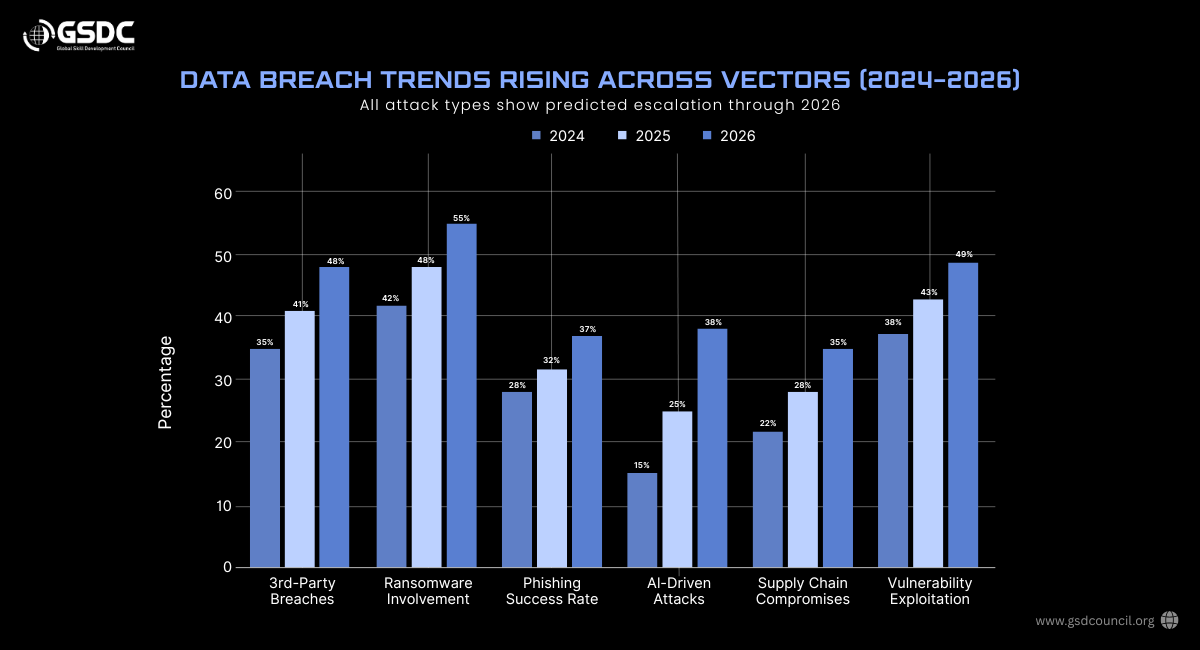
The trend is quite obvious: the investments in cybersecurity solutions are increasing, but the threats are getting even more difficult to handle. If you are looking at a cybersecurity service, talking to cybersecurity consultants, or hiring a professional for managed cybersecurity services, you'd better choose to be with the future.
According to the most recent forecast by Gartner, global end-users' expenditure on information security will be $213 billion by 2025, which would be $193 billion in 2024, and this would mean a growth of 10.4 percent. It is expected that cybersecurity expenditure would increase by 12.5 percent in 2026, to a total of $240 billion.
1. AI and Automation: Redefining Cyber Defense
One of the most frequently asked questions today is what is future of AI in cybersecurity? AI is rapidly transforming both offensive and defensive security strategies. Cybercriminals are leveraging AI to automate phishing attacks, generate deepfake impersonations, and scan systems for vulnerabilities at unprecedented speed. At the same time, organizations are adopting AI-driven security platforms to detect anomalies, predict threats, and respond in real time.
Industry reports highlight that AI-based threat detection can cut breach identification time by more than 50%. This trend clearly reflects how future cybersecurity trends are moving toward proactive and predictive defense models rather than reactive approaches.
However, the rise of AI also introduces governance challenges. Ethical AI use, model transparency, and protection against adversarial AI attacks will be central to answering what is future of AI in cybersecurity? for enterprises and regulators alike.
This development mirrors broader top cybersecurity trends, where proactive and predictive defense models are steadily replacing reactive approaches.
2. Zero Trust and Identity-First Security Models
As hybrid work, cloud computing, and SaaS adoption expand, traditional perimeter-based security is no longer sufficient. Zero Trust Architecture (ZTA) is becoming a cornerstone of the future of the cybersecurity industry. This approach continuously verifies users, devices, and applications, assuming no implicit trust within the network.
Identity is now the primary attack vector, making identity-first security a major component of future cybersecurity trends. Continuous authentication, behavioral analytics, and privileged access management are increasingly critical. According to recent industry data, organizations that fully implement Zero Trust experience significantly fewer data breaches compared to those relying on legacy models.
This shift is also influencing professional roles, especially for the cybersecurity analyst, who must now understand identity systems, cloud security, and access governance in addition to traditional network defense.
3. Evolving Threat Landscape
3.1 Ransomware and Targeting
Ransomware remains a dominant threat, but it’s changing:
- 59% of organizations experienced a ransomware attack in 2024.
- Ransomware remains a peak threat vector, involving 44% of breaches in early 2025.
- Attacks on small and midsize businesses often under-protected accounted for 45% of all cyberattacks in 2025.
3.3 Human Factor
- 68% of breaches in 2024 were linked to human error, including social engineering.
- 94% of businesses experienced phishing attacks in 2024.
These trends reaffirm that while technology remains critical, the human element still represents a major security risk, one that significantly influences future cybersecurity trends.
4. Regulatory and Compliance Pressures
In response to rising threats and costs, governments worldwide are tightening regulations. Regulations such as the EU’s NIS2 Directive and banking-sector security standards require faster reporting and stronger controls.
This regulatory evolution pushes organizations to embed security into governance, risk management, and compliance functions, particularly as boards increase cybersecurity oversight and organizations link governance to cyber insurance.
5. Economic Impact and Market Outlook
Cybercrime continues to impose enormous financial costs on the global economy. Estimates project cybercrime damages to reach trillions of dollars annually by the end of the decade. As a result, cybersecurity spending is increasing across all sectors, from SMEs to large enterprises.
This investment surge directly benefits professionals in the field, driving higher cybersecurity salary benchmarks and sustained demand for skilled talent. For organizations, cybersecurity is no longer viewed as a cost center but as a strategic investment in resilience and trust.6. The Role of Cybersecurity Certifications
Cybersecurity is a field that most importantly undergoes a lot of changes, and therefore, structured learning is indispensable. A cybersecurity foundation certification serves as proof of skill and knowledge in specific areas like cloud security, threat intelligence, governance, and incident response. Additionally, certifications provide support for career growth by increasing trustworthiness and employability.
For professionals specifically targeting AI-driven defense roles, the GSDC AI cybersecurity certification roadmap provides a structured, step-by-step path from foundational CGAIC certification through to specialised AI SOC Analyst, GenAI Red Teamer, AI Security Engineer, and AI Governance Lead tracks.
It is thought that the prospective or current expert side of the profession can be directly influenced by the cybersecurity certification in terms of career growth and income. Researches reveal that certified professionals are usually paid more in the cybersecurity field than their non-certified counterparts, particularly in the case of specialized roles.
Certified professionals are paid more in cybersecurity, particularly in specialised AI roles the GSDC best ai cybersecurity certification (CGAIC) adds $30–50K annually over non-certified peers at the same experience level, based on 2026 salary data from Glassdoor, ZipRecruiter, and Levels.fyi.
Certified professionals are paid more in cybersecurity, particularly in specialised roles and the GSDC best ai cybersecurity certification for hands-on learners is CGAIC, which goes beyond theory to have candidates build 12 production-grade AI security tools including agentic pipelines, GAN detectors, and OWASP LLM audit kits.
Conclusion: Strategic Priorities for 2026 and Beyond
The future of cybersecurity is driven by innovation, integration, and resilience as we move closer to 2026. The following are the main imperatives:
- AI's capability to not only predict but also defend against threats will be the major factor that will not only secure its position as a tool in the future of AI in cybersecurity, but also make it a part of the risk strategy.
- Zero Trust and identity-centric controls will be implemented in companies' security frameworks to lower the risk of vulnerabilities posed by the ever-increasing attack surfaces.
- The presence of highly skilled professionals, particularly cybersecurity analysts with specialized training, is viewed as a major factor in a company's ability to effectively defend itself.
- Companies will need to put a significant amount of resources into certification programs that will not only prove the validity of the experts' skills but will also facilitate career growth.
The security strategy will have to be in sync with the regulatory requirements, governance mechanisms, and overall organizational goals. Organizations and professionals who will choose the right path today will be the ones to create the next trends of cybersecurity, thus securing digital trust and business resilience as far as 2030.

Related Certifications
Stay up-to-date with the latest news, trends, and resources in GSDC
If you like this read then make sure to check out our previous blogs: Cracking Onboarding Challenges: Fresher Success Unveiled
Not sure which certification to pursue? Our advisors will help you decide!