Workplace Coaching: Empowering Employees Through Mentorship Strategies

Written by Matthew Hale
- The Common Leadership Instinct
- From Fixing Problems to Growing People
- Coaching vs Mentoring – Understanding the Difference
- A Simple Coaching Framework
- Key Principles of Effective Coaching
- How Coaching Empowers Employees
- Building a Coaching Culture
- Increasing Coaching Talent Through Certification
- Final Thoughts
- Frequently Asked Questions (FAQs)
Modern workplaces are fast-paced, complex, and constantly evolving. Leaders and managers are expected to solve problems quickly, deliver strong results, and keep their teams engaged and motivated.
But many organizations face a hidden challenge today: employees are becoming increasingly dependent on leaders to think and decide for them. This often happens because leaders focus on providing quick solutions instead of helping employees develop the ability to solve problems on their own.
That is why workplace coaching and workplace mentorship have become essential tools. Understanding what is coaching and mentoring in the workplace is critical for leaders who want sustainable performance. Coaching in the workplace empowers employees to think independently, grow professionally, and perform with greater confidence and ownership.
The Common Leadership Instinct
Imagine a team member comes to you with a problem. Most leaders naturally:
- Give immediate advice
- Offer ready-made solutions
- Tell the employee exactly what to do
This approach feels fast and efficient. The problem gets solved quickly, and work moves ahead.
But there is a hidden downside. When answers always come from the manager, employees stop thinking for themselves. Over time, they begin to wait for instructions instead of using their own judgment.
This is where employee coaching and coaching employees to improve performance become important. What looks like effective leadership today can limit employee growth tomorrow.
From Fixing Problems to Growing People
Great leaders understand one powerful truth: Their job is not to solve every problem.
Their real job is to develop people who can solve problems themselves. This is exactly what workplace coaching achieves and why many organizations ask, what is workplace coaching?
Traditional management focuses on fixing issues quickly. Coaching in the workplace focuses on building people who can handle issues confidently and independently. It is one of the most practical employee development strategies available to modern organizations.
Through structured coaching in the workplace, employees learn to:
- Think critically about their responses before they respond to situations
- More clearly and deeply understand an issue or problem
- Think through many alternatives by themselves
- Take responsibility for their own decisions
- Create a lasting sense of confidence and ability to perform at a high level
- Improve their ability to communicate and collaborate with others
- Be proactive, as opposed to reactive
These benefits of workplace coaching demonstrate the value of coaching in general, as well as the value of mentoring in the workplace, and demonstrate that there is value to both types of non-cash remuneration.
The inability of coaches to give answers limits employees' understanding of how they can develop their own answers. As a result, the employee has a higher quality relationship with their fellow co-workers, has improved ability to work through challenges, and has become a more independent professional.
What Coaching Really Means
Coaching is often misunderstood in the workplace. Many people ask:
- What is coaching in the workplace?
- What is workplace coaching?
Workplace coaching is not a training program or just an HR initiative. It is a structured leadership habit focused on developing thinking.
True coaching does not create dependence. It creates confident and capable professionals through structured conversations, sometimes referred to as a simple coaching structure.
Coaching vs Mentoring – Understanding the Difference
Coaching and mentoring are both essential for employee development, but they are not the same.
Many leaders look for clear coaching vs mentoring examples to understand the distinction.
Mentoring focuses on guidance and experience-sharing. Coaching focuses on developing thinking and independence.
Here is a clearer comparison:
|
Aspect |
Mentoring |
Coaching |
|
Primary Focus |
Sharing knowledge and experience |
Developing thinking and problem-solving |
|
Purpose |
Guide someone through a role or task |
Help employees find their own solutions |
|
Best Used When |
A person is new or needs direction |
Problems are complex or unclear |
|
Approach |
Telling and advising |
Asking and exploring |
|
Role of the Leader |
Expert and guide |
Facilitator and thought partner |
|
Outcome |
Faster learning and onboarding |
Stronger judgment and confidence |
|
Dependency Level |
Can create some dependence |
Builds independence |
|
Type of Support |
Step-by-step guidance |
Question-based support |
|
Communication Style |
Directive |
Collaborative |
|
Skill Developed |
Technical and role-based skills |
Critical thinking and ownership |
|
Time Horizon |
Short-term, task-focused |
Long-term, growth-focused |
|
Decision Making |
The mentor often gives answers |
Employee makes decisions |
Effective leaders do not choose between coaching or mentoring; they use both at the right time.
Understanding what mentoring is in the workplace helps clarify when guidance is needed. Mentoring helps employees learn faster, while coaching builds independent judgment.
A Simple Coaching Framework
Coaching can be simple and not time-consuming.
Leaders can coach effectively with an easy, practical method called the FOCUS Framework.
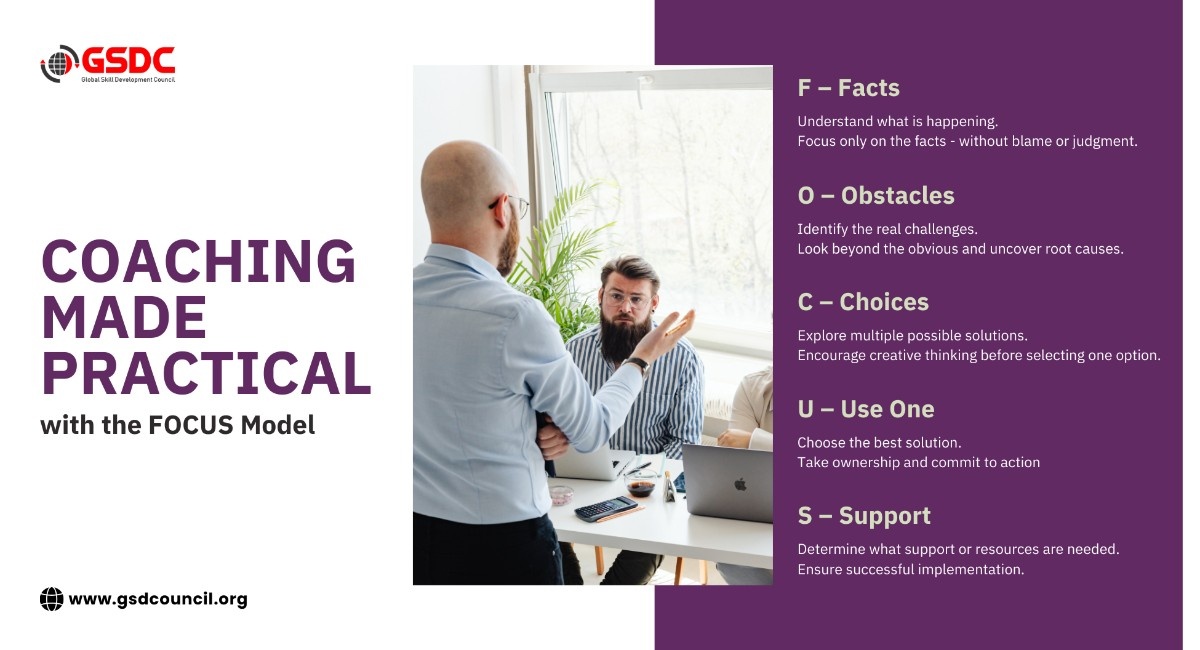 FOCUS helps employees think about their challenges using this structured approach:
- F – Facts: Understand the facts of the situation clearly. Do not use blame or judgment; focus only on what is happening.
- O – Obstacles: Identify the real obstacles and challenges. Help employees to see beyond the obvious to find out what is happening, and help them to think creatively to see multiple ways to resolve their issue.
- C – Choices: Identify multiple options for resolving the issue based on your creative thinking from above. Rather than rushing to a quick answer, help the employee develop several alternatives.
- U – Use One: Choose the best alternative or choice to make a plan for resolving the issue and take responsibility for it. Empower employees with ownership and trust.
- S – Support: Identify the support or resources that will assist the employee in successfully resolving the issue.
Using this basic step-by-step framework will help employees slow down to think through their issues logically, become independent problem solvers, and give you multiple coaching opportunities every day in casual conversations.
Key Principles of Effective Coaching
For coaching to truly work, leaders must follow a few essential principles.
- Leaders must avoid judging employees so they feel safe to think and speak openly.
- Employees should be treated as learners, not as problems to be fixed.
- Coaches must ask open-ended questions to encourage deeper thinking.
- Leaders should listen more than they talk during coaching conversations.
- Trust and confidentiality must be maintained at all times.
- Employees should be allowed to define their own challenges and solutions.
When these principles are followed, coaching becomes a powerful tool for real employee growth and development.
A Real-World Leadership Example
At Microsoft, CEO Satya Nadella encouraged leaders to shift from a “Know-It-All” to a “Learn-It-All” mindset — a philosophy he discusses in his book Hit Refresh (2017). Leaders were trained to ask better questions, listen deeply, and pause before reacting. This coaching-based approach helped create a culture of curiosity, collaboration, and independent thinking.
How Coaching Empowers Employees
When coaching becomes part of everyday leadership behavior:
- Decision-making improves as employees learn to analyze problems and choose solutions independently.
- Confidence increases because people trust their own thinking and abilities.
- Ownership becomes stronger when employees feel responsible for the decisions they make.
- Creativity expands as teams are encouraged to explore ideas instead of following instructions.
- The development of problem-solving skills occurs through the use of reflective practices and structured questions.
- Increasingly, effective reasoning is translated into communication, resulting in greater clarity of communication between employees and their audience.
- As teams gain self-direction, they have less reliance on their managers for day-to-day direction.
Employees who are coached develop into confident professionals with the ability to think, make decisions, and act independently.
Building a Coaching Culture
A coaching culture doesn’t require big budgets or complex programs. It requires consistent leadership behavior.
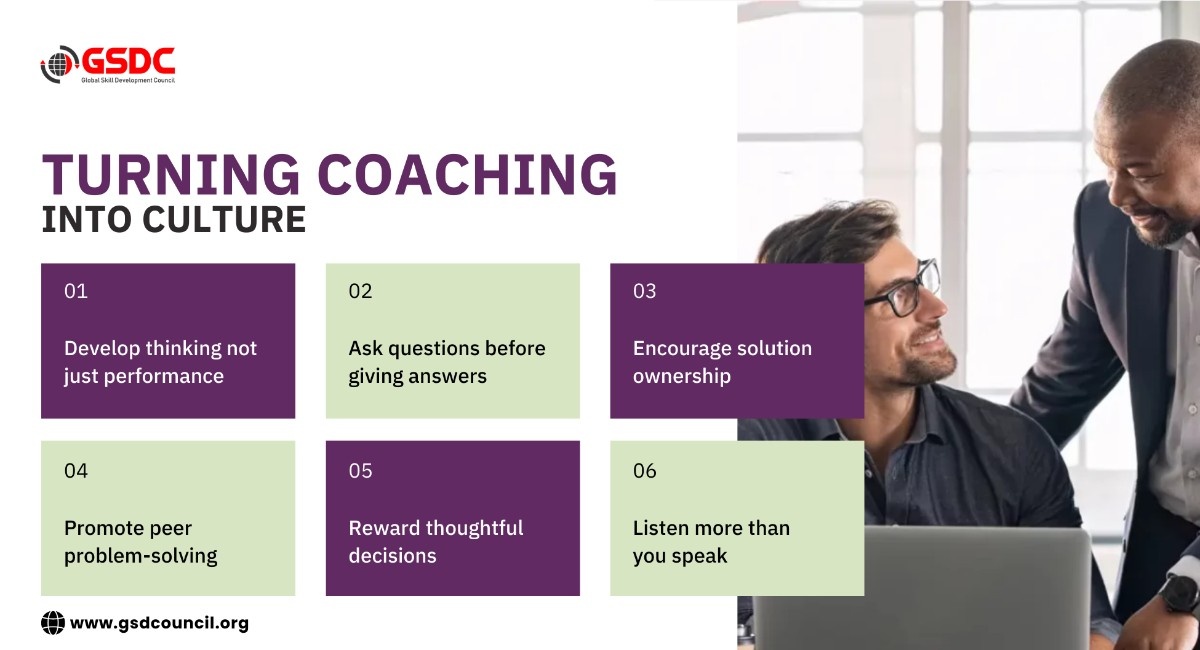 Organizations can start by:
- Teaching leaders that coaching develops thinking, not just performance
- Encouraging question-based conversations instead of quick fixes
- Asking employees to propose solutions before escalating problems
- Promoting peer-to-peer problem-solving across teams
- Rewarding thoughtful decision-making - not just results
- Training managers to listen more than they speak
When these habits become routine, coaching stops being an HR initiative and becomes the way work gets done.
Practical Coaching Habits for Leaders
Leadership will not require specialized tools to begin developing their leadership through coaching. Small, everyday changes result in long-term impact.
- Slow down; listen first before giving advice.
- Ask, "What do you think?" before presenting solutions.
- Allow employees to create options before presenting your opinion.
- Do not make quick assumptions; allow for time to think it over.
- Give people ownership by allowing them to decide.
- Support but don’t micromanage.
- Build self-esteem and confidence
Consistent, small coaching moments build confident, independent teams over time.
Increasing Coaching Talent Through Certification
Coaching is a complex process. To build effective coaching practices in the workplace, we need established methodologies. The Global Skill Development Council (GSDC) has developed the Certified Learning and Development Professional (CLDP) certification to give leaders practical models of how to use coaching effectively as part of developing employees and impacting performance-based employee development strategies.
Because coaching has become a growing area of focus, individuals who are certified have the potential to create consistent and scalable effects on all teams.

Final Thoughts
Coaching in the workplace is more about having a basic mindset change of thinking differently about how we approach issues. Rather than saying, "I will solve this for you" we need to say, "How can I help you to solve this for yourself?" This small change in approach can greatly affect employee development and performance.
When coaching and mentoring are done effectively, employees are empowered to be more confident, self-directed, and accountable. They are able to develop critical thinking skills, be accountable for their decisions, and have the ability and confidence to tackle problems on their own.
Organizations that build a coaching culture do not just create better managers they create better thinkers. And empowered thinkers are the greatest asset any organization can have.
Frequently Asked Questions (FAQs)
1. What is workplace coaching?
Workplace coaching is a structured leadership approach that helps employees improve performance, think independently, and take ownership of decisions. Coaching in the workplace focuses on long-term capability rather than quick fixes.
2. What is coaching in the workplace?
Coaching in the workplace is a conversation-based method where leaders use questions and guided thinking to develop employee problem-solving skills, accountability, and confidence.
3. What is mentoring in the workplace?
Mentoring in the workplace is a professional relationship where experienced individuals share knowledge, insights, and guidance to support career growth and development.
4. What are the types of coaching in the workplace?
The types of coaching in the workplace include employee performance coaching, developmental coaching, skills-based coaching, and executive coaching for leaders. These different types of coaching in the workplace address various growth needs.
5. What are the benefits of coaching and mentoring in the workplace?
The benefits of coaching and mentoring in the workplace include improved performance, stronger accountability, better communication, and increased employee confidence.

Related Certifications
Stay up-to-date with the latest news, trends, and resources in GSDC
If you like this read then make sure to check out our previous blogs: Cracking Onboarding Challenges: Fresher Success Unveiled
Not sure which certification to pursue? Our advisors will help you decide!