Prompt Engineering Techniques: A Practical Guide for AI Users
Written by Matthew Hale
- What Is Prompt Engineering?
- How Does Prompt Engineering Work?
- Prompt Engineering Techniques List
- Latest Prompt Engineering Techniques 2026
- Prompt Engineering Tips for Better AI Results
- Career Opportunities and the Importance of Prompt Engineering Skills
- Development of Industry-Ready Skills in Prompt Engineering
- Conclusion
From drafting emails, generating social media posts, to answering questions and summarizing reports, AI tools have become part of everyday work. However, many users quickly realize that simply asking a question does not always produce the best answer.
The way you write the prompt matters. This is where prompt engineering techniques come into play.
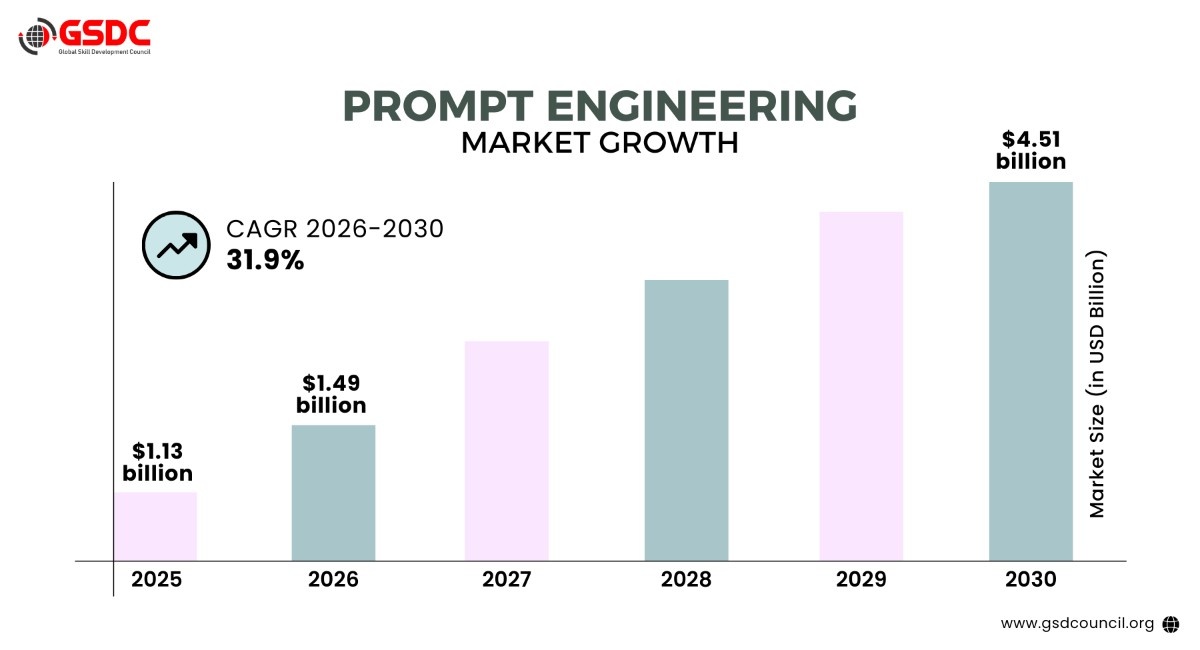
As generative AI adoption grows, the demand for prompt engineering skills is rising rapidly. Industry research estimates the global prompt engineering market will grow from $1.13 billion in 2025 to about $4.51 billion by 2030, at a CAGR of 31.9%.
Prompt engineering is the practice of designing clear instructions that guide the AI model to generate accurate and useful responses.
In this blog, we’ll explore what are the prompt engineering techniques, review a practical prompt engineering techniques list, and share useful prompt engineering tips to help you get better results from AI tools.
What Is Prompt Engineering?
Prompt engineering is all about the way you ask questions. This is about writing instructions that are clear and unambiguous and can guide the AI tools to perform better. The more information you provide, the better you can ask questions, and the more accurate the results will be.
As generative AI tools become more widely used, learning how to prompt engineers effectively is becoming an important skill for professionals across many industries.
How Does Prompt Engineering Work?
To understand its importance, it is first necessary to have a basic understanding of how prompt engineering works. This is because, in AI models, they analyze the prompt and create answers based on patterns they have learned from huge sets of data, and as such, the quality of the prompt has a significant bearing on the quality of the results. Therefore, with more precise prompts, prompt engineering improves the results.
Prompt engineering improves results by giving clearer instructions and context to the AI.
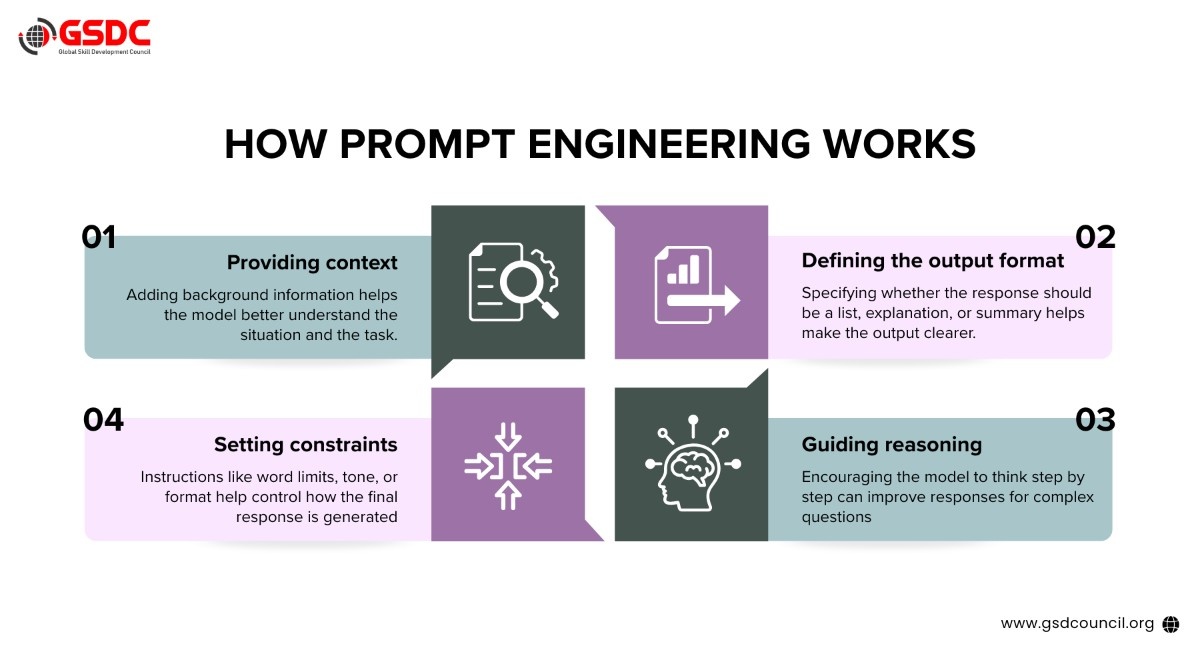
These methods form the foundation of best prompt engineering practices. As demand for AI skills grows, many professionals are also exploring programs such as the Certified Prompt Engineering Certification to develop practical expertise in applying prompt engineering techniques.
Prompt Engineering Techniques List
There are a number of well-known prompt engineering techniques that help in a more effective response from the model to a prompt. The following is a brief overview of some of these well-known techniques in a free form is given below.
| Technique | What It Does | When to Use It | Example Prompt |
| Zero-Shot Prompting | The model is asked to perform a task without any examples. | Suitable for a simple task. | “Explain the benefits of cloud computing for startups.” |
| Few-Shot Prompting | A few examples are given on how the answer should be. | When you want a consistent output. | Example: Q → A Example: Q → A Now answer: ... |
| Chain-of-Thought Prompting | The model is encouraged to think through its reasoning. | Suitable for complex tasks. | “Explain the reasoning step by step before giving the final answer.” |
| Role-Based Prompting | A role or expertise is given to the model. | When responses require a specific perspective. | “Act as a cybersecurity expert and explain how phishing attacks work.” |
| Instruction-Based Prompting | Clearly defines the task and output format. | When structured responses are needed. | “Summarize the following article in five bullet points.” |
The above techniques form a number of best prompt engineering practices for generative AI models. Organisations like the Global Skill Development Council (GSDC) offer professional courses in prompt engineering and generative AI.
Example: How to Prompt Engineer Effectively
Understanding how to prompt engineer can be achieved with the help of an example when you compare a vague prompt with a more precise one.
- Vague Prompt: Explain what artificial intelligence is.
- Precise Prompt: Explain what artificial intelligence is. Explain it to a beginner in 5 bullet points using simple real-world examples.
The precise prompt is effective because it identifies the audience, the form, and the type of explanation expected. These kinds of small changes can make a huge difference in AI results and are among the best pieces of advice for prompt engineering.
Latest Prompt Engineering Techniques 2026
As AI models are continually improved, new methods are being discovered to improve the models' precision and ability to reason. Some of the latest prompt engineering techniques 2026 include:
Multi-Step Prompting
This method involves splitting complex tasks into smaller parts so that the AI model can perform the complex tasks more accurately.
Self-Consistency Prompting
This method involves creating different reasoning paths, then choosing the most consistent final answer.
Retrieval-Augmented Prompting
Using external sources of information in order to improve the precision of the model.
Structured Prompt Templates
Using templates in order to improve the precision of the model.
These are the latest and most prominent techniques in the field of prompt engineering.
Prompt Engineering Tips for Better AI Results
If you are new to using AI tools, there are several prompt engineering tips you can use to improve the results you receive. Here are the basic tips:
1. Be specific
Being very detailed in your prompts is important so that the AI can understand what is required. The more detailed your prompt, the better your response.
2. Provide context
Adding background information or explaining the task helps the model understand the situation and generate more accurate answers.
3. Define the output format
Mentioning the format, such as a list, paragraph, table, or summary, helps guide the structure of the response.
4. Test and refine prompts
Prompt engineering often requires experimentation. Adjusting the wording or structure of a prompt can lead to better results.
5. Use examples when possible
Providing examples, also known as few-shot prompting, helps the AI understand the expected style or format of the output.
Professionals who consistently apply these prompt engineering techniques gradually develop stronger prompt engineering skills and achieve more reliable AI results.
Career Opportunities and the Importance of Prompt Engineering Skills
With the growing use of generative AI technology in the industry, the skill of prompt engineering is becoming increasingly important in many fields. Organizations are looking for professionals who are well aware of the technology and can use the skills of prompt engineering to improve the results.
Professionals can use the skills of prompt engineering by studying the various techniques involved in the field. The growing demand for the skill has encouraged many people to seek the average pay for a prompt engineer.
Prompt Engineering Career Path and Salary
| Role / Designation | Typical Responsibilities | Average Annual Salary (USD) |
| Junior Prompt Engineer | Write and test the prompts. | $80,000 – $100,000 |
| Prompt Engineer | Design complex prompts and improve the workflows. | ~$122,000 |
| Senior Prompt Engineer | Oversee the development and implementation of complex prompts and create AI-powered solutions. | $130,000 – $170,000+ |
| AI Engineer / Generative AI Specialist | Create AI systems and implement the skill of prompt engineering. | $140,000 – $180,000+ |
As AI continues to expand across industries, professionals who understand prompt engineering techniques will have strong career opportunities in the evolving AI ecosystem.
Development of Industry-Ready Skills in Prompt Engineering
With the advent of generative AI technology, professionals who are aware of the skills in prompt engineering techniques are more likely to leverage the power of generative AI tools and increase productivity at work.
For professionals who want to develop skills in this area, there are several resources available in the industry. The Global Skill Development Council (GSDC) has launched the Certified Prompt Engineering Certification program.
This program aims to demystify the concept of prompt engineering and apply the concept of prompting in the real world.

Conclusion
It is more important than ever for people using generative AI technologies to be proficient in the use of prompt engineering techniques as the technology continues to grow. It is important for people to understand the concept of prompt engineering and the tips involved in the field.
Professionals who are proficient in the use of prompt engineering techniques are more likely to take advantage of the opportunities offered by the technology. People who want to improve their knowledge in the field can consider enrolling in a prompt engineering certification program.

Related Certifications
Frequently Asked Questions
Stay up-to-date with the latest news, trends, and resources in GSDC
If you like this read then make sure to check out our previous blogs: Cracking Onboarding Challenges: Fresher Success Unveiled
Not sure which certification to pursue? Our advisors will help you decide!