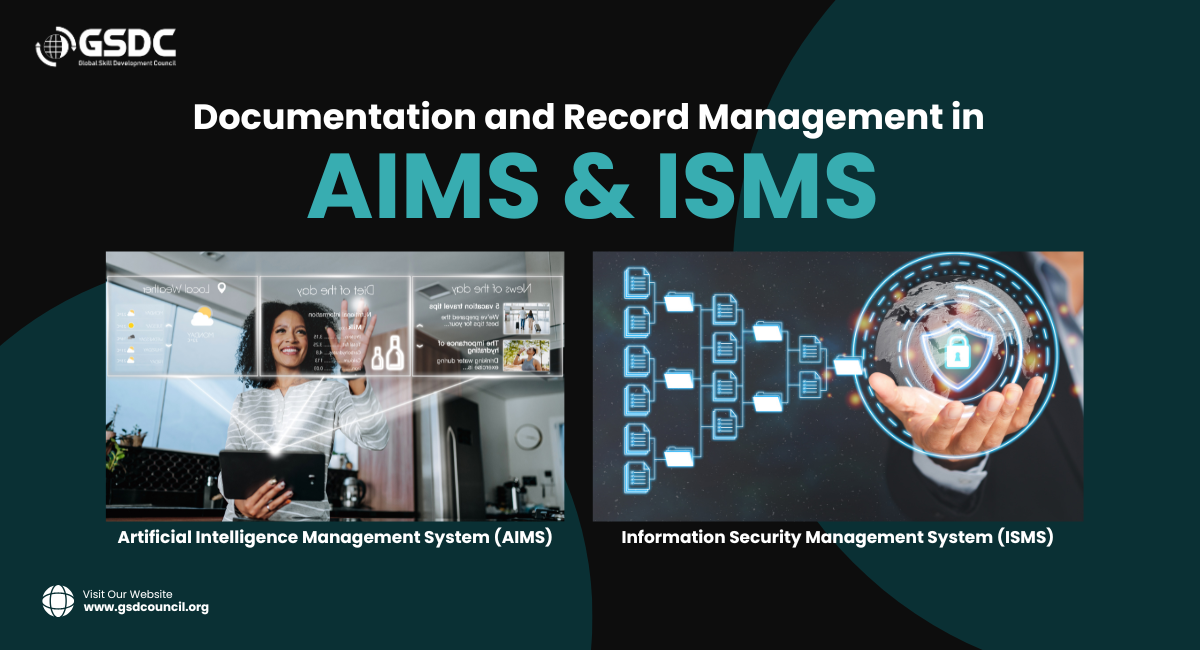
Documentation and Record Management in AIMS and ISMS
Written by Matthew Hale
- Understanding the Foundation: What Is a Management System?
- The AI Management System (AIMS): Bridging Compliance and Innovation
- Information Security Management System (ISMS): The Documentation Standard
- Building a Record Management Program
- Integrating AIMS and ISMS: Documentation Synergy
- Why Documentation Matters in Certification
- Conclusion
During the GSDC Mentor Connect, the last session, the participants discussed one of the most useful but also important areas of compliance and governance: Documentation and Record Management in AIMS and ISMS.
This session was a critical component of the ISO/IEC 42001 AI Management System education experience that linked the dots between the documentation of the AI system, record management programs, and the more general Information Security Management System (ISMS) requirements defined by ISO 27001.
Understanding the Foundation: What Is a Management System?
Before diving into the specifics of AI and information security documentation, the session began with a simple yet important clarification: what is a management system?
A management system is a structured framework of policies, processes, and procedures that enables an organization to achieve specific objectives consistently.
Whether in information security or artificial intelligence governance, a management system ensures that actions are systematic, measurable, and auditable.
In the case of AI, the AI Management System (AIMS) under ISO/IEC 42001 functions as a governance layer that defines how AI is developed, deployed, and monitored responsibly. It ties directly to how to build an AI system that is ethical, explainable, and secure, aligning with the organization's compliance and risk management principles.
The AI Management System (AIMS): Bridging Compliance and Innovation
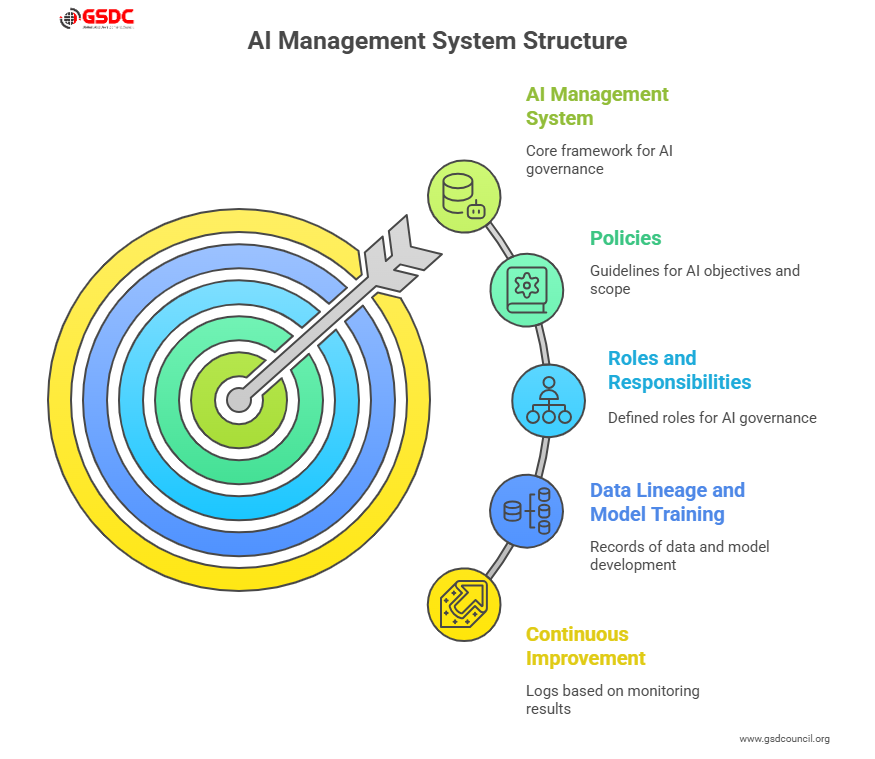
The ISO/IEC 42001 AI Management System provides a structured way for organizations to manage the lifecycle of AI technologies from data sourcing and model training to deployment and monitoring.
The Mentor Connect discussion highlighted that AIMS documentation isn’t just paperwork; it’s the operational backbone that allows AI initiatives to scale responsibly.
This includes:
- Policies outlining AI objectives and scope.
- Defined roles and responsibilities for AI governance.
- Data lineage and model training records.
- Continuous improvement logs based on monitoring results.
By maintaining structured documentation, organizations can align AI innovation with compliance, bridging the gap between creative development and regulated accountability.
This session also introduced participants to the concept of AI-based knowledge management systems, where automation supports document versioning, access control, and traceability, a growing best practice as organizations handle expanding volumes of AI-related records.
Information Security Management System (ISMS): The Documentation Standard
While AIMS focuses on AI-specific governance, the Information Security Management System (ISMS) remains the foundation for protecting data and information assets across all organizational layers.
So, what is an information security management system?
It’s a comprehensive framework for managing an organization's sensitive information to ensure confidentiality, integrity, and availability.
During the session, experts discussed how ISMS documentation requirements are detailed and evidence-driven, including:
- Information security policies and objectives.
- Risk assessment methodologies.
- Control implementation evidence (aligned with ISO 27001 Annex A).
- Audit records and management review reports.
Organizations pursuing an ISO 27001 Information Security Management System Certification must demonstrate that every control, process, and mitigation plan is backed by verifiable documentation.
The same principle extends to the ISO/IEC 42001 framework for AI, ensuring both systems share a unified approach to risk and record management.
Building a Record Management Program
One of the session’s central takeaways was the importance of a record management program a structured approach to handling information created or received during business operations.
A robust record management program underpins both AIMS and ISMS by ensuring:
- Records are accurate, complete, and traceable.
- Retention schedules comply with legal and regulatory requirements.
- Access is restricted based on sensitivity and role.
- Secure disposal of obsolete records reduces data risk.
Modern organizations are moving toward records management system software, automating tasks like classification, indexing, and archiving.
The Mentor Connect dialogue emphasized that in AI contexts, this software can integrate with AI-based knowledge management systems, offering advanced search and retrieval through natural language queries or metadata recognition.
Integrating AIMS and ISMS: Documentation Synergy
A key insight from the session was that AIMS and ISMS are not siloed systems they coexist and complement one another
- The ISO/IEC 42001 AI Management System governs how AI solutions are designed, validated, and maintained.
- The Information Security Management System Framework protects the data that AI systems use.
Together, they ensure ethical AI development and secure data handling. Organizations aligning both systems can leverage shared documentation protocols such as audit checklists, control mappings, and incident response templates to minimize duplication and strengthen compliance readiness.
Participants also discussed how to build an AI system within this dual-governance context. The emphasis was on lifecycle documentation: maintaining version-controlled artifacts for training datasets, model configurations, bias assessment results, and post-deployment monitoring.
Why Documentation Matters in Certification
For professionals pursuing Information Security Management System Certification or preparing for ISO/IEC 42001 implementation, documentation is non-negotiable. Speaking of which, you can check out GSDC for getting the global validation of your expertise.
Accurate, consistent records demonstrate:
- Accountability and transparency.
- Effective control implementation.
- Continuous improvement over time.
Certification bodies rely on this documentation to validate that your systems, whether for AI or information security, meet ISO standards for governance and operational integrity.
Conclusion
The GSDC Mentor Connect on Documentation and Record Management in AIMS and ISMS highlighted one of the primary facts: documentation is not bureaucracy; it is assurance.
As part of organizational resilience, a properly designed record management program, with the help of the newest records management system software and AI-based automation, reinforces the organizational standing.
The ISO/IEC 42001 AI Management System, by mapping it to the Information Security Management System Framework, can be used to guarantee that compliance, security, and innovation are in harmony with each other.

Related Certifications
Stay up-to-date with the latest news, trends, and resources in GSDC
If you like this read then make sure to check out our previous blogs: Cracking Onboarding Challenges: Fresher Success Unveiled
Not sure which certification to pursue? Our advisors will help you decide!