Generative AI in Banking: Where It Actually Works and How to Start
Written by Matthew Hale
- What is AI in banking, and what makes generative AI different?
- How is AI used in banking? A simple map
- Generative AI banking use cases worth your attention
- An example of a generative AI application in finance
- The benefits of AI in banking, in numbers leaders can track
- Why the first wins usually show up in the back office
- The roadblocks: what slows banks down
- Where generative AI doesn't fit yet
- How will AI transform banking in the next few years?
- What skills does this work actually need?
- Final thoughts
A surprising amount of banking is reading, writing, checking and processing. Someone reads the loan file. Someone writes up the case. Someone checks it against the rules, and someone else processes it. That's why generative AI in banking has moved from curiosity to boardroom topic so quickly: it works on exactly this kind of work. McKinsey's 2023 analysis suggests banking could gain new value equal to 9 to 15 percent of its operating profits each year.
Big estimates are easy to quote and hard to act on, though. So this guide sticks to what matters in practice. You'll see where generative AI fits inside a bank, which use cases are realistic, what tends to go wrong and how to begin.
What is AI in banking, and what makes generative AI different?
AI in banking simply means software that learns from data to spot patterns, make predictions or automate decisions. Banks have used it for years for things like credit scoring and flagging odd transactions.
Generative AI adds something new. It can produce content: a summary, a draft email, a reply to a customer or a block of code.
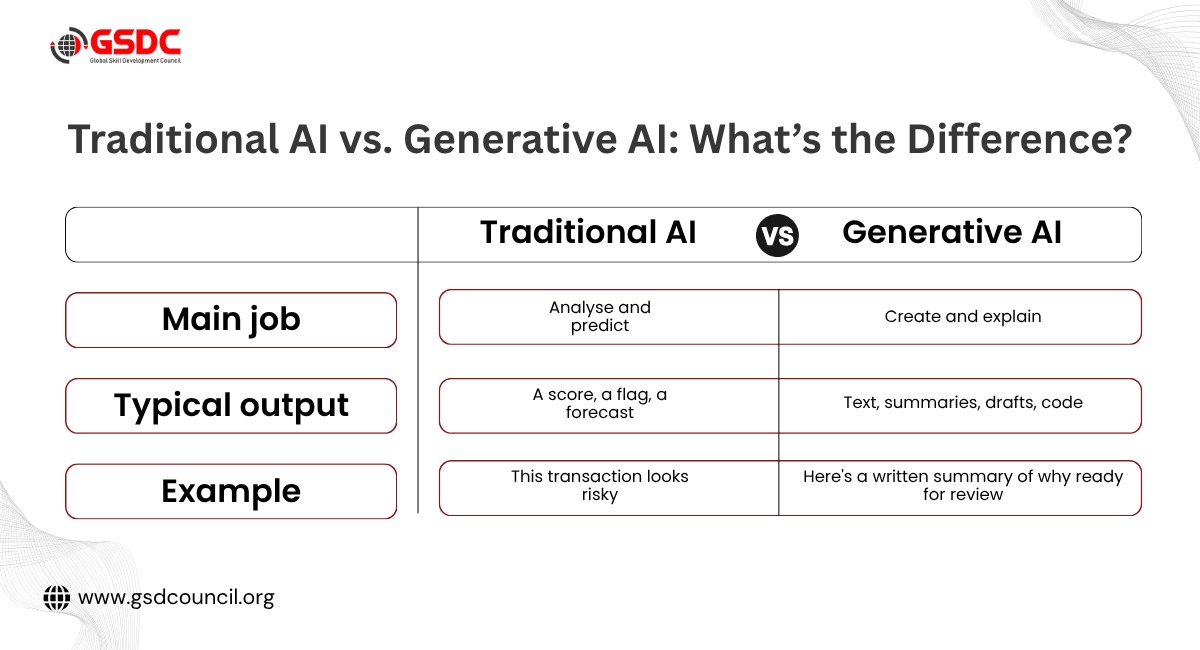
Take a fraud alert. A traditional model scans millions of transactions and flags the one that looks unusual, which is pattern recognition at its best. But a flag is only the start. Someone still has to pull the account history, explain the concern and write it up. That's where generative AI helps, by turning the flag and its surrounding data into a readable draft.
The reverse also holds. Scoring risk or spotting anomalies across huge datasets is usually a job for traditional models, and McKinsey notes that generative AI isn't always the right answer. So the useful question for any task is simple: does it need a prediction, or a first draft? Prediction points to traditional AI. Drafting and explaining point to generative AI. The best workflows often use both.
How is AI used in banking? A simple map
It helps to think of a bank in three layers.
- Front office: everything customers see, such as advice, service and sales
- Middle office: risk, compliance and controls
- Back office: operations, processing, technology and reporting
Here's how AI helps in banking across each layer:
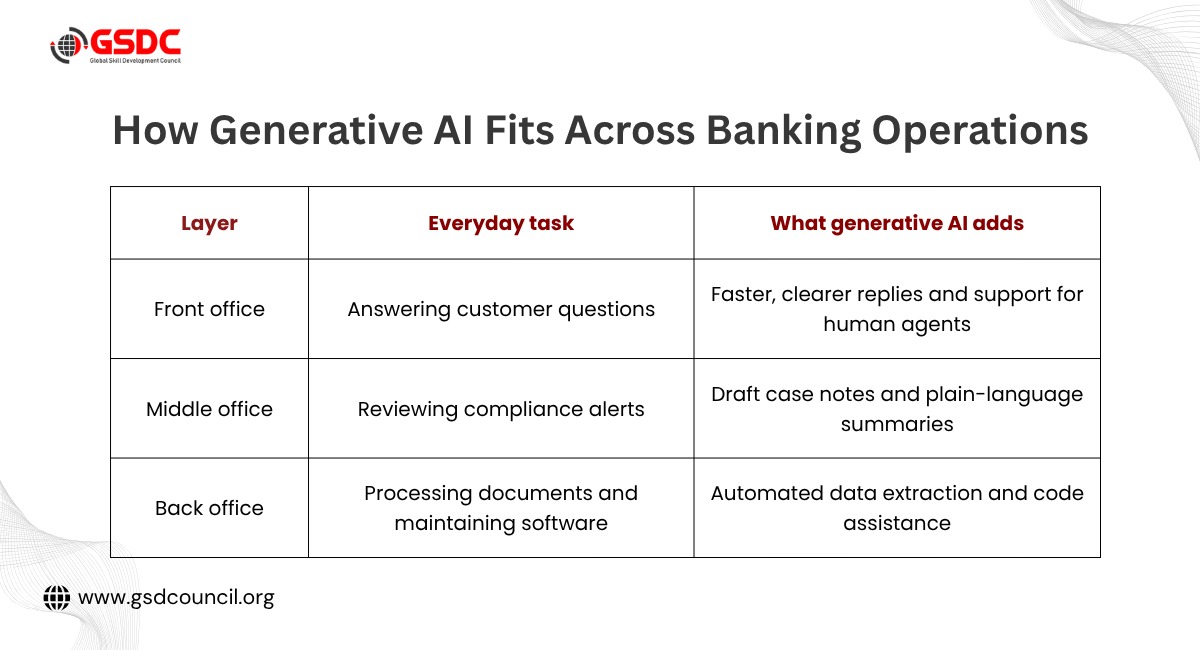
Knowing which layer a task belongs to matters, because each one carries different risks and controls. It's also a handy mental model for anyone preparing for a Certification in Generative AI in Finance and Banking.
Generative AI banking use cases worth your attention
Plenty of AI use cases in banking sound impressive but never leave the pilot stage. These are grounded in everyday work.
1. Customer onboarding and KYC paperwork
Opening an account means collecting IDs, proofs of address and forms. Generative AI can read these documents, pull out the key details and point out what's missing, so customers wait less and staff spend less time on data entry.
Why it matters: people spend their time on exceptions and judgment calls instead of retyping details, and customers hear back sooner.
2. Agent assist in contact centres
Instead of replacing human agents, AI can sit beside them. It can listen to a call, suggest the right answer from the bank's knowledge base and write the call summary afterwards. Agents handle harder questions with better information, and new hires get up to speed faster.
Why it matters: the agent stays in charge of the conversation, while the slow parts, searching and note-taking, fall away.
3. Drafting case notes for financial crime teams
When a system flags a suspicious transaction, an investigator has to write up what happened. AI can prepare the first draft from the case data. The human still decides, but doesn't start from a blank page.
Why it matters: investigators can spend more time on the reasoning behind a case, which is the part that needs their experience.
4. Compliance and regulatory summaries
Regulations are long and they keep changing. Generative AI can summarise a new rule, highlight what affects your products and draft an internal note for the team. McKinsey lists summarizing regulatory reports, drafting pitch books and developing code among the time-consuming tasks banks are already speeding up with the technology.
Why it matters: the first pass of reading and summarising stops being a bottleneck, so teams can respond to new rules faster.
5. Software modernisation
Many banks still run on decades-old systems. AI coding assistants can explain old code, suggest updates and write tests, which shortens the modernisation journey.
Why it matters: engineers spend less time deciphering old code and more time deciding what the new system should do.
Notice the pattern across all five: AI prepares the first draft, and a trained person reviews it. Building that review skill is something organisations such as the Global Skill Development Council (GSDC) support through professional learning programmes.
An example of a generative AI application in finance
Picture a compliance analyst at a mid-sized bank who receives a 150-page regulatory update on a Monday morning.
Before: She prints the key sections, reads for most of a day, then spends the next day writing a summary for the product, legal and operations teams. She works carefully, but by page 90 she's tired, and a clause buried in an appendix is easy to miss. Her summary reaches the other teams on Wednesday.
After: She uploads the document and asks for a structured summary: what's new, which products are affected, which deadlines apply. Minutes later she has a draft. She checks it against the original, catches one clause the tool misread and fixes it. With the first pass done, she has time to add what only she can: what the change means for this bank and what the team should do first. The note goes out that afternoon.
The value isn't magic. It's simply hours returned to the person who understands the rules best. (This is an illustrative scenario, not a specific bank's case.)
The benefits of AI in banking, in numbers leaders can track
"Efficiency" is a vague word. Banks that see results tend to measure concrete things:
- Time saved per task, such as minutes per call summary
- Turnaround time for onboarding or loan review
- Error and rework rates
- Handling time and first-contact resolution in customer service
- How much time specialists spend on high-value work
If you can't measure the gain, it's hard to defend the budget.
Why the first wins usually show up in the back office
Looking at generative AI in the banking industry as a whole, EY-Parthenon research found that banks see the transformative value of GenAI but are prioritizing back-office automation for initial deployments. The reason is straightforward: back-office work is repetitive, the risk to customers is lower and results are easier to measure.
Structure matters too. In a 2024 McKinsey study of 16 of the largest financial institutions in Europe and the United States, more than 50 percent are opting for a more centralized approach, though structures are likely to become more decentralized in the longer term. In plain terms, many banks build one central team that sets the rules and skills, then spread the work outward as they mature.
The roadblocks: what slows banks down
The biggest hurdles aren't always about the technology itself. For many banks, the harder questions are whether they have the right expertise, enough budget and the infrastructure to deploy GenAI responsibly.
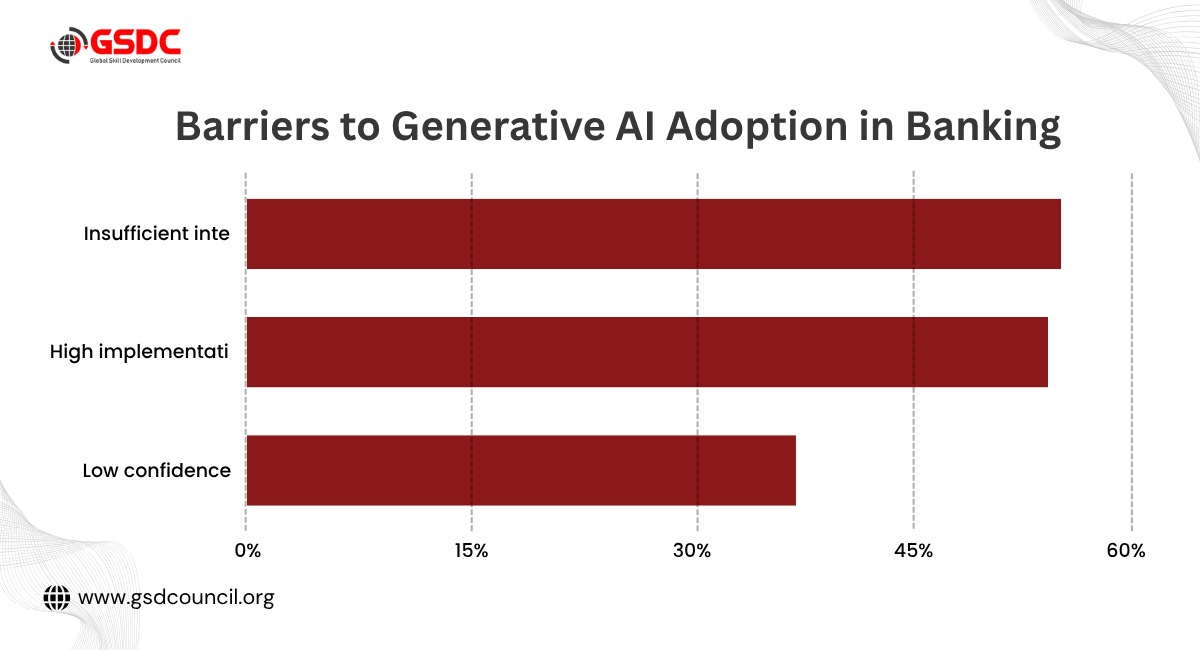
An EY-Parthenon survey of 151 banks found three notable barriers to implementation:
The numbers point to a practical problem: having access to a GenAI tool is one thing; having the people, systems and controls to use it effectively is another.
Banks also have to manage several risks carefully:
- Accuracy: AI can sound confident while still producing incorrect information, so important outputs need human review.
- Data privacy: Customer and financial data need to be protected, with clear rules about which information can be used with AI tools.
- Bias: AI-assisted processes, particularly those involving lending or other high-impact decisions, need appropriate fairness checks.
- Regulation: Financial institutions need governance that keeps pace with changing rules and makes clear who is responsible for AI-assisted decisions.
The takeaway is simple: scaling GenAI isn't just a technology project. It also requires the right skills, controls and accountability.
Where generative AI doesn't fit yet
Being honest about limits makes any AI plan stronger. Generative AI is a poor fit for decisions that carry serious consequences for a customer and need a clear, defensible explanation. Lending is the obvious example. EY warns that using GenAI in lending decisions could produce biased outcomes, and that banks carry the burden of showing regulators why applications were declined and that applicants were treated fairly.
Reliability is the other issue. McKinsey notes that generative AI can give different answers to the same prompt, and that its complexity makes it hard to explain how a given answer was produced. The usual safeguard is to have subject matter experts validate outputs, though McKinsey adds that this may not scale across every use case.
A sensible rule for now: let AI prepare, summarise and suggest, and let people decide. In practice, that means keeping humans in charge of:
- Final lending and credit decisions
- Anything a regulator or customer may ask you to explain step by step
- Work involving sensitive data in tools that haven't been approved
As the tools and the rules mature, that line may move. Today, it's a reasonable place to draw it.
A five-step plan to get started
- Choose one low-risk, measurable task - Document summaries or internal drafting are good candidates.
- Set a baseline - Record how long the task takes today and how many errors occur.
- Keep a human in the loop - Every output gets reviewed before it's used.
- Write simple rules - Cover what data may be used, who approves and how issues get reported.
- Train your people - Tools only pay off when staff know how to use them well.
How will AI transform banking in the next few years?
Change in the future of banking will likely arrive in stages, not overnight.
- Now: drafting, summarising and simple analysis
- Next: deeper scenario analysis and more personalised service
- Later: end-to-end automation of complex processes, with people supervising
What actually changes on the ground? Most likely three things:
- For employees: less time reading, copying and summarising, and more time reviewing, questioning and advising. Checking AI output becomes a core skill in its own right.
- For customers: quicker answers and smoother onboarding, as long as banks keep a human route open for complicated or sensitive issues.
- For operations: shorter turnaround on document-heavy work, plus stronger governance, since every AI-assisted process needs clear owners, checks and records.
So how will AI transform banking? Mostly by shifting where people spend their time. That's also the bigger story for the future of finance: people will need to know how to work effectively with these tools.
What skills does this work actually need?
If expertise is the biggest gap, it's worth being specific about what "expertise" means. You don't need to become a programmer. Most banking professionals working with generative AI need a handful of practical skills:
- AI literacy: knowing roughly how these models work and, more importantly, where they fail
- Review habits: checking AI output against source documents instead of trusting it by default
- Prompting basics: asking clear, specific questions to get usable drafts
- Data awareness: understanding what information should never be pasted into a tool
- Risk and governance thinking: knowing when a task needs extra approval or a human decision
- Domain judgment: the finance and compliance knowledge that AI can't supply
That last one matters most because AI still depends on people who understand the financial context behind the work. For people who want structured learning, a certification in generative AI in finance and banking can cover these areas in one place. GSDC's Certification in Generative AI in Finance and Banking is one example of a generative AI in finance and banking certification.
Final thoughts
Generative AI won't decide what a bank stands for, or how it treats a customer in a hard moment. What it can change is where banking professionals spend their days: less time on paperwork, more on judgment, relationships and the decisions that matter. That's the real shift behind the future of finance, and it's a good one for the people who understand the work best.

Related Certifications
Frequently Asked Questions
Yes. Older AI mostly predicts or flags. Generative AI creates content such as summaries, drafts and code. Banks usually use both together.
Inaccurate outputs, data privacy, bias and changing regulation. Strong governance and human oversight can help reduce these risks.
Not necessarily. Many roles need a strong grasp of finance, risk and AI concepts more than programming skills.
Generative AI is likely to automate some routine tasks while changing how many banking roles are performed. The impact will vary by role, process and how quickly organisations adopt the technology. Human oversight stays essential, especially for decisions involving risk, compliance and customers.
Stay up-to-date with the latest news, trends, and resources in GSDC
If you like this read then make sure to check out our previous blogs: Cracking Onboarding Challenges: Fresher Success Unveiled
Not sure which certification to pursue? Our advisors will help you decide!