The Rise of Forward Deployed Engineers in Enterprise AI
Written by Matthew Hale
- What Is a Forward Deployed Engineer? (Meaning and Definition)
- What Does a Forward Deployed Engineer Do?
- Forward Deployed Engineer vs Software Engineer vs Solutions Engineer
- Forward Deployed Engineer Salary
- Where Forward Deployed Engineer Jobs Are Right Now
- 7 Steps to Become a Forward Deployed Engineer
- Is Forward Deployed Engineering a Good Career?
- Is There a Forward Deployed Engineer Certification or Course?
A forward deployed engineer, or FDE, is not a job title most people had heard of five years ago. Today, the role is appearing far more frequently in tech hiring: Bloomberry's analysis of 1,000 live job listings found that postings carrying the title grew 1,165% year over year. Palantir, OpenAI, and Anthropic are all hiring for it.
If you have come across the term and are wondering what a forward deployed engineer actually does all day, what the role pays, and how to become one, this guide covers the meaning of the job, real salary data, and a practical seven-step roadmap to break in.
What Is a Forward Deployed Engineer? (Meaning and Definition)
A forward deployed engineer is a software engineer placed directly inside a customer's environment to solve a real, often messy business problem, then design, build, and ship a working solution for it. It's a hybrid of software engineer, data engineer, and technical consultant. The term borrows from the military: the engineer is pushed out to where the problem lives, rather than staying at headquarters building a generic product. Palantir coined the title in the mid-2000s for engineers deployed on-site with government clients, before it spread to commercial accounts.
A regular software engineer gets a clear brief: build this service. An FDE is more likely to get something like: a hospital's patient data is scattered across six systems, and clinicians waste hours piecing it together by hand. Figure out what to build, then build it. Since 2023, the title has spread well beyond Palantir, with OpenAI, Anthropic, and a growing list of enterprise AI startups hiring for it directly, largely because getting AI models to work reliably inside a company's legacy systems still takes a person on the ground.
What Does a Forward Deployed Engineer Do?
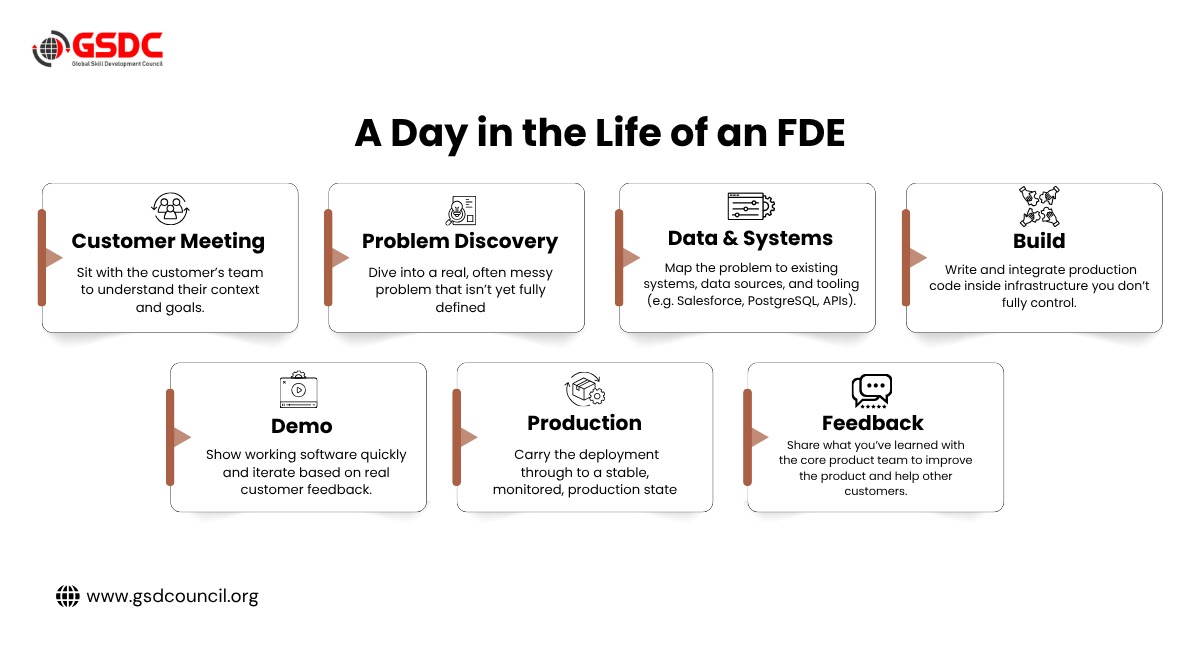
Day-to-day, the work looks less like writing isolated features and more like owning a problem end to end. A typical week involves:
- Sitting with a customer's team to understand a problem that has not yet been cleanly defined
- Mapping that problem to the company's existing platform, models, or tooling
- Writing production code inside infrastructure the FDE did not design and does not fully control
- Building data pipelines and integrations against systems such as Salesforce, PostgreSQL, internal REST APIs, and spreadsheets that were never meant to talk to each other
- Demoing working software quickly, then iterating based on what the customer actually says, not what the original spec assumed
- Carrying the deployment through to a stable, monitored, production state
Feeding what was learned in the field back to the core product team
Forward Deployed Engineer vs Software Engineer vs Solutions Engineer
Aspect | Forward Deployed Engineer | Traditional Software Engineer | Solutions Engineer |
Primary output | Working software deployed in a customer's environment | Features and services in a shared product codebase | Demos, proofs of concept, and pre-sales technical support |
Where they work | On-site or embedded with the customer | Centrally, on the core product | Mostly pre-sale, alongside account teams |
Problem definition | Ambiguous, defined together with the customer | Usually scoped by a product manager | Defined by the sales cycle |
Code ownership | Ships and maintains production code | Ships and maintains production code | Rarely ships production code |
Success metric | The customer's problem is actually solved and live | The feature works and ships on time | The deal closes |
If you're looking to build the mix of engineering, deployment, and customer-facing skills that this role requires, a Certified Forward Deployed Engineer program can provide a structured way to develop and demonstrate those capabilities alongside hands-on projects.
Forward Deployed Engineer Salary
Pay for the role is high relative to standard software engineering, and it varies a lot by company and seniority. It also gets reported a few different ways, so it's worth being precise about what each number actually measures before you anchor on it.
US data from Glassdoor, based on 652 self-reported figures for total compensation (base salary plus bonus and, where applicable, equity), looks like this:
Percentile | Total compensation (US) |
25th percentile | $124,805 |
Average | $156,088 |
75th percentile | $198,276 |
90th percentile | $243,968 |
Source: Glassdoor, forward deployed engineer salaries, United States
Bloomberry's separate analysis looked at a different thing: base salary as disclosed in job postings, not self-reported total compensation. That analysis put the median forward deployed engineer salary at $173,816. The two figures aren't measuring the same slice of pay, which is part of why they land in different places, and it's a useful reminder not to average numbers from different sources as if they were interchangeable.
The better way to read these figures is as an indication of the compensation currently associated with the role, rather than as a fixed number you should expect on an offer.
For anyone working toward the role, the more important question is what skills justify that level of compensation. Building capabilities across software engineering, AI, deployment, and customer-facing problem-solving is central to the FDE path. GSDC's Certified Forward Deployed Engineer program can be one structured way to build and formalize that skill set alongside practical project experience.
Where Forward Deployed Engineer Jobs Are Right Now
Forward deployed engineer jobs are concentrated in three groups of companies:
- Palantir, which still uses the original forward deployed software engineer (FDSE) title, treats the role as a defined career track with its own leadership ladder.
- Frontier AI labs, chiefly OpenAI and Anthropic, are scaling their own forward deployed engineering organizations to get agents and models working reliably inside enterprise, government, and healthcare accounts.
- Enterprise software and AI implementation firms, including Databricks and a growing number of AI-native startups, hire for a related but slightly narrower "AI forward deployed engineer" profile, focused specifically on deploying large language model and agent-based systems rather than a full data platform.
Outside those three groups, consulting firms and systems integrators are also building forward deployed practices as their enterprise clients push to get AI pilots into production. If you are searching for the role, it's worth checking listings under all three related titles, since companies use them somewhat interchangeably: forward deployed engineer, forward deployed software engineer, and AI forward deployed engineer.
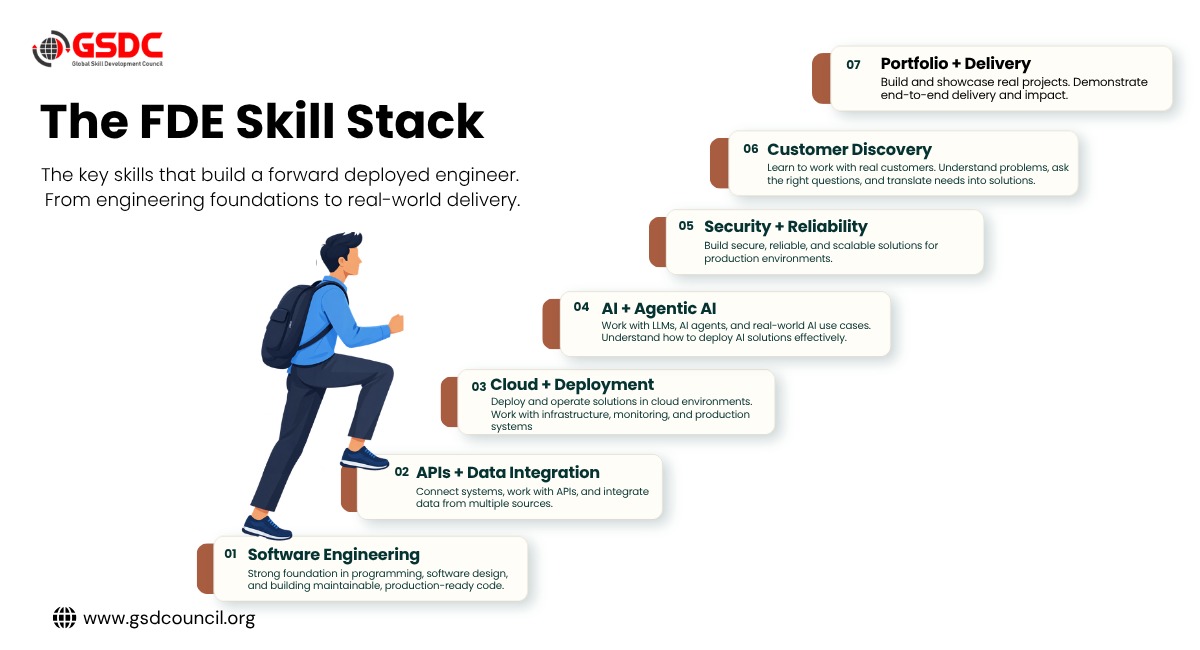
7 Steps to Become a Forward Deployed Engineer
There is no single accepted forward deployed engineer roadmap, because the role pulls skills from several disciplines at once. The seven steps below cover the skill combination that shows up consistently across FDE job descriptions at Palantir, OpenAI, and Anthropic.
Step 1: Build genuinely strong software engineering fundamentals
This is the non-negotiable base. You need to write clean, tested, production-quality code fast, not just pass a coding interview.
- Get fluent in one general-purpose language (Python, Java, or TypeScript are the most common in FDE postings), including testing, packaging, and debugging, not just syntax
- Learn data structures, algorithms, and object-oriented design well enough to reason about trade-offs on the spot
- Get comfortable with Git, code review, and working in an unfamiliar codebase without hand-holding
Step 2: Get fluent in APIs, databases, and messy data integration
Customers never hand you a clean CSV. They hand you a mix of PostgreSQL, Salesforce, internal REST APIs, spreadsheets, PDFs, and permissions set up by someone who left the company years ago.
- Practice SQL until joins, window functions, and query performance are second nature
- Learn how to read documentation for an API you have never touched and integrate it the same day: authentication, pagination, rate limits, webhooks
- Understand basic data modeling and ETL concepts well enough to design a pipeline from scratch
Step 3: Learn to deploy and operate software, not just write it
"It works on my laptop" doesn't count. FDEs are usually expected to own something from prototype through to a stable deployment that keeps running after they move to the next account.
- Learn Docker well enough to containerize and debug a real application
- Get hands-on with at least one cloud provider: compute, storage, managed databases, IAM, and basic networking
- Understand monitoring, logging, and what to do when something breaks in a system you did not build
Step 4: Build applied and agentic AI engineering skills
Many forward deployed engineer roles, especially AI forward deployed engineer roles, expect you to be comfortable building with large language models, not just calling an API once.
- Learn how LLM APIs behave in practice: tokens, context windows, structured output, tool calling, and cost
- Understand retrieval-augmented generation, embeddings, and vector search well enough to build a working pipeline
- Learn how agentic systems are evaluated. A demo that looks impressive once is not the same as a system that holds up across hundreds of real customer cases
If you're learning these skills independently rather than through a team that already builds agent systems, a structured applied-AI credential can help organize the learning and validate the fundamentals you've built. We'll come back to this in the certification section below.
Step 5: Learn enterprise security and reliability basics
This is what separates a portfolio demo from something a company would actually deploy against real customer data. Some FDE listings call out tenant isolation and least-privilege access by name, which tells you it's not treated as a security-team-only concern.
- Understand authentication versus authorization, role-based access control, secrets management, and audit logging
- Know what should happen when an API times out, a model returns malformed output, or a tool call runs twice
- Get familiar with basic data handling rules: PII, retention, and prompt injection risk if you are building with LLMs
Step 6: Practice customer discovery and turning ambiguity into a plan
This is one of the biggest differences between an FDE and a conventional backend engineer, and it's the hardest to fake in an interview. A customer might say "we need a chatbot." Your job is not to build a chatbot; it's to find out who will use it, what problem they are actually trying to solve, what data exists, and what would make the project count as a success.
- Practice asking follow-up questions that narrow a vague request into a concrete, buildable problem
- Get comfortable presenting technical trade-offs to non-technical stakeholders in plain language
- Write short design documents that explain a decision and its trade-offs, not just the final architecture
Step 7: Build a deployable portfolio and target the right companies
Skip ten disconnected tutorial projects. Build two or three complete systems that prove you can integrate with messy sources, deploy them properly, and make sound decisions under real constraints.
- One project could be a customer-support agent that combines retrieval with ticketing and tool execution, including auth, an eval set, and failure logging
- One could be a document-processing pipeline: ingest PDFs, extract structured data, validate it, store it, and expose the result through an API, deployed in Docker
- Document the customer problem, the trade-offs, and the known failure cases in each repository, not just the code
- Apply directly through the forward deployed engineering pages at Palantir, OpenAI, and Anthropic, and search enterprise software job boards for "forward deployed" and "AI forward deployed engineer" as well
Is Forward Deployed Engineering a Good Career?
- The learning curve is steep and broad, since you need real depth in engineering, data, and increasingly AI, not just one of them
- Travel and client-facing pressure are real at most companies hiring for the title, and not everyone enjoys being the engineer in the room when a deployment goes wrong
- Frequent context switching between customers and technologies can be tiring in a way that a single, stable codebase is not
- You have less control over the technical environment than in a conventional engineering role, since you're building inside someone else's infrastructure and constraints
- Success can depend on factors outside your direct control, like how clean the customer's data actually is or how responsive their internal team is, which can impact timelines, implementation, and overall project outcomes.
Is There a Forward Deployed Engineer Certification or Course?
There is no single, universal forward deployed engineer certification that companies expect to see on a resume. The title is earned through a demonstrated combination of skills and a portfolio that proves you can integrate, deploy, and communicate, not through one exam.
That said, two things genuinely help. A recognized cloud certification (AWS, Azure, or GCP) signals you can actually operate software in production. And if the applied-AI side of your background is the thinnest, a structured credential such as GSDC’s Certified Forward Deployed Engineer can validate the agent-building skills covered in Step 4, giving you something concrete to point to alongside your portfolio.
Interviews for the role typically combine a standard coding round with a systems or integration exercise and a customer-scenario discussion, so treat any course as preparation for those three, not a substitute for them.


Related Certifications
Frequently Asked Questions
A forward deployed engineer is a software engineer embedded directly with a customer to understand a business problem, then design, build, and deploy a working solution against it, usually inside the customer's own systems and infrastructure.
They scope ambiguous customer problems, write production code, build data integrations, deploy and monitor the resulting system, and feed what they learn back to the core product team.
In the United States, Glassdoor puts average total compensation for a forward deployed engineer at around $156,000, with a typical range of roughly $125,000 to $198,000 depending on level and company. Bloomberry's separate analysis of posted job listings found a median base salary of $173,816.
They are largely the same role. Forward deployed software engineer (FDSE) is Palantir's original title, and most other companies use forward deployed engineer or FDE for the equivalent position.
No single certification is required. What matters most is a proven skill combination across software engineering, data integration, deployment, and applied AI, backed by a portfolio. Credentials like a cloud certification or an applied-AI credential can support that, particularly for the AI-focused portion of the role.
Not quite. AI engineering roles typically focus on building and improving models or AI systems for internal or general product use. Forward deployed engineering, including the AI forward deployed engineer variant, is specifically about deploying and adapting those systems inside a customer's own environment.
Stay up-to-date with the latest news, trends, and resources in GSDC
If you like this read then make sure to check out our previous blogs: Cracking Onboarding Challenges: Fresher Success Unveiled
Not sure which certification to pursue? Our advisors will help you decide!