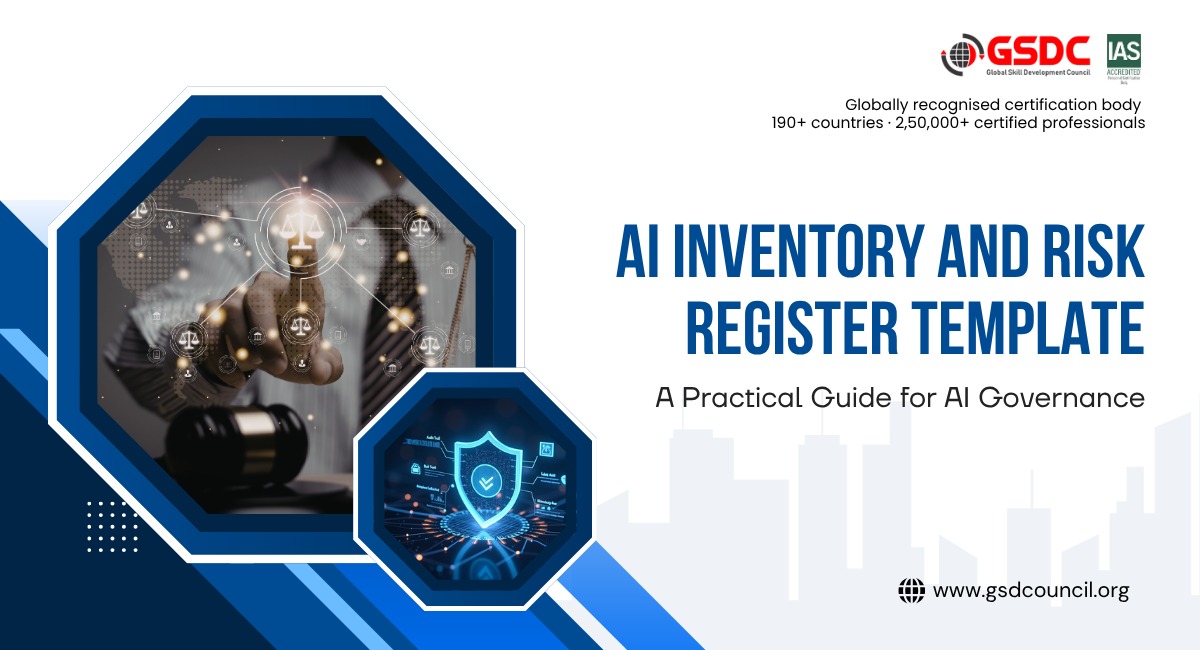
AI Inventory and Risk Register Template: A Practical Guide for AI Governance
Written by Emily Hilton
- What Is AI Governance?
- Why an AI Inventory Matters
- What Should an AI Inventory Contain?
- AI Risk Register: Turning Inventory Into Risk Management
- Key AI Risks to Include
- How AI Policy Templates Fit Into the Process
- AI Governance Checklist
- AI Governance Training and Auditing
- From Spreadsheet to Governance Capability
As organizations adopt generative AI, machine learning, and agentic AI across business functions, knowing where AI is being used and what risks those systems create is becoming essential. An AI inventory and risk register provide a practical foundation for achieving visibility, accountability, and control across the AI lifecycle.
But an inventory is more than a list of AI tools. It should capture information about each AI system, including its purpose, data sources, owner, users, risk level, regulatory considerations, and controls. A corresponding risk register helps organizations identify, assess, prioritize, and monitor risks associated with those systems.
This guide explains what is AI governance, how an AI inventory works, what an AI risk register should contain, and how organizations can use these tools to build a structured governance program.
What Is AI Governance?
AI governance is the framework of policies, processes, roles, controls, and oversight mechanisms used to ensure that AI systems are developed and used responsibly.
Effective governance addresses questions such as:
- What AI systems does the organization use?
- Who owns each system?
- What decisions does the AI influence?
- What data does it process?
- What risks could it create?
- What controls are in place?
- How is AI performance monitored?
- When should an AI system be reviewed, modified, or retired?
For organizations developing an enterprise AI governance program, an AI inventory and risk register provide the visibility needed to answer these questions consistently.
Why an AI Inventory Matters
Organizations often use AI in more places than they realize. Employees may use public AI assistants, developers may integrate third-party models into applications, and business teams may deploy AI-powered software through SaaS platforms.
Without an inventory, these systems can become "shadow AI" AI applications operating without adequate organizational oversight.
An AI inventory creates a centralized record of AI systems and their characteristics. It can support:
- Risk classification
- Regulatory compliance
- Vendor assessment
- Data protection
- Security reviews
- Model monitoring
- Internal audits
- Incident management
- AI system retirement
The inventory can also become one of the most important AI governance tools within an organization's governance framework.
What Should an AI Inventory Contain?
There is no single universal format, but a practical inventory should capture enough information to understand each AI system and its associated risks.
A basic AI inventory template can include the following fields:
Inventory Field | What to Capture |
AI System Name | Name of the model, application, or AI-enabled product |
Business Owner | Person or department accountable for the system |
Technical Owner | Team responsible for implementation and maintenance |
Business Purpose | Why the AI system is being used |
AI Type | Generative AI, ML, agentic AI, predictive analytics, etc. |
Model/Provider | Internal model or third-party provider |
Data Used | Personal, confidential, public, financial, operational, etc. |
Users | Employees, customers, partners, or other users |
Business Impact | Potential impact if the system fails |
Risk Classification | Low, medium, high, or organization-defined category |
Regulatory Scope | Applicable laws, regulations, and standards |
Security Controls | Relevant cybersecurity and access controls |
Human Oversight | How and when humans review AI outputs |
Monitoring | Performance, security, fairness, and drift monitoring |
Review Date | Date of the next governance review |
Status | Proposed, active, suspended, or retired |
Organizations can expand these fields depending on their industry, regulatory environment, and AI maturity.
AI Risk Register: Turning Inventory Into Risk Management
An AI inventory tells you what AI systems exist. A risk register helps determine what could go wrong and what should be done about it.
An AI risk register should connect individual risks to specific AI systems in the inventory.
For example, a generative AI application processing customer information might introduce privacy, security, accuracy, and third-party risks.
A practical AI risk register template could contain:
Risk Register Field | Example |
Risk ID | AI-001 |
AI System | Customer Support Assistant |
Risk Description | AI may generate inaccurate customer guidance |
Risk Category | Accuracy / Operational |
Likelihood | Medium |
Impact | High |
Risk Level | High |
Existing Controls | Human review and response validation |
Mitigation Action | Improve evaluation and escalation rules |
Risk Owner | Customer Operations Manager |
Target Date | Defined remediation deadline |
Residual Risk | Medium |
Status | Open / Monitoring / Closed |
The objective is not to eliminate every AI risk. Rather, organizations should understand their risks, apply proportionate controls, document decisions, and continuously monitor changing risk conditions.
Key AI Risks to Include
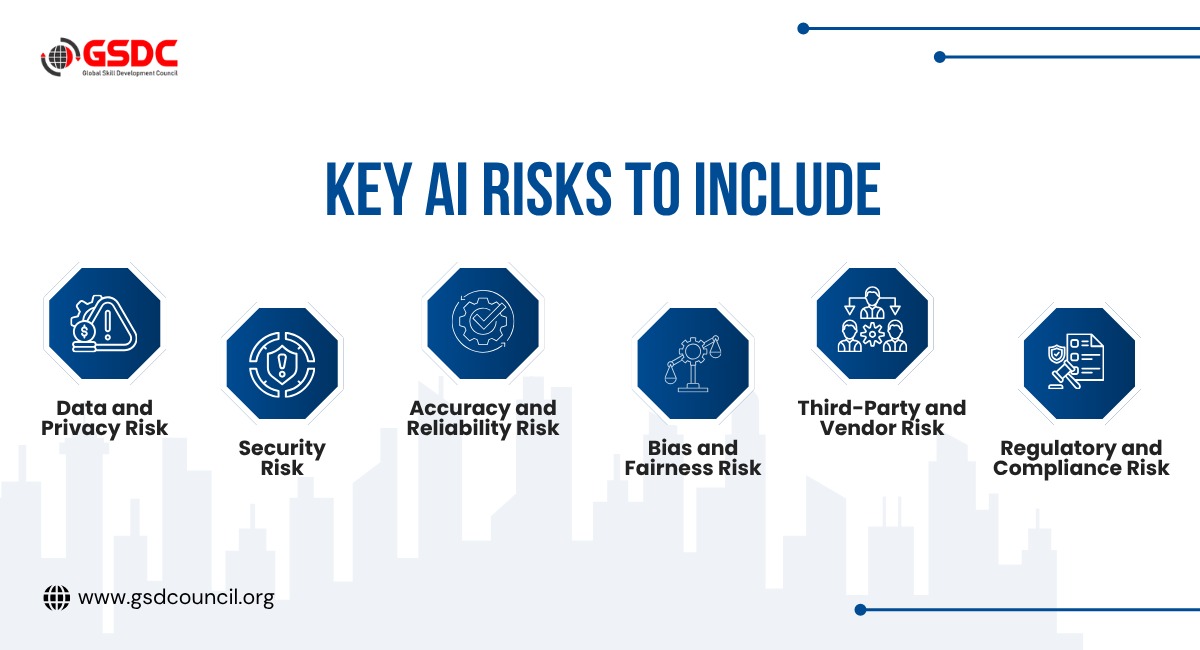
A useful risk register should consider risks across the AI lifecycle rather than focusing only on model performance.
1. Data and Privacy Risk
AI systems may process personal, confidential, proprietary, or sensitive information. Poor data controls can lead to unauthorized disclosure or inappropriate use.
This is where ai data governance and data governance for ai become particularly important. Organizations should establish rules for data collection, classification, access, quality, retention, and permitted AI use.
2. Security Risk
AI systems can introduce vulnerabilities such as prompt injection, unauthorized access, data leakage, insecure integrations, and attacks against supporting infrastructure.
Security controls should therefore be considered during AI design, deployment, and monitoring.
3. Accuracy and Reliability Risk
Generative AI systems can produce inaccurate or fabricated information. Traditional predictive models can also degrade as underlying data or business conditions change.
Risk registers should document evaluation methods, performance thresholds, human oversight, and escalation procedures.
4. Bias and Fairness Risk
AI systems used for hiring, lending, insurance, healthcare, or other sensitive decisions may create discriminatory outcomes if data or models are poorly designed.
Organizations should identify where fairness assessments are necessary and document the relevant controls.
5. Third-Party and Vendor Risk
Many organizations depend on external AI providers, APIs, cloud platforms, and foundation models.
Vendor assessments should examine data handling, security practices, model transparency, service dependencies, contractual obligations, and incident response capabilities.
6. Regulatory and Compliance Risk
AI regulations and industry requirements continue to evolve. The inventory should identify which systems fall within specific regulatory or internal policy requirements.
How AI Policy Templates Fit Into the Process
An inventory and risk register should operate alongside documented governance policies.
An ai policy template can define acceptable and prohibited AI use, data-handling requirements, approval processes, employee responsibilities, and monitoring expectations.
Similarly, an ai governance policy template can establish broader organizational requirements covering AI development, procurement, deployment, risk assessment, documentation, oversight, and accountability.
The inventory then provides visibility into where these policies apply.
AI Governance Checklist
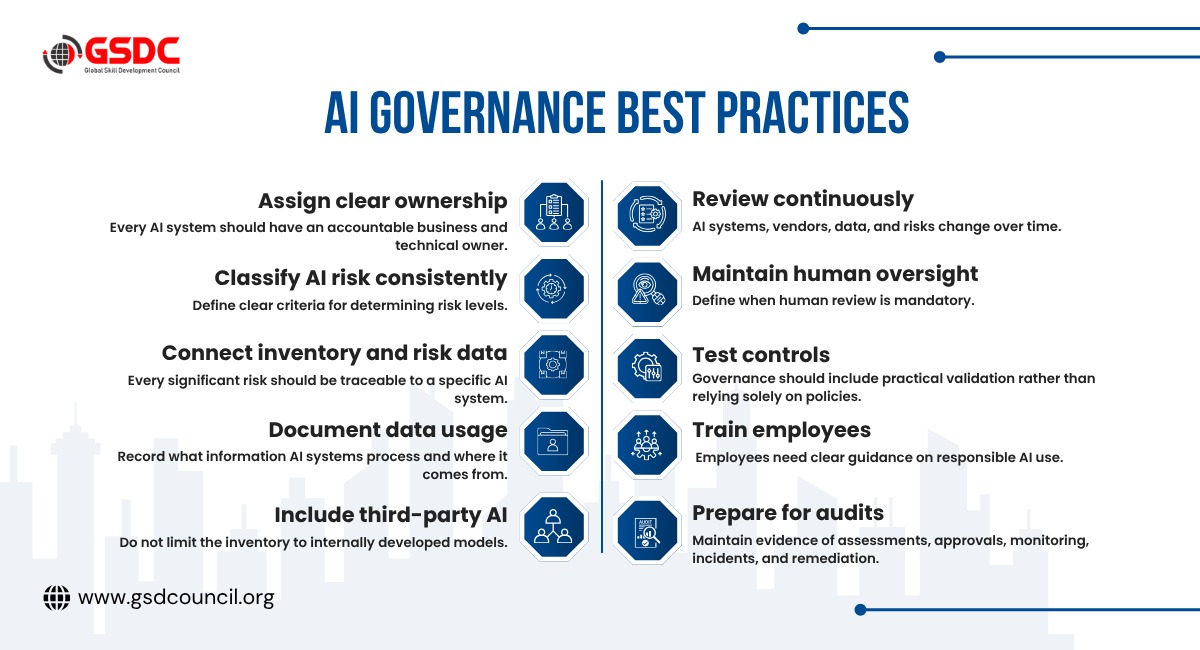
Before considering an AI governance process operational, organizations can use an ai governance checklist such as:
- Is every known AI system recorded?
- Does every system have an owner?
- Is the system's purpose documented?
- Are data sources identified?
- Has an AI risk assessment been completed?
- Are privacy and security risks documented?
- Are third-party providers assessed?
- Are human oversight requirements defined?
- Are AI outputs monitored?
- Are incidents documented?
- Are remediation actions tracked?
- Are governance reviews scheduled?
- Are employees receiving appropriate AI governance training?
- Is evidence available for AI governance auditing?
This checklist can be incorporated into onboarding, procurement, development, and periodic review processes.
AI Governance Training and Auditing
Technology alone cannot create effective governance. People need to understand their responsibilities.
AI governance training can cover responsible AI principles, risk identification, data handling, policy requirements, model oversight, incident reporting, and regulatory expectations.
Organizations should also establish ai governance auditing processes to verify whether governance controls are operating as intended.
Audits can examine:
- AI inventory completeness
- Risk assessment quality
- Policy compliance
- Data governance controls
- Model documentation
- Monitoring records
- Vendor assessments
- Incident management
Evidence of human oversight
From Spreadsheet to Governance Capability
An AI inventory and risk register may begin as simple spreadsheets, but they can eventually become part of a broader governance platform.
As AI adoption expands, organizations can integrate inventory information with GRC platforms, model management systems, data governance solutions, security tools, and compliance workflows.
The important point is to start with visibility and accountability rather than waiting for a perfect governance platform.
A well-maintained inventory answers "What AI do we have?"
A risk register answers "What could go wrong?"
Governance policies answer "What rules should we follow?"
Monitoring and auditing answer "Are those controls working?"
Together, these components create a practical foundation for responsible AI management.
An AI inventory and risk register may begin as simple spreadsheets, but they can eventually become part of a broader governance platform.
As AI adoption expands, organizations can integrate inventory information with GRC platforms, model management systems, data governance solutions, security tools, and compliance workflows.
The important point is to start with visibility and accountability rather than waiting for a perfect governance platform.
A well-maintained inventory answers "What AI do we have?"
A risk register answers "What could go wrong?"
Governance policies answer "What rules should we follow?"
Monitoring and auditing answer "Are those controls working?"
Together, these components create a practical foundation for responsible AI management.
Build Your AI Governance Expertise
GSDC’s Certified AI Governance Professional certification helps professionals develop a structured understanding of how organizations can manage AI responsibly, securely, and transparently.
The Certified AI Governance Professional certification covers key areas such as AI risk management, governance frameworks, policies, accountability, compliance, AI inventories, and risk assessment. The certification can help professionals understand how to establish governance processes that align AI initiatives with business objectives and regulatory expectations.

It is relevant for AI governance professionals, risk managers, compliance teams, auditors, consultants, and technology leaders involved in responsible AI adoption. By earning an AI governance certification, professionals can strengthen their ability to identify AI-related risks, support governance programs, and contribute to effective oversight across the AI lifecycle.
Final Thoughts
An AI inventory and risk register are among the most practical starting points for building an AI governance program. They create visibility into AI systems, identify potential risks, establish accountability, and provide evidence for ongoing monitoring and auditing.
As organizations move toward broader enterprise AI governance, these tools should evolve alongside their AI landscape. The goal is not to create paperwork for its own sake. It is to create a repeatable process that helps organizations understand where AI is being used, identify potential risks, apply appropriate controls, and continuously improve governance.
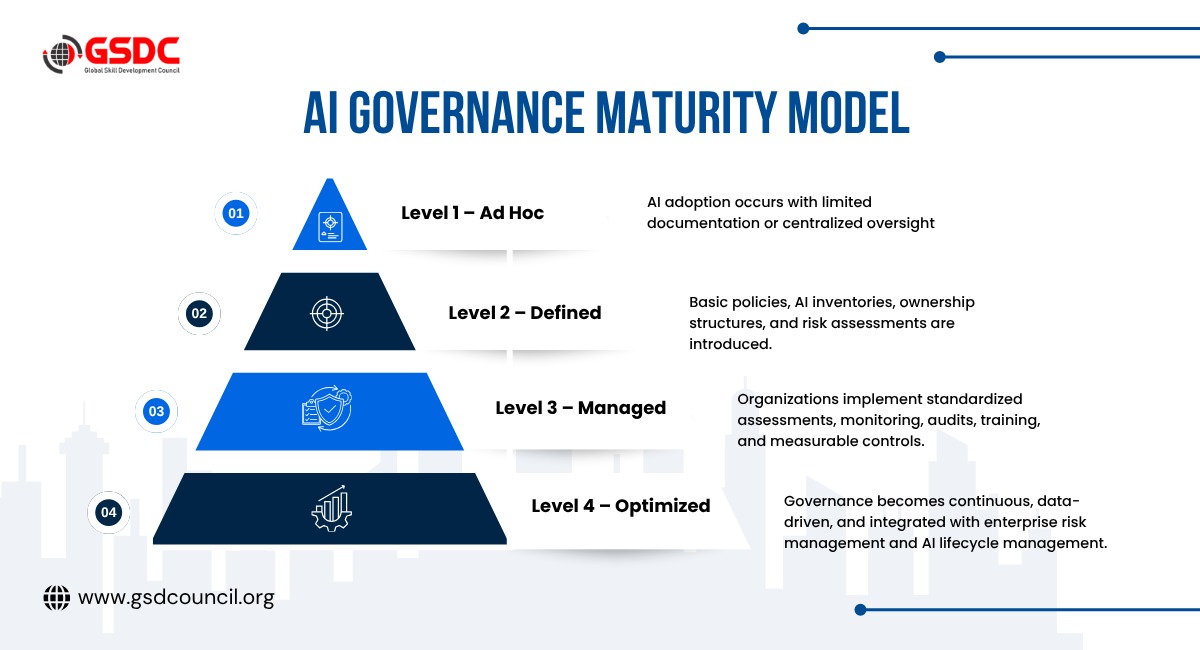
Whether an organization is beginning its AI governance journey or formalizing an existing program, a structured inventory, risk register, policy framework, and governance maturity assessment can provide the foundation for more responsible and accountable AI adoption.

Related Certifications
Stay up-to-date with the latest news, trends, and resources in GSDC
If you like this read then make sure to check out our previous blogs: Cracking Onboarding Challenges: Fresher Success Unveiled
Not sure which certification to pursue? Our advisors will help you decide!