AI Governance Committee: Roles, Structure, Responsibilities, and RACI
Written by Emily Hilton
Artificial intelligence is moving rapidly from experimentation to business-critical operations. Organizations are using AI for customer service, software development, fraud detection, content creation, analytics, decision support, and increasingly autonomous workflows.
As AI adoption expands, governance cannot remain the responsibility of one technology or compliance team. Organizations need a structured way to decide which AI systems can be used, what risks they create, who is accountable for them, and how those risks will be monitored over time.
This is where an AI Governance Committee becomes important.
An AI Governance Committee brings together business, technology, cybersecurity, data, legal, compliance, risk, and other relevant stakeholders to oversee AI-related decisions. Its purpose is not simply to approve or reject AI projects. It establishes the policies, accountability mechanisms, review processes, and oversight needed to support responsible AI adoption.
NIST's AI Risk Management Framework (AI RMF) describes governance as a cross-cutting function that informs AI risk management throughout the AI system lifecycle. It emphasizes policies, accountability structures, defined roles, AI inventories, executive responsibility, and continuous risk management.
What Is an AI Governance Committee?
An AI Governance Committee is a cross-functional group responsible for overseeing an organization's use and management of AI.
Depending on the organization's size and industry, the committee may be responsible for:
- Establishing AI governance policies and standards
- Reviewing higher-risk AI use cases
- Defining AI risk tolerance
- Maintaining oversight of the organization's AI inventory
- Coordinating legal, privacy, security, and compliance reviews
- Establishing requirements for generative AI
- Addressing unauthorized or unapproved AI use
- Reviewing AI incidents and exceptions
- Monitoring AI systems after deployment
- Reporting significant AI risks to senior leadership
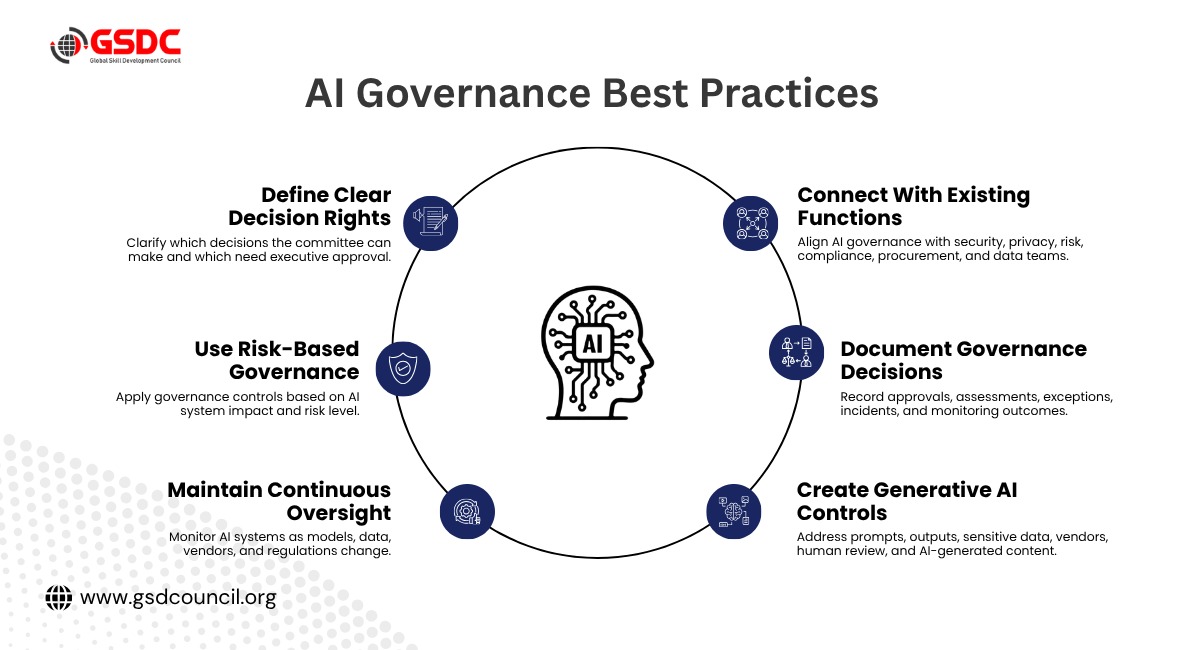
The committee should work alongside existing enterprise risk, cybersecurity, privacy, data governance, procurement, and compliance functions rather than operating as a completely separate structure.
ISO/IEC 42001:2023 provides requirements for establishing, implementing, maintaining, and continually improving an Artificial Intelligence Management System (AIMS). It provides an organizational approach for managing AI-related risks and opportunities rather than focusing only on individual AI applications.
Why Do Organizations Need an AI Governance Committee?
AI creates risks that frequently cross departmental boundaries.
For example, an AI application might process sensitive customer information, rely on a third-party model, generate business content, influence decisions, or connect directly to organizational systems.
No single department necessarily has all the expertise required to assess these issues.
Generative AI makes this challenge even more significant. NIST's Generative AI Profile identifies risks that are unique to or intensified by generative AI and recommends incorporating risk management throughout the AI lifecycle. It also highlights the need for additional oversight, human review, tracking, and documentation in some generative AI contexts.
A committee therefore provides a central governance mechanism while allowing individual teams to remain responsible for their specific areas of expertise.
AI Governance Committee Structure
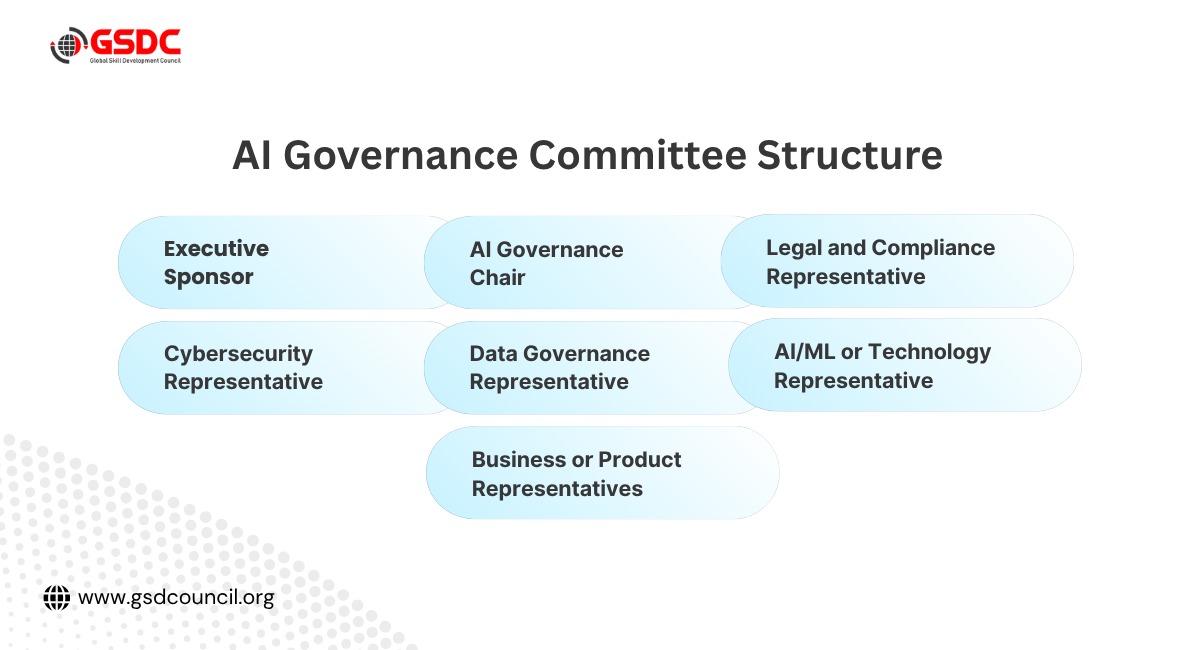
There is no single structure that works for every organization. A financial institution may require more extensive risk and compliance representation than a small technology company, while a global enterprise may need regional or business-unit representatives.
A practical committee can include the following roles.
1. Executive Sponsor
The executive sponsor provides senior-level authority and connects AI governance with organizational strategy.
Responsibilities can include:
- Approving the overall AI governance strategy
- Establishing or approving AI risk tolerance
- Providing resources for governance activities
- Reviewing significant AI risks
- Escalating major issues to executive leadership or the board
NIST specifically notes that executive leadership should take responsibility for decisions concerning risks associated with AI development and deployment.
2. AI Governance Chair
The chair coordinates the committee's activities and ensures governance decisions are followed through.
Typical responsibilities include:
- Setting the committee agenda
- Coordinating AI risk reviews
- Maintaining governance documentation
- Tracking decisions and exceptions
- Monitoring remediation activities
- Escalating unresolved issues
The chair may come from an AI, risk, compliance, technology, or another function depending on the organization's structure.
3. Legal and Compliance Representative
Legal and compliance specialists help determine whether proposed AI uses meet applicable legal, regulatory, contractual, and organizational requirements.
They may review:
- Data protection requirements
- Intellectual property considerations
- Industry regulations
- Contractual obligations
- Transparency requirements
- AI-related regulatory developments
This role is particularly important for generative AI compliance, because organizations may need to evaluate how generative AI tools process data, produce content, and interact with customers or employees.
4. Cybersecurity Representative
The security function evaluates threats associated with AI systems, applications, integrations, and data.
Areas of responsibility can include:
- Access controls
- AI application security
- Third-party AI services
- Prompt injection and other AI-related attacks
- Data protection
- Security monitoring
- AI-related incident response
Security oversight is especially important where employees or applications can submit confidential information to external AI services.
5. Data Governance Representative
AI governance and data governance are closely connected.
The data governance representative can establish requirements for:
- Data classification
- Data quality
- Data access
- Data provenance
- Data retention
- Privacy
- Appropriate use of organizational data
This helps address AI data leakage, unauthorized data processing, and inappropriate use of sensitive information with AI systems.
6. AI/ML or Technology Representative
The technical representative provides expertise on how AI systems are designed, acquired, evaluated, deployed, monitored, and maintained.
Responsibilities can include:
- Model evaluation
- AI architecture
- Testing
- Performance monitoring
- Model documentation
- Third-party model assessment
- Technical controls
- AI lifecycle management
7. Business or Product Representatives
Business owners provide the context necessary to determine whether an AI system is appropriate for its intended purpose.
They can define:
- Business objectives
- Intended users
- Expected outcomes
- Operational requirements
- Acceptable performance levels
- Business impacts
- Human oversight requirements
This ensures that governance decisions are connected to actual business use rather than being based solely on technical considerations.
Core Responsibilities of an AI Governance Committee
Once established, the committee should have clearly documented responsibilities and decision rights.
1. Establish AI Policies and Standards
The committee should define organizational expectations for the development, acquisition, deployment, and use of AI.
An AI policy may address:
- Approved AI tools
- Prohibited use cases
- Sensitive data restrictions
- Human oversight
- Third-party AI requirements
- AI incident reporting
- Model monitoring
- Documentation
- Employee responsibilities
These policies should be periodically reviewed as AI capabilities, organizational requirements, and regulatory expectations change.
2. Maintain an AI Inventory
Organizations cannot effectively govern AI systems they do not know about.
An AI inventory can record:
- AI system or application
- Business owner
- Purpose
- Model or provider
- Data used
- Risk classification
- Deployment environment
- User population
- Monitoring requirements
- Review date
NIST recommends mechanisms for maintaining AI system inventories and notes that inventories can provide a holistic view of organizational AI assets.
3. Manage AI Risks
The committee should establish a consistent process for identifying, assessing, treating, and monitoring AI risks.
Depending on the use case, this can include:
- Privacy risks
- Security vulnerabilities
- Bias and harmful impacts
- Poor-quality or inaccurate outputs
- Lack of transparency
- Intellectual property concerns
- Third-party dependencies
- Excessive automation
- Regulatory exposure
For generative AI, these activities become part of broader generative AI risk management.
NIST's Generative AI Profile identifies governance, pre-deployment testing, content provenance, and incident disclosure as major considerations for managing generative AI risks.
4. Govern Shadow AI
One of the growing challenges for organizations is unauthorized AI adoption.
What Is Shadow AI?
Shadow AI refers to the use of AI tools, applications, models, or services within an organization without appropriate authorization, visibility, or governance.
An employee might use a public AI chatbot to summarize an internal document, generate code, analyze customer information, or create marketing content without realizing that the activity could create security, privacy, intellectual property, or compliance concerns.
Shadow IT vs Shadow AI
Shadow IT traditionally refers to employees using unauthorized technology, software, hardware, or cloud services.
Shadow AI is a related concept focused specifically on unauthorized AI use.
The difference is important because AI systems can introduce additional concerns involving prompts, model outputs, data exposure, automated decisions, model behavior, and third-party AI providers.
Shadow AI Risks
Common shadow AI risks can include:
- Confidential information being submitted to external AI services
- Exposure of intellectual property
- Unauthorized processing of personal information
- Unapproved third-party AI dependencies
- Inaccurate AI-generated outputs
- Lack of auditability
- Security vulnerabilities
- Compliance violations
Shadow AI Detection and Governance
Effective shadow AI governance should combine policies with visibility and employee awareness.
Organizations can consider:
- Approved AI tool registries
- Identity and access controls
- Network and application monitoring
- Data loss prevention
- SaaS discovery
- API monitoring
- Employee reporting mechanisms
- Periodic assessments of AI usage
The goal of shadow AI detection should not simply be to block every unapproved tool. The committee should understand why employees are using these tools and determine whether safer, approved alternatives can address the same business requirement.
AI Governance Decision-Making Workflow
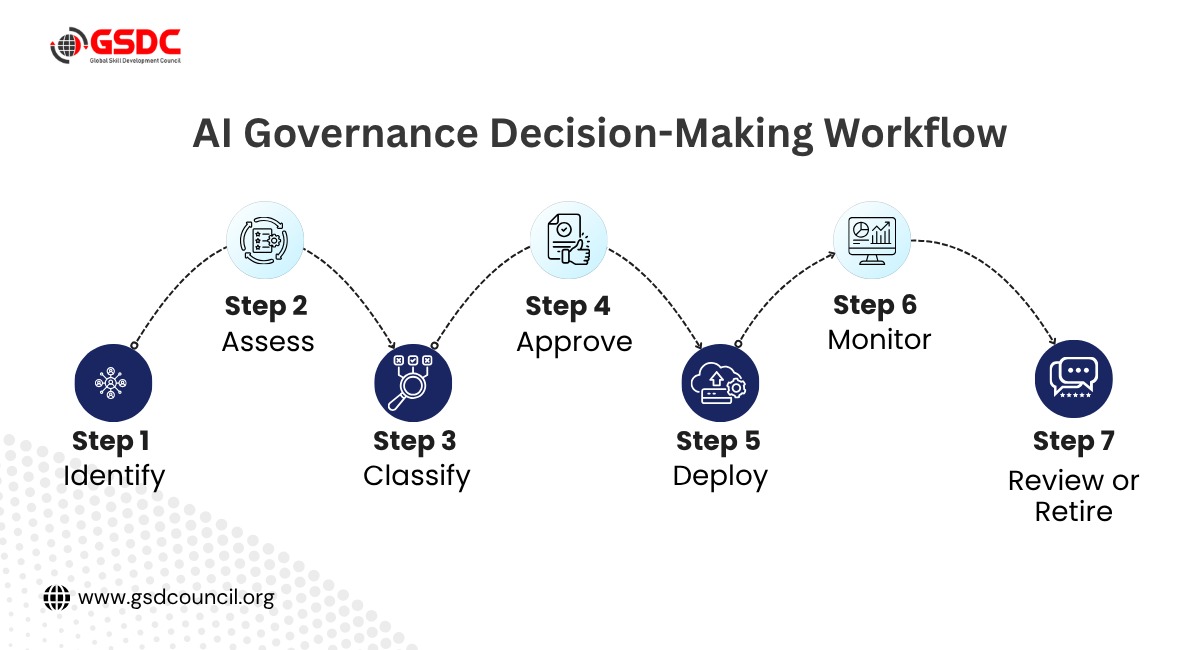
Rather than relying on a complex RACI matrix, organizations can make committee responsibilities easier to understand through a lifecycle-based decision workflow.
Step 1: Identify
A business team identifies an AI use case and registers it with the organization.
The initial documentation should explain:
- What the AI system will do
- Who will use it
- What data it will process
- Whether it involves a third-party provider
- What business outcome is expected
Step 2: Assess
Relevant stakeholders assess the proposed system.
Depending on the risk, this may involve legal, privacy, cybersecurity, data governance, compliance, procurement, and technical teams.
The objective is to understand the system's potential benefits, limitations, and risks.
Step 3: Classify
The organization determines the appropriate level of governance based on factors such as:
- Potential impact
- Data sensitivity
- User population
- Degree of automation
- Regulatory exposure
- Business criticality
Higher-risk applications should generally receive greater scrutiny and oversight.
Step 4: Approve
The appropriate authority reviews the assessment and determines whether the AI system can proceed, requires additional controls, or should not be deployed.
Approval should be documented along with any conditions or limitations.
Step 5: Deploy
Once approved, technical and business teams implement the AI system together with the required safeguards.
Controls may include:
- Access restrictions
- Human review
- Logging
- Data controls
- Security measures
- Testing requirements
- User training
Step 6: Monitor
Governance does not end after deployment.
The organization should monitor relevant aspects of AI system performance, risk, security, compliance, and changes in the operating environment.
NIST emphasizes that AI risk management should be continuous throughout the AI system lifecycle.
Step 7: Review or Retire
Significant changes to a model, provider, data source, use case, or level of automation may require another governance review.
When an AI system is no longer required or cannot meet organizational requirements, it should be safely decommissioned.
Build Practical AI Governance Skills with GSDC
The GSDC Certified AI Governance Professional certification helps professionals develop practical skills in AI governance, risk management, compliance, and responsible AI.
The program covers frameworks such as ISO/IEC 42001 and NIST AI RMF, along with AI inventories, risk registers, governance committees, RACI structures, impact assessments, data governance, Generative AI governance, security, and regulatory compliance.
Certified AI Governance Professional certification also focuses on implementing, monitoring, and improving enterprise AI governance programs. With practical learning, expert-led sessions, study resources, and job support, the certification can help professionals build capabilities for managing AI risks and supporting responsible AI adoption.
Final Thoughts
An AI Governance Committee provides an organizational foundation for responsible AI adoption. Its effectiveness depends on clearly defined responsibilities, appropriate decision rights, cross-functional participation, documented processes, and continuous oversight.
From establishing AI policies and maintaining an AI inventory to managing generative AI risks, addressing shadow AI risks, preventing AI data leakage, and supporting generative AI compliance, the committee connects AI strategy with operational accountability.
The objective is not simply to control AI use. It is to establish a repeatable governance process that helps organizations understand where AI is being used, identify the risks it creates, assign accountability, and respond as those risks evolve.
As AI becomes increasingly embedded in business processes, a well-structured governance committee can help turn AI governance from a reactive compliance activity into an ongoing organizational capability.

Related Certifications
Stay up-to-date with the latest news, trends, and resources in GSDC
If you like this read then make sure to check out our previous blogs: Cracking Onboarding Challenges: Fresher Success Unveiled
Not sure which certification to pursue? Our advisors will help you decide!