What Is Generative AI? A Complete Guide to Tools, Use Cases and Career Opportunities
Written by Matthew Hale
- What Is Generative AI?
- How Does Generative AI Work?
- Agentic AI vs Generative AI
- Why Generative AI Matters Right Now
- Key Generative AI Trends Right Now
- Generative AI Tools to Know
- Generative AI Applications and Use Cases Across Industries
- Generative AI Use Cases in the Workplace
- Generative AI Skills Employers Are Looking For
- What Skills Do You Need to Work With Generative AI?
- Generative AI Course vs Certification: What Should You Learn?
- The Future of Generative AI
A few years ago, generative AI was something people experimented with. Today, it is showing up inside the tools they already use for writing, research, coding, design, customer support, and everyday work.
So if you've typed "what is generative AI" into Google recently, or you're weighing a generative AI certification against a general AI course, this guide walks through the meaning, the tools worth knowing, where it's actually being used, and how to turn that knowledge into a career move.
What Is Generative AI?
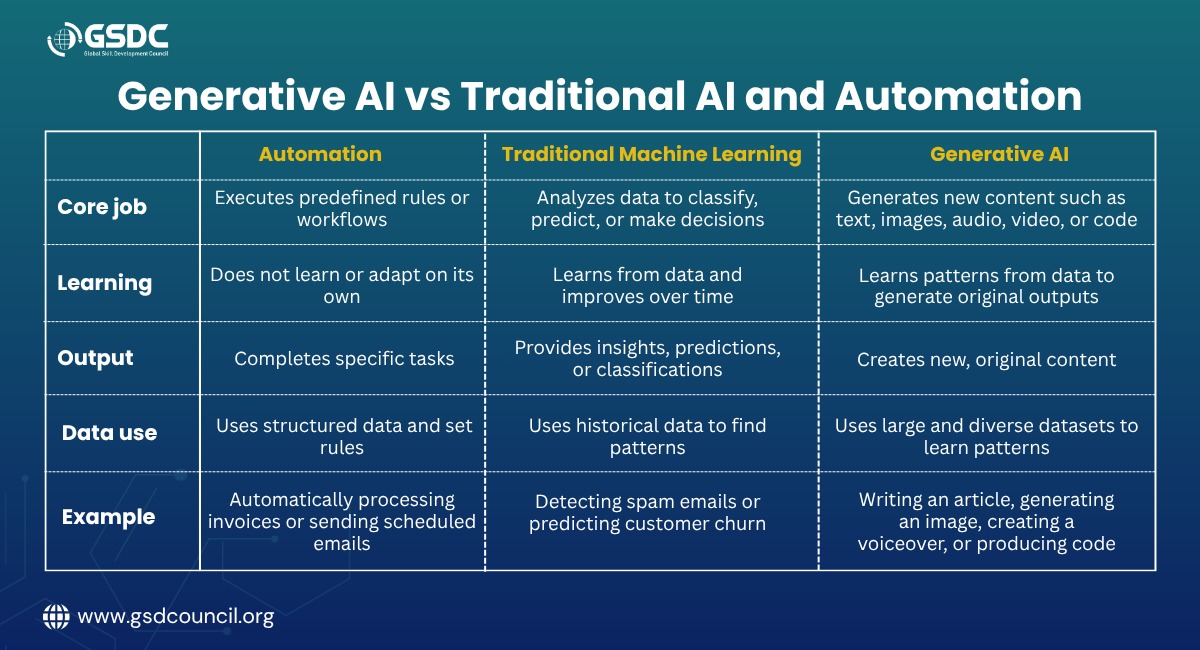
Generative AI, sometimes shortened to gen AI, refers to AI systems that create new content rather than just analyze existing data. Ask it for a blog outline, a product image, a snippet of code, or a voiceover, and it produces something that didn't exist a second ago. That's the core of generative AI meaning: creation, not just prediction.
How Does Generative AI Work?
Many generative AI systems are built on foundation models, including large language models for text and code and other models designed for images, audio, or video. They learn statistical patterns well enough to generate original, coherent output from a prompt.
This is also why prompt quality matters. A vague prompt tends to produce a vague answer. A specific one, with context and a clear format in mind, gets you something you can actually use. That's the idea behind prompt engineering: the discipline of writing inputs that reliably get useful outputs, especially in enterprise settings.
Agentic AI vs Generative AI
Agentic AI and generative AI are often discussed together, but they are designed for different kinds of tasks.
A simple way to think about the difference: generative AI primarily creates outputs in response to instructions, while agentic AI is designed to plan and carry out a sequence of actions toward a goal, often calling on external tools along the way. Generative AI answers. Agentic AI acts, though the amount of autonomy varies quite a bit from one agentic system to the next.
Generative AI | Agentic AI | |
Core job | Produces content (text, images, code) | Plans and executes steps toward a goal |
Behavior | Responds to a prompt | Can operate with limited ongoing human input |
Memory | Often stateless by default | Frequently retains context across steps |
Tool use | Limited unless added on | Commonly calls APIs and external systems |
Example | Writing an email draft when asked | Drafting a reply, checking a CRM, and scheduling a follow-up as one workflow |
Many agentic systems use generative AI models as part of their reasoning or decision-making layer. For professionals building careers in this space, understanding both technologies matters because AI-related roles increasingly sit across technical, business, and operational functions, not just one or the other.
Why Generative AI Matters Right Now
Generative AI has moved quickly from experimentation into everyday use. According to Stanford HAI’s 2026 AI Index Report, generative AI reached 53% population adoption within three years of ChatGPT’s launch, faster than the personal computer or internet. Organizational AI adoption also reached 88% in 2025, although most companies are still in the early stages of scaling AI.
Investment reflects the same momentum. Stanford reports that global corporate AI investment reached $581.7 billion in 2025, up 130% from the previous year.
The takeaway is simple: AI is becoming part of how organizations work, but adoption does not automatically translate into business impact. The next challenge is turning AI tools into reliable, measurable workflows. McKinsey’s 2025 State of AI research similarly highlights workflow redesign and AI governance as important steps toward capturing value from generative AI.
Key Generative AI Trends Right Now
- Agentic workflows becoming more common.
Multi-step AI agents increasingly handle tasks like drafting, checking data sources, and reporting results with less ongoing supervision.
- Multimodal AI as the default.
Tools increasingly handle text, images, audio, and video together instead of one at a time, producing responses that feel more natural.
- Embedded workplace AI.
Generative features are built directly into Office, Google Workspace, and Zoom, so people use AI without opening a separate app.
- Growing ROI scrutiny.
As budgets scale, leadership teams are asking harder questions about which tools deliver measurable value, not just which ones are trending.
- A widening skills gap.
As adoption grows, knowing how to choose, use, evaluate, and manage AI tools is becoming a valuable workplace skill. This is also why structured learning paths such as a Generative AI Foundation Certification can be relevant for professionals who want to build practical confidence across different AI tools, rather than learning one platform in isolation.
Generative AI Tools to Know
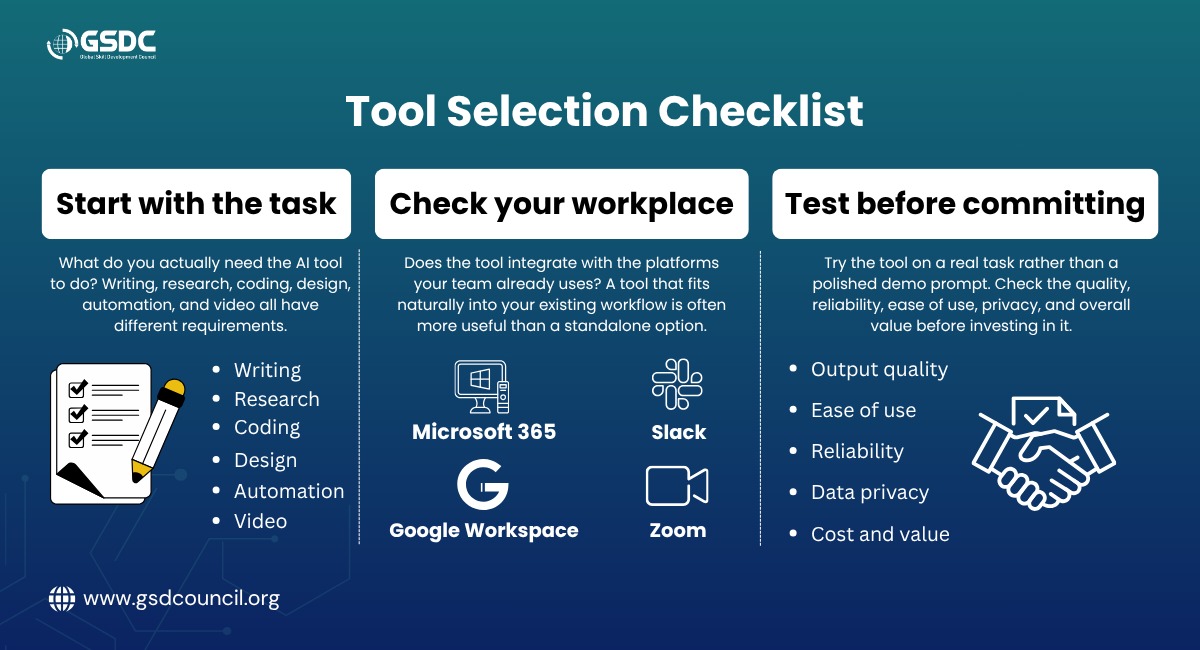
If you're comparing generative AI tools for enterprise deployment rather than individual use, the tool name matters less than what sits underneath it. Worth evaluating before you commit:
- Security and data privacy controls around what happens to your input data
- Governance and access controls, so you can define who can use which model for what
- Integration depth with the systems your teams already work in
- Model choice and flexibility, rather than being locked into a single vendor
- Auditability, so outputs and decisions can be traced back
- Cost structure at scale, not just per-seat pricing
- Measurable business outcomes, defined before rollout, not after
For organizations building AI capabilities, the challenge is not simply selecting the best generative AI tools. Teams also need people who understand how to evaluate, use, and govern them effectively. This is where structured learning can help. GSDC’s AI-focused learning and certification programs can be one way for professionals to build a broader understanding of AI tools and their practical applications across workplace workflows.
Generative AI Applications and Use Cases Across Industries
Generative AI applications are already showing up across several sectors:
- HR and L&D:
Job descriptions, resume screening support, and personalized training content. Companies including Volkswagen and Unilever have incorporated generative AI into parts of their talent acquisition process.
- Marketing and sales:
Campaign drafts, email sequences, and customer data analysis. Coca-Cola has used AI to help test new flavor concepts based on customer feedback patterns.
- Business operations:
Forecasting, reporting, and process automation, with companies like Tesla and Netflix citing generative AI in parts of their operational workflows.
- Software development:
Code generation, debugging assistance, and documentation, one of the fastest-growing generative AI use cases in business.
- Customer service:
Chatbots and ticket routing that resolve routine queries before they need a human.
Generative AI Use Cases in the Workplace
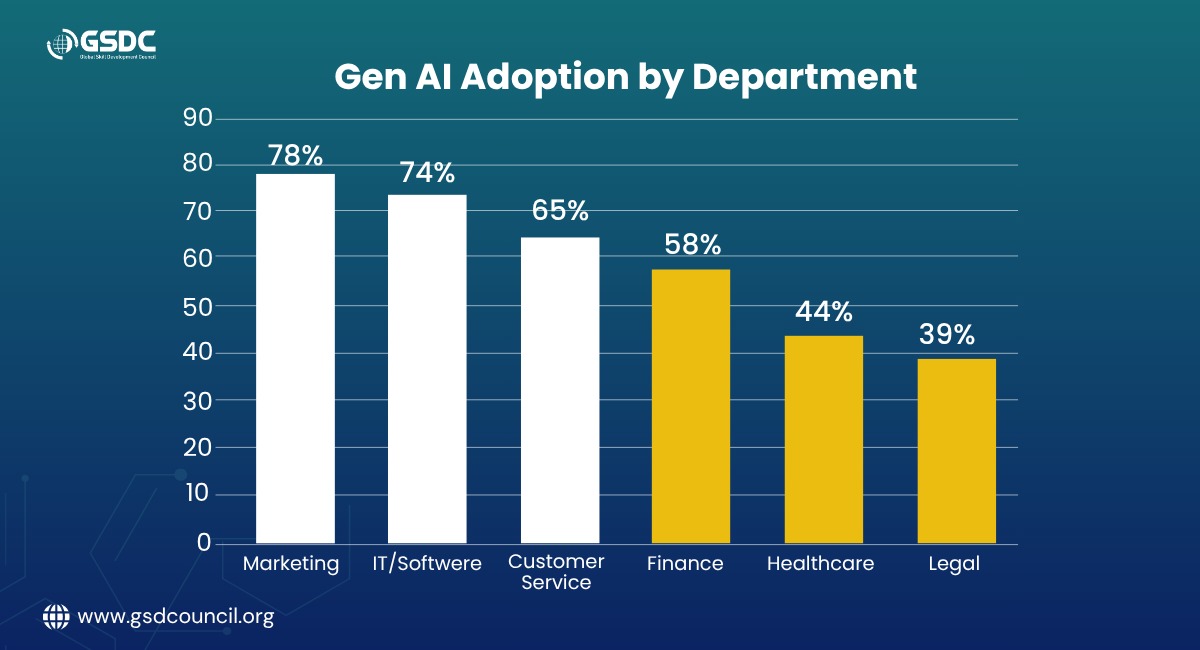
Zooming in from industry-wide applications to daily work, the most common generative AI use cases in business right now tend to be less dramatic than the headlines suggest: drafting a first version of an email, summarizing a long document before a meeting, generating a rough outline for a presentation, or turning meeting notes into an action list. The pattern across all of these is the same. Generative AI adapts to domain knowledge instead of replacing it, and it works best paired with someone who already understands the work, not as a standalone substitute for judgment.
Generative AI Skills Employers Are Looking For
Before jumping to certifications, it's worth understanding what's actually being asked for. The World Economic Forum's Future of Jobs Report places AI and big data at the top of the list of fastest-growing skills, ahead of cybersecurity and technological literacy. The same report estimates that 39% of workers' core skills will change by 2030, and that a majority of the global workforce will need some degree of reskilling in the years ahead.
In practice, that translates into a mix of two things: technical fluency with AI tools (prompt writing, evaluating outputs, integrating tools into a workflow) and the human skills that AI doesn't replace, like judgment, creative thinking, and the ability to adapt as tools change. Employers are increasingly looking for people who can do both, not just operate a chatbot.
What Skills Do You Need to Work With Generative AI?
Breaking that down further, the skills that come up most often across generative AI job postings and training programs fall into five practical buckets:
- AI fundamentals:
Understanding how models work at a basic level, including prompts, context windows, hallucinations, multimodal AI, and where these systems tend to get things wrong.
- AI tool fluency:
Knowing how to select and use tools based on the task at hand rather than defaulting to one platform for everything.
- Evaluation skills:
Knowing how to fact-check, test, and improve AI output before it goes anywhere near a client, customer, or decision.
- Workflow thinking:
Understanding where AI fits into an existing process, and just as importantly, where human review still needs to happen.
- Domain expertise:
Applying AI knowledge to a specific field, whether that's marketing, HR, finance, content, software, or operations, rather than treating AI skill as generic.
Generative AI Career Opportunities
That skills shift is already reshaping hiring. As organizations adopt generative AI, new AI-adjacent responsibilities are emerging across content, consulting, workflow automation, and business operations. Not every AI-adjacent role requires a traditional computer science background. Requirements vary considerably by role, with some positions emphasizing domain expertise, workflow design, and AI tool proficiency, while more technical roles may still require programming, data, or machine learning skills.
How to Start Learning Generative AI
You don't need to master everything at once. A realistic starting path looks like this:
- Pick one or two tools. Start with a text tool and either a design or productivity tool, not five at once.
- Apply it to something real. Use it for a task you already do weekly, like summarizing meeting notes or drafting outreach emails.
- Build a small project. Refresh your resume, write a few LinkedIn posts, or design a simple graphic using AI support.
- Get feedback. Share what you build and stay close to how the tools are evolving, since this space changes month to month.
- Stay consistent. Ten focused minutes a day adds up faster than one long session a month.
Generative AI Course vs Certification: What Should You Learn?
Not everyone needs the same starting point. A short generative AI course is usually enough if you want a working familiarity with tools like ChatGPT, Gemini, or Copilot for your own day-to-day tasks. A more structured generative AI certification makes more sense if you want to demonstrate applied skills to an employer, move into an AI-adjacent role, or lead adoption within a team, since it typically covers governance, tool selection, and use-case design in more depth than a single tool tutorial.
For professionals who want structured learning, a Generative AI Foundation Certification can provide a framework for building and validating foundational skills. GSDC offers an AI-focused certification option for learners who want to formalize their understanding of AI tools and applications, covering practical application across content creation, search optimization, and business process automation rather than just tool mechanics.
The Future of Generative AI
The tools themselves will keep changing, sometimes faster than any single guide can track. What's less likely to change is the underlying shift: AI is moving from something people occasionally experiment with to something built into how work gets planned, drafted, and reviewed. The professionals who get the most from generative AI won't necessarily be the ones who know the most tools. They'll be the ones who know when to use them, how to evaluate the output, and where human judgment still matters.

Related Certifications
Frequently Asked Questions
Generative AI is a category of AI systems that create new content, such as text, images, audio, video, or code, based on a prompt, rather than simply analyzing existing data.
Common uses include drafting written content, generating images and video, writing and debugging code, summarizing documents, and automating parts of customer service and marketing workflows.
ChatGPT, Gemini, Claude, and Microsoft Copilot are among the most widely used text and chat tools, alongside tools like Midjourney and Canva for image generation.
No. ChatGPT is one product built on generative AI technology. Generative AI is the broader category that also includes image, video, audio, and code generation tools from many different companies.
Generative AI creates content in response to a prompt. Agentic AI plans and carries out a sequence of actions toward a goal, often with less ongoing human input.
For professionals who want to formalize applied skills and stand out for AI-related roles, a certification can be a useful way to structure learning and demonstrate that knowledge to employers, though it works best paired with hands-on practice rather than in place of it.
Beginners generally do well starting with a short, tool-focused course that covers one or two platforms in depth before moving to a broader certification that covers strategy, governance, and business use cases.
Stay up-to-date with the latest news, trends, and resources in GSDC
If you like this read then make sure to check out our previous blogs: Cracking Onboarding Challenges: Fresher Success Unveiled
Not sure which certification to pursue? Our advisors will help you decide!