Top 5 ISO 9001 Lead Auditor Exam Mistakes to Avoid in 2026
Written by Matthew Hale
- A Quick Note on What This Exam Is Actually Testing
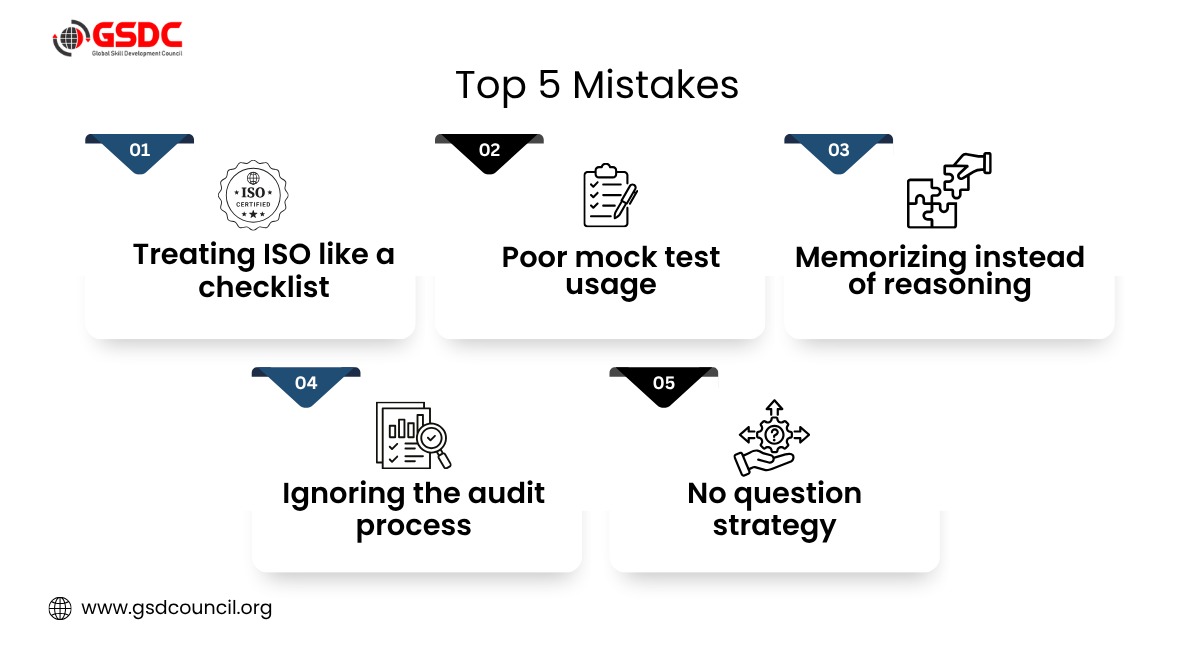
- Mistake #1: Treating ISO 9001 Like a Checklist Instead of a System
- Mistake #2: Taking Mock Tests Without Actually Learning From Them
- Mistake #3: Confusing Terminology With Judgment
- Mistake #4: Underweighting the Audit Process Content
- Mistake #5: Arriving at the Exam Without a Question-Reading Strategy
- A Preparation Timeline That Works
- What This Exam Is Actually Preparing You For
- Start Your Preparation the Right Way
- Conclusion
Every year, thousands of quality professionals across the United States sign up for Lead Auditor training with a genuine commitment - the study materials, the highlighted notes, the quiet confidence heading into exam week. And yet, a significant number walk out of that exam room disappointed. Not because the content was beyond them. Not because they didn't put in the hours. But because there's a specific kind of preparation this exam demands, most candidates don't realize what it is until it's too late.
If you've ever wondered why people fail the ISO 9001 Lead Auditor exam despite being experienced in quality management, the answer is rarely about intelligence or effort. It's almost always about approach. The mistakes are consistent, they're predictable - and once you know what they are, they're entirely avoidable.
That's exactly what this blog is about.
A Quick Note on What This Exam Is Actually Testing
Before diving into the mistakes, it’s worth being precise about what the ISO 9001 Lead Auditor exam is designed to measure.94
ISO/IEC 17021-3:2017 - the international standard that governs competence requirements for auditors of quality management systems - draws a clear distinction between knowledge and competence. Knowledge is understanding what a requirement says. Competence is the demonstrated ability to apply that understanding in real audit situations, under realistic conditions, with sound professional judgment.
The Lead Auditor exam is built to assess competence. Scenario-based questions are specifically designed to separate candidates who have studied the standard from those who can actually function as an auditor. That distinction is what makes this exam harder than people expect - and it shapes every mistake on this list.
Mistake #1: Treating ISO 9001 Like a Checklist Instead of a System
This is the most consistent pattern among candidates who struggle with their ISO 9001 study. They work through the standard clause by clause - read Clause 4, move to Clause 5, continue to Clause 10 - memorizing what each section requires without building a mental model of how the standard operates as a whole.
ISO 9001:2015 was intentionally restructured around what’s known as the High Level Structure (HLS) - a common architectural framework shared across all major ISO management system standards. This structure is grounded in the Plan-Do-Check-Act (PDCA) cycle and held together by two foundational principles: the process approach and risk-based thinking. These aren’t abstract concepts - they’re the logic that connects every clause to every other clause.
Clause 4 (Context of the Organization) establishes the risk and stakeholder landscape that everything else is built on. Clause 6 (Planning) is where identified risks and opportunities translate into concrete objectives and actions. Clause 9 (Performance Evaluation) is where you verify whether those actions achieved anything. A gap in one clause doesn’t stay contained - it ripples.
When the Lead Auditor exam puts you in a scenario and asks what an auditor should examine next, it’s nearly always testing whether you understand those ripple effects - not whether you can quote a clause word for word.
What to do instead: During your ISO 9001 preparation, invest time in mapping clause relationships explicitly. Draw the connections. Ask yourself: if an organization has a gap in Clause 6.1 risk planning, where would the evidence of that gap most likely surface - in Clause 8 operations, in Clause 10 corrective actions, or both? This kind of systems-based thinking is a core skill expected from professionals preparing for a Certified ISO 9001:2015 Lead Auditor role, where understanding how processes interact is often more important than memorizing clauses individually.
Mistake #2: Taking Mock Tests Without Actually Learning From Them
It’s common for candidates to take one or two ISO 9001 mock tests during their prep, check the score, note what they got wrong, and move on. That approach captures only a fraction of the value that practice testing offers - and misses the mechanism that makes it actually work.
Cognitive science research is clear on this point. A landmark review published in Psychological Science in the Public Interest (Dunlosky et al., 2013) found that retrieval practice - actively pulling information from memory under test conditions - produced significantly stronger long-term retention than re-reading, highlighting, or summarizing. These are the default study habits of most exam candidates.
For the Lead Auditor exam specifically, ISO 9001 mock tests expose you to the structure and phrasing of scenario-based questions, reveal time management problems, and surface knowledge gaps that are invisible during passive reading. Many incorrect answer options aren’t obviously wrong - they’re written to reflect what a well-intentioned but incompletely trained person might actually do.
What to do instead: Schedule at least three to four full-length, timed ISO 9001 mock tests as part of your auditor exam prep. After each one, do a structured review of every incorrect answer - not just identifying what the right answer was, but reasoning through why each wrong option was wrong. That deeper analysis is where real audit thinking develops, which is why many globally recognized certification frameworks, including programs aligned with GSDC standards, place strong emphasis on scenario-based learning and practical audit reasoning.
Mistake #3: Confusing Terminology With Judgment
Most candidates sitting the Lead Auditor exam can define “nonconformity” accurately. But ask them to read a scenario and determine whether what’s described constitutes a nonconformity, a minor observation, or an opportunity for improvement - and the hesitation is immediate.
This gap between knowing a definition and applying a concept is one of the primary documented reasons why people fail ISO 9001 Lead Auditor exam. The ISO 9001 exam is calibrated specifically to test the application. Scenario-based questions don’t reward the candidate who can quote the standard most precisely - they reward the candidate who can reason through an audit situation methodically and reach a defensible conclusion.
ISO 19011:2018 - the international guideline standard for auditing management systems - describes the attributes of a competent auditor in terms that go well beyond technical knowledge. Analytical thinking, systematic reasoning, professional skepticism, and sound judgment are all explicitly identified. These are the core of what it means to function as an auditor, and the exam is designed to assess whether you’ve begun to develop them.
What to do instead: When studying any concept during your auditor exam prep, push past the definition into application. Ask: How would I recognize this in a real audit? What would objective evidence look like? How would I write a nonconformity statement that’s specific, factual, and traceable to a requirement? Practicing this structured reasoning is one of the most high-value ISO exam tips that experienced practitioners consistently point to.
Mistake #4: Underweighting the Audit Process Content
Many candidates direct the bulk of their preparation energy toward understanding ISO 9001 requirements. That’s appropriate - the standard is foundational. But they allocate significantly less attention to the mechanics of how audits are actually conducted, and this creates a measurable blind spot on exam day.
The Lead Auditor exam draws substantially from ISO 19011:2018, which covers the full scope of audit program management and execution. Topics include: establishing audit objectives, scope, and criteria; selecting and preparing the audit team; conducting document reviews; preparing working documents; opening and closing meetings; interviewing techniques; gathering and recording evidence; classifying findings; writing the audit report; and managing corrective action follow-up.
Candidates who treated this content as secondary often find themselves confident on requirements-based questions and uncertain when the question shifts to what a lead auditor should do when evidence contradicts a procedure, or how a finding should be categorized based on the scenario described.
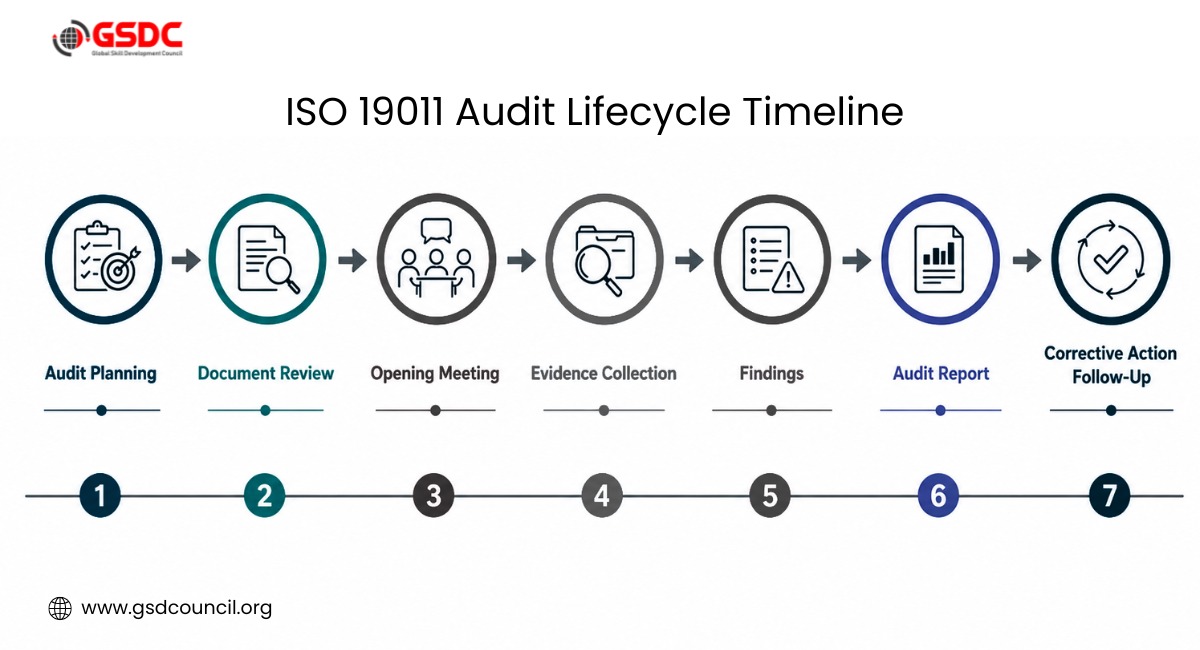
What to do instead: Structure your ISO 9001 study so that audit process content receives equal priority alongside the standard. Work through the complete audit lifecycle - from program planning through post-audit activities - and understand the decision points a lead auditor encounters at each stage. Scenario questions spanning the full audit lifecycle are among the highest-value ISO 9001 preparation you can do.
Mistake #5: Arriving at the Exam Without a Question-Reading Strategy
This tends to be dismissed as less important than “real” content preparation. In practice, it’s one of the most consistent differentiators between candidates who pass and those who don’t.
The scenario-based questions in the Lead Auditor exam are carefully constructed. They frequently include two answer options that both appear reasonable - one reflecting what a good quality professional might instinctively do, and one reflecting what a properly trained auditor operating within their defined scope and methodology should do. Those are not always the same answer, and the distinction is intentional.
There’s a time management dimension here as well. Depending on the format, Lead Auditor exams typically present 40 to 80 questions across a two-to-three-hour window. Without a deliberate pacing strategy, candidates routinely find themselves with too many questions and too little time.
What to do instead: Build your question strategy during ISO 9001 mock test sessions, not on exam day. Practice identifying what each scenario question is actually testing before reading the answer options. Develop a habit of eliminating answers that fall outside the auditor’s role or contradict either ISO 9001 or ISO 19011. Set a time budget per question during practice runs and enforce it. This disciplined, standards-grounded thinking is the clearest expression of the best way to pass ISO 9001 Lead Auditor exam - and it’s a skill that transfers directly into your career as a practicing auditor.
A Preparation Timeline That Works
Based on outcomes tracked across GSDC’s certification programs, candidates who follow a structured seven-to-eight-week ISO 9001 preparation schedule - averaging eight to ten focused hours per week - consistently outperform those who compress or skip stages:
Weeks 1–2: Standards Mastery
Deep ISO 9001 study of ISO 9001:2015. Focus on the HLS framework, the process approach, risk-based thinking, and how the clauses interconnect. Read actively - annotate, question, and build connections between concepts rather than just moving through the text.
Weeks 3–4: Audit Process Foundations
Work through ISO 19011:2018. Map the full audit lifecycle from program planning through corrective action follow-up. Understand the role of the lead auditor at each stage, documentation requirements, and how findings are classified and communicated.
Weeks 5–6: Applied Scenario Practice
Shift into scenario-based question work. Begin full-length, timed ISO 9001 mock tests. Track error patterns systematically. Return to the source material for any concept generating consistent errors.
Week 7: Strategy and Consolidation
Focus on question-reading technique and time management. Review your most common error patterns from weeks five and six. These are ISO 9001 Lead Auditor exam tips and tricks that pay off most in the final stretch.
Final Days: Rest and Readiness
Light review only. At this stage, sleep and mental composure contribute more to performance than additional content consumption.
What This Exam Is Actually Preparing You For
It’s worth stepping back from the prep mechanics for a moment to note what the Lead Auditor credential actually represents in professional terms.
ISO 9001 is the most widely adopted management system standard in the world, with over one million certified organizations across more than 170 countries as of the most recent ISO Survey. Lead auditors are the professionals trusted to evaluate whether those organizations are genuinely implementing the standard or simply maintaining the appearance of doing so. That’s a significant professional responsibility - and the exam reflects it.
Candidates who approach their ISO 9001 preparation as professional development - building the judgment, discipline, and reasoning of a real auditor - tend to find both the ISO 9001 exam and the work that follows significantly more manageable. The exam is a checkpoint, not the destination.
Start Your Preparation the Right Way
Here at the Global Skill Development Council, our ISO 9001 Lead Auditor courses are crafted in the mold of competency-based instruction – meaning that they teach you to think like the ISO 9001 exam.
We provide you with organized Lead Auditor training from certified professionals with practical auditing experience, ISO 9001 sample test questions complete with explanations for each answer, audit simulations that sharpen the practical reasoning tested in the exam, and strategic planning for answering scenario-based questions.
US professionals have relied upon our course materials in order to successfully obtain their ISO 9001 Lead Auditor certification. Start preparing the right way with us today.

Conclusion
The process of preparing for the ISO 9001 Lead Auditor exam does not necessarily mean remembering the content of the clauses and sitting through a couple of exams. It rather consists of developing the right mindset – making connections between processes, forming opinions based on evidence, and understanding how management systems work overall.
The positive thing is that exam errors can be largely predicted and, thus, prevented by using an appropriate set of preparation tactics. Using scenario learning, structured mock test preparation, knowledge of the audit process, and standards reasoning, one can enter the exam hall with increased confidence.
Most importantly, such preparation does not only imply obtaining the certification but developing the skills required to conduct an audit. The skills practiced while getting ready for an exam include analytical skills, risk assessment, planning, and decision-making.

Related Certifications
Frequently Asked Questions
The ISO 9001 Lead Auditor exam can be challenging because it focuses heavily on scenario-based thinking, audit judgment, and practical application of ISO 9001 requirements rather than simple memorization.
Most professionals prepare effectively within 6–8 weeks using a structured study plan that includes ISO 9001 study, ISO 19011 guidance, and regular mock test practice.
The best preparation strategy includes:
- understanding ISO 9001 clauses deeply
- studying ISO 19011 audit processes
- practicing scenario-based questions
- taking timed ISO 9001 mock tests
- improving audit reasoning skills
Yes. ISO 9001 mock tests help candidates improve time management, understand question patterns, identify weak areas, and develop practical audit-thinking skills.
Common mistakes include:
- relying only on memorization
- skipping audit process preparation
- avoiding mock tests
- misunderstanding scenario-based questions
- lacking time management strategies
Not always. While auditing experience can help, many professionals successfully pass the exam through structured training, practical preparation, and consistent mock test practice.
ISO 19011 provides guidance on audit principles, audit planning, evidence collection, audit reporting, and auditor responsibilities — all of which are commonly tested in Lead Auditor exams.
The exam typically evaluates:
- analytical thinking
- audit judgment
- evidence evaluation
- risk-based thinking
- audit planning
- nonconformity classification
- decision-making skills
The number of questions varies by certification body and training provider, but many Lead Auditor exams include approximately 40–80 scenario-based questions completed within a limited time frame.
Yes. A Certified ISO 9001:2015 Lead Auditor credential can help professionals strengthen auditing expertise, improve quality management knowledge, and access opportunities in compliance, quality assurance, and management system auditing roles.
Stay up-to-date with the latest news, trends, and resources in GSDC
If you like this read then make sure to check out our previous blogs: Cracking Onboarding Challenges: Fresher Success Unveiled
Not sure which certification to pursue? Our advisors will help you decide!