ISO 9001 Lead Auditor vs Six Sigma: Which Is Right for You?
Written by Matthew Hale
- Why Quality Certifications Matter More Than Ever in the US
- What Is ISO 9001 Lead Auditor Certification?
- What Is Six Sigma Certification?
- ISO 9001 Lead Auditor vs Six Sigma: Where They Fundamentally Different
- What the US Job Market Actually Pays
- Side-by-Side Comparison
- Which One Is Better for Career Growth in the US?
- Why ISO 9001 Lead Auditor Deserves Serious Consideration in 2025
- Building Practical Audit Skills for Long-Term Growth
- Final Thoughts: Be Strategic About Where You Invest
If you're looking to grow your career in quality management in the United States, chances are you've been weighing two of the most talked-about credentials in the field: ISO 9001 Lead Auditor certification and Six Sigma. Both are respected. Both are in demand. And both will genuinely move the needle on your career - but in very different directions.
The problem is that most comparison guides treat them as interchangeable options on a checklist. They're not. Choosing between them without understanding what each actually does - and who it's built for - can mean investing months of effort into a certification that doesn't align with where you actually want to go.
This blog cuts through the noise. We'll break down what each credential involves, where they differ in focus and application, what the US job market actually pays for each, and most importantly, which one makes the most strategic sense for your career goals right now.
Why Quality Certifications Matter More Than Ever in the US
Let's take a step back before we get into the comparison - because the why matters here.
Not too long ago, quality management was seen as a support function. The team in the corner that checked boxes and filed reports. That's changed significantly. Today, quality professionals are sitting at the table when companies make decisions about supply chains, regulatory compliance, and long-term growth strategy - particularly in sectors like aerospace, healthcare, medical devices, automotive, and advanced manufacturing, where the cost of getting quality wrong is measured in contracts lost, recalls issued, and reputations damaged.
And the numbers back this up in a pretty striking way.
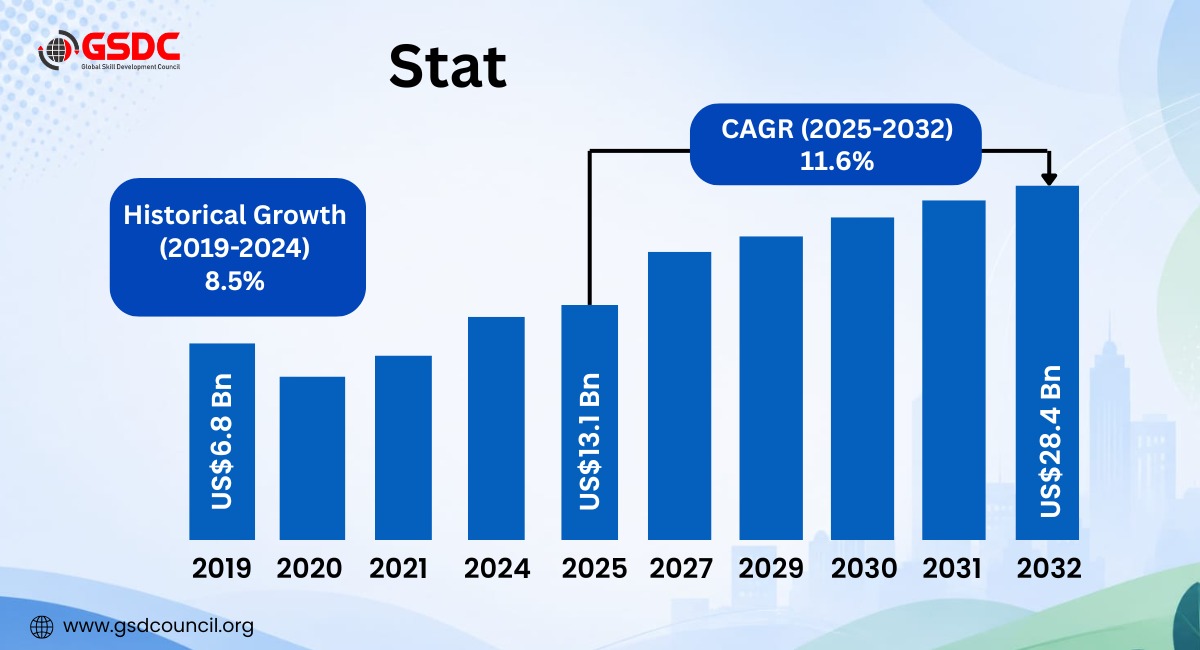
As of 2024, over 2.1 million organizations worldwide hold at least one ISO certification - up 7.8% from the year before. In the US alone, more than 120,000 businesses are ISO 9001 certified. The global ISO certification market was valued at around $12.7 billion in 2024, and it's projected to keep growing at a 7.1% CAGR through 2033 - which is the kind of growth trajectory that creates real, sustained demand for qualified professionals, not just a short-term hiring spike.
Six Sigma tells a similar story. A 2025 labor market scan found over 48,000 active US job postings referencing Six Sigma skills on LinkedIn - and that number has been climbing year on year.
The point is this: the demand is there. The career opportunity is real. The only question worth asking is which path gets you to where you actually want to go.
What Is ISO 9001 Lead Auditor Certification?
Every organization that holds an ISO 9001 certificate needs someone qualified to assess whether their quality systems actually hold up. That someone is a Lead Auditor.
The ISO 9001 Lead Auditor certification qualifies you to plan, lead, conduct, and report on audits of an organization's Quality Management System (QMS) against the ISO 9001:2015 standard. This isn't a passive credential; you're the professional who walks into an organization and evaluates whether their quality systems are genuinely functioning, identifying nonconformities, assessing risks, and recommending corrective actions. The stakes of a failed audit, lost certification, regulatory trouble, and supply chain disruption are simply too high for anything less.
What gives this certification its staying power is how many ways you can use it. The same credential lets you work as:
- An internal auditor keeping a company's QMS compliant and audit-ready on an ongoing basis
- A second-party auditor assessing suppliers on behalf of clients - common in automotive, aerospace, and medical device supply chains
- A third-party auditor conducting formal ISO 9001 certification and surveillance audits with an accredited certification body
- An independent consultant helping organizations prepare for certification or close out nonconformities
That last point is worth noting. Very few quality credentials open the door to independent consulting, and the ISO 9001 Lead Auditor is one of them. It's recognized and required by international certification bodies, making it portable across industries, borders, and business types.
The GSDC Certified ISO 9001:2015 Lead Auditor program develops professionals who can operate confidently across quality management, compliance, supplier audits, and continuous improvement in regulated, globally operating industries.
Best suited for: Quality managers, compliance professionals, supplier quality leads, internal audit managers, and anyone looking to assess and improve organizational quality systems in-house or as a consultant.
What Is Six Sigma Certification?
If ISO 9001 is about evaluating whether an organization's quality system meets a standard, Six Sigma is about rolling up your sleeves and fixing what's broken inside a process. It's a data-driven methodology built around one core idea: defects and variation are measurable, and if you can measure them, you can eliminate them.
Six Sigma originated at Motorola in the mid-1980s and really took off when General Electric made it the backbone of its operations strategy in the 1990s. Since then, it's become one of the most widely used process improvement frameworks across manufacturing, healthcare, logistics, and beyond.
The methodology runs on a structured five-step problem-solving framework called DMAIC:
- Define the problem and what success looks like
- Measure how the current process is actually performing
- Analyze the data to find the real root causes, not assumptions
- Improve the process by directly addressing those root causes
- Control the improved process so the gains stick
Certifications follow a belt-level progression - yes, borrowed from martial arts:
- Yellow Belt - foundational understanding, supports project teams
- Green Belt - leads smaller improvement projects with solid data analysis skills
- Black Belt - leads complex, cross-functional, high-impact projects
- Master Black Belt - coaches Black Belts and drives Six Sigma strategy at the organizational level
One thing worth knowing before you commit: there's no single governing body for Six Sigma certification. Multiple organizations offer it, and the rigor and employer recognition can vary quite a bit depending on who issued your credential. The provider you choose matters - so do your homework before enrolling.
Best suited for: Engineers, operations managers, manufacturing professionals, and process improvement specialists who are comfortable working with data and want to drive measurable efficiency gains at the process level.
ISO 9001 Lead Auditor vs Six Sigma: Where They Fundamentally Different
This is the comparison most people get wrong - and once you understand the distinction clearly, the right choice for your career becomes much easier to identify.
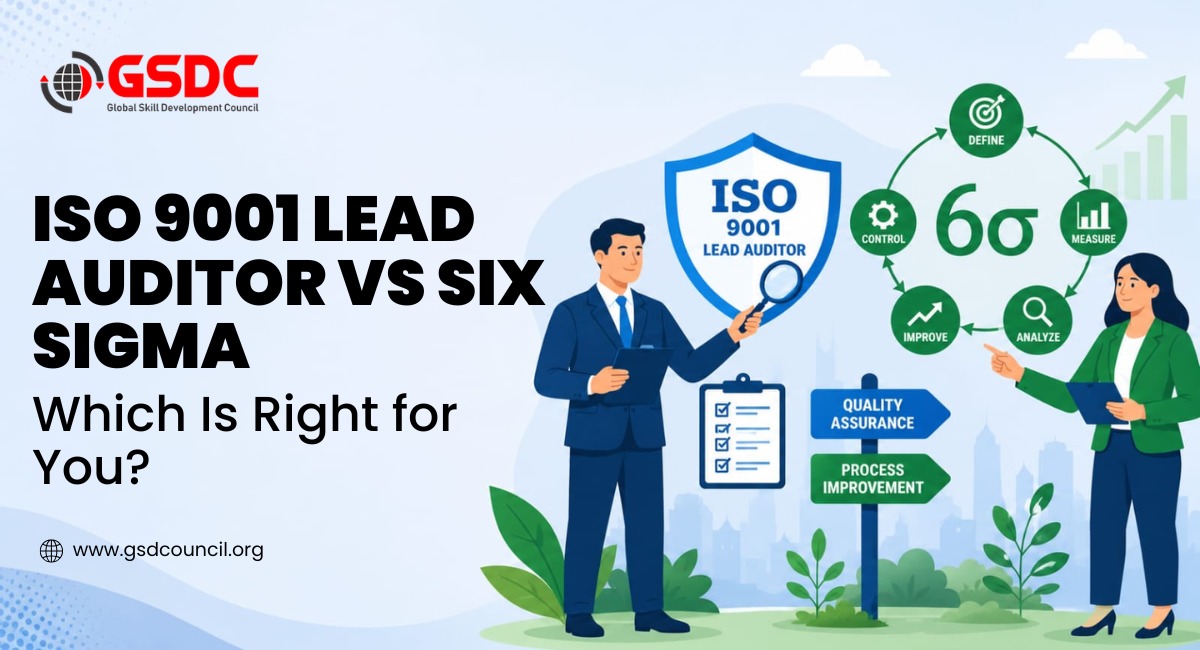
- ISO 9001 Lead Auditor is a systems-level credential. It asks: Does this organization's Quality Management System meet the requirements of ISO 9001:2015? The Lead Auditor's job is to evaluate the entire organization's approach to quality - its policies, procedures, processes, documentation, and outcomes - and determine whether the system as a whole is conforming to the standard and driving genuine improvement.
- Six Sigma is a process-level methodology. It asks: How do we eliminate defects and reduce variation in this specific process? A Six Sigma Black Belt dives deep into individual processes using statistical tools - control charts, regression analysis, hypothesis testing, design of experiments - to identify and fix the root causes of inefficiency or defects.
Think of it this way: the ISO 9001 Lead Auditor looks at the forest. Six Sigma looks at individual trees.
Neither perspective is more important than the other. But they serve fundamentally different organizational needs - and they lead to very different career paths.
When a company needs an ISO 9001 Lead Auditor:
- Preparing for initial ISO 9001 certification
- Undergoing surveillance or recertification audits
- Conducting supplier qualification audits
- Responding to nonconformities identified by an external certifier
- Building or overhauling their internal audit program
When a company needs a Six Sigma professional:
- A production line is generating too many defects
- Customer complaints are rising, and the root cause is unclear
- A business process has excessive cycle time or cost
- Leadership wants to drive measurable, data-backed efficiency improvements
The organizations that tend to hire both - and many do - are typically larger manufacturers, healthcare systems, or aerospace/defense contractors running mature quality operations. At that level, having professionals who bring both capabilities is genuinely valuable.
What the US Job Market Actually Pays
Salary data is one of the most honest indicators of market demand, so let's look at what each credential commands in the current US job market.
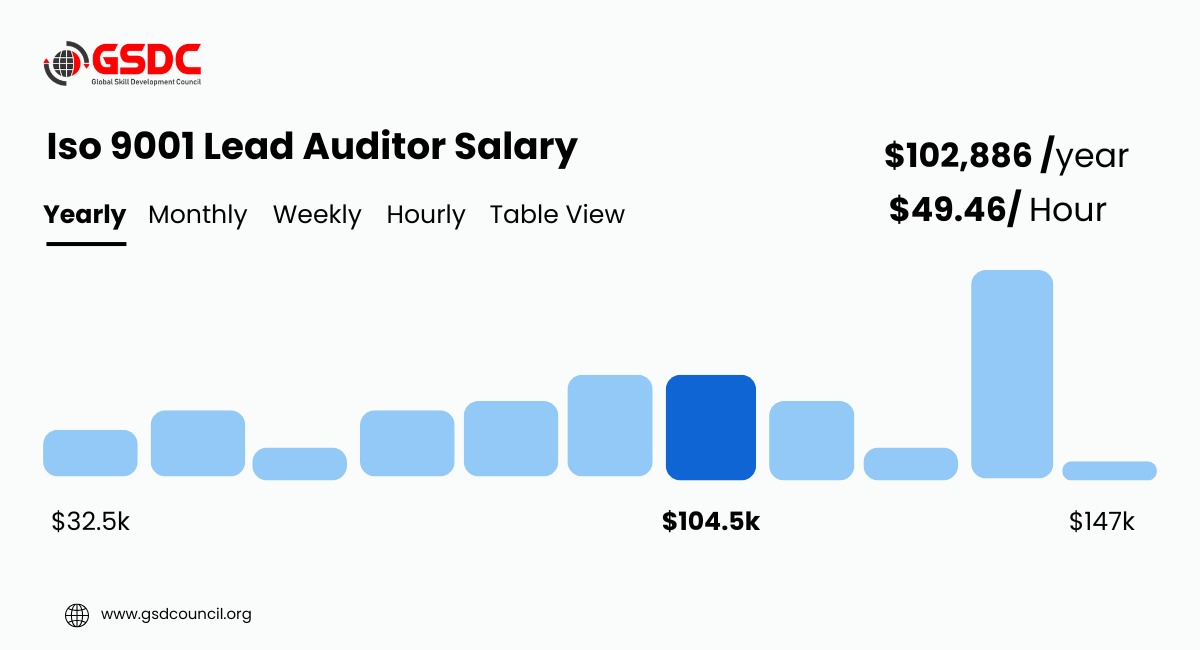
ISO 9001 Lead Auditor: According to ZipRecruiter data from early 2026, the average ISO 9001 Lead Auditor salary in the United States is approximately $102,886 per year, with top earners exceeding $147,000 annually. Senior Lead Auditors and independent consultants in high-demand industries like aerospace, medical devices, and pharmaceutical manufacturing often earn at the upper end of this range or beyond
-
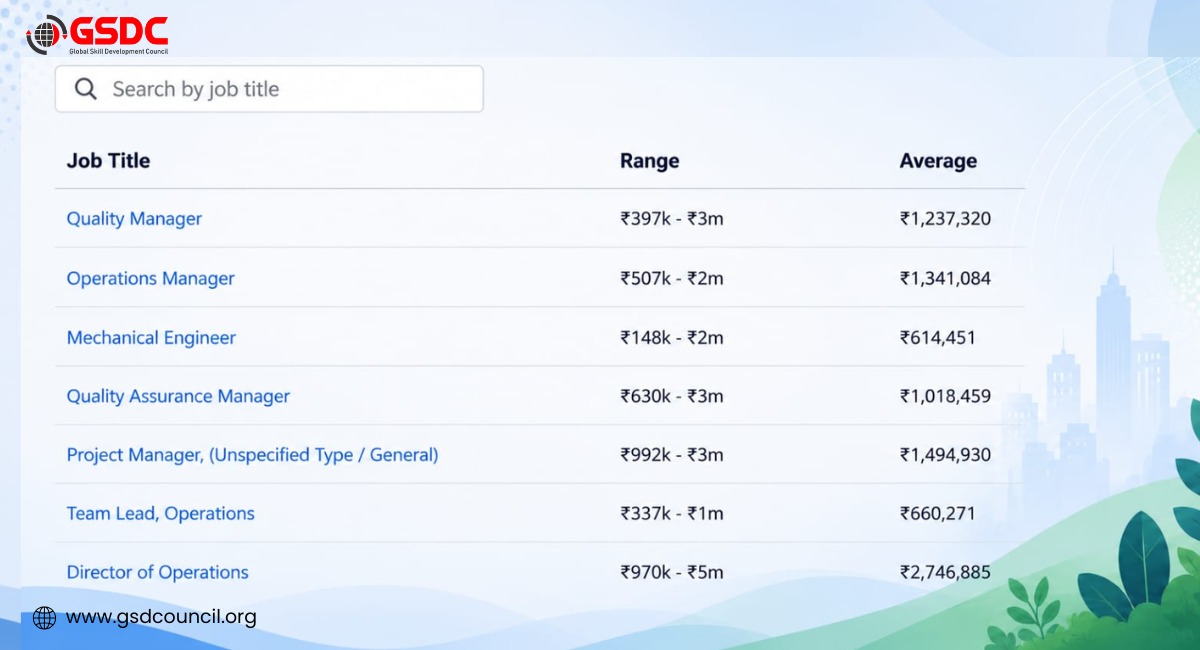
- Six Sigma: Six Sigma salary potential varies by belt level, industry, and experience. According to industry salary data, Certified Six Sigma Green Belt professionals can earn an average salary of approximately $8,000–$12,000 per year in India, while experienced Black Belt professionals are often associated with significantly higher-paying leadership and process improvement roles.
The Six Sigma salary premium at the Black Belt and Master Black Belt level is real - but it's tied to seniority and project leadership responsibility. A Black Belt is expected to lead complex, cross-functional improvement initiatives and demonstrate measurable financial impact. The higher pay reflects higher-stakes expectations.
-
- For ISO 9001 Lead Auditors, the earning potential through independent consulting and third-party audit work can be substantial - particularly for those who build specialist expertise in sectors like aerospace (AS9100), medical devices (ISO 13485), or automotive (IATF 16949).
- One important factor for US professionals to consider: 82% of manufacturers in the United States prioritize ISO 9001 standards for supply chain transparency, according to 2024 industry data. That level of adoption means auditing work - and demand for qualified Lead Auditors - isn't going away.
Side-by-Side Comparison
Factor | ISO 9001 Lead Auditor | Six Sigma (Black Belt) |
Primary Focus | QMS auditing & compliance | Process improvement & defect reduction |
Core Framework | ISO 9001:2015 standard | DMAIC methodology |
Approach | Systems-level evaluation | Process-level analysis |
Best For | Auditors, compliance leads, consultants | Engineers, operations, process analysts |
Global Recognition | Very high - required by certification bodies | High - varies by issuing provider |
Avg. US Salary | ~$102,886/yr | ~$132,800/yr (Black Belt) |
Top Earner Potential | $147,000+ (more via consulting) | $180,000+ (Master Black Belt) |
Career Path | Lead Auditor → Quality Director → Consultant | Green Belt → Black Belt → Master Black Belt |
Entry Barrier | Moderate (accredited training + exam) | Low to moderate (varies by provider) |
Consulting Potential | Very high | Moderate |
Industry Portability | Extremely high across all sectors | Strong in manufacturing, healthcare, ops |
Standardization | Globally standardized (ISO/IRCA) | No universal standard - varies by body |
The Global Skill Development Council (GSDC) focuses on helping professionals build practical knowledge in quality management, auditing, compliance, supplier quality, and continuous improvement practices used across modern industries.
Which One Is Better for Career Growth in the US?
There's no single right answer here - but there is a right answer for you, depending on what kind of work you want to do.
Choose ISO 9001 Lead Auditor if:
- You want to work in auditing, compliance, or supplier quality management
- You're drawn to assessing and improving organizational systems rather than individual processes
- You want internationally portable credentials that work across global supply chains
- You're interested in building an independent consulting practice
- You work in or want to break into aerospace, medical devices, pharmaceuticals, food manufacturing, or automotive - all of which are heavily ISO-driven
- You want to achieve a meaningful credential without needing 8+ years of experience first
Choose Six Sigma if:
- You're an engineer or operations professional whose daily work involves process data and improvement projects
- You want to lead data-intensive projects with measurable financial outcomes
- Your organization already uses Six Sigma as its primary improvement methodology
- You're aiming for senior operations or engineering leadership roles
- You enjoy statistical analysis and working at the granular process level
Consider both if:
- You're aiming for a Quality Director or VP of Quality role in a large US manufacturer
- You want to position yourself as a complete quality professional capable of both system-level auditing and process-level improvement
- Your industry requires compliance with ISO standards and aggressive efficiency targets
That last scenario - holding both credentials is increasingly common among senior quality leaders in the US. An ISO 9001 Lead Auditor who also holds a Six Sigma Black Belt brings a rare, high-value combination that commands serious attention from hiring managers in complex industrial organizations.
Why ISO 9001 Lead Auditor Deserves Serious Consideration in 2025
ISO 9001 Lead Auditor tends to be seen as a mere compliance certification, but there is no doubt that the value of the ISO 9001 Lead Auditor increases with each passing year within international industries. With ISO 9001 standards being applied to 1.4 million certifications worldwide and to 120 thousand businesses in the United States, there is an urgent need for professional auditors.
The increasing adoption of ISO 9001 by manufacturing, healthcare, technology, and other organizations makes the ISO 9001 Lead Auditor certification highly relevant to professionals working in such areas.
There is one important benefit of this certificate that should not be overlooked: The ISO 9001 Lead Auditor certification is directly related to auditing processes.
Building Practical Audit Skills for Long-Term Growth
For professionals exploring audit and quality management careers, certifications like the Certified ISO 9001:2015 Lead Auditor from the Global Skill Development Council (GSDC) can help strengthen knowledge of quality systems, compliance practices, supplier audits, and continuous improvement processes used across modern industries.

Final Thoughts: Be Strategic About Where You Invest
A professional certification is always an investment into yourself. In any case, the right decision for you will depend on your career aspirations.
In case you intend to become an auditor, develop a quality management system, or deal with the global supply chain, the ISO 9001 Lead Auditor certification can bring you a lot of success in the future.
However, if process optimization and efficiency are important for you, then Six Sigma would be the right decision for you and would suit your engineering profession much better.
Remember, both certifications are relevant and highly demanded on the job market, and can serve as a great investment in your career.

Related Certifications
Frequently Asked Questions
ISO 9001 Lead Auditor concentrates on the auditing and assessment of QMS according to ISO 9001:2015 standards; Six Sigma concentrates on the improvement of processes, decrease of defects, and increase of productivity.
The choice will depend on what you are aiming for. If you are planning to specialize in auditing or consulting, then the first one would suit better, but if you are interested in process improvement, then Six Sigma certification is a good choice.
Yes, there is. There is a high demand for people with this qualification in the manufacturing sector, health care organizations, aviation, automotive companies, pharmaceuticals, and many other sectors where Quality Management Systems are employed.
The role of the ISO 9001 Lead Auditor is planning, conducting, and reporting audits of a QMS in an organization.
Sectors such as manufacturing, aerospace, health care, medical devices, automobile, food processing, logistics, and pharmaceuticals commonly hire ISO 9001 Lead Auditors.
Yes. It is common for experienced quality management professionals to have both these certifications.
Six Sigma is more concerned about process improvement and statistical analysis, while ISO 9001 deals with the implementation and maintenance of structured quality management systems.
It generally takes a few days to a few weeks to complete the training of an ISO 9001 Lead Auditor.
The skills that professionals can develop by taking the training include audit planning, audit reporting, risk assessment, supply chain audit, knowledge of quality management principles, non-conformance, and continual improvement methods.
These quality management certifications will help professionals develop knowledge in compliance, auditing, process improvement, and operational excellence.
Stay up-to-date with the latest news, trends, and resources in GSDC
If you like this read then make sure to check out our previous blogs: Cracking Onboarding Challenges: Fresher Success Unveiled
Not sure which certification to pursue? Our advisors will help you decide!