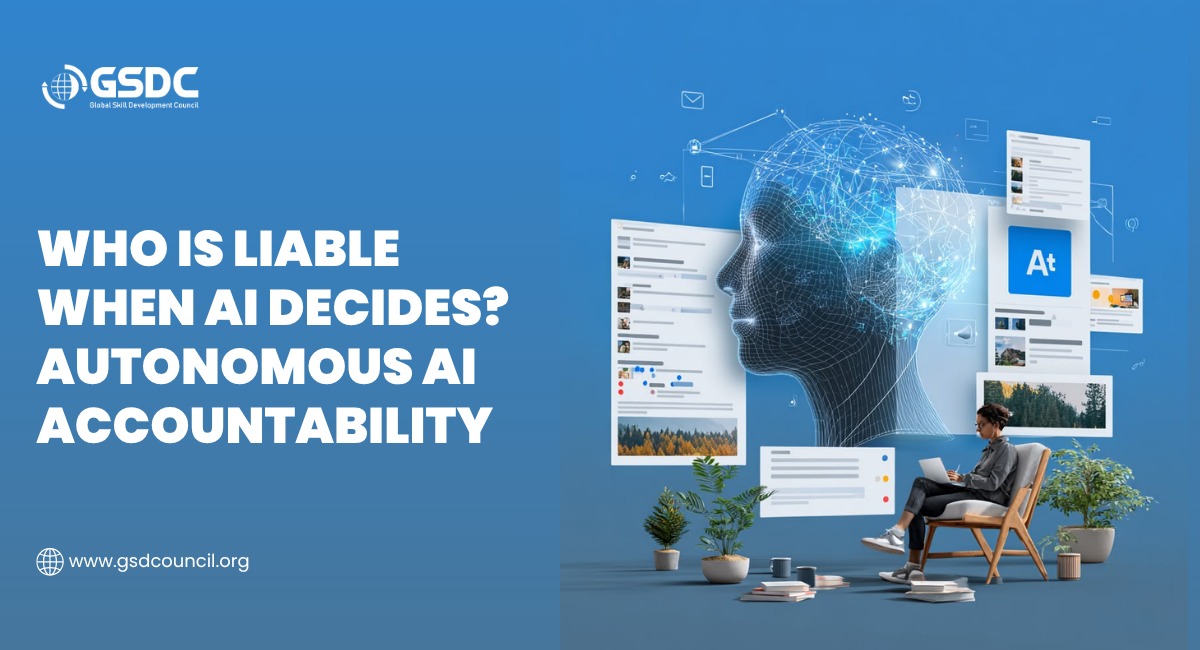
Who Is Liable When AI Decides? Autonomous AI Accountability
Written by Pravena K
- The Growing Role of AI in Business Decision-Making
- Why AI Cannot Be Held Accountable
- The Three Stages of AI-Assisted Decision Making
- The Major Risks of AI-Assisted Decisions
- What Happens When AI-Assisted Decisions Fail?
- Organizational Impact of Unclear AI Accountability
- Why Traditional AI Governance Is Not Enough
- Building a Structured AI Accountability Framework
- Making AI Accountability Operational
- The Future of Responsible AI
- Conclusion
Artificial Intelligence (AI) has rapidly evolved from being a productivity tool to becoming an active participant in business decision-making. Unlike Traditional AI, which primarily supports predefined tasks, modern systems are moving toward what is autonomous AI capabilities, where autonomous agents AI can independently analyze information and recommend or execute actions.
Organizations across industries are using AI to screen job applicants, generate financial insights, automate operations, and handle customer interactions. While these capabilities improve efficiency and reduce manual effort, they also introduce a critical question:
When AI influences or makes a decision, who is accountable if something goes wrong?
This question is no longer theoretical. As AI systems become deeply embedded in everyday workflows, businesses must rethink governance, responsibility, and risk management. The growing Risks of AI-Assisted decision-making include bias and discrimination in ai and bias in generative ai, which can lead to unfair or unintended outcomes. AI can recommend actions, prioritize options, and automate responses, but it cannot take legal or ethical responsibility for the consequences of those decisions.
This shift from AI as a support tool to AI as a decision enabler has made ai accountability one of the most important topics in modern business governance.
The Growing Role of AI in Business Decision-Making
Many organizations have already integrated AI into their daily operations, often without fully realizing how much influence it has over business outcomes.
Consider a few common examples:
AI in Human Resources
AI-powered recruitment platforms can scan thousands of resumes, identify qualified candidates, and rank applicants based on predefined criteria.
Although the final hiring decision may still be made by a recruiter or hiring manager, the AI system has already shaped the available options by determining which candidates are reviewed and which are filtered out.
This means that AI influences the hiring process before a human even enters the decision-making stage, increasing concerns about bias and discrimination in ai.
AI in Finance
Finance teams increasingly rely on AI for:
- Financial forecasting
- Budget planning
- Data analysis
- Trend identification
- Risk assessment
Instead of manually reviewing raw data, decision-makers often depend on AI-generated insights. If those insights are incomplete, inaccurate, or affected by bias in generative ai, financial decisions can also become flawed.
AI in Operations
Operational departments use AI to automate repetitive tasks, assign workloads, trigger workflows, and streamline business processes through autonomous agents ai.
These automated actions reduce manual intervention but also create situations where systems make decisions with minimal human oversight.
AI in Customer Management
AI chatbots and virtual assistants now manage customer queries, generate responses, and support communication across multiple channels.
While these systems improve response times, they also represent the organization's voice. An inappropriate or inaccurate AI-generated response can damage customer trust and brand reputation, highlighting the Risks of AI-Assisted communication.
The Accountability Gap
The challenge arises because AI can influence decisions without owning responsibility for them.
When everything works well, accountability is rarely questioned. However, when a problem occurs, organizations often struggle to determine where responsibility lies.
For example:
- Was the AI system at fault?
- Did the employee rely too heavily on the AI output?
- Was the organization responsible for implementing the technology without proper controls?
In many cases, there is no clear answer.
This uncertainty creates what experts call the AI accountability gap, a situation where decisions are influenced by AI, but ownership of outcomes remains undefined, making ai accountability a critical business requirement.
Why AI Cannot Be Held Accountable
One of the biggest misconceptions about AI is that it "understands" decisions.
In reality, Traditional AI and even advanced systems designed around what is autonomous ai do not possess judgment, ethics, or awareness. They identify patterns from training data and generate outputs based on those patterns.
AI does not understand:
- Business context
- Legal implications
- Organizational values
- Human emotions
- Long-term consequences
It simply predicts the most likely response based on available information. This limitation can contribute to bias and discrimination in ai and bias in generative ai when the underlying data or models are flawed.
This is why AI cannot carry accountability. Responsibility must always remain with humans and the organizations deploying these systems, making ai accountability essential for managing the Risks of AI-Assisted decision-making.
The Three Stages of AI-Assisted Decision Making
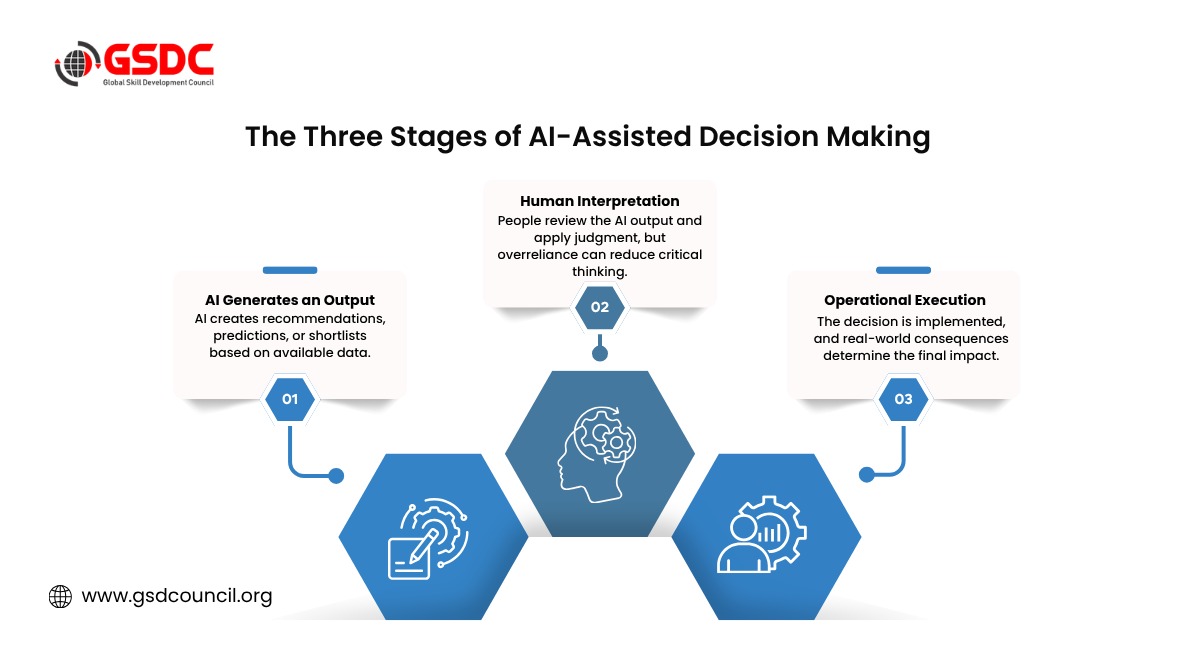
Understanding accountability requires understanding how AI-driven decisions actually happen.
1. AI Generates an Output
The AI system creates a recommendation, prediction, shortlist, or response based on available data.
Examples include:
- Resume shortlisting
- Budget recommendations
- Customer response generation
- Operational automation
At this stage, the AI is producing information but is not responsible for how it will be used.
2. Human Interpretation
A person reviews the AI-generated output and applies personal judgment.
However, this process is not always objective. People often assume AI outputs are accurate simply because they appear confident and data-driven.
Over time, trust in AI can reduce critical thinking and encourage blind acceptance.
3. Operational Execution
The decision is implemented.
A candidate is hired, a financial investment is approved, or a customer message is sent.
This is where real-world consequences emerge. If something goes wrong, tracing responsibility across these stages becomes increasingly difficult.
The Major Risks of AI-Assisted Decisions
Organizations that integrate AI into decision-making processes face several key risks.
Accuracy Risk
AI outputs are only as reliable as the data used to train and operate the system.
Information may be:
- Outdated
- Incomplete
- Contextually incorrect
- Factually inaccurate
Confident-looking responses can easily create false confidence among users.
Over-Reliance Risk
As AI tools become more efficient, people may stop verifying outputs.
Employees gradually shift from being decision-makers to simply approving AI recommendations.
Without proper review, errors can pass through unnoticed.
Bias Risk
AI systems learn from historical data. If that data contains bias, the output can also become biased.
This can affect:
- Hiring decisions
- Customer interactions
- Credit assessments
- Financial evaluations
Bias may not always be obvious, but it can significantly impact fairness and organizational integrity.
Traceability Risk
Many organizations cannot clearly explain how an AI-assisted decision was made.
Questions such as:
- What data was used?
- Which logic was applied?
- Who approved the decision?
often remain unanswered.
Without traceability, accountability becomes extremely difficult.
What Happens When AI-Assisted Decisions Fail?
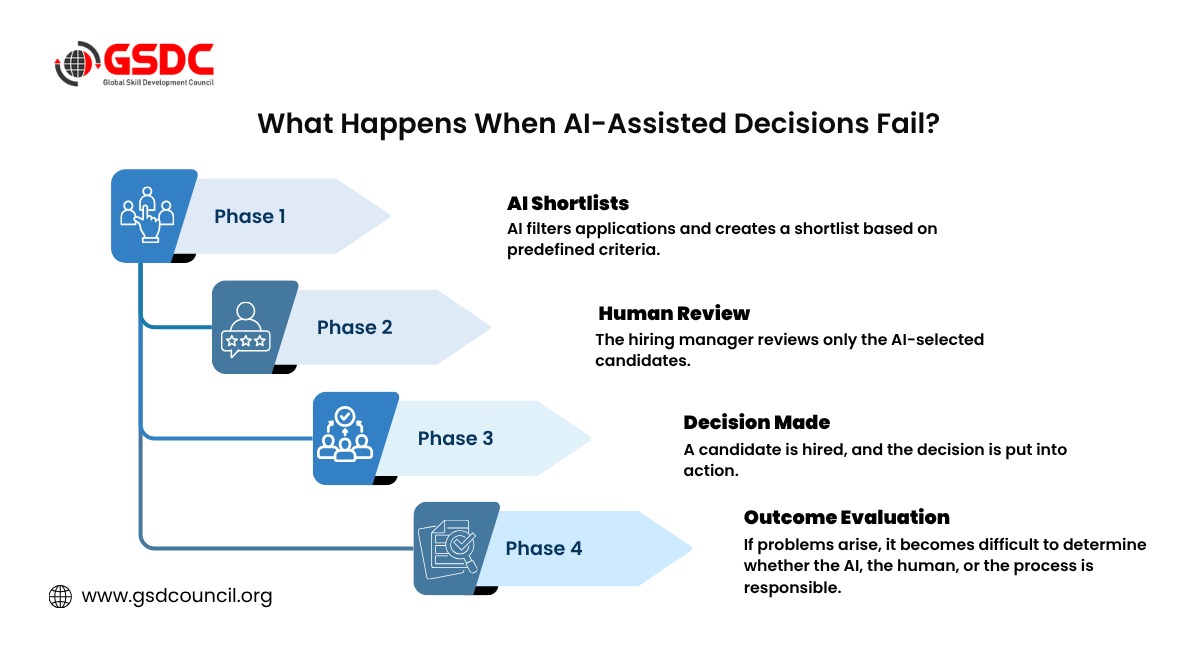
A hiring scenario provides a practical example.
Phase 1: AI Shortlists Candidates
The AI filters 100 applications and selects only 30 based on predefined criteria.
The remaining 70 candidates are never reviewed by a human, creating potential concerns around bias and discrimination in ai.
Phase 2: Human Reviews the Shortlist
The hiring manager evaluates only the AI-selected candidates.
The manager assumes the shortlist is reliable but has no visibility into the excluded applications or possible bias in generative ai and algorithmic outputs.
Phase 3: Decision Is Implemented
A candidate is hired and becomes part of the organization.
Resources are invested, and expectations are established, even though the process may involve Risks of AI-Assisted decision-making.
Phase 4: Outcome Appears
If the employee underperforms, questions begin to emerge.
Was the issue caused by:
- The AI screening process?
- The hiring manager's decision?
- The recruitment criteria?
- The implementation process?
Since responsibility was never clearly assigned, accountability becomes fragmented, highlighting the importance of ai accountability in modern hiring practices.
Organizational Impact of Unclear AI Accountability
The effects of poor AI governance extend far beyond technology.
Loss of Trust
Employees and customers expect organizations to make fair and transparent decisions.
When businesses cannot explain AI-driven outcomes, especially those affected by bias and discrimination in ai, confidence declines.
Reputational Damage
Biased hiring practices or inappropriate AI-generated responses can quickly become public issues.
In today's digital environment, reputation can be damaged rapidly and on a large scale, particularly when bias in generative ai goes unchecked.
Operational Challenges
When ownership is unclear, teams spend time identifying who is responsible instead of solving the actual problem.
This creates delays, confusion, and inefficiency, increasing the Risks of AI-Assisted business processes.
Compliance and Regulatory Risks
HR, finance, and customer management functions are often subject to legal and regulatory requirements.
Organizations must be able to explain how decisions were made, especially when AI plays a role. Strong ai accountability frameworks help ensure that responsibility remains clearly defined.
As AI regulations continue to evolve worldwide, governance will become even more important.
Why Traditional AI Governance Is Not Enough
Many organizations believe they have AI governance because they have:
- AI policies
- Technology guidelines
- Data protection procedures
- Approved AI tools
However, these measures often remain disconnected from daily operations.
Common limitations include:
- Policies that are not embedded in workflows
- Unclear ownership across teams
- Excessive focus on technology instead of decision design
- Poor documentation and audit trails
As a result, governance exists on paper but not in practice.
Building a Structured AI Accountability Framework
To close the accountability gap, organizations need a structured framework that defines responsibility at every stage.
Input Accountability
Organizations must control what information enters the AI system.
Questions to ask include:
- What data is being used?
- Are prompts properly designed?
- Is the context complete and unbiased?
Poor input quality leads to poor outcomes.
Model Accountability
Not every AI model is suitable for every task.
Organizations should evaluate:
- Why a specific AI tool was selected
- Whether it is appropriate for the business function
- Its limitations and capabilities
Choosing the wrong model can create unnecessary risks.
Validation Accountability
Human review should never disappear from critical decisions.
Every AI-generated output should be:
- Verified
- Questioned
- Reviewed for context and accuracy
Validation ensures AI remains a support tool rather than an unchecked decision-maker.
Decision Accountability
One clearly identified individual or role must own the final decision.
Responsibility cannot be assigned to "the team" or "the system."
Whether it is a hiring manager, finance director, or customer service lead, accountability must remain human.
Outcome Accountability
The process should not end after implementation.
Organizations need to monitor:
- Performance
- Customer reactions
- Business impact
- Lessons learned
Tracking outcomes creates feedback loops that improve future decisions.
Making AI Accountability Operational
A practical AI accountability process can follow four simple steps:
Define: Clearly assign ownership at every stage.
Validate: Review and verify AI-generated outputs.
Decide: Ensure a designated person makes the final decision.
Track: Monitor results and continuously improve the process.
This approach transforms AI governance from a theoretical concept into an operational business practice.
The Future of Responsible AI
AI will continue to become more autonomous and influential across industries. As organizations adopt autonomous agents ai and explore what is autonomous ai, businesses that focus only on technology adoption without establishing accountability frameworks may face significant operational, legal, and reputational risks.
The goal should not be to replace human judgment but to combine AI efficiency with human responsibility while minimizing Risks of AI-Assisted decision-making.
The GSDC's Agentic AI Certification is designed for professionals who want to understand and implement autonomous AI systems in real-world business environments. The certification covers agentic AI concepts, AI governance, decision-making frameworks, autonomous agents, and responsible AI practices, helping learners build practical skills to develop, manage, and deploy intelligent AI solutions with confidence.
Successful organizations will recognize that AI can support decisions, but accountability must always remain with people. Strong ai accountability practices also help address challenges related to bias and discrimination in ai and bias in generative ai.
As AI becomes an integral part of modern workplaces, designing clear ownership, validation processes, and governance structures will be essential for building trust and ensuring responsible innovation.
Conclusion
The question is not whether AI will participate in decision-making; it already does.
The real challenge is ensuring that organizations know who is responsible when AI influences outcomes, especially as autonomous agents ai become more common and businesses explore what is autonomous ai capabilities.
AI can analyze data, recommend actions, and automate processes, but it cannot understand ethics, legal obligations, or business consequences. It also cannot independently address bias and discrimination in ai or bias in generative ai. Those responsibilities belong to humans and the organizations that deploy these technologies.
By creating structured accountability frameworks that cover inputs, models, validation, decisions, and outcomes, businesses can reduce the Risks of AI-Assisted operations while maximizing the value of AI.
In the future, the most successful organizations will not simply be those that use AI the most. They will be the ones who use it responsibly, transparently, and with clearly defined ai accountability.

Related Certifications
Frequently Asked Questions
Stay up-to-date with the latest news, trends, and resources in GSDC
If you like this read then make sure to check out our previous blogs: Cracking Onboarding Challenges: Fresher Success Unveiled
Not sure which certification to pursue? Our advisors will help you decide!