Who Should Get ISO 9001 Lead Auditor Certified ?
Written by Matthew Hale
- First, What Is an ISO 9001 Lead Auditor - Really?
- Who Is This Certification Built For?
- The Self-Assessment: 10 Questions to Help You Decide
- What the ISO 9001 eligibility Requirements Actually Look Like
- What You Actually Learn in a Lead Auditor Course
- The Real Benefits of ISO Lead Auditor Certification
- When This Certification Might Not Be the Right Fit - Yet
- What Industries Benefit Most?
- How to Choose the Right Lead Auditor Training Program
- Ready to Become a Certified ISO 9001:2015 Lead Auditor?
- Final Thought: This Is a Career Investment, Not a Certificate Collection
Lead Auditor certification isn't for everyone - and that's actually a good thing. It's built for professionals ready to take ownership of quality systems, lead audit teams, and drive real organizational impact.
Let’s be upfront about something: not every professional needs a Lead Auditor certification. There are plenty of quality-related credentials out there, and choosing the wrong one is a waste of time, money, and energy.
But if you’re the kind of person who finds yourself asking “why does this process keep breaking?” or “how do we actually know this quality management system is working?” - there’s a good chance you’re exactly who this certification is designed for.
This blog will walk you through a clear, honest self-assessment. No fluff, no pressure. Just real questions to help you decide whether pursuing an ISO 9001 certification path through a Lead Auditor credential makes sense for where you are in your career right now.
First, What Is an ISO 9001 Lead Auditor - Really?
Before you assess yourself, it helps to understand what you’re actually assessing yourself against.
A Lead Auditor is a certified professional who can plan, conduct, lead, and report on third-party or internal audits of a Quality Management System (QMS) based on ISO 9001 standards. The keyword is “lead.” You’re not just participating in audits - you’re running them.
This involves organizing the audit team, reviewing documentation, interviewing personnel, identifying nonconformities, writing audit reports, and presenting findings to senior management. It requires both technical knowledge and soft skills - the ability to ask the right questions without making people feel interrogated, and to write findings that are clear and actionable rather than vague and accusatory.
Professional Lead Auditor certifications are offered by recognized training providers and organizations such as the Global Skill Development Council (GSDC). These programs typically combine classroom learning with practical auditing exercises to prepare professionals for real-world quality audits.
An ISO 9001 Lead Auditor doesn’t just check boxes - they understand what good quality management looks like in practice, and they’re trained to see the gaps between what a QMS says it does and what actually happens on the floor.
Who Is This Certification Built For?
Here are the six professional profiles that genuinely benefit from becoming a Certified ISO 9001:2015 Lead Auditor. See which one resonates with you.
Quality Managers & QA ProfessionalsAlready managing quality systems and want formal auditor credentials to add weight to your role and expand audit responsibilities. | ISO Auditor Career GrowthMid-career professionals looking to move from technical or operational roles into quality leadership, consulting, or full-time auditing. |
Compliance & Risk OfficersProfessionals who manage regulatory compliance and want a structured framework to evaluate quality management effectiveness. | Consultants & AdvisorsIndependent consultants helping organizations get or maintain ISO 9001 certification - this credential is essentially a requirement for credibility. |
Internal Auditors Going ExternalExperienced internal auditors who want to qualify for third-party or certification body roles with a recognized credential. | Early-Career Quality ProfessionalsRecent graduates or professionals early in their careers looking to build a strong credential foundation quickly. |
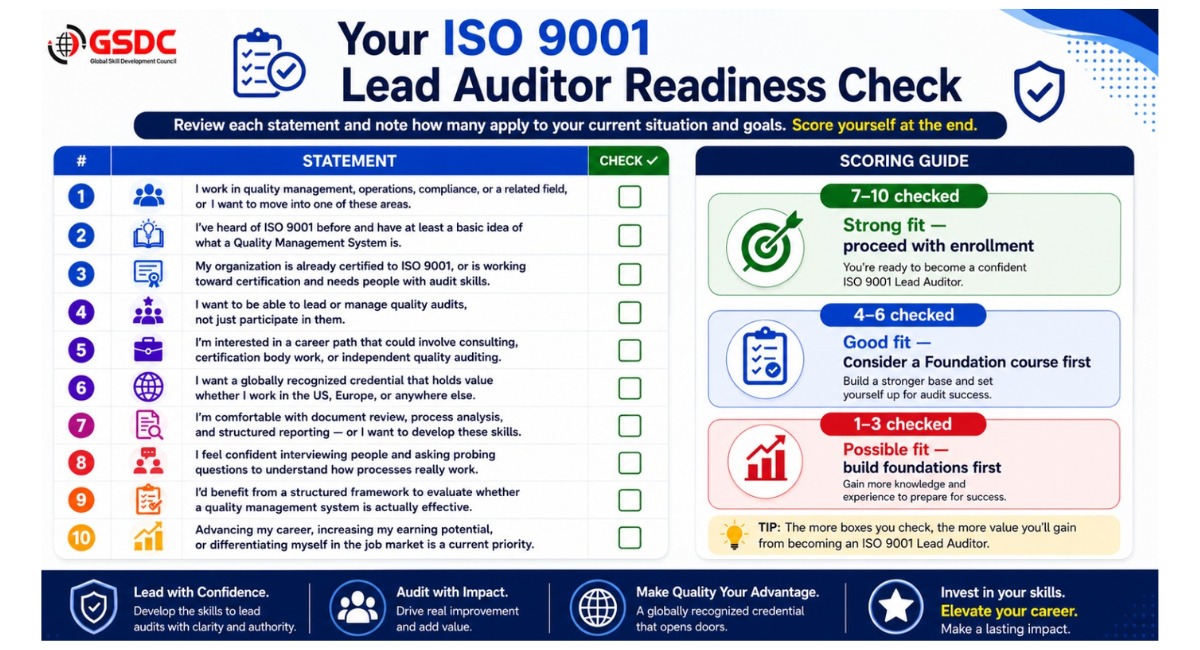
The Self-Assessment: 10 Questions to Help You Decide
Go through this honestly. There are no wrong answers - only more or less aligned career situations. Check every statement that genuinely applies to you.
What the ISO 9001 eligibility Requirements Actually Look Like
Here’s some good news: the eligibility requirements for a Lead Auditor course are less intimidating than many people expect.
Most accredited training providers ask for:
- A basic understanding of ISO 9001 or quality management principles
- Some professional experience in a relevant industry
- Comfort with English-language training materials
- Willingness to complete practical auditing exercises
- A passing score on the written assessment
A NOTE ON ISO 9001 ELIGIBILITY
If you’ve never worked in quality management but are transitioning into the field, consider pairing the Lead Auditor course with an introductory Foundation course first.
What You Actually Learn in a Lead Auditor Course
A good Lead Auditor course isn’t just a lecture series with a test at the end. The better programs spend about half the week in practical, role-played audit scenarios where you actually practice the skills you’ll use in real audits.
- The structure and requirements of ISO 9001:2015
- Audit principles and planning techniques
- How to develop audit checklists
- Effective interview techniques
- Identifying and classifying nonconformities
- Writing defensible audit findings
- Presenting audit conclusions to management
- Managing audit teams and resolving conflicts
The biggest surprise for most participants? The soft skills section. Technical knowledge of ISO 9001 is teachable - but learning how to conduct an effective interview without putting people on the defensive, or how to communicate a major nonconformity without causing a defensive reaction, is where many people discover their real developmental opportunities.
The Real Benefits of ISO Lead Auditor Certification
Let’s move past the generic “advance your career” messaging and get into the specific, tangible things this credential actually does for you.
It opens doors in a globally fragmented job market
ISO 9001 is recognized in virtually every industry in every major economy. Whether you’re looking at manufacturing, healthcare, financial services, defense contracting, or technology, organizations that operate under ISO 9001 need people who can evaluate and maintain their QMS. A recognized quality auditor certification signals that you can do that job immediately, without significant onboarding.
It positions you for consulting and independent work
One of the less-talked-about benefits of the ISO auditor career path is the consulting opportunity. Many certified Lead Auditors eventually move into independent consulting - helping small to mid-sized businesses prepare for and maintain ISO 9001 certification. In the US market, especially, there is consistent demand for consultants with recognized credentials to guide organizations through first-time certification.
It makes your internal value clearer
If you’re currently working inside an ISO-certified organization, this certification makes you a more measurable asset. You can take on audit responsibilities that might otherwise require hiring external auditors, lead management review preparations, and act as the primary liaison with certification body auditors during surveillance visits.
It gives you a structured framework for something you might already be doing intuitively
Many quality professionals say their biggest takeaway from the Lead Auditor course wasn’t new information - it was structure. The certification gives formal language and methodology to processes they were already applying by instinct. That structure makes their work more defensible, more consistent, and easier to communicate to stakeholders.
“The credential didn’t change what I was doing. It changed how seriously people took what I was doing.”
When This Certification Might Not Be the Right Fit - Yet
We said we’d be honest. So here are situations where it might make sense to wait, or to consider a different path first:
- If your role is entirely technical with no process evaluation or communication component, you may want to build those competencies before investing in auditor training.
- If you’re only interested in auditing one specific area (like IT or environmental), a more specialized standard (ISO 27001, ISO 14001) might be a better primary credential.
- If you’re looking for a quick resume line item without practical application, this credential will not serve you well - it requires post-certification audit logging to maintain status.
Worth knowing: To maintain your Lead Auditor status with most certifying bodies, you need to complete a minimum number of audits annually. If your role won’t give you audit opportunities, factor that into your decision before enrolling.
What Industries Benefit Most?
Almost every major industry sector in the US has organizations operating under ISO 9001. But certain sectors have particularly high concentrations of demand for qualified auditors:
- Aerospace and defense
- Automotive manufacturing
- Medical devices and healthcare
- Government contractors
- Electronics and technology manufacturing
- Food and beverage processing
- Construction and engineering
- Logistics and supply chain management
How to Choose the Right Lead Auditor Training Program
Not all Lead Auditor courses are created equal. Here’s what to look for when evaluating your options:
- Training aligned with internationally recognized ISO 9001 auditing practices
- At least 40 hours of structured learning with practical audit exercises
- Trainers with real-world auditing and quality management experience
- Hands-on audit simulations and role-play scenarios, not just theory
- Post-training support and guidance for applying auditing skills professionally
- A structured assessment process that validates practical understanding
Ready to Become a Certified ISO 9001:2015 Lead Auditor?
Get ready for a practical approach to learning how to be a successful audit professional with the Certified ISO 9001:2015 Lead Auditor course offered by the Global Skill Development Council (GSDC). This course aims to develop the skills and knowledge of professionals seeking to become experts in Quality Management Systems (QMS), quality auditing skills, and advance in their careers.
GSDC’s quality management programs aim at equipping professionals with practical experience on how to do quality audits and the internationally accepted ISO 9001 standards for successful auditing.
This course will give you the tools to take your ISO 9001 auditor career to the next level, as well as enhance your knowledge of ISO 9001 standards.

Final Thought: This Is a Career Investment, Not a Certificate Collection
The professionals who get the most out of their Lead Auditor certification are the ones who see it as a tool rather than a trophy. They use the methodology every day. They actively seek audit opportunities. They stay current as the standard evolves. They apply what they learned in the role-plays to real interviews with real process owners.
If that’s the kind of professional you’re trying to become - someone who leads, evaluates, and improves quality systems rather than just manages them - then the ISO 9001 Lead Auditor path is worth serious consideration.
Go back to your self-assessment results. If you checked six or more of those statements honestly, you already have your answer.

Related Certifications
Frequently Asked Questions
The role of a Certified ISO 9001:2015 Lead Auditor includes assessing the effectiveness of an organization’s Quality Management System. They are responsible for audit planning and improvement of organizational performance in quality terms.
It can be very beneficial for those in quality management or internal audit, compliance, consultancy, or even if you want to move into the field from another discipline.
If your job is at a point where a little extra will make a world of difference, getting your lead auditor certification may just be that little extra.
The requirements are rather straightforward. Usually, candidates must have fundamental knowledge of either ISO 9001 or quality management in general and should be experienced in a particular industry.
Certainly, beginners can enroll as well. In case you have absolutely zero knowledge of quality management, it is more convenient to start with the ISO 9001 Foundation Course.
You will learn how to organize your audit process, interview your employees, identify any deviations, create audit reports, and evaluate the Quality Management System according to ISO 9001 requirements.
There are various fields where a lead auditor is always needed; some of these are manufacturing, healthcare, automotive, aerospace, logistics, construction, and technology fields.
While an internal auditor focuses on doing audits in his own organization, a Lead Auditor knows how to lead an audit team and conduct audits professionally on behalf of another party.
Certification of Lead Auditor will enable you to move from your present stage to a higher stage in your auditing career.
This takes about five days of intensive training sessions.
Stay up-to-date with the latest news, trends, and resources in GSDC
If you like this read then make sure to check out our previous blogs: Cracking Onboarding Challenges: Fresher Success Unveiled
Not sure which certification to pursue? Our advisors will help you decide!