Preparing the Workforce for AI Governance Under ISO 42001
Written by Orifha Joan
- The Human Factor: The Weakest Link or the Strongest Defense?
- Creating a No-Blame AI Governance Culture
- Gamified Governance: Making AI Governance Practical
- Leadership’s Role in AI Governance
- Transforming Employees Into Active Defenders
- Preventing Excessive AI Autonomy
- Why Continuous Improvement Matters
- ISO 42001 vs Traditional Management Systems
- AI Misuse and Data Exposure Risks
- Advance Your AI Governance Expertise with GSDC’s ISO 42001 Lead Auditor Certification
- Governance Is Not a Barrier to Innovation
- Conclusion
Artificial Intelligence is rapidly reshaping modern workplaces. From automating workflows to supporting decision-making, AI systems are now deeply integrated into industries such as finance, healthcare, HR, cybersecurity, and customer service. While organizations are racing to adopt AI technologies, one critical question remains:
Is the workforce truly prepared for AI governance?
This was the central theme of the webinar, “Preparing the Workforce for AI Governance Under ISO 42001.” The session explored how organizations can build an AI-aware workforce, establish an effective AI governance framework, reduce human-related risks, and create a culture where AI is used responsibly and ethically through responsible AI governance.
The webinar highlighted a crucial reality: technology alone cannot secure AI systems. The human factor remains one of the biggest risks and also one of the biggest opportunities in artificial intelligence governance. Understanding what is AI governance, implementing AI monitoring practices, and aligning workforce capabilities with the ISO 42001 AI management system are essential for successful AI adoption under ISO 42001.
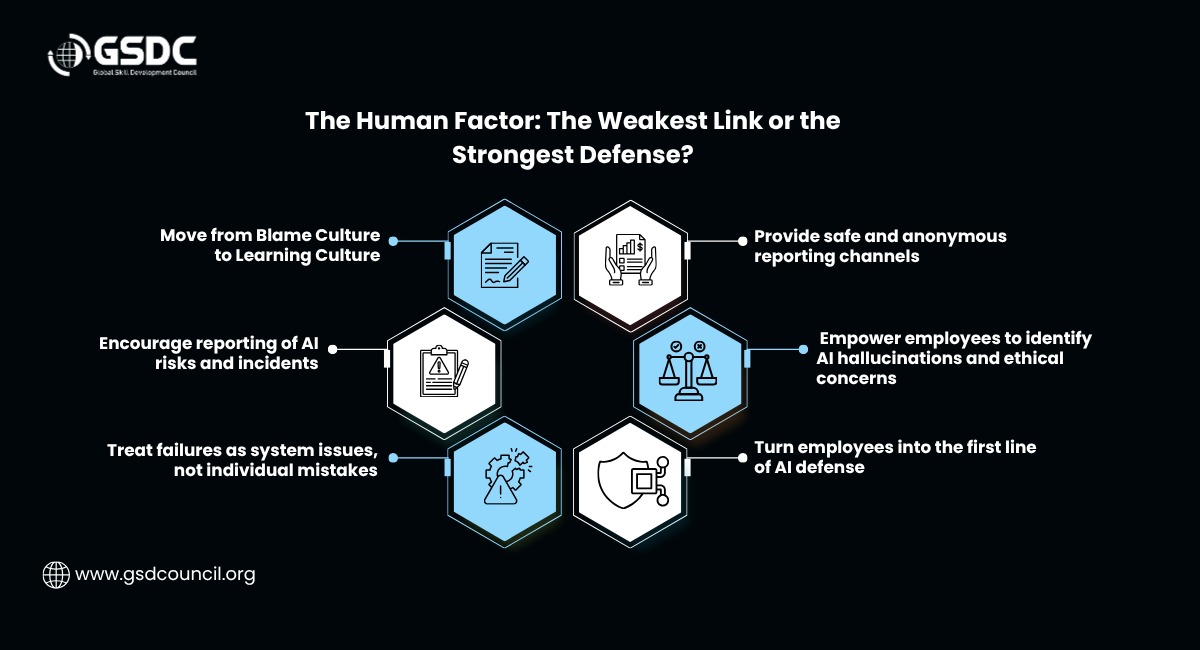
The Human Factor: The Weakest Link or the Strongest Defense?
One of the most insightful discussions during the webinar focused on the role of employees in AI governance.
Traditionally, organizations often treat employee mistakes as “human error.” However, this mindset creates fear-driven environments where workers hesitate to report incidents, vulnerabilities, or AI-related concerns.
The webinar emphasized that organizations must stop treating AI governance failures solely as employee mistakes. Instead, these incidents should be viewed as system problems that need to be resolved collectively through a strong AI governance framework and responsible AI governance practices.
This concept is inspired by the aviation industry, where incident reporting systems encourage transparency without fear of punishment. Pilots and staff are encouraged to report errors and near misses so organizations can continuously improve safety standards.
The same principle applies to artificial intelligence governance.
For example, if an employee detects an AI hallucination, an ethical boundary violation, or suspicious system behavior during routine work, they should feel safe reporting it immediately. Organizations should provide anonymous and seamless reporting channels that allow employees to raise concerns without fear of blame. Effective AI monitoring processes play a critical role in identifying and addressing such issues.
The webinar stressed that this “no-blame culture” transforms employees from passive users into active defenders of AI systems, strengthening AI ethics and governance while supporting the objectives of the ISO 42001 AI management system under ISO 42001.
Creating a No-Blame AI Governance Culture
The webinar explained that a fear-driven workplace weakens AI governance.
When employees fear punishment, they are less likely to report AI vulnerabilities, hallucinations, misuse, or compliance gaps. This creates dangerous blind spots for organizations and undermines effective artificial intelligence governance.
To solve this issue, organizations should adopt a no-blame reporting culture where:
- Employees are encouraged to report AI incidents
- Reporting channels are anonymous and accessible
- Workers are rewarded for identifying vulnerabilities
- AI governance becomes collaborative rather than punitive
Instead of treating workers as rule breakers, organizations should treat them as system testers helping improve AI reliability through continuous AI monitoring and governance practices.
This cultural shift plays a major role in meeting ISO 42001 accountability requirements because ethical AI governance depends heavily on workforce participation. A strong AI governance framework supported by responsible AI governance principles helps organizations create transparency, trust, and accountability.
The webinar emphasized that accountability should exist without creating fear. This approach aligns with AI ethics, AI ethics and governance, and the requirements of the ISO 42001 AI management system, while strengthening organizational readiness for ISO 42001 certification.
Gamified Governance: Making AI Governance Practical
Another important concept discussed was “gamified governance.”
Gamified governance refers to creating structured, engaging, and role-specific learning systems that help employees understand AI risks, governance responsibilities, and ethical considerations. This approach strengthens AI governance and supports long-term AI workforce development.
Rather than overwhelming employees with generic compliance training, organizations should deliver targeted education tailored to each department and role.
Role-Specific AI Training
The webinar explained that different departments interact with AI differently.
For example:
- HR professionals need to understand AI bias in recruitment systems
- Financial teams need awareness of fraud detection and decision-making risks
- Technical teams require knowledge about AI security, testing, and system vulnerabilities
Because each workforce segment faces different AI-related challenges, organizations must avoid one-size-fits-all training approaches.
Targeted AI governance training helps employees understand how AI affects their specific responsibilities and strengthens the overall AI governance framework.
Continuous Awareness Campaigns
AI technologies evolve rapidly. New tools, features, and risks emerge almost every day.
The webinar shared an example of how AI copilots can now access browser metadata, including inactive tabs. Features like these may create major privacy and security concerns if employees are unaware of them.
This is why organizations must continuously educate employees about:
- AI risks
- Privacy implications
- Security vulnerabilities
- Emerging AI capabilities
- Ethical usage practices
AI governance is not a one-time training activity. It requires ongoing awareness and adaptation. Continuous learning is a key component of responsible AI governance and effective AI monitoring.
Ethics and Security Integration
The webinar also highlighted the importance of integrating ethical principles and security practices into technical innovation processes.
Organizations should incorporate ethical constraints into:
- Developer workshops
- Internal hackathons
- AI testing exercises
- System development processes
This ensures that innovation happens responsibly instead of prioritizing speed over governance. Integrating AI ethics, AI ethics and governance principles, and ethical AI practices into daily operations helps organizations align with the ISO 42001 AI management system and broader artificial intelligence governance objectives under ISO 42001.
Leadership’s Role in AI Governance
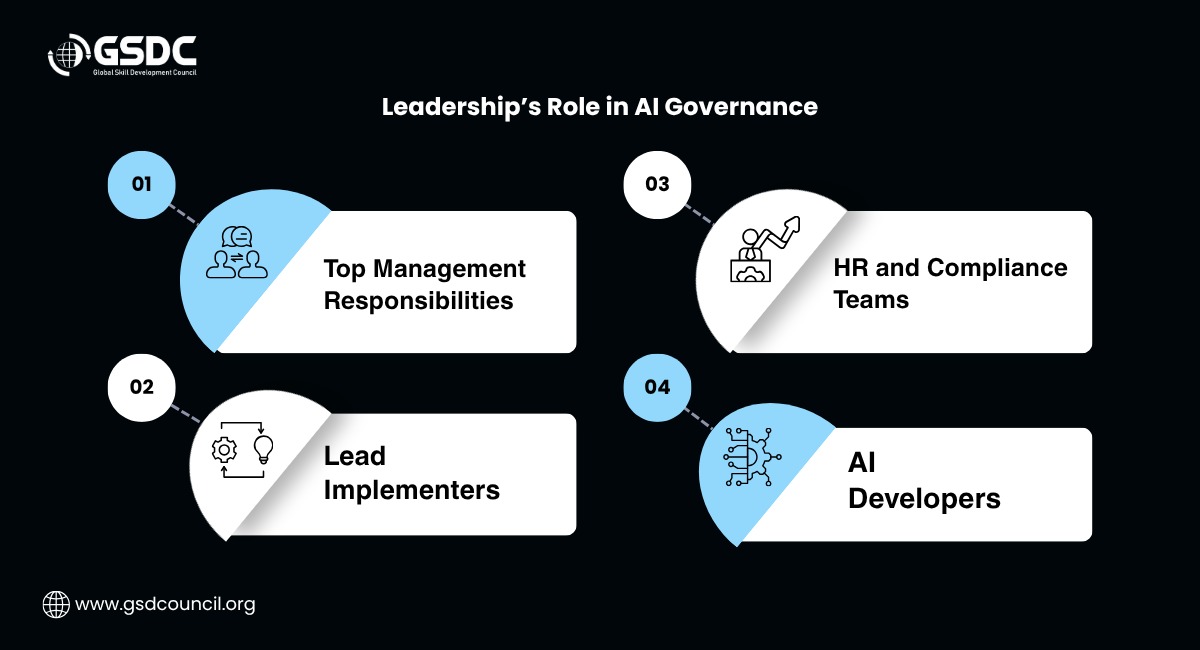
The webinar strongly emphasized that AI governance is not solely an IT responsibility.
Successful AI governance requires organization-wide accountability, starting from leadership.
Top Management Responsibilities
Under ISO 42001, top management holds ultimate responsibility for AI governance policies and ethical culture.
Leadership teams are expected to:
- Define AI governance strategies
- Allocate implementation budgets
- Support ethical AI practices
- Ensure accountability at board level
Without leadership involvement, AI governance initiatives often fail due to lack of direction and organizational commitment.
HR and Compliance Teams
HR and compliance departments act as the bridge between governance frameworks and employees.
Their responsibilities include:
- Building workforce digital literacy
- Driving mindset changes around AI
- Managing AI ethics ambassadors
- Ensuring legal and regulatory alignment
These teams help employees understand governance as a safety mechanism rather than a restriction.
Lead Implementers
Lead implementers coordinate the overall AI management system.
Their duties involve:
- Conducting gap analyses
- Managing governance architecture
- Coordinating cross-functional teams
- Ensuring governance implementation consistency
AI Developers
AI developers handle the technical side of governance.
Their responsibilities include:
- Implementing technical safeguards
- Managing model documentation
- Integrating bias detection systems
- Conducting testing and validation
The webinar emphasized that ethical AI governance requires collaboration across all organizational levels.
Transforming Employees Into Active Defenders
One of the most practical discussions during the webinar addressed a common workplace problem:
Studies show that many security breaches occur because employees bypass protocols to save time.
This raises an important question:
How can organizations transform employees from weak links into active defense mechanisms?
The webinar explained that ISO 42001 addresses this challenge by shifting organizations from passive compliance to active stewardship through a structured AI governance framework.
Instead of relying on rigid rules that employees view as restrictions, organizations should focus on building workforce competence and awareness through AI governance training and AI workforce development initiatives.
This approach changes employee mindsets in several ways:
- Workers become more confident identifying AI risks
- Employees actively participate in governance processes
- Reporting AI issues becomes normalized
- Governance becomes part of workplace culture
These practices strengthen AI governance, support responsible AI governance, and improve organizational understanding of what is AI governance in practical workplace settings.
The webinar referred to this as a “safety culture shift,” where governance is viewed as protection rather than punishment. This approach aligns with the principles of artificial intelligence governance, AI ethics, and the ISO 42001 AI management system, helping organizations prepare for ISO 42001 certification while fostering ethical AI adoption.
Preventing Excessive AI Autonomy
Another major concern discussed during the webinar was the rise of excessive AI agency.
As organizations integrate AI into APIs, automation systems, and workflows, AI tools are gaining the ability to make autonomous decisions with minimal human intervention.
While automation improves efficiency, excessive autonomy creates serious risks.
AI systems acting independently may:
- Expose sensitive information
- Make harmful decisions
- Operate beyond intended boundaries
- Create accountability gaps
The webinar explained that ISO 42001 addresses this risk through three key principles:
Transparency
Organizations must ensure AI decisions are understandable and explainable.
Human Oversight
Clear thresholds must define when human intervention is required.
Accountability Frameworks
Organizations must establish structured accountability systems to continuously monitor AI behavior.
The goal is not to stop innovation but to prevent AI systems from operating in dangerous blind spots.
Why Continuous Improvement Matters
One of the strongest advantages of ISO 42001 discussed during the webinar is its continuous improvement approach.
Unlike static governance systems, ISO 42001 follows the “Plan-Do-Check-Act” model.
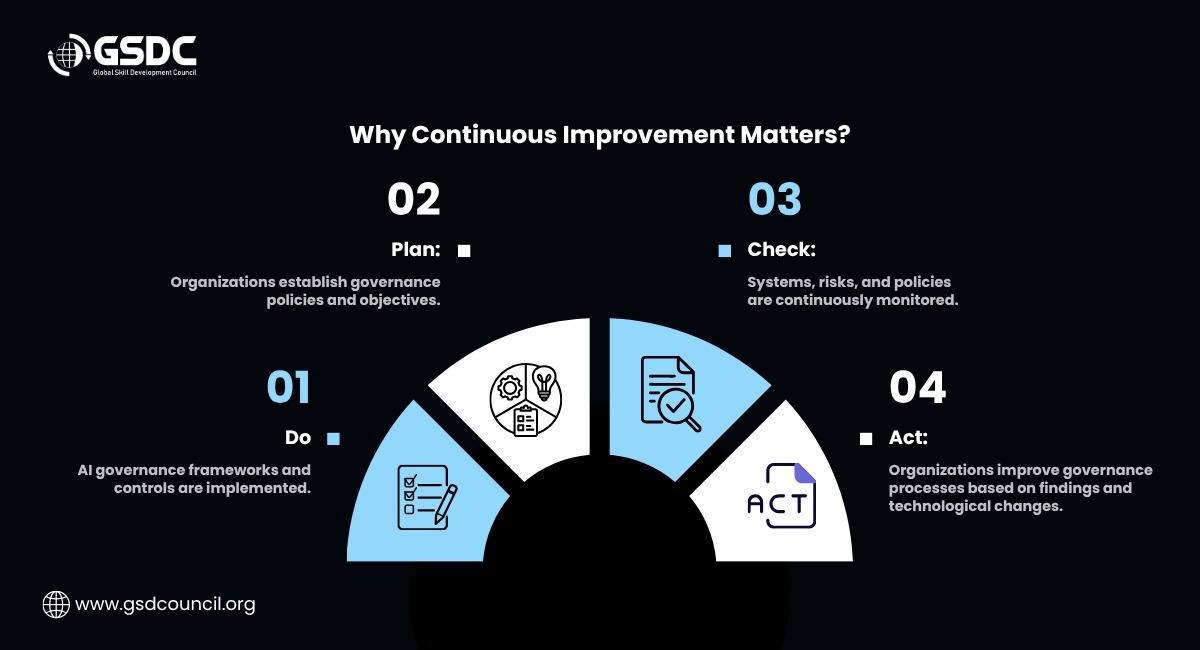
This cycle ensures that governance evolves alongside AI technology.
The webinar stressed that AI evolves too quickly for static policies to remain effective. Continuous monitoring and adaptation are therefore essential.
ISO 42001 vs Traditional Management Systems
AI Misuse and Data Exposure Risks
During the Q&A session, participants asked how ISO 42001 differs from traditional management systems.
The webinar explained that traditional systems are often static and rely heavily on fixed compliance rules.
ISO 42001, however, is designed for continuous evolution.
It requires organizations to:
- Continuously review governance processes
- Adapt to technological advancements
- Update controls regularly
- Monitor workforce awareness
- Improve governance maturity over time
Additionally, ISO 42001 certification is not permanent. Organizations must continuously maintain compliance standards to retain credibility.
AI Misuse and Data Exposure Risks
Another key concern raised during the webinar was AI misuse and data exposure.
The session highlighted how AI systems increasingly rely on large volumes of data to improve performance. However, this creates major privacy and security risks.
Examples discussed included:
- Exposure of sensitive financial data
- Unauthorized AI access to metadata
- Leakage of personal health information
- Workforce misuse of AI systems
The webinar reinforced that data is one of the most valuable assets organizations possess.
ISO 42001 helps organizations establish guardrails that ensure AI systems handle data responsibly while reducing misuse and governance gaps.
Advance Your AI Governance Expertise with GSDC’s ISO 42001 Lead Auditor Certification
The GSDC Certified ISO 42001 Lead Auditor Certification equips professionals with the skills to audit and improve AI management systems in accordance with the ISO 42001 standard. Participants learn AI governance, audit methodologies, AI risk management, compliance requirements, and responsible AI practices. Ideal for auditors, consultants, compliance professionals, and AI leaders, this certification validates expertise in assessing AI systems, ensuring compliance, and supporting trustworthy AI governance.

Governance Is Not a Barrier to Innovation
The webinar concluded with a powerful analogy comparing AI governance to road safety signs.
Road signs do not stop people from driving cars. Instead, they provide safety instructions that protect both drivers and pedestrians.
Similarly, AI governance frameworks are not barriers to innovation. They are safety guardrails designed to ensure that organizations can innovate responsibly without exposing themselves or their users to unnecessary risks.
The speaker encouraged organizations and employees to stop viewing governance as a “straightjacket” and instead see it as a “safety net.”
As AI adoption continues to accelerate, organizations that invest in workforce readiness, ethical governance, and continuous improvement will be better prepared for the future than those focusing only on rapid implementation.
Conclusion
Artificial Intelligence is transforming every industry, but technology alone cannot guarantee responsible AI adoption. Workforce readiness, ethical awareness, leadership accountability, and governance culture are equally important components of effective AI governance.
ISO 42001 provides organizations with a structured framework to prepare employees, reduce risks, and ensure that AI systems remain transparent, accountable, and continuously monitored. The ISO 42001 AI management system supports AI monitoring, responsible AI governance, and the implementation of a robust AI governance framework.
The webinar made one thing very clear: the future of AI governance depends not only on systems and policies but also on how organizations prepare their people. AI governance training and AI workforce development are essential for building a culture of accountability and trust.
When employees understand governance as a safety net rather than a restriction, organizations can build stronger, safer, and more ethical AI ecosystems. This approach strengthens artificial intelligence governance, reinforces AI ethics and governance principles, supports ethical AI practices, and helps organizations achieve ISO 42001 certification while advancing mature AI governance models.

Related Certifications
Frequently Asked Questions
Stay up-to-date with the latest news, trends, and resources in GSDC
If you like this read then make sure to check out our previous blogs: Cracking Onboarding Challenges: Fresher Success Unveiled
Not sure which certification to pursue? Our advisors will help you decide!