AI and Sustainability: Designing Intelligent Systems That Respect the Planet
Written by Matthew Hale
- What Is Green AI?
- Why Sustainability Matters in AI
- How AI Supports Sustainability
- The Problem With Overusing AI
- AI Design Tools That Support Sustainability
- Making Models More Efficient
- Careers in Sustainable AI
- Building Capability Through GSDC and the Certified AI Tool Expert
- Conclusion
- Frequently Asked Questions
AI is becoming cheaper to use and more expensive to run. Every enterprise prompt now carries a hidden cost in energy, water, and emissions. This growing AI environmental impact is no longer an infrastructure issue; it is a design issue.
As AI systems scale across organisations, the cumulative demand placed on data centres, power grids, and cooling systems continues to rise, turning what was once a background technical concern into a strategic business risk.
The Global Skill Development Council (GSDC) addresses this challenge through initiatives such as the GSDC Certified Learning Holiday AI Bootcamp: Winning Clients, Delivering Smarter, Deciding Faster, which emphasise the development of practical skills in Green AI, modern AI design tools, and the core principles of design required to achieve measurable AI sustainability.
In this context, artificial intelligence sustainability is no longer an abstract concept. It is a practical outcome shaped by engineering choices, architectural decisions, and the ability of organisations to design systems that balance innovation with environmental responsibility.
What Is Green AI?
Many people ask, “What is green AI?”
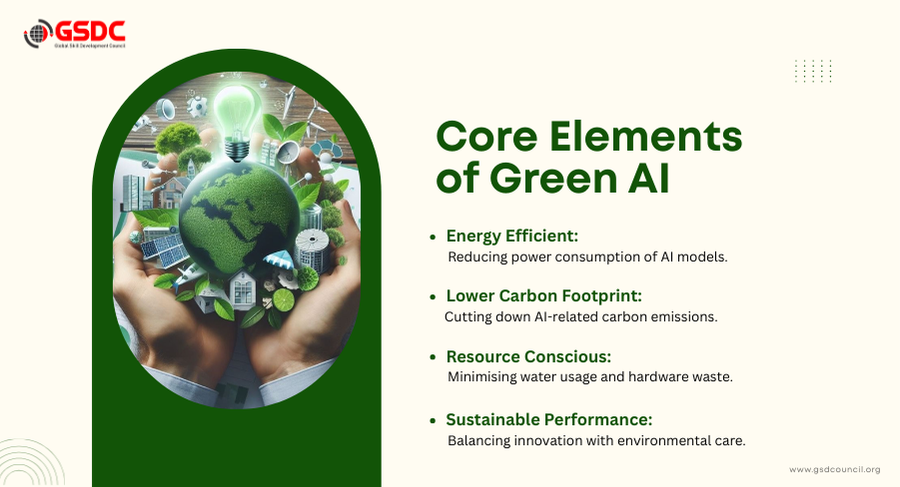
Green AI refers to building artificial intelligence systems that deliver strong business performance while minimising energy usage, carbon emissions, and resource waste. It is a key pillar of artificial intelligence sustainability and central to how organisations approach AI and sustainability.
Why Sustainability Matters in AI
Sustainability means creating systems that do not deplete resources so that future generations can also use them. For artificial intelligence, sustainability has become a design requirement rather than an option.
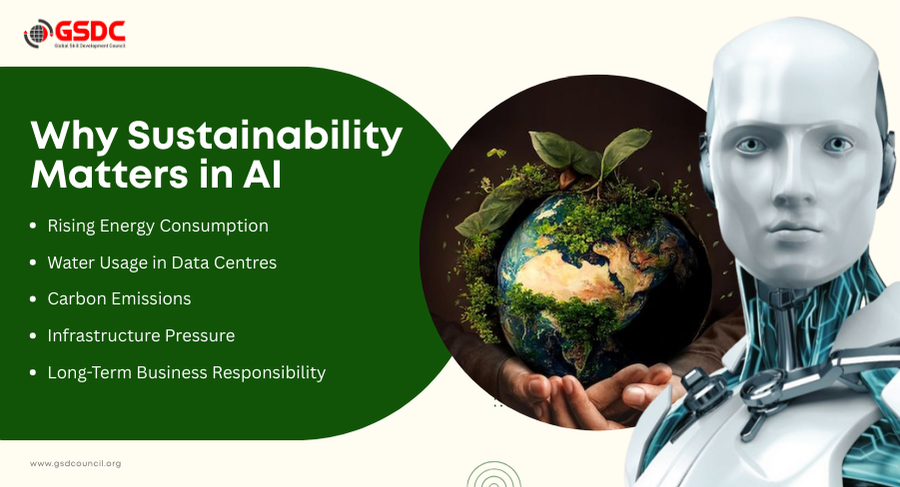
1. Rising Energy Consumption: To run AI models, machines with high computational power are needed; in turn, these machines consume a lot of electricity. As the energy needed to run AI increases, so does the demand, and the negative impact on the environment gets worse.
2. Water Usage in Data Centres: Most modern data centres use water for cooling the heat generated by GPUs. This results in a large amount of water consumption, even if the source is an area already suffering from water shortage.
3. Carbon Emissions: Most of the electricity used for AI research comes from power plants that burn fossil fuels. Therefore, AI growth is the cause of, or at least a major contributor to, carbon emissions, unless green design practices are used.
4. Infrastructure Pressure: As AI keeps getting bigger and bigger, it requires more and more different types of physical infrastructure, e.g., cooling systems, power grids, and the hardware supply chains. Sustainability is what keeps these systems functioning and affordable over time.
5. Long-Term Business Responsibility: The use of green AI design is not only a matter of concern for the environment but is also a business strategy. Organisations that are not committed to sustainability will face increasing costs and regulatory risks
How AI Supports Sustainability
Artificial intelligence can be a major sustainable force for organisations, provided that the use of AI is intentional and disciplined.
1. Optimising Energy Use: AI systems scan the operational data to figure out energy consumption inefficiencies, and then they make the changes that lower the energy waste.
2. Reducing Manual Rework: AI-driven automation is getting rid of the most common manual tasks, thus the process delays and the waste of computing and organisational resources are reduced.
3. Supporting Data-Driven Decisions: AI takes in and analyses a great amount of data to raise the quality of the decisions, thus empowering organisations to put into effect efficient and sustainable operational strategies.
4. Improving System Efficiency: If proper design principles are followed, AI systems can be designed to require less computation, thus they directly lower their environmental footprint.
The Problem With Overusing AI
Many organisations implement artificial intelligence across various processes just because the technology is there, not because it is necessary.
- Increased Operational Cost: Unnecessary usage of AI results in higher costs for cloud services, excessive token consumption, and inflated infrastructure costs.
- System Complexity: Using AI for embedding in simple, rule-based tasks unnecessarily creates new dependencies, thus making the system more difficult to maintain and scale.
- Higher Environmental Load: Every extra AI call requires more electricity and water consumption for cooling, and results in more carbon emissions, thereby directly contributing to the worsening of the AI's environmental impact.
- Reduced System Reliability: Using probabilistic models over heavily deterministic tasks can lead to inconsistent behaviour, errors, and unpredictable outputs.
These issues illustrate why responsible AI design should be governed by design principles and the main principles of responsible AI rather than just assuming universal AI deployment.
AI Design Tools That Support Sustainability
Modern AI design tools are pivotal in implementing Green AI, and thus, they help consolidate organisational AI sustainability strategies.
- OpenRewrite: OpenRewrite enables deterministic, rule-based code transformation across large codebases. The usage of predefined transformation recipes, it avoids repeated AI inferences, hence the computational overhead and environmental load are significantly reduced.
- Oracle Code Assist: Oracle Code Assist is instrumental in creating transformation recipes that OpenRewrite implements in bulk. This method of combining intelligent assistance with deterministic execution empowers teams to carry out AI design efficiently without wasteful compute usage.
- Ontology-Driven RAG: Ontology-driven Retrieval Augmented Generation (RAG) adds semantic understanding to AI workflows. This upgrade enables systems to grasp the meaning of the data instead of just processing unstructured text, which drastically cuts down hallucinations and token usage, the main contributors to sustainability issues in AI.
Making Models More Efficient
Several optimisation techniques enhance model performance while cutting the AI environmental impact.
- Quantisation: Quantisation reduces the numerical precision of model parameters. For Example, converting from 32-bit floating point to lower-precision formats. As a result, memory usage is reduced, processing time is shortened, and energy consumption is significantly lowered.
- Pruning: Pruning goes through the model parameters, components and removes those that contribute least to output quality. By getting rid of redundant elements, models become smaller, faster, and more resource-efficient.
- Speculative Decoding: Speculative decoding uses smaller draft models to predict likely outputs and then uses larger models for verification. This method is, therefore, cutting the number of expensive computations that are necessary for inference.
Together, these measures, temporal, quantitative, and algorithmic, improvements to large language models, help to align advanced AI design with practical AI sustainability objectives.
Measuring AI Sustainability
Effective AI alongside sustainability strategies require continuous measuring and analysis.
- Token Usage: The tracking of the number of tokens processed provides an unequivocal understanding of AI models' usage intensity and which areas are contributing to the excessive or unnecessary consumption.
- Inference Frequency: By looking at how often models are used, organisations become aware of workload patterns and can identify the places where redundant AI call reductions will have the most effect.
- Energy Consumption: The operational cost of AI systems is made clear when token and inference data are converted into estimated energy usage.
- Carbon and Water Footprint: When energy data is linked with carbon emissions and water consumption, teams get to know the real environmental impact of AI.
These indicators turn sustainability from a nebulous concept into a controllable operational objective.
Careers in Sustainable AI
- Growing Market Demand: The worldwide sustainable AI market is expected to grow at an annual rate of more than 29% from 2024 to 2029, which indicates a strong investment by organisations in eco-friendly technologies. This situation results in a proliferation of new positions in the field of AI sustainability.
- Need for Green AI Expertise: A professional knowledge of Green AI concepts is a mandatory requirement for the future job market. It means being able to design and implement AI systems that consume less energy, produce less waste, and follow sustainability principles over time.
- Proficiency in AI Design Tools: Being proficient in practical AI design tools such as OpenRewrite, ontology-driven RAG systems, and model optimisation techniques is a prerequisite for creating performant and environmentally friendly AI solutions.
- Ability to Manage Environmental Impact: Companies are looking for employees who can monitor and reduce the ecological footprint of AI systems resulting from their deployment. Additionally, it involves transforming AI usage metrics into estimates of energy, carbon, and water footprints.
Those abilities will be vital in shaping tomorrow's workforce when companies integrate sustainability at the core of their AI strategies.
Building Capability Through GSDC and the Certified AI Tool Expert
AI sustainability cannot be successful without as many skilled professionals as technology.
The Global Skill Development Council (GSDC) meets this requirement by creating the Certified AI Tool Expert, which focuses on the practical application of Green AI, the use of AI for the benefit of the environment, and AI-friendly principles of design.
By participating in this program, professionals become capable of measuring and lessening the environmental impact of AI, thus contributing to the ultimate goal of AI sustainability.
Conclusion
The sustainability of artificial intelligence in the future largely depends on whether the right design principles are applied today. Larger models alone will not produce sustainable outcomes, but it will be a matter of architectural decisions, resource efficiency, and continuous environmental impact measurement.
Education and capability building, therefore, have an immense influence on the pace of responsible AI adoption. Through hands-on programs like the Certified AI Tool Expert by the Global Skill Development Council, professionals gain the necessary knowledge to carry out Green AI, make a correct choice of AI design tools, and handle the AI environmental impact in the field of real-world systems.
By integrating technical skills with sustainability understanding, companies will be able to guarantee that the next AI systems will not only be efficient but also environmentally and economically viable in the long run.
Frequently Asked Questions
1. How can small teams adopt Green AI without large budgets?
Small teams may concentrate on efficient AI by implementing optimisation techniques and by selecting lightweight AI design tools that are less energy consumers. Such a method is consistent with the sustainability of AI and does not require a significant infrastructure investment.
2. How can organisations measure AI's environmental impact?
Keeping track of token usage and inference frequency allows organisations to compute energy consumption, carbon emissions, and water usage, thus opening a way to measurable AI and sustainability practices.
3. Are there standards for artificial intelligence sustainability?
There are currently no formal standard requirements as such, but more and more lifecycle analysis and sustainability benchmarking are being used as a means to assess the level of artificial intelligence sustainability and to provide a framework for responsible AI design.
4. How can large-scale systems be monitored for sustainability?
Assessment of large-scale deployments can be achieved by optimisation metrics, infrastructure efficiency audits, as well as the integration of the main features of responsible AI and good principles of design.
5. What happens if sustainability is ignored in AI design?
Sustainability neglect will inevitably lead to a rise in costs and a deterioration of the AI's environmental impact.

Related Certifications
Stay up-to-date with the latest news, trends, and resources in GSDC
If you like this read then make sure to check out our previous blogs: Cracking Onboarding Challenges: Fresher Success Unveiled
Not sure which certification to pursue? Our advisors will help you decide!