From RPA Projects to Automation Culture: How Businesses Transform

Written by Matthew Hale
- The Journey So Far: RPA’s Evolution Inside Organizations
- What an Automation Culture Looks Like
- The RPA Professional’s New Role: From Implementer to Enabler
- Building the Foundation: How to Drive Automation Adoption
- The Role of Certification in Building Leadership Credibility
- Conclusion: Turning Vision into Everyday Practice
When Coca-Cola began using Blue Prism to automate its HR and finance operations, the company didn’t just cut costs, it transformed how work gets done. After deploying Blue Prism’s digital workforce, Coca-Cola moved from an 8-hour day to a 24-hour day of continuous activity without adding any further headcount.
This transformation reflects a larger shift happening across industries. No longer limited to isolated bots or pilot programs, automation culture is becoming a fundamental part of digital transformation. For today’s experienced managers and professionals, embracing workflow automation and business process automation is no longer optional; it's a key driver of operational agility and innovation.
When automation stops being a short-term project and becomes part of the organizational mindset, the results extend far beyond efficiency. Businesses gain resilience, scalability, and the freedom to focus human talent on strategic growth.
The Journey So Far: RPA’s Evolution Inside Organizations
It was very basic when companies initially considered the implementation of RPA - just to save costs and to automate monotonous tasks that take up a large part of their time. These initial attempts brought in fast but small successes that were usually separate from and did not link to the overall business goals.
Over time, the organizations understood the fact that in the world of automation, quality is the deciding factor. The comparison of RPA vs traditional automation brought out the distinction:
- Traditional Automation: Requires heavy IT changes, long development cycles, and system overhauls
- RPA: It is a Non-invasive, flexible, and scalable tool sitting on top of existing systems for faster deployment
Enterprises went through these initial journeys with the help of a tool like Blue Prism which was instrumental in them. This software enabled organizations to:
- Commit themselves to small and controllable pilot projects as a starting point
- Create systems which then can be used as a source for the automation of other tasks
- Implement dependable workflows without existing operations being disrupted
Yet, pilot projects alone are not enough to leave a permanent mark. RPA project management is at this point crucial. It secures the following:
- Standardization and optimization of the processes for the most effective automation
- Tracking of key performance metrics together with automation ROI
- With the support of strong RPA governance, the teams are effectively adapting to changes
The growing adoption of RPA further reinforces this trend. The global RPA market is projected to grow from USD 3.05 billion in 2021 to USD 24 billion by 2030, at a CAGR of 27%, showing how businesses are rapidly moving from small pilots to enterprise-wide automation.
Together, these steps mark the evolution from short-term projects to a strategic capability, laying the groundwork for the next phase: building a true automation culture across the organization.
What an Automation Culture Looks Like
 A true RPA transformation goes beyond individual projects. Automation becomes part of everyday work, not just a temporary experiment. In an automation culture, everyone from managers to team members thinks about how processes can be automated and improved continuously.
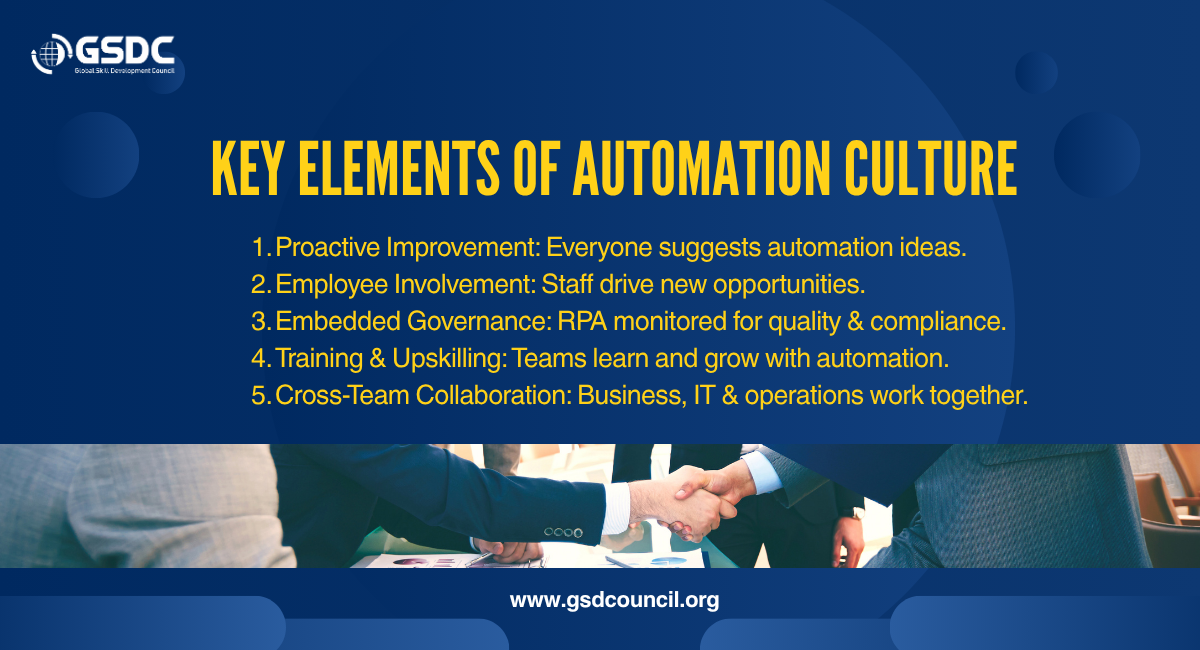
Key Elements of Automation Culture
- Proactive Process Improvement: The workforce always comes up with the ideas of tasks automation through repetition. It is no longer a matter solely for the IT or the automation teams - everyone is involved.
- Employee Involvement: Employees are motivated to propose automation ideas, thus becoming a source of potential opportunities that the company may not have considered.
- Embedded Governance: The use and monitoring of RPA along with the related performance indicators are seamlessly integrated into everyday activities thus assuring quality, compliance, and stable results.
- Training and Upskilling: Personnel are brought up to speed with the help of automation tools and involved in the process thus creating a shared sense of accomplishment.
- Collaboration Across Teams: Business, IT, and operations working hand in hand break the silos and ensure that the automation is in line with the overall business goals.
Impact of Automation Culture
- Consistency and Accuracy: Automation significantly reduces the risk of human errors and ensures standardization of operations.
- Faster Processes: The work that took time is done quickly thus freeing humans for strategic tasks.
- Scalability: With heavier workloads, process-based business models can keep going without the necessity of hiring new staff.
- Innovation Mindset: Employees no longer focus on task completion but rather on process improvement and creating smarter workflows.
By fostering an automation culture, organizations turn technology from a one-time project into a business-wide habit. Professionals who earn a certificate in RPA professional can play a key role in driving this change, ensuring automation aligns with strategy, encourages continuous improvement, and empowers employees to lead innovation.
The RPA Professional’s New Role: From Implementer to Enabler
As organizations embrace a full automation culture, the role of RPA professionals evolves. Professionals are no longer just executing tasks; they become enablers of automation across the business, guiding initiatives to deliver real value. Earning recognition from GSDC further validates their expertise and readiness for this leadership role.
Key Responsibilities
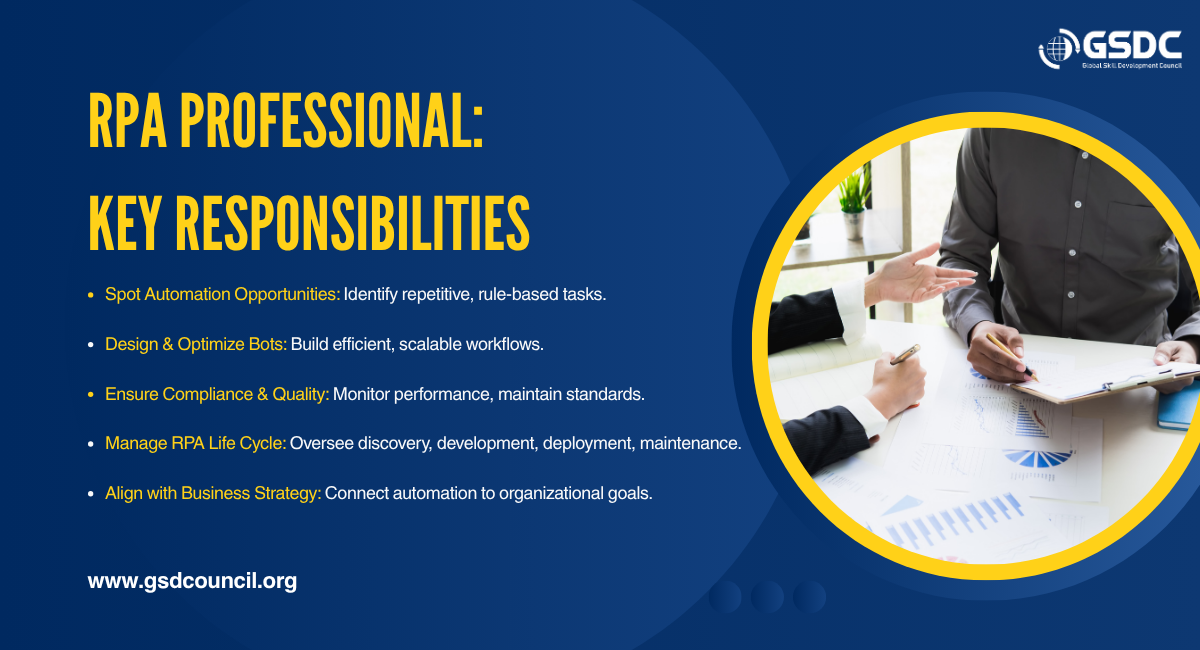
- Identifying Automation Opportunities: Knowledge of the process enables Professionals to spot tasks that are repetitive, rule-based, and thus suitable for automation.
- Designing and Optimizing Bots: Being equipped with both strong RPA Skills and RPA developer skills, Professionals are able to build bots in an efficient manner and also production workflows optimally to achieve the highest possible impact.
- Ensuring Compliance and Quality: Through RPA governance, they maintain standards, monitor bot performance, and ensure processes are secure and audit-ready.
- Managing the RPA Life Cycle: A thorough understanding of the RPA life cycle from processing discovery to development, deployment, and maintenance, guarantees continuous growth.
Aligning with Business Strategy: Professionals equipped with knowledge of the RPA fundamentals can easily link the organization's automation efforts with its goals and strategy in the long run.
This Role Helps Value Addition:
- Automation becomes more universally accepted across departments and is less likely to be confined to specific silos.
- The flow of work automation is enhanced through the effectiveness and scalability of bots.
- Gives the business process automation insights that facilitate managers to make data-driven decisions.
- Serves as a liaison between the IT and business teams, thus ensuring that automation initiatives meet both the technical and strategic requirements.
To sum it all up, RPA professionals today are not merely task executors, they are change leaders who chart the way from isolated automation projects to an intelligent automation culture that generates measurable business benefits.
Download our PDF on automation strategy, RPA governance & project management.📘 Learn RPA Best Practices!
✨ Empower your team with actionable insights!
Building the Foundation: How to Drive Automation Adoption
Driving broad automation adoption means going beyond building bots; it means aligning automation with business goals and ensuring teams adopt it across functions.
- Create an Automation Strategy
- Define an automation strategy that links automation initiatives to organizational objectives, such as growth, cost efficiency, and improved service.
- Prioritize automation opportunities where you’ll get clear value and quick wins, then expand.
- Include metrics, governance, stakeholder roles, timelines, and pilot-to-scale plans.
- Measure Automation ROI
- Tracking automation ROI is essential to validate investment and secure support.
- Use metrics such as cost savings, error reduction, cycle-time improvement, and operational throughput.
- Share results with stakeholders to build credibility and momentum.
- Engage Managers & Boost Operations
- Managers play a key role by championing automation, removing roadblocks, and ensuring cross-functional collaboration.
- Automation strengthens operations by enabling consistent workflows, faster processes, and scalable outcomes.
- Encourage collaboration between business teams, IT, operations, and automation specialists to ensure the right processes are automated effectively.
Best Practices for Adoption
- Communicate openly about automation goals, benefits, and processes to show value early.
- Engage stakeholders early: involve users, managers, and IT so that automation is seen as an enabler, not a threat.
- Train staff and build capability in automation literacy and process thinking.
- Continuously reviewing, optimizing, and scale automation is a journey of continuous improvement, not a one-time project.
The Role of Certification in Building Leadership Credibility
As RPA becomes an enterprise-wide culture, professionals need more than technical skills; they need credibility and leadership. Earning a Certified RPA Professional or certificate in RPA professional from GSDC demonstrates expertise and readiness for leadership roles.
Why It Matters:
- Validates Knowledge: Confirms understanding of enterprise-level RPA implementation, RPA governance, and scaling strategies.
- Bridges Skills: Connects technical know-how with business strategy for effective leadership.
- Builds Credibility: Signals to managers and stakeholders that you can lead automation initiatives.
With GSDC certification, professionals move from bot builders to automation leaders, driving strategy and delivering measurable business value.

Conclusion: Turning Vision into Everyday Practice
The journey from isolated automation projects to a full automation culture transforms organizations. Businesses that embrace this shift gain operational efficiency, scalability, and a mindset of continuous improvement.
For professionals, this evolution presents an opportunity to move beyond task execution and become strategic leaders. Developing strong RPA skills and understanding enterprise-level automation equips you to guide organization-wide initiatives effectively.
Ultimately, success in RPA is not just about technology. It’s about a mindset one that sees workflow automation as a tool to create lasting business value, empower teams, and drive digital transformation across the organization.

Related Certifications
Stay up-to-date with the latest news, trends, and resources in GSDC
If you like this read then make sure to check out our previous blogs: Cracking Onboarding Challenges: Fresher Success Unveiled
Not sure which certification to pursue? Our advisors will help you decide!