RPA Career Evolution: Trends That Redefine the Role of Automation Professionals

Written by Matthew Hale
- Understanding the Core of Robotic Process Automation
- Popular Robotic Process Automation Tools
- Applications Across Industries
- Why RPA Is a Promising Career Path
- Understanding What an RPA Certification Is
- Conclusion: Turning Automation Skills into Strategic Value
- Frequently Asked Questions (FAQs) About RPA
The demand for professionals who can align automation with business strategy is rising fast. Organizations now seek RPA experts who can scale technology to deliver measurable results.
Robotic Process Automation (RPA) is central to modern operations, automating repetitive, rule-based tasks and freeing teams to focus on higher-value work. For those wondering what robotic process automation is, it refers to using software bots to perform tasks that were traditionally handled by humans.
Studies show 53% of organizations have begun their RPA journey, while 78% plan to expand investments within three years. Adoption could reach near-universal levels in five years, driven by gains in compliance, quality, and productivity. Resistance is low-only 17% of firms report hesitation-though scaling remains a challenge, with just 3% achieving full deployment.
As automation advances, understanding why RPA is important, its purpose, and what an RPA certification is has become essential for professionals aiming to grow in this evolving field.
Understanding the Core of Robotic Process Automation
In a world where efficiency defines competitiveness, understanding what robotic process automation has become crucial for businesses aiming to stay ahead. RPA is transforming how work gets done by using software bots to perform repetitive tasks such as data entry, report generation, and transaction processing with unmatched speed and accuracy.
Unlike traditional automation that requires complex coding or system redesigns, robotic process automation interacts directly with existing interfaces, making it faster to implement, easier to manage, and more scalable across enterprise systems.
How Robotic Process Automation Works
RPA follows predefined workflows to complete digital tasks across systems with precision and consistency. Modern implementations go further by integrating AI, machine learning, and analytics - creating intelligent, self-optimizing processes.
Key Characteristics of RPA:
- Rule-Based Automation: Executes repetitive, structured activities.
- 24/7 Operation: Works continuously without fatigue or downtime.
- Error Reduction: Minimizes manual effort and enhances precision.
- Seamless Integration: Connects with enterprise tools effortlessly.
By 2026, nearly 90% of large enterprises are expected to use RPA in some form, with bots completing over 20% of back-office operations across sectors like finance and healthcare.
Popular Robotic Process Automation Tools
Leading RPA tools are helping organizations scale automation, boost efficiency, and accelerate intelligent digital transformation across industries.
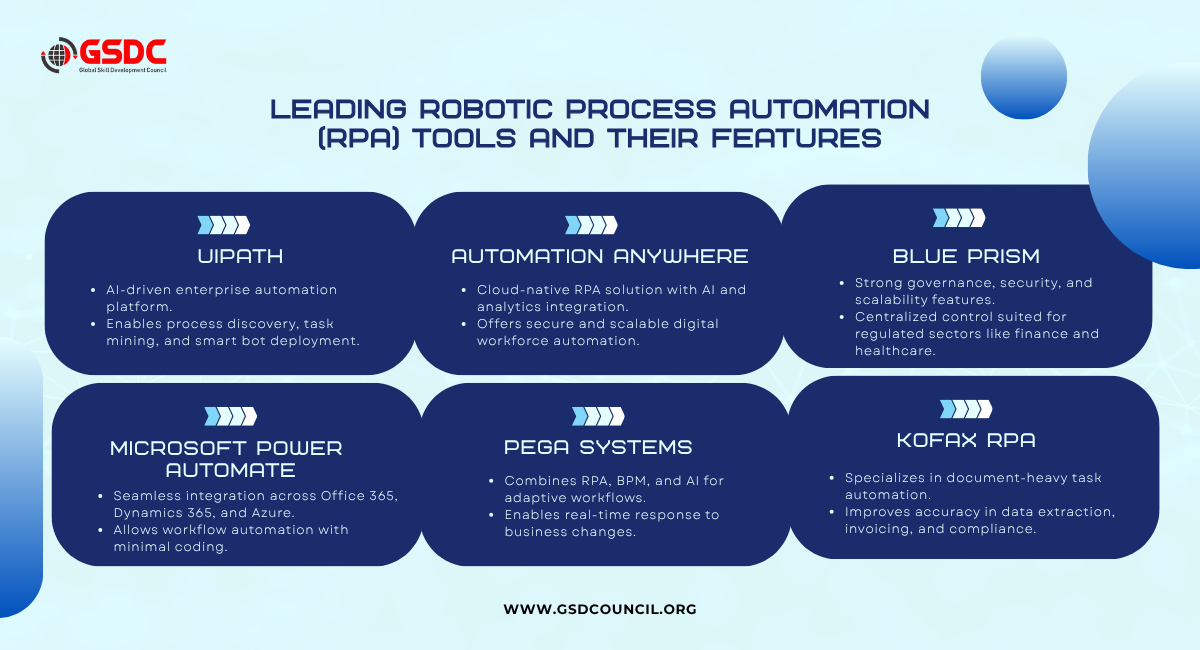
These RPA platforms enable automation with speed, accuracy, and scalability. Professionals can enhance their expertise with certifications from GSDC (Global Skill Development Council).
Business Benefits and Purpose of RPA
The purpose of RPA extends beyond automation-it’s about driving measurable impact on efficiency, cost, and performance.
- Improved Efficiency: Executes tasks faster with zero downtime, boosting overall process speed and consistency across departments.
- Cost Reduction: Cuts operational expenses by 25–40% through reduced manual work, minimized rework, and optimized resource utilization.
- Enhanced Accuracy and Compliance: Eliminates human error and ensures regulatory compliance through automated, traceable audit trails.
- Higher Productivity: Frees employees from repetitive tasks, allowing them to focus on innovation, problem-solving, and strategic decision-making.
- Digital Agility: Connects legacy systems with modern digital workflows, supporting rapid scalability without major infrastructure changes.
- Accelerated ROI: Delivers return on investment within the first year, with up to 50% faster process execution and substantial cost savings.
These benefits explain why organizations use robotic process automation as a strategic advantage in the digital economy.
Download the checklist for the following benefits:
📘 Download the RPA Career Toolkit packed with guides & resources.
💼 Learn how to master RPA and stand out in the digital workforce.
Applications Across Industries
Robotic Process Automation is revolutionizing how industries function-streamlining operations, improving accuracy, and cutting costs.
- Finance: Automates invoice processing, reconciliations, and audit preparation, improving compliance and reporting accuracy.
- Healthcare: Handles claims processing, patient data management, and appointment scheduling to enhance patient experience and efficiency.
- Retail: Streamlines order fulfillment, customer service, and inventory tracking, ensuring faster delivery and better customer satisfaction.
- Manufacturing: Coordinates supply chains, performs quality checks, and manages production reporting for improved operational flow.
- Government & Insurance: Simplifies policy administration, strengthens compliance, and accelerates case management workflows.
With RPA capable of automating up to 80% of rule-based tasks, organizations are achieving faster turnaround times, improved service delivery, and significant productivity gains.
Key Job Roles and the Role of RPA Professionals
The RPA career landscape has expanded beyond programming into strategic roles bridging business and technology.
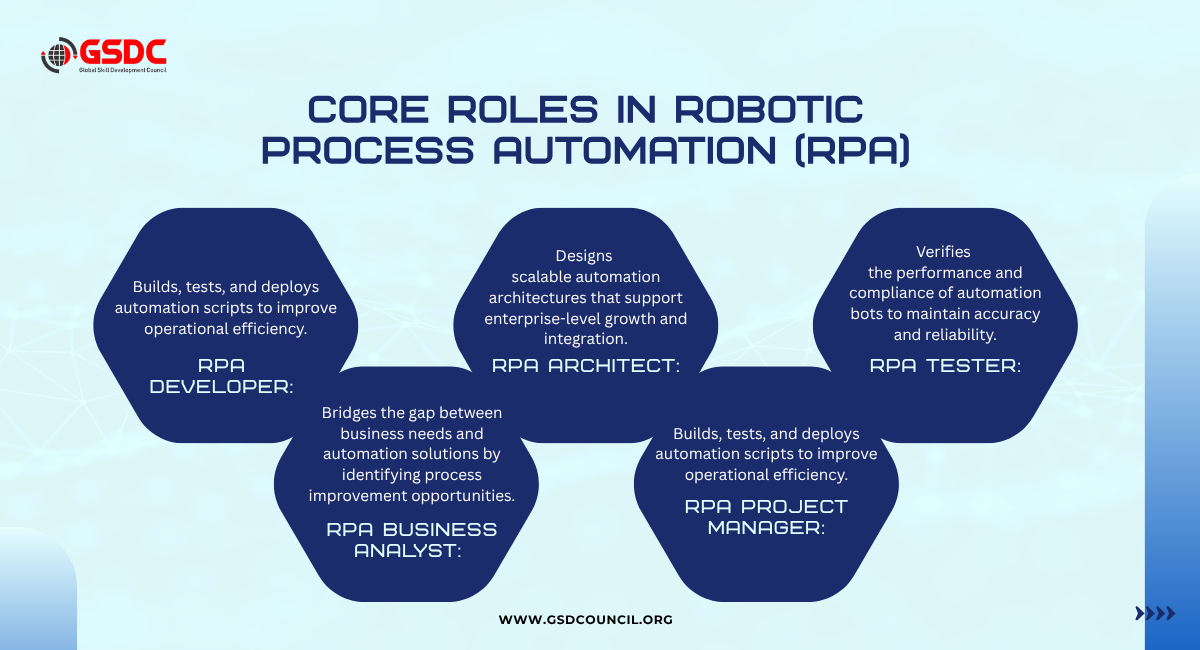
The RPA job market continues to grow by over 25% annually, making it a strong career path for those pursuing future-ready roles in digital transformation. Earning the Certified RPA Professional credential can further boost credibility and open doors to advanced opportunities in this evolving field.
Essential Skills for a Certified RPA Professional
Success in this field requires both technical and analytical expertise.
Key skills include:
- Programming Knowledge: Proficiency in Python, Java, or C#.
- Tool Expertise: Experience with UiPath, Blue Prism, or Automation Anywhere.
- Analytical Thinking: Identifying processes suitable for automation.
- Project Management: Coordinating automation projects across teams.
- Problem-Solving & Communication: Ensuring collaboration between business and IT.
Continuous learning and robotic process automation certification enhance credibility, validating expertise and keeping professionals ahead in this evolving field.
Why RPA Is a Promising Career Path
RPA is reshaping the global workforce, creating opportunities across industries such as manufacturing, finance, and technology.
- Rising Demand: Automation is expected to create millions of new roles worldwide by 2025.
- Career Growth: RPA developers and analysts rank among the highest-paid IT professionals.
- Global Impact: The automation market is projected to surpass USD 13 billion by 2030.
RPA Salaries and Career Growth
The RPA specialist salary reflects strong market demand. Based on verified profiles (as of October 2025), the average RPA salary in India is ₹24.3 lakhs per year, ranging from ₹18.7 to ₹48.1 lakhs. Globally, automation investments have surpassed USD 249 billion, showcasing career stability and financial growth.
Professionals with RPA certification enjoy faster promotions, global opportunities, and leadership potential in automation-driven enterprises.
Emerging Robotic Process Automation Trends
The future of robotic process automation is evolving toward intelligent, end-to-end automation through trends such as:
Key robotic process automation trends include:
- Automation-as-a-Service (AaaS): Cloud-based RPA delivery models are gaining traction, allowing organizations to scale automation on demand without heavy upfront infrastructure investment.
- Hyperautomation: A leading trend that merges RPA with AI, ML, and analytics to automate not just tasks but complex business decisions and processes across departments.
- AI and Machine Learning Integration: Bots are evolving to interpret unstructured data, recognize patterns, and continuously learn from outcomes-creating a more adaptive and intelligent digital workforce.
- Natural Language Processing (NLP) and Computer Vision: These technologies empower bots to understand human language, analyze documents, and interpret visual data, expanding RPA’s capabilities across industries like healthcare and finance.
- Low-Code and No-Code Platforms: These user-friendly solutions enable non-technical professionals to design and deploy automation workflows quickly, democratizing RPA development within organizations.
- Cybersecurity Automation: RPA is being used to enhance digital resilience-automating real-time threat detection, incident response, and compliance monitoring to strengthen enterprise security.
As these robotic process automation trends evolve, organizations are moving closer to achieving fully autonomous operations-where AI-enhanced bots not only execute processes but also make informed, strategic decisions that drive long-term business value.
Understanding What an RPA Certification Is
An RPA certification validates your ability to design, manage, and optimize automation workflows. It demonstrates technical competence, problem-solving skills, and understanding of why RPA is important for business transformation.
Certifications from reputed bodies such as the Global Skill Development Council (GSDC) hold global relevance. The Certified RPA Professional credential signifies proficiency in automation strategy, bot deployment, and process optimization-key for advancing your RPA career.

Conclusion: Turning Automation Skills into Strategic Value
The purpose of robotic process automation extends far beyond automating tasks-it’s about reimagining how businesses operate, innovate, and grow.
Professionals with certified RPA expertise are driving this change. With automation expected to contribute over USD 15 trillion to the global economy by 2030, those investing in robotic process automation certification today are building the foundation for tomorrow’s digital enterprise.
Frequently Asked Questions (FAQs) About RPA
1. Is RPA a good career?
Yes. RPA is a good career with high demand, strong salaries, and opportunities in automation, AI, and digital transformation.
2. What does an RPA Developer do?
An RPA developer builds, tests, and maintains software bots that automate repetitive business tasks and improve process efficiency.
3. What is an RPA certification?
An RPA certification validates your skills in creating and managing automation workflows using tools like UiPath or Blue Prism.
4. Why is RPA important?
RPA is important because it boosts efficiency, reduces costs, and minimizes human errors in business operations.
5. How robotic process automation works?
Robotic process automation works by using bots that follow rules to perform digital tasks quickly and accurately.
6. Why use robotic process automation?
Organizations use robotic process automation to save time, cut costs, and improve service quality across departments.
7. What is RPA certification and who should get it?
A RPA certification is ideal for professionals in IT, business, or operations who want to grow in automation careers.

Related Certifications
Stay up-to-date with the latest news, trends, and resources in GSDC
If you like this read then make sure to check out our previous blogs: Cracking Onboarding Challenges: Fresher Success Unveiled
Not sure which certification to pursue? Our advisors will help you decide!