Python Full Stack Developer Roadmap 2026: A Step-by-Step Guide
Written by Emily Hilton
- What Is a Python Full Stack Developer?
- Python Full Stack Developer Roadmap 2026
- How Long Does It Take to Become a Python Full Stack Developer?
- Should You Get a Python Full Stack Developer Certification?
- Take Your Python Full Stack Skills to the Next Level with GSDC
- What Comes After the Python Full Stack Developer Roadmap?
- Final Thoughts
Becoming a Python Full Stack Developer can feel overwhelming when you look at everything you are expected to learn. Python, HTML, CSS, JavaScript, databases, APIs, frameworks, Git, deployment, testing the list can quickly become intimidating.
The good news? You do not need to learn everything at once.
A structured roadmap can help you understand what to learn, in what order, and how each skill connects to the next. Whether you are a complete beginner, a student, or an existing developer looking to move into full-stack development, following the right learning path can make the process much easier.
This Python Full Stack Developer Roadmap 2026 breaks the journey into practical steps, from learning Python fundamentals to building and deploying complete web applications.
By the end, you will understand the essential full-stack developer skills, technologies, projects, and career steps needed to work toward a Python full-stack development career.
What Is a Python Full Stack Developer?
A Python Full Stack Developer is a professional who can work on both the front end and back end of a web application, while using Python extensively for server-side development.
The front end is the part users see and interact with. It typically involves:
- HTML
- CSS
- JavaScript
- Responsive design
- Front-end frameworks or libraries
The back end handles the application's logic, data processing, authentication, APIs, and communication with databases. Python frameworks such as Django, Flask, and FastAPI are commonly used for these tasks.
A Python Full Stack Developer may also work with:
- SQL and databases
- REST APIs
- Git and GitHub
- Testing
- Cloud platforms
- Docker and deployment
- Authentication and security
- Performance optimization
In simple terms, a full-stack developer understands how the different pieces of a web application fit together.
Python Full Stack Developer Roadmap 2026
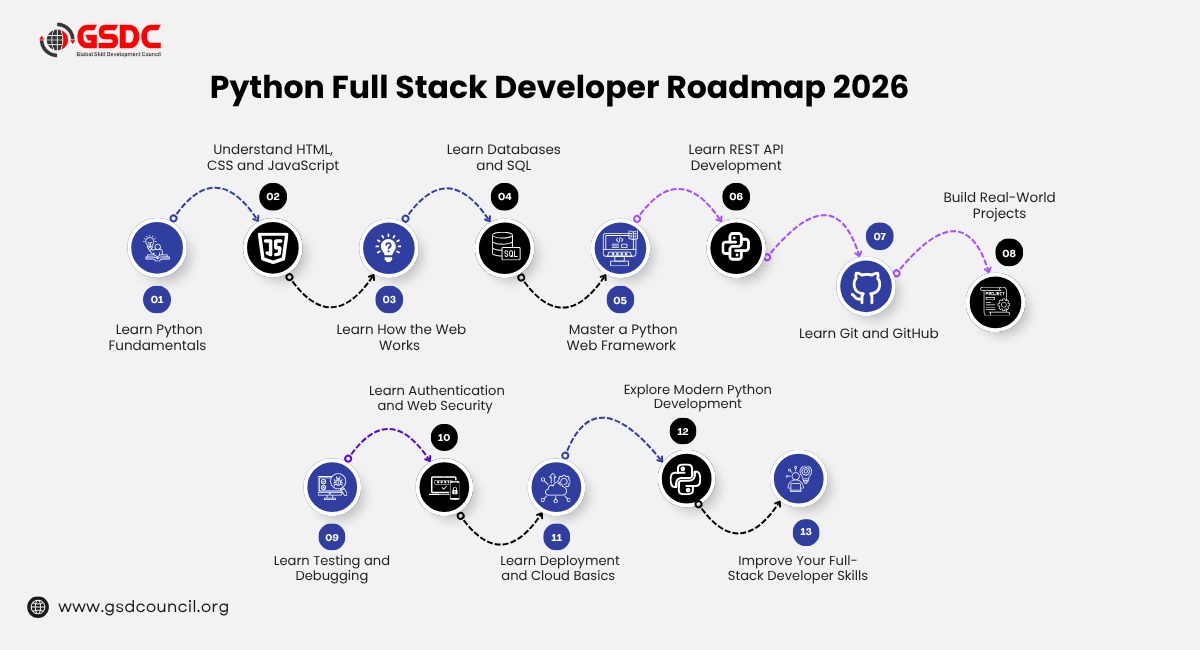
A practical learning path can be divided into the following stages:
Python Basics → Web Fundamentals → Front-End Development → Databases → Python Frameworks → APIs → Full-Stack Projects → Git & Testing → Deployment → Advanced Skills → Career Preparation
Let's explore each step.
Step 1: Learn Python Fundamentals
Python should be your starting point because it will become the foundation of your back-end development skills.
You do not need advanced Python knowledge before building your first application. Start with the fundamentals and gradually move toward writing real programs.
Topics to learn:
- Variables and data types
- Strings
- Numbers
- Lists, tuples, sets, and dictionaries
- Conditional statements
- Loops
- Functions
- Modules and packages
- File handling
- Exception handling
- Object-oriented programming
- List and dictionary comprehensions
- Virtual environments
- Basic debugging
For example, understand how to create reusable functions rather than writing the same code repeatedly.
Once you are comfortable with the basics, start solving small programming problems. Build simple programs such as a calculator, expense tracker, quiz application, or contact management system.
Your goal at this stage
Don't aim to memorize every Python feature.
Your goal should be to think logically, write clean code, understand errors, and solve problems using Python.
Step 2: Understand HTML, CSS and JavaScript
Knowing Python alone does not make you a full-stack developer.
You also need to understand how websites work from the user's perspective.
Start with HTML to understand the structure of web pages.
Then learn CSS for styling and layout.
After that, learn JavaScript to make web pages interactive.
Focus on:
HTML
- Semantic elements
- Forms
- Tables
- Links and images
- Accessibility basics
CSS
- Selectors
- Box model
- Flexbox
- Grid
- Responsive design
- Media queries
- Basic animations
JavaScript
- Variables
- Functions
- Arrays and objects
- DOM manipulation
- Events
- Fetch API
- Promises
- Async/await
- JSON
You don't necessarily need to become a JavaScript specialist before learning Python back-end development. However, you should be comfortable enough to connect your front end with a Python-powered back end.
Step 3: Learn How the Web Works
This step is often skipped by beginners, but understanding web fundamentals makes full-stack development much easier.
Learn concepts such as:
- Client and server
- HTTP and HTTPS
- Requests and responses
- HTTP methods
- Status codes
- URLs
- Headers
- Cookies
- Sessions
- JSON
- DNS
- Browsers
- APIs
For example, when a user logs into a website, the browser sends information to the server. The server processes the request, verifies the credentials, and sends a response.
Understanding this process helps you troubleshoot applications instead of simply following tutorials.
Step 4: Learn Databases and SQL
Almost every practical web application needs a database.
A Python Full Stack Developer should understand how applications store, retrieve, update, and delete information.
Start with relational databases and SQL.
Learn:
- Tables
- Rows and columns
- Primary keys
- Foreign keys
- Relationships
- SELECT
- INSERT
- UPDATE
- DELETE
- JOIN
- GROUP BY
- Indexes
- Basic database normalization
PostgreSQL and MySQL are useful databases to explore.
You should also understand when an application might use a NoSQL database such as MongoDB.
Don't just learn SQL syntax
Build something with a database.
For example, create a simple employee management application where users can:
- Add employees
- View employee records
- Update information
- Delete records
- Search employees
This will help you understand how application logic interacts with stored data.
Step 5: Master a Python Web Framework
Now you can move into the back end.
This is where Python becomes especially valuable.
There are several Python frameworks, but Django, Flask, and FastAPI are worth understanding.
Django
Django is a powerful framework designed for building robust web applications.
Learn:
- Django project structure
- Apps
- URLs
- Views
- Models
- Templates
- Forms
- Django ORM
- Authentication
- Admin panel
- Middleware
Django is particularly useful when you want many features and conventions available within a mature framework.
Flask
Flask is lightweight and flexible. It is useful for understanding how web applications work without relying on as many built-in components.
FastAPI
FastAPI is especially useful when your work involves modern APIs and Python-based backend services.
It can be a valuable skill for developers interested in API development, microservices, and applications that interact with other software systems.
Which should you learn first?
For beginners, choosing one primary framework is usually better than trying to master all three simultaneously.
If your goal is traditional web application development, Django can be an excellent starting point.
If your goal is API-focused development, FastAPI can be a strong option.
Step 6: Learn REST API Development
Modern applications rarely operate as isolated websites.
They often communicate with mobile apps, front-end applications, third-party services, and other systems through APIs.
That makes API development an important part of the Python Full Stack Developer Roadmap.
Learn:
- REST architecture
- GET requests
- POST requests
- PUT/PATCH requests
- DELETE requests
- JSON
- Authentication
- Authorization
- HTTP status codes
- API validation
- Error handling
- API documentation
For example, imagine you build an online bookstore.
Your front end might request:
GET /books
The Python backend retrieves the books from the database and returns the information as JSON.
The front end can then display that information to the user.
Once you understand this flow, you will have a much clearer picture of how modern full-stack applications communicate.
Step 7: Learn Git and GitHub
Learning Git is not optional if you want to work professionally as a developer.
Git helps you track changes in your code, experiment safely, collaborate with other developers, and maintain different versions of a project.
Learn these Git concepts:
- Repository
- Commit
- Branch
- Merge
- Clone
- Pull
- Push
- Pull request
- Merge conflicts
- .gitignore
You should also learn how to maintain projects on GitHub.
A good GitHub profile can become part of your portfolio because recruiters and hiring managers may use it to understand how you approach projects and code.
Step 8: Build Real-World Projects
This is one of the most important stages of the roadmap.
Watching tutorials can teach you concepts, but projects teach you how to solve problems.
Start with small applications and gradually increase complexity.
Beginner projects
- Calculator
- To-do list
- Quiz application
- Expense tracker
- Notes application
Intermediate projects
- Blog platform
- E-commerce application
- Employee management system
- Appointment booking system
- Learning management system
Advanced projects
- Multi-user SaaS application
- Real-time communication platform
- AI-powered web application
- Analytics dashboard
- API-driven business application
A good project should demonstrate more than a visually attractive interface.
Try to include:
- User registration
- Login/logout
- Database integration
- CRUD operations
- API integration
- Form validation
- Error handling
- Authentication
- Responsive design
- Deployment
The project rule
Instead of building ten nearly identical projects, build three to five meaningful projects that demonstrate different skills.
Step 9: Learn Testing and Debugging
Professional developers don't simply write code—they test it.
Start by understanding different types of testing:
- Unit testing
- Integration testing
- API testing
- Functional testing
For Python applications, learn testing tools such as pytest or Python's built-in testing capabilities.
You should also become comfortable with debugging.
When something goes wrong, don't immediately search for the exact error online.
First ask:
- What was the application supposed to do?
- What actually happened?
- Where does the error occur?
- What changed recently?
- What information does the error message provide?
Developing this problem-solving habit is an important part of your career guide to becoming a full-stack developer.
Step 10: Learn Authentication and Web Security
Security should be part of your development process from the beginning.
Learn the basics of:
- Password hashing
- Authentication
- Authorization
- Sessions
- Tokens
- JWT
- CSRF
- CORS
- SQL injection
- XSS
- Secure API practices
- Environment variables
You don't need to become a cybersecurity expert, but you should understand common vulnerabilities and how to avoid introducing them into your applications.
Never store passwords as plain text, and never commit API keys or database credentials to a public repository.
Step 11: Learn Deployment and Cloud Basics
Building an application on your computer is only part of the job.
You should also learn how to make your application accessible to other people.
Start with deployment fundamentals:
- Linux basics
- Environment variables
- Web servers
- Application servers
- Domain names
- HTTPS
- Database deployment
- Logs
- Basic cloud concepts
You can then explore platforms and services offered by major cloud providers.
Docker is another useful skill because it helps package applications and their dependencies into consistent environments.
You don't need to become a cloud engineer immediately.
Your first goal is simply to understand:
How does my application move from my laptop to a production environment?
Step 12: Explore Modern Python Development
The Python ecosystem continues to expand beyond traditional web development.
In 2026, developers can also explore areas such as:
- AI application development
- Generative AI
- Machine learning integration
- Automation
- Data processing
- Cloud-native applications
- Microservices
- API-driven applications
For example, a Python full-stack application could integrate an AI model through an API and provide users with an intelligent feature through a web interface.
This doesn't mean you need to become a machine learning engineer.
Instead, understand how Python applications can consume AI services and integrate intelligent features into products.
Step 13: Improve Your Full-Stack Developer Skills
Technical knowledge is only one part of becoming employable.
A strong career guide for full-stack developers should also include professional skills.
Important skills include:
- Problem-solving
- Communication
- Logical thinking
- Team collaboration
- Time management
- Debugging
- Documentation
- Code review
- Requirement analysis
- Continuous learning
You may know Python, Django, JavaScript, and SQL, but professional development also involves understanding what the user or business actually needs.
A developer who can communicate clearly and solve real problems can be more valuable than someone who simply knows a long list of technologies.
How Long Does It Take to Become a Python Full Stack Developer?
The timeline depends on your previous experience, learning schedule, and how much practical work you do.
A beginner studying consistently might structure their journey like this:
Months 1–2: Foundations
Focus on:
- Python
- HTML
- CSS
- JavaScript basics
Months 3–4: Back-End Development
Focus on:
- Django or FastAPI
- SQL
- Databases
- APIs
- Authentication
Months 5–6: Full-Stack Projects
Build:
- One beginner project
- Two intermediate projects
- One portfolio-level project
Learn Git, testing, deployment, and basic cloud concepts alongside your projects.
The goal shouldn't be to finish a roadmap as quickly as possible.
The real goal is to become capable of building applications independently.
Should You Get a Python Full Stack Developer Certification?
A Python Full Stack Developer Certification can complement practical learning, particularly for beginners who want structured learning and a credential that demonstrates their commitment to developing the required skills.
However, certification should not replace hands-on experience.
When evaluating a certification, look for a program that covers practical areas such as:
- Python programming
- Front-end development
- Databases
- Backend frameworks
- API development
- Real-world projects
- Testing
- Deployment
- Practical assessments
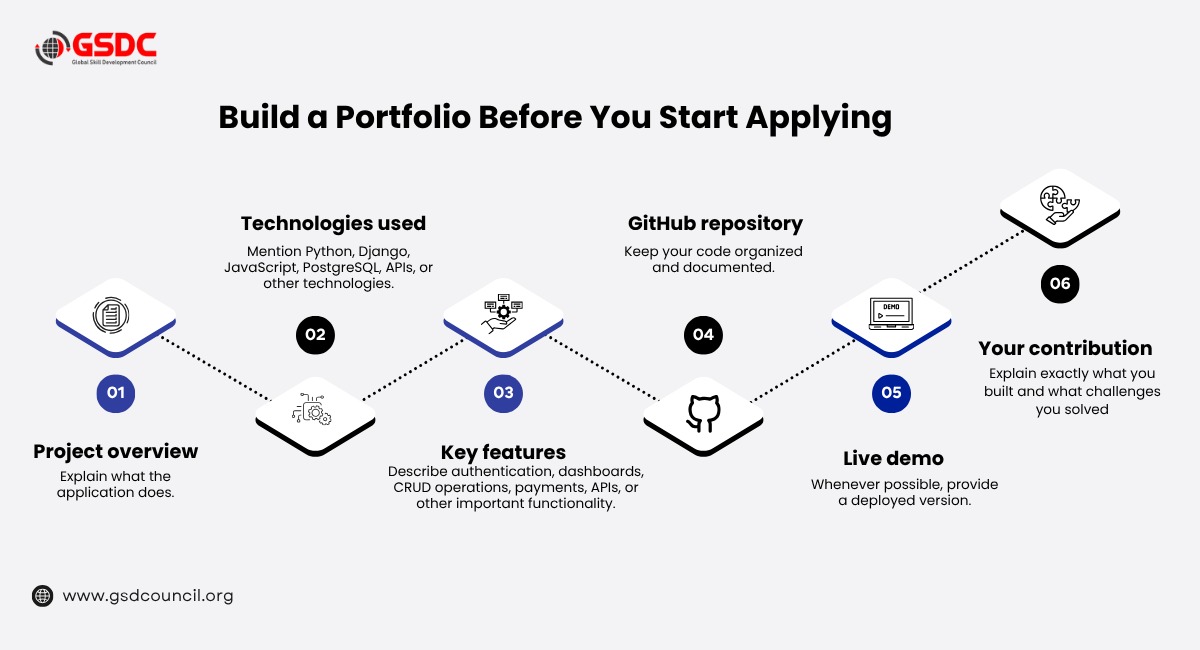
Most importantly, use your certification journey to create projects that you can showcase in your portfolio.
A certificate can support your profile, but your ability to build, explain, troubleshoot, and improve applications is what ultimately demonstrates your development skills.
Common Mistakes to Avoid
Following a roadmap is useful, but how you learn matters just as much.
1. Trying to learn everything at once
Don't start Python, Django, React, Docker, Kubernetes, AWS, AI, and machine learning simultaneously.
Build your foundation first.
2. Watching tutorials without coding
A two-hour tutorial does not equal two hours of development experience.
Pause the tutorial and build things yourself.
3. Copying projects
Copying code can help you understand a concept initially, but eventually build something without following every tutorial step.
4. Ignoring JavaScript
You don't need to master every JavaScript framework, but understanding JavaScript is important for full-stack development.
5. Avoiding databases
A developer who understands Python but cannot design or query a database will struggle with many real-world applications.
6. Skipping Git
Start using Git from your first serious project instead of waiting until you are job hunting.
7. Focusing only on certificates
Certification can support your learning, but projects, problem-solving, and practical skills should remain central.
Take Your Python Full Stack Skills to the Next Level with GSDC
In today's competitive tech landscape, having a recognized certification can make all the difference. GSDC's Certified Python Full Stack Developer program is designed for developers and aspiring professionals who want to turn their Python skills into a career advantage.
Through this certification, you'll build practical expertise across the full stack from front-end to back-end development while gaining a credential that proves your capabilities to employers worldwide. Whether you're looking to break into full stack development or formalize skills you already have, this program offers a structured path forward.
Learn more about the Certified Python Full Stack Developer Certification and start building the career you're aiming for.
What Comes After the Python Full Stack Developer Roadmap?
Once you are comfortable with full-stack development, you can specialize according to your career goals.
You could move toward:
- Python Backend Developer
- Python Full Stack Developer
- Django Developer
- FastAPI Developer
- API Developer
- Software Developer
- Cloud Application Developer
- AI Application Developer
- Full-Stack AI Developer
You can also deepen your knowledge of system design, cloud computing, DevOps, cybersecurity, AI, or data engineering.
The roadmap doesn't end when you get your first job. Technology changes continuously, so successful developers keep learning and adapting.
Final Thoughts
The best Python Full Stack Developer Roadmap 2026 is not simply a list of technologies to memorize. It is a progression from understanding programming fundamentals to building, testing, deploying, and maintaining real applications.
Start with Python. Learn how websites work. Build your front-end foundation. Understand databases. Pick a Python framework. Learn APIs and Git. Then put everything together through real projects.
As your confidence grows, add testing, security, deployment, cloud technologies, and modern areas such as AI integration.

Related Certifications
Stay up-to-date with the latest news, trends, and resources in GSDC
If you like this read then make sure to check out our previous blogs: Cracking Onboarding Challenges: Fresher Success Unveiled
Not sure which certification to pursue? Our advisors will help you decide!