Top Python Full Stack Developer Skills You Need in 2026
Written by Emily Hilton
The definition of a good full-stack developer is changing.
A few years ago, knowing a programming language, a frontend framework, and a database could be enough to build a basic web application. In 2026, development teams increasingly expect developers to understand the entire application lifecycle from writing code and working with APIs to testing, securing, deploying, and maintaining applications.
For a Python Full Stack Developer, this means Python is only one part of the skill set. Current full-stack learning and skills guides consistently emphasize frontend fundamentals, backend development, databases, version control, testing, deployment, and practical development experience.
So, what are the Python Full Stack Developer skills that actually matter in 2026? Let's look at them based on what a developer needs to be capable of doing, not simply what technologies they should list on a resume.
What Skills Does a Python Full Stack Developer Need?
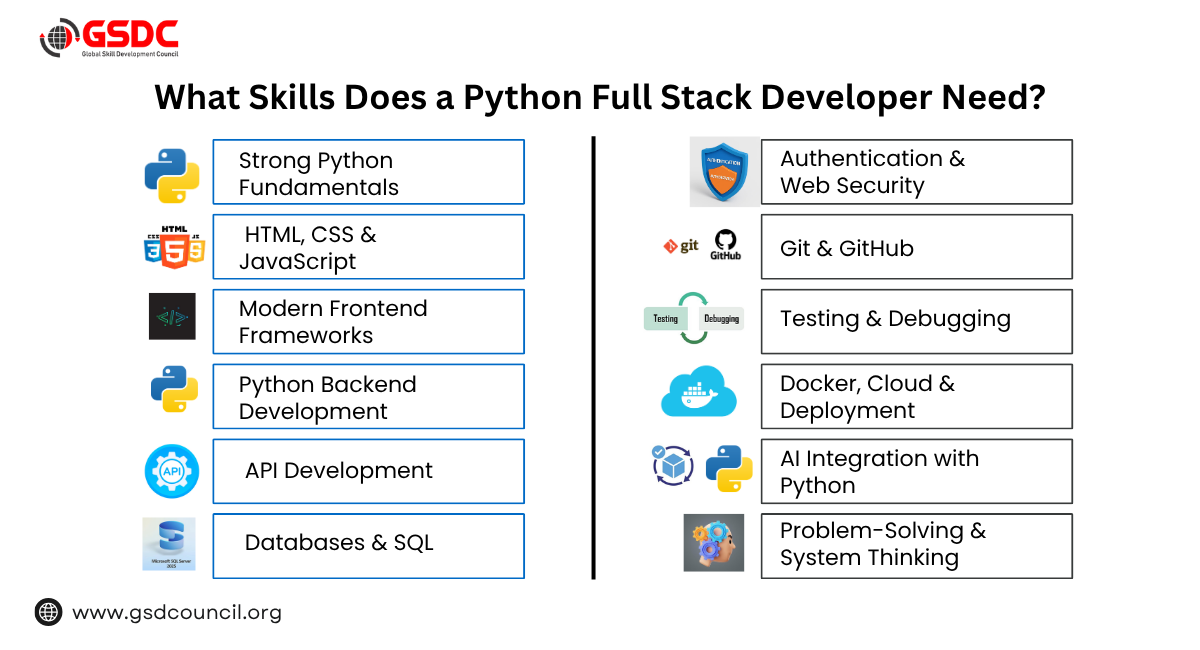
A Python Full Stack Developer works across the entire application from the screen users see to the server, database, APIs, and deployment behind it.
You don't need to master every tool. What matters is knowing how the different parts of an application work together.
Here are the key skills to focus on in 2026:
1. Strong Python Fundamentals
Python is the foundation of the stack. Beyond basic syntax, you should know:
- Functions and OOP
- Data structures
- Exception handling
- Modules and packages
- Virtual environments
- Debugging and clean coding practices
The goal is to move from “I can write Python” to “I can build and maintain a Python application.”
2. HTML, CSS & JavaScript
Even if Python handles the backend, your users interact with the frontend.
You should be comfortable with:
- HTML and CSS
- Responsive design
- JavaScript fundamentals
- DOM manipulation
- JSON and API requests
- Async/await and promises
You don't need to become a frontend specialist. You should simply understand how the browser communicates with your Python backend.
3. Modern Frontend Frameworks
For larger applications, learn at least one modern framework such as React, Vue, or Angular.
The practical goal is to build interfaces that can:
- Consume APIs
- Handle forms and validation
- Manage application state
- Display errors
- Respond to backend updates
4. Python Backend Development
This is where frameworks such as Django and FastAPI come in.
You should know how to build:
- Routes and APIs
- Business logic
- Authentication
- Data validation
- Error handling
- Database integrations
Django is useful for building complete web applications, while FastAPI is a strong choice for modern API-driven applications.
5. API Development
Modern applications rarely work in isolation. Your frontend, mobile app, or third-party services may all communicate through APIs.
Learn how to work with:
- REST APIs
- HTTP methods and status codes
- JSON
- Request validation
- Authentication and authorization
- API documentation
- Error handling
A good API should be predictable, secure, and easy for other applications to use.
6. Databases & SQL
Don't just learn how to connect Python to a database. Learn how to structure and work with data.
You should understand:
- SQL
- Tables and relationships
- Primary and foreign keys
- Indexing
- Transactions
- Query optimization
- ORMs such as Django ORM and SQLAlchemy
For example, an e-commerce app may connect customers, products, orders, payments, and order items. Understanding those relationships is more valuable than simply memorizing SQL commands.
7. Authentication & Web Security
If your application has users, security matters.
Understand the basics of:
- Login and sessions
- Password hashing
- JWTs and tokens
- Role-based access
- HTTPS
- CORS
- Secure cookies
- Environment variables and secrets
You should also know how to avoid common risks such as SQL injection and cross-site scripting (XSS).
8. Git & GitHub
Real-world development is collaborative, so Git is essential.
Learn how to:
- Create branches
- Make meaningful commits
- Merge changes
- Resolve conflicts
- Create pull requests
- Review and revert code
Think of Git as part of your development workflow, not just a place to upload code.
9. Testing & Debugging
Professional developers don't just write code they verify it.
Tools such as pytest can help you automate testing, while debugging skills help you find and fix problems.
A useful mindset is:
Reproduce → Investigate → Fix → Test again.
This is often more valuable than simply memorizing error messages.
10. Docker, Cloud & Deployment
Your application needs to work outside your laptop, too.
Learn the basics of:
- Docker and containers
- Linux
- Environment configuration
- Application servers
- Domains and HTTPS
- Cloud platforms
- Logs and monitoring
- CI/CD pipelines
You don't need to become a DevOps engineer, but you should understand what happens between “my code works” and “my application is live.”
11. AI Integration with Python
In 2026, AI is becoming an increasingly useful addition to full-stack development.
You don't necessarily need to build AI models from scratch. Instead, learn how to integrate AI into applications.
For example, you could build a Python application that:
- Summarizes documents
- Answers questions using company data
- Classifies customer requests
- Generates content
- Adds an AI-powered search feature
This makes Python + AI integration a valuable skill for modern full-stack developers.
12. Problem-Solving & System Thinking
Technology changes quickly. Problem-solving doesn't.
A strong developer can look at a slow application and ask:
Is the problem in the frontend, API, backend, database, or infrastructure?
That's where systems thinking comes in. As you progress, learn the basics of caching, queues, scalability, architecture, and performance optimization.
The Bottom Line
You don't need to learn 20 frameworks to become a Python Full Stack Developer.
Focus on building a strong foundation:
Python → Frontend → Backend → APIs → Databases → Security → Git → Testing → Deployment → AI
Most importantly, build projects while learning. The ability to connect these skills and solve real problems is what turns a list of technologies into real full-stack development expertise.
Which Python Full Stack Developer Skills Matter Most?
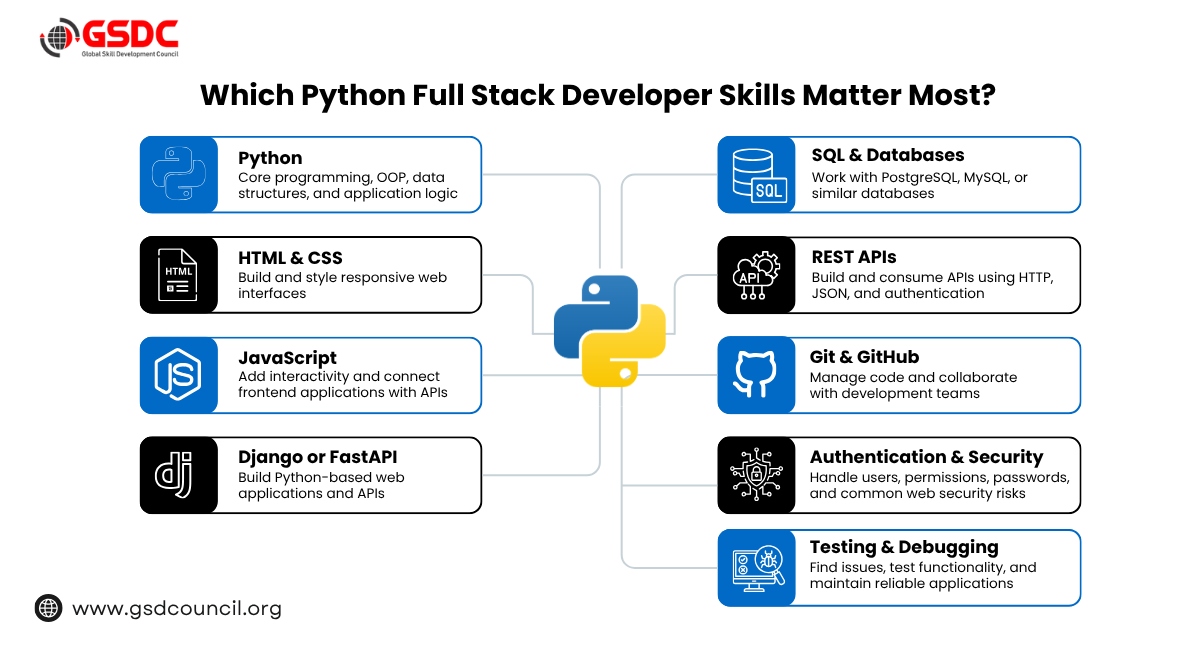
You don't need to master every technology to become a Python Full Stack Developer. Focus on these core skills first:
Skills That Give You an Edge
Once your fundamentals are strong, add:
- React or another frontend framework
- Docker
- Cloud & CI/CD
- AI integration with Python
- Basic system design
The best approach is T-shaped learning: build broad knowledge across the full stack while developing deeper expertise in a few areas, such as Python, Django/FastAPI, SQL, and AI integration.
Don't try to learn everything at once. Build projects, solve real problems, and expand your stack as you grow.
Python Full Stack Developer Certification: Can It Validate These Skills?
A Python Full Stack Developer Certification can provide structured learning and a way to demonstrate that you have completed a defined program.
However, certification alone doesn't prove that you can build a production application.
A useful certification should connect learning with practical development.
For example, a strong program may combine Python and backend development with frontend technologies, databases, APIs, projects, assessments, and practical application.
When considering a Python Full Stack Developer Certification, look beyond the certificate itself. Ask whether the program helps you demonstrate the skills employers actually expect.
Your strongest profile combines:
Technical skills + practical projects + portfolio + certification + problem-solving ability
Certification can support your credibility, but practical capability should remain at the center.
Level Up Your Career with GSDC's Python Full Stack Developer Certification
Want to sharpen your Python full-stack skills and stand out with a credential employers recognize? The Certified Python Full Stack Developer (CFSD) certification from GSDC is built to help you do just that.
The program covers the core areas of Python full-stack development, giving you hands-on, job-ready skills while validating what you already know. It's a practical way to strengthen your resume and show employers you're ready for the next opportunity.
Ready to get started?
Check out the Certified Python Full Stack Developer Certification and take the next step in your full-stack development career.

Final Thoughts
The most valuable Python Full Stack Developer skills in 2026 are not defined by a single framework or programming language. Python remains an important foundation, but a capable developer needs to understand the complete application environment around it.
A developer who knows Django but cannot diagnose a database problem is limited. A developer who knows React but cannot understand an API is limited. A developer who can write Python but cannot deploy or secure an application is also limited. Full-stack development is valuable because it brings these areas together.
So, instead of asking "How many technologies should I learn?", ask a better question:
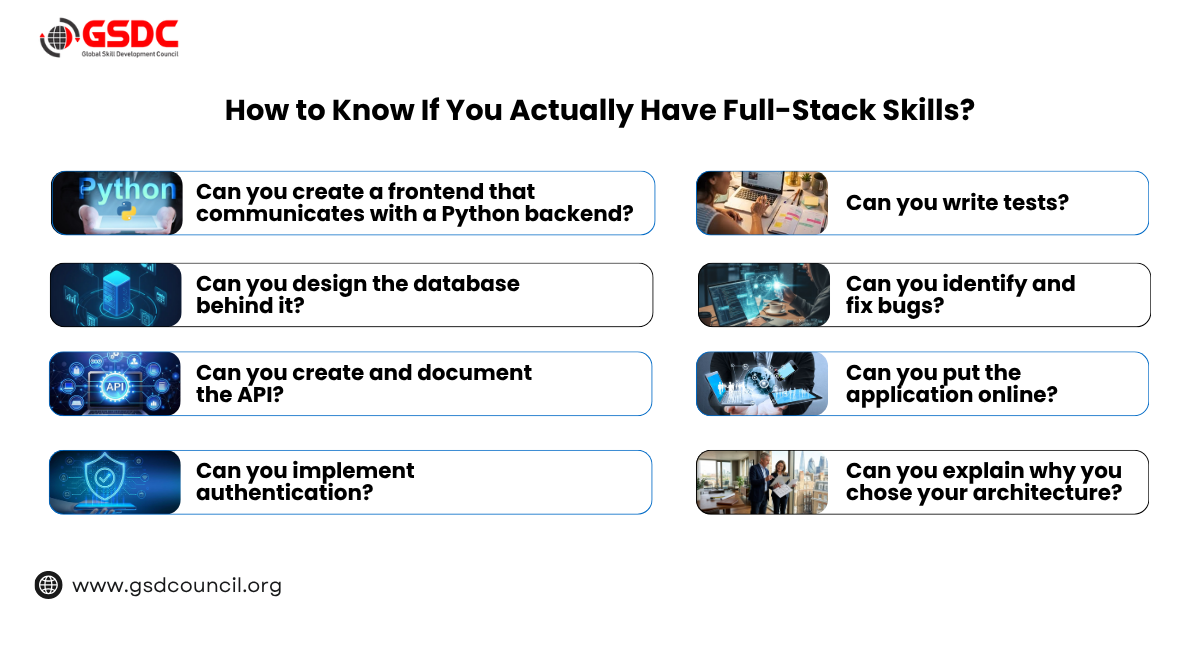
"Can I take an application from an idea to a working, secure, tested, and deployable product?"
That is the capability these skills are ultimately designed to build.

Related Certifications
Stay up-to-date with the latest news, trends, and resources in GSDC
If you like this read then make sure to check out our previous blogs: Cracking Onboarding Challenges: Fresher Success Unveiled
Not sure which certification to pursue? Our advisors will help you decide!