Why Chatbots Are No Longer Enough for Modern IT Service Management
Written by Matthew Hale
- The Chatbot Era: Useful, But Limited
- AI Agent vs Chatbot: What's Actually Different
- What Agentic AI in ITSM Actually Looks Like
- The Data Behind the Shift
- Where Agentic AI Is Already Changing ITSM: Real Use Cases
- From ITSM Automation to Intelligent Automation
- Beyond IT: Enterprise Service Management
- What This Means for ITSM Careers
- The Catch: Governance, Risk, and Realistic Expectations
- Where to Actually Learn This Stuff
- Getting Ready for the Agentic Shift
A few years ago, "AI in the helpdesk" meant a chatbot that could reset your password and point you to a knowledge base article if it got confused. That was the ceiling. Today, the same IT service desk can have software that reads an incident ticket, checks server logs, restarts the right service, and closes the ticket - without a human ever touching it.
That's not a small upgrade. It's a different category of technology. And it's forcing every IT Service Management (ITSM) team to rethink how they staff, train, and run their service desks.
This blog walks through what's actually changed, how AI agents differ from the chatbots we're used to, where agentic AI in ITSM is already delivering results, and what it means for the people who work in this field.
The Chatbot Era: Useful, But Limited
Rule-based and NLP chatbots have been part of ITSM for over a decade. They're good at narrow, repetitive jobs: answering FAQs, guiding password resets, routing a ticket to the right queue, or collecting basic information before a human agent steps in.
The catch is that a chatbot generally works within a script. It recognizes intent, matches it to a pre-built flow, and hands off anything it can't classify. It doesn't independently decide what to do next, and it can't take action across multiple systems on its own. If a chatbot needs to check a user's license status, restart a VPN service, and update a CMDB record, someone usually has to build three separate integrations and still supervise the outcome.
This is where a lot of confusion starts, because the terms "chatbot" and "AI agent" get used interchangeably in marketing material even though they describe very different things.
AI Agent vs Chatbot: What's Actually Different
Is a chatbot an AI agent? Not quite, and the distinction matters more than it sounds. A chatbot is built to hold a conversation. An AI agent is built to complete a goal, and a conversation is just one of the tools it might use along the way.
| Traditional Chatbot | Autonomous AI Agent | |
| Primary job | Answer questions, guide users through a script | Complete a task or resolve an issue end-to-end |
| Decision-making | Follows pre-set rules or intents | Reasons through steps and adapts based on context |
| System access | Usually limited to one channel or app | Can act across ticketing, monitoring, identity, and infrastructure tools |
| Memory | Often stateless between sessions | Retains context across a task and sometimes across sessions |
| Escalation | Hands off when confused | Escalates only when a genuine judgment call or policy exception is needed |
| Best fit | FAQs, basic routing, simple resets | Incident triage, root-cause investigation, multi-step remediation |
So when people ask about ai agents and chatbots as if they're the same thing, the honest answer is: a chatbot can be one small part of an agent's toolkit, but an agent is the one actually doing the work, not just talking about it. It's also the first distinction covered in the Certified Generative AI in ITSM program, because most of the confusion around "agentic AI" in ITSM traces straight back to this one mix-up.
What Agentic AI in ITSM Actually Looks Like
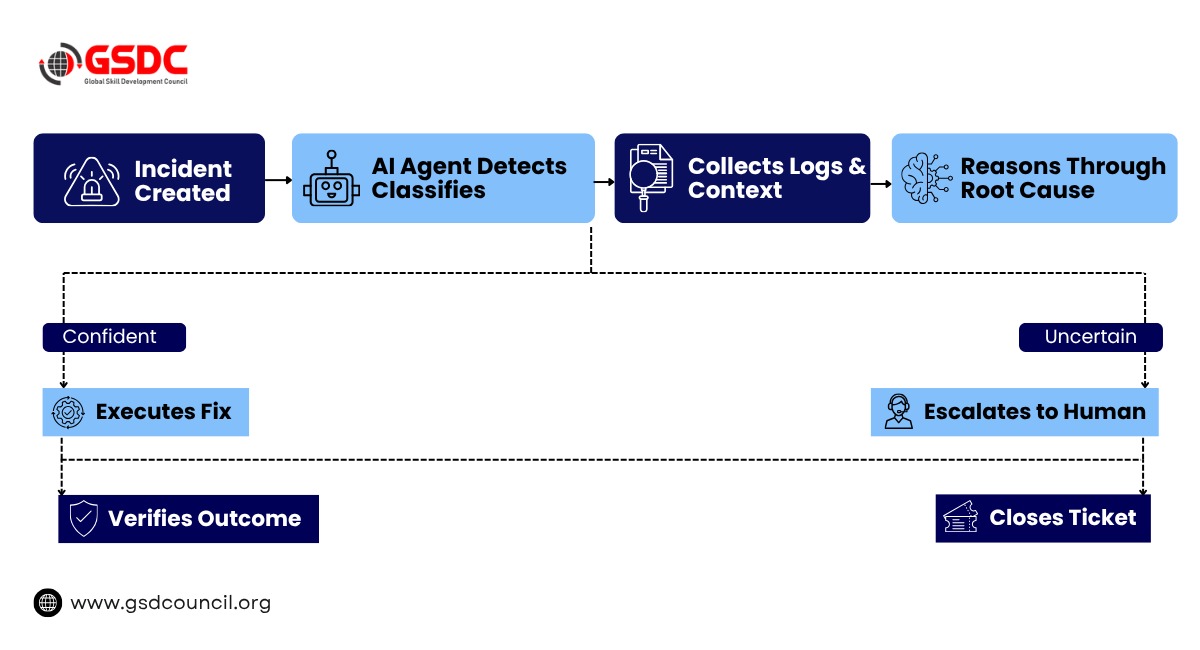
Agentic AI systems are built around a loop: perceive, reason, act, verify. Applied to a service desk, that looks like this:
- A ticket comes in flagging slow application performance.
- The agent checks recent deployment logs, server metrics, and past similar incidents.
- It identifies a memory leak pattern matching a known issue.
- It applies the documented fix, verifies the service is stable, and updates the ticket with what it did and why.
- If anything falls outside its confidence threshold, it loops in a human engineer with full context attached, instead of just forwarding a vague alert.
That loop, visually, looks like this:
That last point matters. Autonomous agents in AI systems aren't designed to replace human judgment entirely. Independent 2026 benchmarking from support-AI research firm Lorikeet found that deeply integrated, action-taking agents on well-scoped use cases are achieving 70-85% resolution rates, compared to 30-50% for early-stage deployments still running on shallow, lookup-only bots. The gap between those numbers is almost entirely about whether the agent can act on a system, not just retrieve information from one.
A real-world example: Equinix, the global data center operator, deployed an AI agent to route employee IT support requests. According to the vendor's published customer results, the agent routes requests to the right expert or group with 96% accuracy and has cut ticket lifespan by a third. That's a modest, well-scoped starting point - routing and triage - not a full agentic overhaul, which is exactly the kind of narrow use case Gartner recommends starting with.
The Data Behind the Shift
It's easy to be skeptical of "AI is changing everything" claims, and honestly, you should be. But this particular shift isn't just vendor talk - it's showing up in independent analyst research, and the numbers are specific enough to build a real business case around.
Gartner expects 40% of enterprise applications to include task-specific AI agents by the end of 2026, up from under 5% just a year earlier. On the service side specifically, the firm projects that agentic AI will autonomously resolve 80% of common customer service issues by 2029, which it estimates could cut operational costs by roughly 30%. Here's how those figures stack up against the rest of the picture:
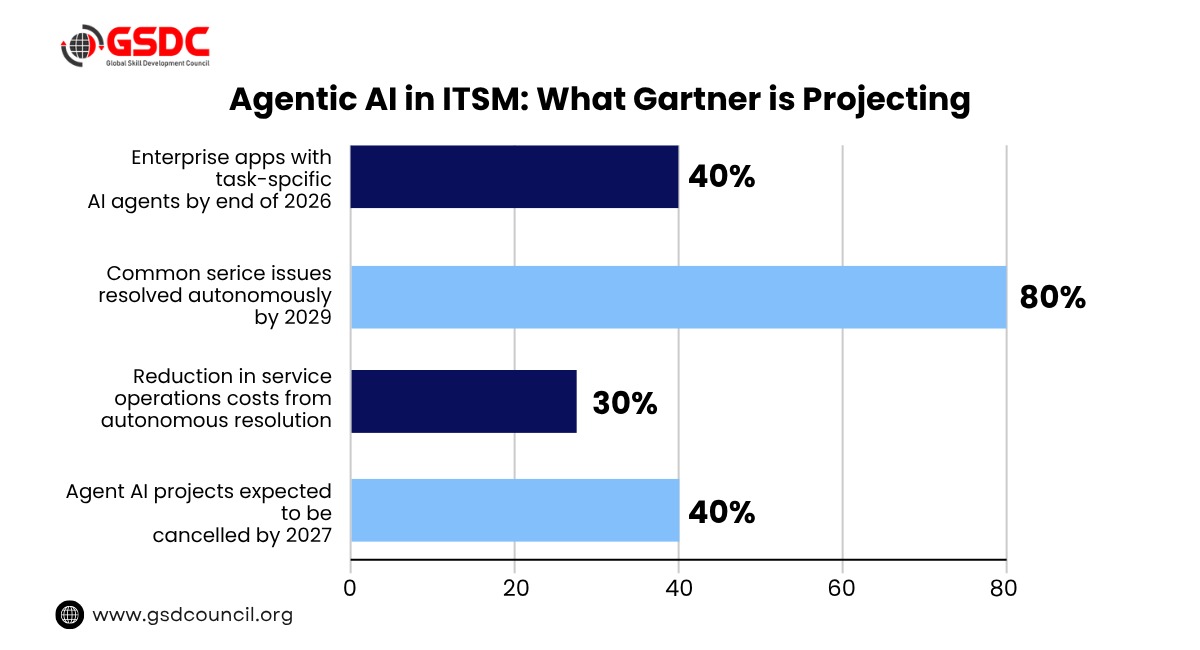
That last bar is the one worth sitting with. Gartner ITSM research isn't all upside - the firm also expects a large share of agentic AI pilots to fail outright by 2027, mainly from unclear ROI or weak risk controls. In most cases, that's not a technology failure. It's what happens when a company bolts an agent onto a messy, undocumented legacy process instead of redesigning the workflow around it first. The lesson for ITSM leaders isn't to wait this out until the tools mature - it's to start with one well-scoped use case and clean data, not a company-wide rollout on day one.
Where Agentic AI Is Already Changing ITSM: Real Use Cases
Looking at actual deployments rather than roadmaps, a handful of ITSM AI use cases show up again and again:
AI ticketing system automation.
Instead of a human triaging every incoming request, an agent classifies the ticket, sets priority based on business impact, assigns it to the right queue, and - for known issue types - resolves it outright. This is usually the first place organizations start, because ticket volume is high and the patterns are repetitive.
AI-enabled incident management.
When something breaks, an agent can correlate alerts across monitoring tools, identify the probable root cause faster than a human scanning multiple dashboards, and either apply a known fix or assemble a war-room summary for the on-call engineer. This cuts the time spent just figuring out what's wrong, which is often the slowest part of an incident.
AI help desk software for employee support.
Password resets, software provisioning, access requests, and onboarding checklists are largely repetitive and rules-based, which makes them ideal for agentic handling. A new employee can get their accounts, licenses, and hardware requests processed by an agent working across HR, IT, and identity systems, with no ticket sitting in a queue overnight.
Change and problem management support.
Agents can review proposed changes against past incidents, flag high-risk changes for extra review, and after an incident is resolved, help draft the problem record and root-cause analysis, which is often the task most likely to get skipped when teams are stretched thin.
These four are also where the Global Skill Development Council (GSDC) ends its focus on its ITSM training material, mainly because they're the use cases most teams actually get their hands on first, long before anything more ambitious.
From ITSM Automation to Intelligent Automation
It helps to place this within the bigger picture, because "automation" isn't one thing - it's a spectrum, and most ITSM teams are sitting somewhere in the middle of it.
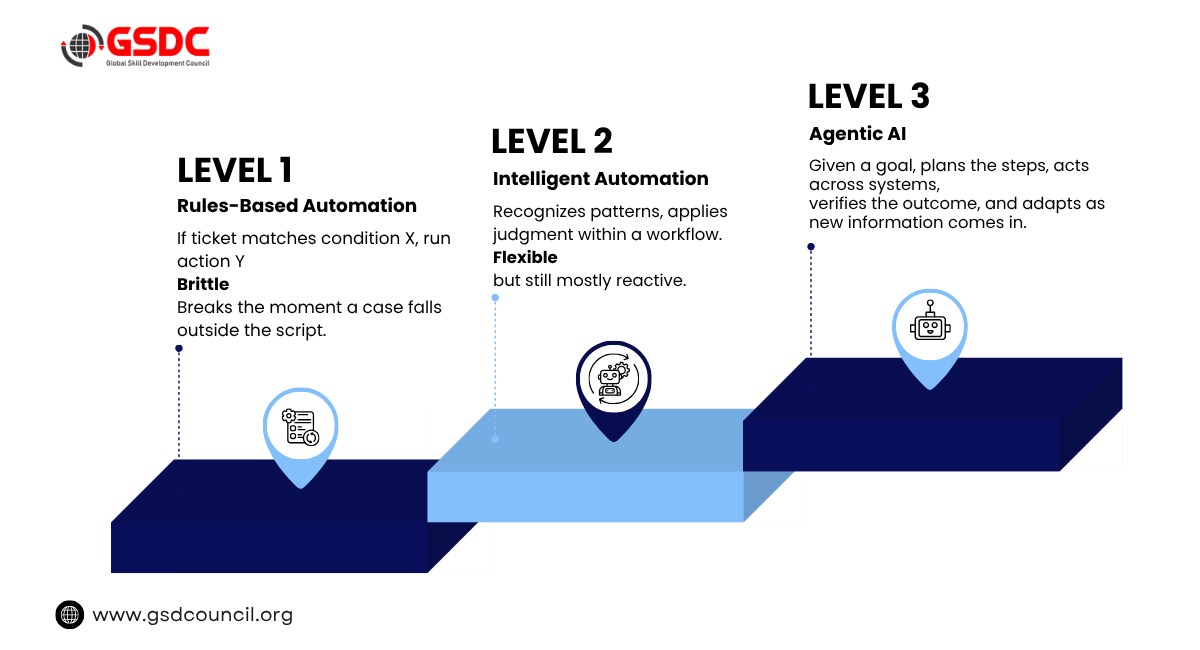
ITSM automation, in its original form, meant scripted workflows: if a ticket matches condition X, run action Y. That's Level 1 - rules-based, and brittle, because the moment a scenario falls outside the script, it breaks.
Intelligent automation is the layer above that, combining automation with AI reasoning so the system can handle variation instead of just following a fixed path. Agentic AI is the newest and most capable expression of intelligent automation, sitting at Level 3: it doesn't just execute a workflow, it can plan one on the fly and adjust as new information comes in.
This is also why the shift is showing up beyond the IT department.
Beyond IT: Enterprise Service Management
Once a service desk proves agentic AI can triage tickets and resolve issues reliably, other departments want the same thing. That's enterprise service management (ESM) - applying ITSM principles and tooling to HR, facilities, legal, and finance requests too.
This is already a real product category, not a theory. ServiceNow's Enterprise Service Management Foundation, for example, puts IT, HR, finance, legal, and facilities on one AI platform, where agents resolve routine requests automatically and route the rest - no inbox-and-spreadsheet handoffs between teams.
A common ITSM example: one new-hire onboarding request can trigger IT to provision accounts, Facilities to set up a workspace, and HR to schedule orientation, all at once, with the employee tracking it through a single dashboard instead of chasing three departments. The common thread is one service catalog, one ticketing backbone, and now, one layer of AI agents running across all of it.
What This Means for ITSM Careers
The ITSM role is shifting, not disappearing. Repetitive tier-1 work is the most exposed to automation; what's growing is demand for people who can design, supervise, and govern AI agents.
That shows up in pay too. US ITSM Analysts average $84,050 a year, rising to $120,921 at senior level, with ITIL certifications adding a further premium. Add genuine AI skills on top and the number moves again - PwC's 2026 Global AI Jobs Barometer found AI-skilled professionals earning a 62% wage premium in 2026, with IT among the sectors most willing to pay it.
The takeaway for ITSM salary growth: pure ticket-handling is losing value, while process expertise paired with AI oversight is what's actually being hired for.
The Catch: Governance, Risk, and Realistic Expectations
None of this works by simply switching on an agent and walking away. A few things organizations consistently underestimate:
Data quality.
An agent making decisions from a messy CMDB or outdated knowledge base will confidently make bad decisions. Clean data is the actual prerequisite, not the AI model itself.
Guardrails.
Agents need clear boundaries on what they can do without approval - restarting a service is very different from deleting a user account.
Auditability.
Every autonomous action needs a log explaining what was done and why, both for compliance and for building trust with the humans who still own the outcome.
Change management.
Staff needs to understand what the agent is doing and why, or you'll get silent workarounds and shadow processes that undermine the whole rollout.
Gartner's own research on cancelled agentic AI projects backs this up - most failures trace back to unclear scope and weak governance, not the underlying technology.
Where to Actually Learn This Stuff
Most ITSM professionals learned their craft on ITIL frameworks and change management boards - not on how to evaluate an AI agent's reasoning or decide what it should be allowed to touch unsupervised. That's not a gap in anyone's ability; the job just didn't ask for it five years ago.
It's part of why programs like the Global Skill Development Council's (GSDC) Certified Generative AI in ITSM exist now - built around exactly this: scoping a first agentic use case, setting governance around what an agent can act on, and telling a real deployment apart from a vendor demo. Worth knowing about if this is the direction your role is already heading.
Getting Ready for the Agentic Shift
This isn't a future trend to watch from a distance - it's already reshaping how ITSM teams are staffed and structured. Organizations that start with a narrow, well-governed use case and build up from there are seeing real results; the ones that try to automate everything at once are showing up in that "40% cancelled" statistic. For IT professionals, the move is the same: build fluency in both classic service management practices and the AI systems now running inside them, since that combination is what's actually driving hiring.
The future of ITSM isn't about replacing people with AI - it's about replacing repetitive work with systems that free people up for judgment, strategy, and service improvement, the parts of the job that were always the real value. If you're looking to build that combination of skills, structured, industry-recognized training is one of the fastest ways to close the gap.

Related Certifications
Frequently Asked Questions
Not quite. A chatbot answers questions and follows a script - think password resets or FAQ replies. An AI agent goes further: it can log into systems, make a decision, and actually fix the problem. A chatbot tells you how to request a new laptop; an agent just orders it and updates the ticket.
Some of it, yes - resets, routine provisioning, basic triage. But someone still has to build these agents, set their boundaries, and handle the cases they escalate. Expect fewer entry-level tier-1 seats and more demand for people who can supervise and govern AI agents.
Older automation was rule-based: "if condition A, do action B" - and it broke the moment something didn't match. Agentic AI can reason through unfamiliar situations and figure out a next step on its own. That's the real jump: automation that adapts instead of just following a script.
Something high in volume and low in risk - password resets, access requests, basic routing. Not your messiest, highest-stakes process. Start small, watch how the agent behaves, and build trust before handing it anything sensitive.
It spreads fast once IT proves it out. That's essentially what enterprise service management is - HR, legal, finance, and facilities using the same ticketing structure and AI agents IT already validated. New-hire onboarding is the classic example: one request, several departments, no separate emails.
Stay up-to-date with the latest news, trends, and resources in GSDC
If you like this read then make sure to check out our previous blogs: Cracking Onboarding Challenges: Fresher Success Unveiled
Not sure which certification to pursue? Our advisors will help you decide!