15 AI Governance Best Practices Every Auditor Should Know
Written by Matthew Hale
Artificial intelligence is becoming a part of everyday business operations. Organizations use AI to automate tasks, analyze large amounts of data, improve customer experiences, and make better decisions. As the use of AI continues to grow, businesses also need to make sure these systems are used responsibly and safely. This is where AI governance becomes important.
AI systems can create risks if they are not properly managed. Poor-quality data, biased outcomes, security issues, or lack of transparency can lead to financial losses, legal problems, and damage to an organization's reputation. A strong governance process helps organizations reduce these risks while ensuring AI systems remain reliable and compliant. For an AI auditor, understanding AI governance best practices is no longer optional. Auditors are expected to evaluate whether AI systems follow policies, meet regulatory requirements, and operate in a fair and transparent manner. They also play an important role in identifying gaps before they become serious problems.
This guide explains the 15 AI governance best practices that every auditor should know. Whether you are preparing for an AI governance audit, implementing an AI governance framework, or learning about ISO 42001, these best practices will help you understand what organizations should do to manage AI responsibly.
15 AI Governance Best Practices
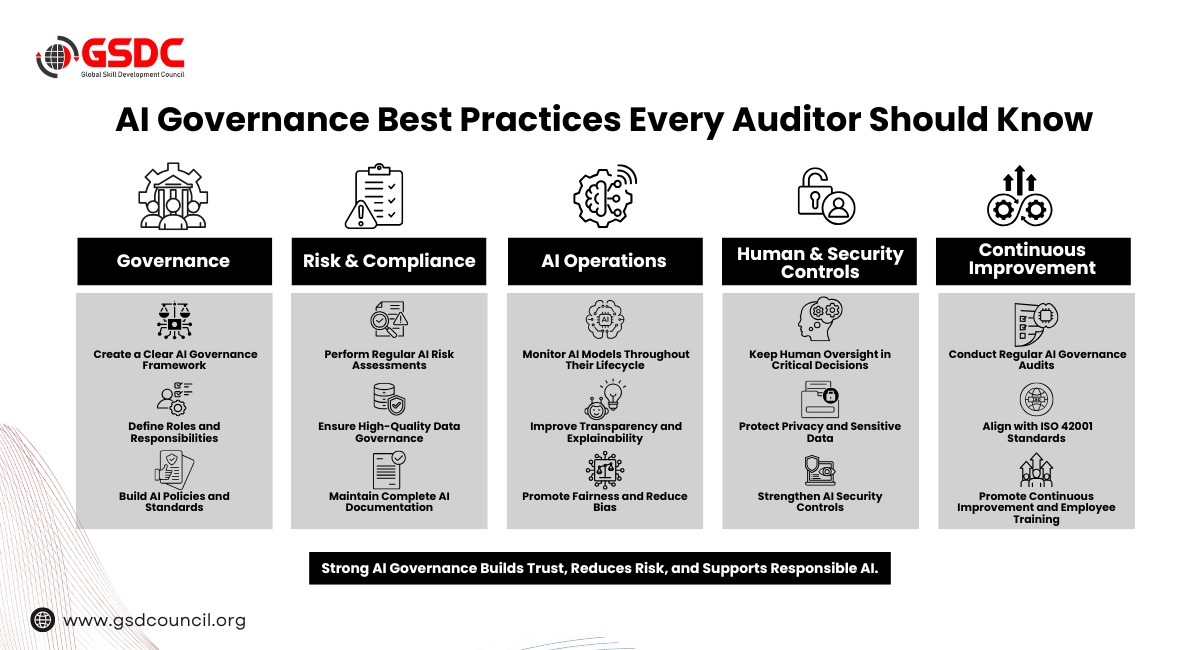
1. Create a Clear AI Governance Framework
Every organization using AI should have a well-defined AI governance framework. It serves as the foundation for managing AI systems throughout their lifecycle. Without a clear framework, different teams may follow different processes, making it difficult to maintain consistency and compliance.
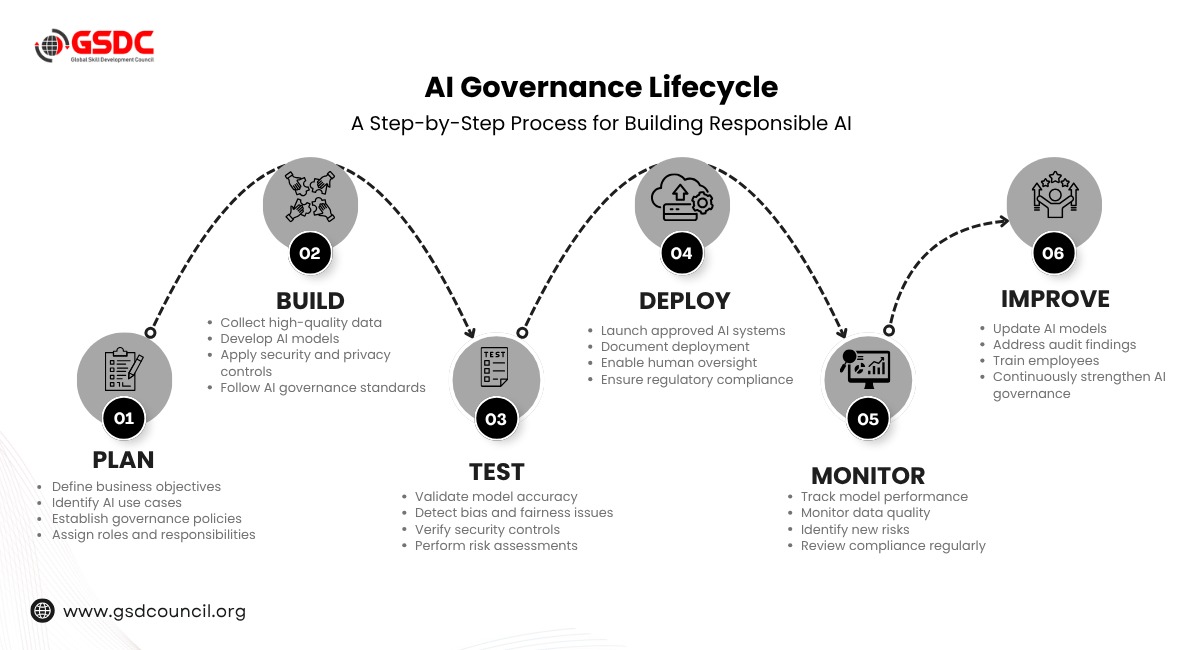
An effective framework explains how AI projects are approved, developed, tested, deployed, monitored, and improved. It should also include guidelines for managing risks, protecting data, and meeting legal and regulatory requirements.
For an AI auditor, reviewing the governance framework is one of the first steps in an AI governance audit. The auditor should verify that the framework is documented, approved by leadership, and followed across the organization. A strong framework helps organizations reduce uncertainty, improve accountability, and support long-term AI governance compliance. It also creates a structured approach for adopting Responsible AI practices.
2. Define Roles and Responsibilities
AI governance becomes difficult when people are unsure about their responsibilities. Every organization should clearly define who is responsible for designing AI models, managing data, reviewing risks, approving deployments, monitoring performance, and responding to issues.
Clear responsibilities improve communication and reduce confusion. They also ensure that important governance activities are not overlooked.
Auditors should check whether roles are documented and understood by employees. They should also verify that decision-making authority is assigned to the right individuals and that there is accountability for AI-related activities. Organizations that clearly define responsibilities usually respond to risks more quickly and maintain stronger governance processes. This is one of the basic AI governance principles that supports effective oversight.
3. Build AI Policies and Standards
Every organization should create written policies that explain how AI should be developed and used. These policies provide consistent guidance for employees and help ensure that AI systems support business goals while meeting legal and ethical requirements.
Policies may include topics such as data usage, privacy, security, model testing, documentation, human oversight, and monitoring. They should also explain how AI risks will be managed and how decisions will be reviewed.
During an AI governance audit, auditors should verify that these policies are documented, regularly updated, and communicated to relevant teams. Well-written policies strengthen AI governance compliance and make it easier for organizations to maintain consistent practices across different departments.
4. Perform Regular AI Risk Assessments
Every AI system carries some level of risk. These risks may involve inaccurate predictions, biased decisions, privacy concerns, cybersecurity threats, or non-compliance with regulations.
Organizations should perform regular AI risk management activities to identify, evaluate, and reduce these risks before they affect business operations. Risk assessments should be conducted before an AI system is deployed and repeated whenever major changes are made. Organizations should also document identified risks, their potential impact, and the actions taken to reduce them.
An AI auditor should review these assessments to confirm that risks are properly evaluated and monitored. Regular risk assessments help organizations make informed decisions while supporting a stronger AI governance process.
5. Ensure High-Quality Data Governance
AI systems are only as reliable as the data used to train and operate them. Poor-quality or incomplete data can lead to inaccurate results, unfair decisions, and unreliable business outcomes.
Organizations should establish strong data governance practices that focus on data accuracy, consistency, completeness, security, and privacy. Data sources should be verified before they are used for AI development.
Auditors should review how data is collected, stored, processed, and protected. They should also confirm that organizations follow applicable privacy regulations and internal policies. Good data governance improves AI performance and reduces operational risks. It also supports Responsible AI by helping organizations produce more accurate and fair outcomes.
6. Maintain Complete AI Documentation
Documentation is one of the most important parts of AI governance. Without proper records, it becomes difficult to understand how an AI system was developed, tested, or modified over time.
Organizations should document every stage of the AI lifecycle. This includes project objectives, data sources, model selection, testing results, identified risks, approvals, monitoring activities, and updates made after deployment.
Complete documentation allows auditors to verify that governance processes have been followed correctly. It also provides evidence during internal reviews, regulatory inspections, and compliance assessments. Maintaining detailed records improves transparency and supports continuous improvement. It is also an important requirement for organizations implementing an AI management system based on ISO 42001.
7. Monitor AI Models Throughout Their Lifecycle
AI governance does not end after a model is deployed. AI systems should be continuously monitored to ensure they continue producing reliable and accurate results.
Over time, business conditions, customer behavior, and data patterns may change. These changes can reduce the performance of AI models if they are not regularly reviewed. Organizations should establish monitoring processes that track model accuracy, system performance, security events, user feedback, and operational risks. Significant changes should trigger additional testing or model updates.
An AI auditor should verify that monitoring activities are documented and performed regularly. Continuous monitoring helps organizations identify issues early and maintain effective AI governance compliance.
8. Improve Transparency and Explainability
Many AI systems influence important business decisions. Employees, customers, regulators, and business partners should understand how these decisions are made.
Organizations should make AI systems as transparent as possible. They should clearly explain the purpose of each system, the data it uses, and the factors that influence its decisions whenever appropriate. Explainability also helps auditors evaluate whether AI systems are operating fairly and consistently. If a decision cannot be reasonably explained, it becomes difficult to verify its reliability.
Improving transparency builds trust and supports key AI ethics principles such as fairness, accountability, and openness. It also makes AI governance audits more effective because auditors can better understand how AI systems operate and whether they meet organizational requirements.
9. Promote Fairness and Reduce Bias
AI systems should make decisions fairly for everyone. If the data used to train an AI model is incomplete or biased, the results may also be biased. This can affect hiring, loan approvals, healthcare decisions, customer service, and many other business processes.
Organizations should regularly test AI models to identify and reduce bias. They should review training data, evaluate model outputs, and update models whenever unfair patterns are found. Different teams should also be involved in reviewing AI systems to provide diverse perspectives.
During an AI governance audit, an AI auditor should verify that bias testing is performed regularly and that corrective actions are documented. Fair and unbiased AI systems help organizations build trust while supporting Responsible AI and AI ethics.
10. Keep Human Oversight in Critical Decisions
AI can process large amounts of information quickly, but it should not replace human judgment in every situation. Some decisions require experience, business knowledge, and ethical consideration that only people can provide.
Organizations should identify high-risk activities where human approval is required before an AI-generated decision is accepted. This may include financial approvals, healthcare recommendations, legal decisions, or employee evaluations.
An AI governance framework should clearly explain when human intervention is required and who has the authority to make the final decision.
Auditors should verify that these controls are working effectively. Human oversight reduces the risk of incorrect decisions and strengthens overall AI governance compliance.
11. Protect Privacy and Sensitive Data
AI systems often process customer information, employee records, financial data, and other confidential information. Protecting this data should be a priority for every organization.
Organizations should establish clear rules for collecting, storing, using, and deleting data. Access should only be given to authorized individuals, and sensitive information should be protected using appropriate security measures.
An AI auditor should review whether privacy controls are implemented and whether the organization follows applicable legal and regulatory requirements. Strong privacy practices protect both the organization and its customers. They also support a reliable AI management system and demonstrate responsible use of artificial intelligence.
12. Strengthen AI Security Controls
As organizations rely more on AI, cyber threats also continue to grow. Attackers may try to manipulate AI models, steal sensitive data, or disrupt business operations.
Organizations should include AI systems in their overall cybersecurity strategy. Security controls such as access management, encryption, system monitoring, vulnerability assessments, and regular updates should be applied throughout the AI lifecycle.
Auditors should verify that security controls are documented, tested, and regularly improved. Any weaknesses should be addressed before they create larger business risks. Strong security measures support AI risk management and help organizations maintain safe and reliable AI systems.
13. Conduct Regular AI Governance Audits
An effective governance program requires regular reviews. Organizations should perform periodic AI governance audits to evaluate whether policies, controls, and processes are working as intended.
These audits should examine documentation, governance policies, risk assessments, security controls, monitoring activities, and compliance with organizational requirements.
The findings should be documented, and improvement actions should be assigned to the appropriate teams. Follow-up reviews should confirm that identified issues have been resolved. Regular audits help organizations identify weaknesses early, improve governance processes, and maintain long-term AI governance compliance.
14. Align with ISO 42001 and Other Standards
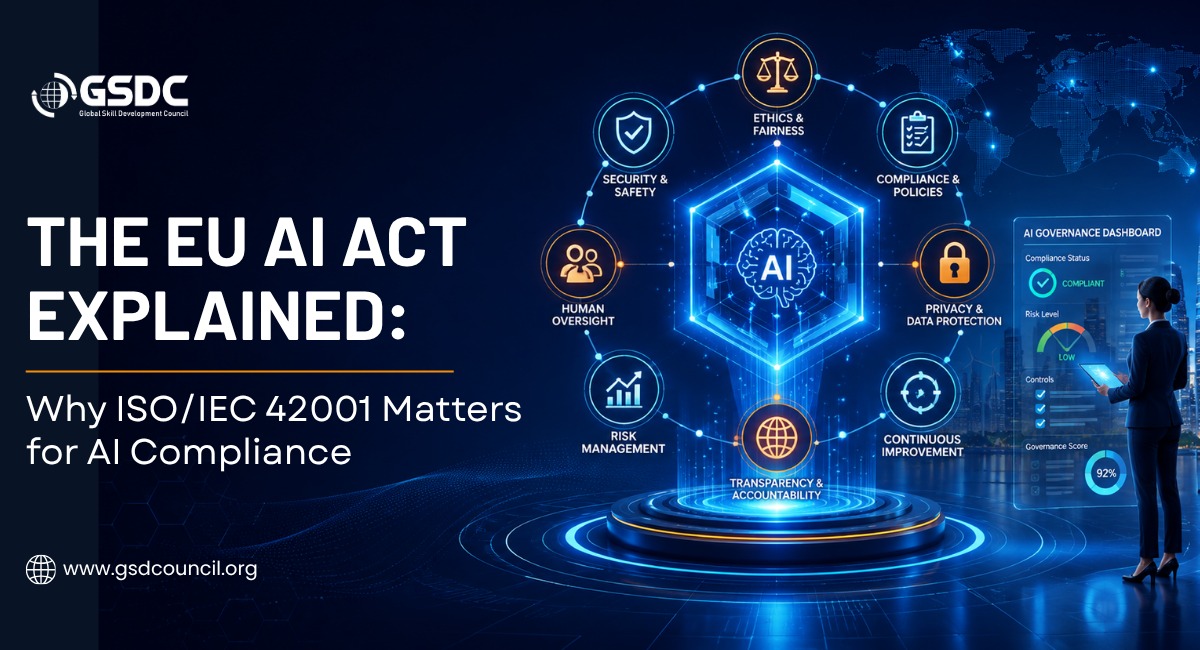
International standards provide organizations with a structured approach to managing AI responsibly. One of the most important standards in this area is ISO 42001, which focuses on establishing an AI management system.
ISO 42001 helps organizations create documented governance processes, manage AI risks, assign responsibilities, improve transparency, and support continuous improvement. During an AI governance audit, auditors often review whether organizational practices align with recognized standards such as ISO 42001. Following an established framework makes governance activities more consistent and easier to evaluate.
Professionals who want to specialize in AI governance can also benefit from earning an ISO 42001 Lead Auditor certification. It helps them understand audit techniques, governance requirements, and international best practices for AI management.
15. Promote Continuous Improvement and Employee Training
AI technology changes quickly. Governance practices that work today may need updates as regulations, business requirements, and technologies continue to evolve.
Organizations should regularly review their governance processes, update policies, and improve controls based on audit findings, new risks, and industry developments.
Employee training is equally important. Everyone involved in AI projects should understand governance policies, security responsibilities, ethical considerations, and compliance requirements. Regular training helps employees make better decisions and reduces the risk of mistakes.
An AI auditor should verify that organizations have ongoing improvement plans and provide regular governance training. Continuous learning helps organizations maintain effective AI governance and prepare for future challenges.
Why These AI Governance Best Practices Matter
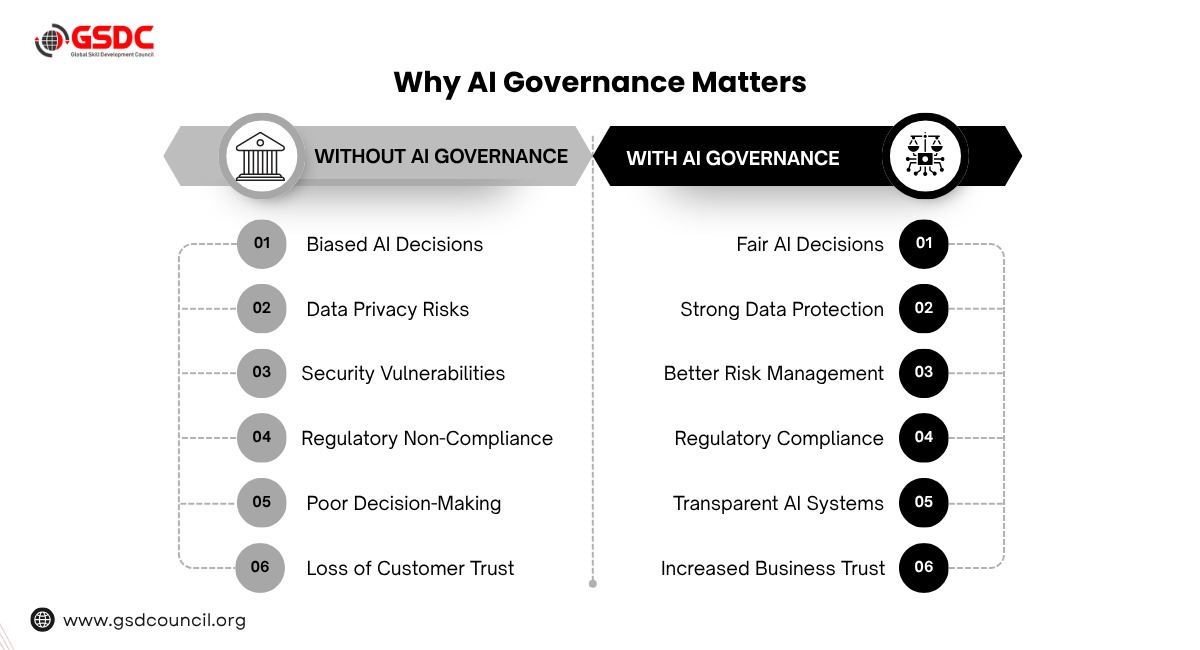
Following these AI governance best practices helps organizations build AI systems that are secure, transparent, and reliable. Strong governance also improves decision-making, reduces operational risks, and increases confidence among customers, employees, and regulators.
For auditors, these best practices provide a structured way to evaluate whether an organization is managing AI responsibly. Instead of focusing only on compliance, auditors can also identify opportunities to strengthen governance and support continuous improvement.
Organizations that invest in good governance today will be better prepared for future regulations, changing technologies, and growing business expectations.
Common AI Governance Mistakes Organizations Should Avoid
Even organizations that invest in AI can face problems if they do not have strong governance practices. Many of these issues are preventable with proper planning and regular reviews. Auditors should be aware of these common mistakes when evaluating an organization's AI governance program.
1. Not Having a Clear AI Governance Framework
Some organizations start using AI without creating a formal AI governance framework. As a result, different teams follow different processes, making it difficult to manage risks and maintain consistency.
2. Poor Documentation
If AI models, policies, testing results, or risk assessments are not documented, it becomes difficult to understand how decisions were made. Proper documentation is essential for audits and compliance.
3. Ignoring AI Risks
Organizations sometimes focus only on AI performance and overlook security, privacy, fairness, or operational risks. Regular AI risk management helps identify these issues before they become serious problems.
4. Weak Human Oversight
Allowing AI systems to make important decisions without human review can increase business risks. Human oversight should always be included for high-impact decisions.
5. Limited Employee Training
Employees who do not understand governance policies may unintentionally misuse AI systems. Regular training helps everyone follow the same standards and supports better AI governance compliance.
6. Not Reviewing AI Systems Regularly
AI models can change over time as data and business conditions evolve. Organizations should continuously monitor and review AI systems instead of treating deployment as the final step.
How ISO 42001 Supports AI Governance
As organizations continue to adopt AI, they need a structured way to manage risks and maintain compliance. ISO 42001 provides that structure by defining the requirements for an AI management system.
The standard helps organizations establish clear governance processes for developing, deploying, monitoring, and improving AI systems. It also encourages organizations to document policies, manage risks, assign responsibilities, and continuously improve their governance practices.
For auditors, ISO 42001 provides a recognized framework for evaluating whether an organization's AI governance program is effective. It also supports important areas such as AI ethics, Responsible AI, transparency, accountability, and continuous monitoring.
Organizations that align with ISO 42001 are often better prepared to manage regulatory requirements, reduce operational risks, and build trust with customers and stakeholders.
Advance Your Career with the GSDC ISO 42001 Lead Auditor Certification
As AI adoption continues to grow, organizations need professionals who understand how to evaluate and improve AI governance. This has created strong demand for skilled auditors with knowledge of international AI governance standards.
The GSDC ISO 42001 Lead Auditor Certification is designed for professionals who want to build expertise in AI governance, AI governance audits, and AI management systems. The certification helps you understand ISO 42001 requirements, audit planning, risk assessment, governance controls, and compliance practices.
By earning this certification, you can:
- Gain a globally recognized AI governance credential.
- Learn how to conduct effective AI governance audits.
- Understand the requirements of ISO 42001.
- Build practical knowledge of AI risk management and governance controls.
- Improve your career opportunities in AI governance, compliance, risk management, and auditing.
- Demonstrate your expertise in managing and auditing responsible AI systems.
Whether you are an auditor, compliance professional, consultant, risk manager, or AI governance specialist, this certification can help you stay ahead as organizations continue to expand their use of artificial intelligence.
Conclusion
Artificial intelligence is transforming the way organizations work, but its success depends on responsible management. Strong AI governance helps organizations reduce risks, improve transparency, protect sensitive data, and build trust with customers and stakeholders.
The 15 AI governance best practices discussed in this guide provide a practical approach for managing AI throughout its lifecycle. From building a clear AI governance framework to conducting regular AI governance audits, each practice strengthens an organization's ability to use AI responsibly.
For auditors, understanding these practices is becoming an essential skill. As regulations continue to evolve and organizations adopt international standards like ISO 42001, professionals with expertise in AI governance will play an increasingly important role in ensuring compliance and continuous improvement.
Investing in AI governance knowledge today will help organizations build more reliable AI systems and prepare professionals for the future of auditing.


Related Certifications
Frequently Asked Questions
AI governance best practices are the processes, policies, and controls that help organizations develop, use, monitor, and manage AI systems responsibly while reducing risks and maintaining compliance.
AI governance is a structured approach that helps organizations manage artificial intelligence throughout its lifecycle. It includes policies, risk management, monitoring, accountability, and continuous improvement.
AI governance helps organizations reduce risks, improve transparency, protect sensitive data, meet regulatory requirements, and build trust in AI systems.
An AI governance framework defines the policies, roles, responsibilities, and processes that guide how AI systems are developed, monitored, and managed within an organization.
An AI governance audit evaluates whether an organization's AI systems follow governance policies, risk management processes, security controls, and compliance requirements.
ISO 42001 is the international standard for establishing an AI management system. It helps organizations manage AI responsibly through structured governance, risk management, and continuous improvement practices.
Professionals who want to build expertise in AI governance auditing can benefit from an ISO 42001 Lead Auditor Certification. The GSDC ISO 42001 Lead Auditor Certification is a globally recognized credential that helps professionals understand AI governance frameworks, AI governance audits, AI risk management, compliance requirements, and auditing techniques. It is suitable for auditors, compliance professionals, AI governance specialists, consultants, and risk managers who want to advance their careers in AI governance.
AI risk management helps organizations identify, evaluate, and reduce risks related to AI systems. It is one of the most important parts of an effective AI governance program.
Responsible AI focuses on developing and using AI systems that are fair, transparent, secure, accountable, and aligned with ethical principles.
Organizations can improve AI governance by creating a clear governance framework, performing regular risk assessments, maintaining documentation, monitoring AI systems, training employees, conducting audits, and aligning with standards like ISO 42001. Professionals who want to strengthen their knowledge of these practices can also consider the GSDC ISO 42001 Lead Auditor Certification, which provides practical insights into AI governance, compliance, and auditing based on the ISO 42001 standard.
Stay up-to-date with the latest news, trends, and resources in GSDC
If you like this read then make sure to check out our previous blogs: Cracking Onboarding Challenges: Fresher Success Unveiled
Not sure which certification to pursue? Our advisors will help you decide!