Full Stack Developer Interview Questions & Career Guide
Written by Matthew Hale
- Who this guide is for
- What Is a Full Stack Developer?
- Is full stack development a good career path?
- Full stack developer career path
- Top full stack developer interview questions
- Part 1: Frontend and client-side
- Part 2: Backend, API, and database
- Part 3: System design and scenario-based
- Final thoughts
AI coding assistants now handle most of the boilerplate, so full stack interviews have shifted: less syntax trivia, more probing of how you think through architecture, security, and production trade-offs. This guide covers both sides of that shift: a refreshed set of full stack developer interview questions, and a practical look at the career path, salary bands, and certifications worth your time.
Who this guide is for
- Developers preparing for full stack developer interview questions
- Candidates weighing a full stack developer certification before their next application cycle
- Java, Python, or JavaScript developers moving from a single-layer role
- Students and career switchers lining up their first full stack developer role
What Is a Full Stack Developer?
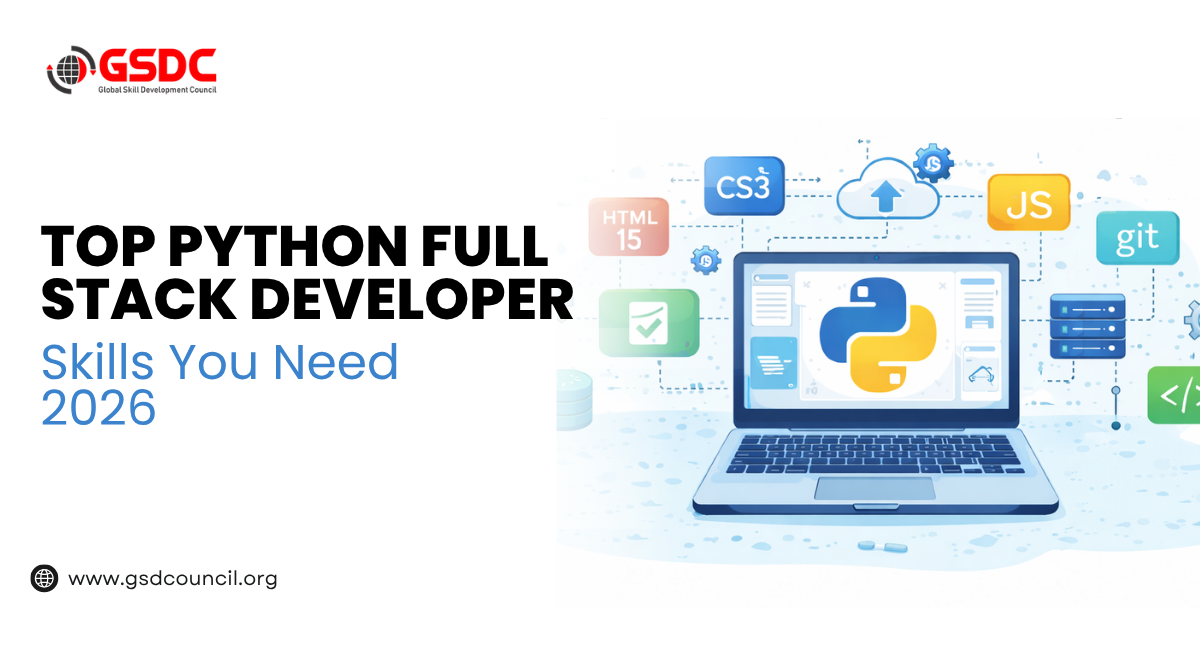
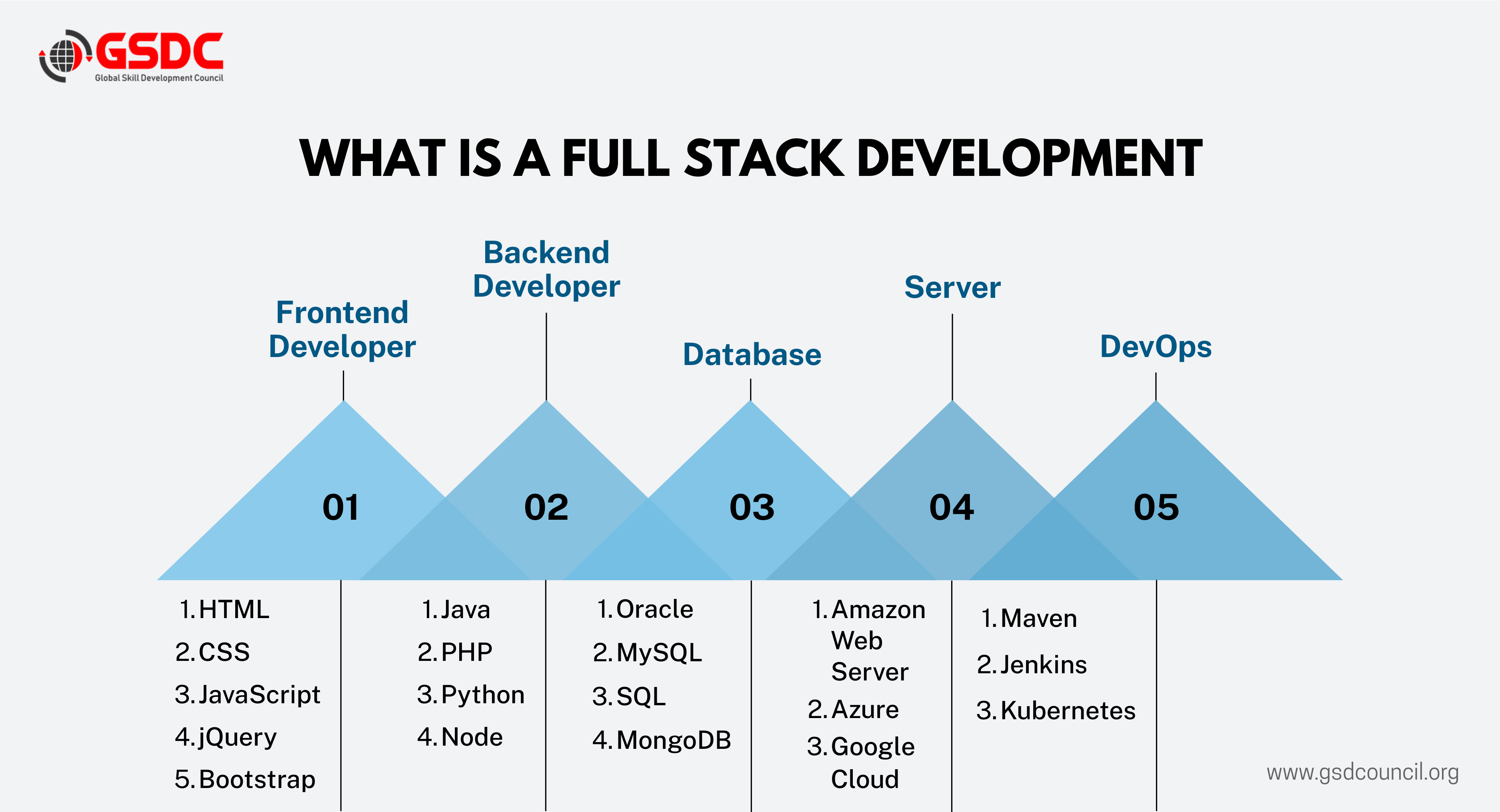
A full stack developer builds and maintains both sides of an application: the interface people see and the systems behind it. That still spans four areas: frontend (HTML, CSS, JavaScript/TypeScript, UI frameworks), backend (APIs, server logic, authentication), databases (SQL and NoSQL, schema design), and DevOps (CI/CD, containers, cloud deployment). What's new is a fifth area nobody can ignore: AI fluency. Hiring managers increasingly expect developers to work comfortably with AI coding tools, wire LLM APIs into products, and review AI-generated code critically rather than accept it at face value.
Is full stack development a good career path?
Mostly yes, with a caveat worth taking seriously. The U.S. Bureau of Labor Statistics projects 16% employment growth for software developers between 2024 and 2034, well ahead of the 3% average across all occupations, with a median annual wage of $133,080 as of May 2024. Full stack specifically is more mixed: some 2026 market analyses note demand for generalist roles has softened relative to specialized tracks like AI/ML and data engineering, largely because AI coding tools let individual developers cover more ground than before.
That doesn't mean full stack is losing relevance. The bar has shifted from "can code both ends" to "can own a product end to end while using modern tooling to move faster." Developers who integrate AI APIs and operate across cloud-native infrastructure are being hired actively, particularly at startups and mid-market companies where one versatile engineer covers ground that used to take a small team.
Full stack developer career path
A full stack career typically moves from junior (0-2 years), to mid-level (3-6 years), to senior/technical lead, with opportunities to move into staff engineering, management, DevOps, or technical leadership.
Pay varies widely by location and employer. In the US, Glassdoor reports an average base salary of around $118,900, while reported India ranges are roughly ₹3.5-10 LPA for junior and ₹6-20 LPA for mid-level roles.
Today, a T-shaped skill set matters: deep expertise in one area with working knowledge across the stack. JavaScript, React, Node.js, cloud, Docker, and AI tool fluency remain valuable skills for modern full stack roles.
Top full stack developer interview questions
Organized into frontend, backend, and system design or scenario questions, the way most interviews for a full stack position are actually structured.
Part 1: Frontend and client-side
1. What is full stack development?
It spans the entire application lifecycle: interface, backend logic, data, and integrations. A warm-up question testing whether you can draw a clean line between layers.
2. Frontend vs. backend?
Frontend is everything the user sees and interacts with. Backend is server-side logic: APIs, databases, authentication, security.
3. What do HTML, CSS, and JavaScript handle?
HTML structures content, CSS styles it, JavaScript makes it interactive.
4. What is the DOM?
The browser's live, structured representation of a page. JavaScript reads and modifies it to insert elements, update styles, and respond to input.
5. Flexbox vs. Grid?
Flexbox handles one-dimensional layouts; Grid handles two-dimensional ones.
6. CSR vs. SSR?
Client-side rendering builds the UI in-browser, good for interactive SPAs. Server-side rendering sends pre-built HTML, usually faster first paint and better SEO. Frameworks like Next.js mix both.
7. What is the virtual DOM, and why does it matter?
React and similar frameworks keep an in-memory representation of the UI. When state changes, the framework diffs the new version against the old one and batches the minimal real DOM updates needed. The diffing and batching, not the virtual DOM itself, is what keeps re-renders fast: a strong answer separates the data structure from reconciliation, the algorithm using it.
8. What is event delegation?
Attaching one listener to a shared parent instead of every child, letting events bubble up. Common for handling clicks on dynamically generated lists.
9. What are Web Components?
A browser-native way to build reusable, self-contained custom elements without a specific framework.
10. How do you optimize frontend performance?
Minify assets, lazy-load non-critical scripts and images, compress files, use a CDN, and control bundle size with code splitting.
Part 2: Backend, API, and database
11. What is a REST API, and what does "stateless" actually require?
REST uses standard HTTP methods (GET, POST, PUT, DELETE) for client-server communication. Statelessness means each request must carry everything it needs, typically an auth token, since the server keeps no memory of prior ones. That's what lets you run multiple server instances behind a load balancer without breaking sessions.
12. SQL vs. NoSQL?
SQL is structured and strong on consistency, suited to data-integrity-critical apps. NoSQL is schema-flexible and scales horizontally. Most real systems use both.
13. What is middleware?
Code running between an incoming request and the response, handling logging, auth, error handling, or parsing. Express.js, Django, and Spring lean on it heavily.
14. What is a JWT, and where does it fall short?
A signed, stateless auth token with a header, payload, and signature. The signature proves it wasn't tampered with, but anyone can decode the payload, so it shouldn't hold sensitive data, and it can't be revoked like a server-side session: a stolen token stays valid until expiry. Good answers mention short expiry, refresh token rotation, and safe storage against XSS.
15. Explain the JavaScript event loop.
It lets single-threaded JavaScript handle async work by coordinating the call stack, Web APIs, and task queues. Microtasks (resolved promises) drain completely before the next macrotask (like setTimeout) runs, which is why promise callbacks can jump ahead of a zero-delay timeout, a detail that causes real Node.js bugs when missed.
16. Monolithic vs. microservices?
A monolith is one codebase, simpler to start but harder to scale. Microservices split functionality into independent services over APIs, but that doesn't automatically make scaling easier: it trades problems for network latency, harder cross-service debugging, and real operational overhead. It helps when parts of a system need to scale independently, not as a default upgrade.
17. What is CI/CD?
Continuous Integration and Continuous Deployment automate integration, testing, and release, reducing manual error and shortening the gap between writing and shipping code.
18. Why containerize with Docker?
Containers package an app with its dependencies so it behaves the same everywhere, killing "works on my machine" and making deployment predictable.
19. What is database normalization?
Structuring tables to reduce redundancy through the first three normal forms.
20. What are the ACID properties?
Atomicity, Consistency, Isolation, Durability: the guarantees that make relational transactions reliable through failures.
21. How would you connect an LLM API to a production application?
A thin answer stands out for the wrong reasons. A solid one covers: storing and rotating API keys server-side; handling streamed, token-by-token responses; timeouts with backoff retries; graceful rate-limit handling; tracking token usage and cost; validating model output as untrusted input before acting on it; a defined fallback for failed calls; and logging prompts, responses, and latency for debugging. Interviewers use this to see whether you treat an LLM call as unreliable external infrastructure, not a function that always returns clean output.
Part 3: System design and scenario-based
22. Design a scalable chat application.
WebSockets for real-time messaging, load balancers for traffic, message queues for spikes, an optimized schema for messages and presence, and auth that scales with concurrent users.
23. How do you handle application security end to end?
Validate and sanitize every input, use parameterized queries, hash passwords with bcrypt or Argon2, enforce HTTPS, configure CORS, and add CSRF protection on state-changing requests.
24. How do you optimize performance across the whole stack?
Frontend: bundling, lazy loading, CDNs, compression. Backend: caching, indexing, query tuning, async processing. The best answers connect the two.
25. Walk me through a genuinely hard bug you solved.
Use STAR: situation, task, debugging actions, and result. Interviewers listen for method, not just the punchline.
26. How do you manage code changes across modules that shift together?
Branching strategy, modular architecture, integration testing, disciplined commits, feature flags, and code review to catch regressions.
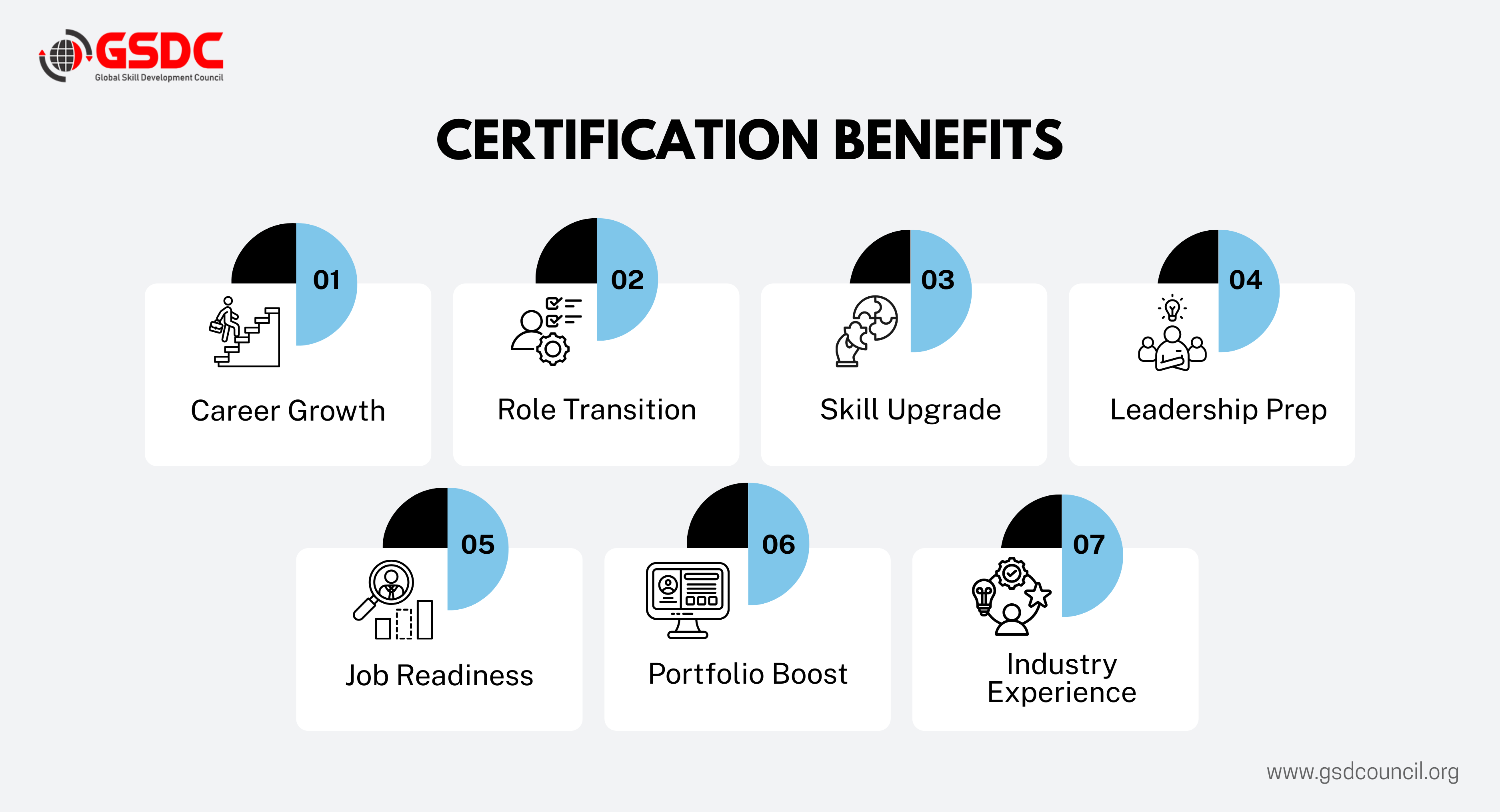
With degrees no longer guaranteeing an interview, a recognized certification can be one practical way to signal current, verified skills, especially for career switchers. Done well, it provides a defined curriculum instead of scattered tutorials, hands-on projects to discuss in interviews, and a credential hiring managers can recognize. The value depends on the program, so check whether it covers current tooling, includes real buildable projects, and is recognized where you're job-hunting.
Several organizations offer full stack certification tracks across Java, Python, and .NET, covering front-end and back-end development, databases, APIs, and secure, scalable application design. The Global Skill Development Council (GSDC) is one example, with its Certified Java Full Stack Developer (CFSD) certification. The value isn't the certificate alone, but the structured practice and hands-on work it provides.
Final thoughts
The fundamentals here, HTML through system design, haven't gone anywhere, and they're still what most full stack developer interview questions are built around. What's changed is the context: AI tools have raised the baseline for how fast you're expected to move, and interviewers are using that speed to dig deeper into judgment rather than syntax. Prepare the fundamentals, get comfortable discussing real trade-offs, and treat certification as a way to close gaps, not a substitute for shipped work.

Related Certifications
Stay up-to-date with the latest news, trends, and resources in GSDC
If you like this read then make sure to check out our previous blogs: Cracking Onboarding Challenges: Fresher Success Unveiled
Not sure which certification to pursue? Our advisors will help you decide!