Does AI Certification Increase Your Salary? We Analyzed the Data
Written by Matthew Hale
- The AI Job Market Right Now: Numbers That Put Things in Context
- What Does an AI Engineer Actually Earn?
- AI Salary Ranges by Experience Level (U.S., 2025–2026)
- The Certification Premium: What the Data Actually Shows
- AI Certification ROI: The Numbers We Ran
- What the Best AI Certifications Actually Cover
- Who Benefits Most from Getting Certified?
- The Generative AI Jobs Salary Picture
- Generative AI Salary Guide by Role (U.S., 2025–2026)
- How to Make Your AI Certification Work Harder for You
- What This Means If You're Planning Your Next Move
- Final Takeaway
Let's be honest about something most training providers won't say out loud: a certificate hanging on your wall doesn't automatically translate into a bigger paycheck. What matters is what that certificate unlocks - the skills it validates, the roles it opens, and how employers actually respond to it in a market that's moving faster than any of us expected.
So we decided to stop speculating and start calculating.
We pulled salary data from the U.S. Bureau of Labor Statistics, Glassdoor, PwC's 2025 Global AI Jobs Barometer, and multiple hiring intelligence reports covering tens of thousands of verified job offers. Then we mapped that data against what certified AI professionals are actually earning - compared to their non-certified peers doing similar work.
Here's what we found.
The AI Job Market Right Now: Numbers That Put Things in Context
Before we talk about certifications specifically, you need to understand the landscape you're walking into.
LinkedIn ranked "Artificial Intelligence Engineer" as the single fastest-growing job category in early 2025. Veritone's Q1 2025 labor market analysis counted over 35,000 active AI positions across the country - up 25.2% from the same period the year before - with a median posted salary of nearly $157,000.
That's not a niche. That's a transformation of the entire employment landscape.
The U.S. Bureau of Labor Statistics projects 20% job growth for AI-related computer and information research roles between 2024 and 2034 - roughly five times faster than the national average across all occupations. The talent gap is structural: the U.S. is projected to need 1.3 million AI professionals over the next two years, but current supply covers fewer than half that number.
What this means in plain terms: employers are competing hard for people who can actually do this work. That competitive pressure is one of the biggest reasons AI certification carries real salary weight right now.
What Does an AI Engineer Actually Earn?
Let's start with the baseline.
The median AI engineer salary in the United States sits at approximately $145,080, according to the most recent Bureau of Labor Statistics data. Glassdoor's aggregated figures put the median base salary at around $134,023, while total compensation - including bonuses, equity, and profit-sharing - pushes the average well past $160,000 annually.
Here's how that breaks down by experience level:
AI Salary Ranges by Experience Level (U.S., 2025–2026)
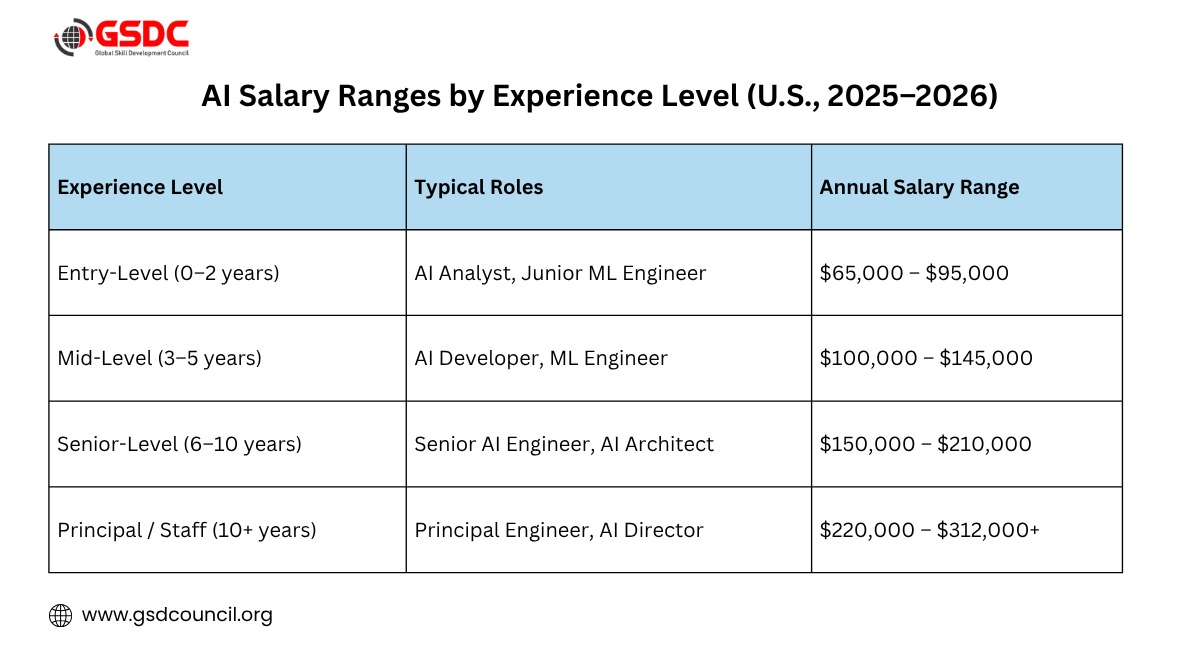
For comparison, the mean annual salary across all U.S. occupations is $65,470. An entry-level AI professional starts near that ceiling.
The AI developer salary picture is similar: mid-level developers working on production AI systems are routinely pulling $110,000–$145,000 in base pay, with senior developers in specialized roles (particularly LLM fine-tuning and agentic systems) commanding $200,000 or more.
Generative AI jobs are commanding their own premium. Senior generative AI engineer salary figures are clustering between $180,000 and $250,000 at major tech firms, with specialists in LLM architecture frequently earning at the top of that band or above it.
The Certification Premium: What the Data Actually Shows
Here's the core question: does getting certified move the needle on pay, or is it just a line on your résumé?
PwC's 2025 Global AI Jobs Barometer - which analyzed close to one billion job postings across six continents - found that workers with verified AI skills earn an average 56% wage premium compared to colleagues in the same roles without those skills. That figure was 25% just one year prior. It more than doubled in twelve months.
That's one of the fastest-growing skill premiums in modern labor market history.
A separate analysis by Indeed found that professionals with demonstrated generative AI skills see salary increases of up to 47%, with the strongest gains in:
- Sales and marketing: up to 43%
- Finance: up to 42%
- Business operations: up to 41%
- Legal and compliance: up to 37%
- Human resources: up to 35%
And for those specifically pursuing AI certification through recognized credentialing programs, the ROI data is even more specific.
AI Certification ROI: The Numbers We Ran
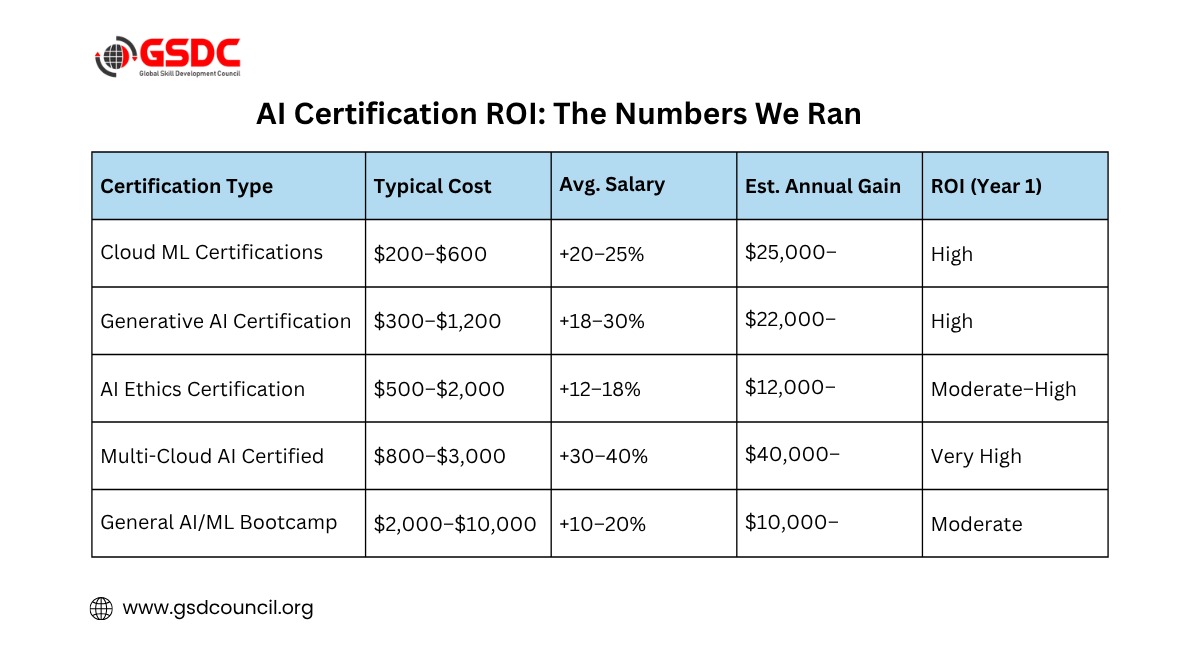
The pattern here is clear: certification doesn't just signal learning - it signals employable learning. Especially when paired with portfolio projects and hands-on experience, certified professionals are consistently landing higher initial offers and faster promotions than non-certified peers. For those starting out, entry-point credentials like the Generative AI Foundation Certification - which cover the conceptual and applied basics employers now expect - are increasingly showing up as a baseline qualifier in job postings across industries.
What the Best AI Certifications Actually Cover
Choosing the best AI certification isn't about picking whatever has the most Google searches. It's about matching the credential to where you are in your career and where you want to go.
The certifications with the strongest salary correlation consistently cover some combination of:
- Core technical skills: Machine learning algorithms, deep learning, neural network architecture, data preprocessing, and model evaluation. These form the foundation of almost every well-paying AI role.
- Applied deployment: The ability to take a model from a Jupyter notebook into production. Tools like TensorFlow, PyTorch, and cloud AI services (AWS SageMaker, Azure ML, Google Vertex AI) are heavily weighted by employers - and certifications that validate these skills tend to translate into the most direct salary gains.
- Generative AI fluency: Understanding how generative AI works - transformer architectures, prompt engineering, fine-tuning, retrieval-augmented generation - is now a baseline requirement for many senior AI roles. This is where generative AI certification programs are adding the most salary value right now.
- AI ethics and governance: This one surprises people. AI ethics certification, while not the highest-paying specialization on its own, is increasingly required for senior and leadership roles at regulated companies - particularly in healthcare, finance, and government contracting. Research 2025 Salary and Jobs Report found that 77% of surveyed AI governance professionals held at least one recognized certification, and that certified practitioners earned measurably more than their non-certified counterparts in the same job categories.
When evaluating programs, it's worth prioritizing those with global recognition and curriculum that spans all four of these areas. Organizations like the Global Skill Development Council design their certifications specifically around this framework - ensuring coverage moves from foundational theory through to applied, job-ready skills.
Who Benefits Most from Getting Certified?
The salary impact of certification isn't uniform. Based on the data, three groups tend to see the clearest financial return:
Career changers entering AI from adjacent fields.
Software developers, data analysts, and backend engineers who add a recognized AI certification can reposition for roles paying $30,000–$60,000 more than their current band. The credential validates a skill pivot that experience alone can't prove.
Mid-level professionals seeking promotion.
The jump from mid-level AI developer to senior AI engineer typically comes with a $40,000–$70,000 salary increase. Certification helps bridge that gap, especially when combined with demonstrable project experience. Many hiring managers describe certification as the "proof point" that unlocks the conversation.
Professionals in non-technical functions adopting AI tools.
Remember those generative AI salary gains in sales, finance, and HR? Those don't require deep engineering credentials. Business-facing AI certifications - focused on AI strategy, prompt engineering, and AI-augmented workflows - are delivering meaningful salary bumps to professionals who never planned to write a single line of Python.
The Generative AI Jobs Salary Picture
Generative AI deserves its own section, because the salary data here is moving so fast that figures from even twelve months ago are significantly outdated.
The generative AI engineer salary range in 2025–2026 is sitting between $160,000 and $280,000 for senior roles at major tech companies, with LLM fine-tuning specialists earning 25–40% above generalist ML engineers doing comparable work. According to hiring intelligence compiled from verified offer data, LLM and generative AI specialists in senior positions are seeing base pay of $240,000 to $350,000+ - a band that barely existed as a job category three years ago.
For generative AI jobs broadly, the picture depends heavily on seniority and specialization:
Generative AI Salary Guide by Role (U.S., 2025–2026)
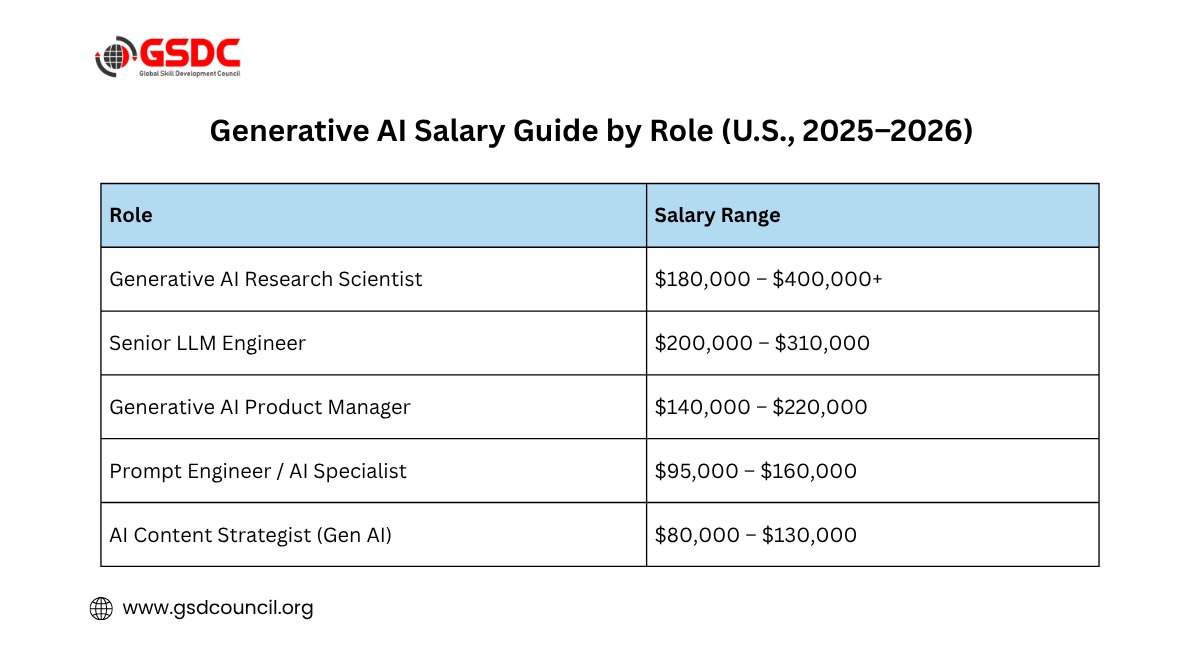
The growth trajectory here is steep. Understanding how generative AI works - and being able to demonstrate that understanding through certified training and real projects - is rapidly becoming a qualifier for some of the highest-paying individual contributor roles in tech.
How to Make Your AI Certification Work Harder for You
The salary data is compelling - but the professionals seeing the biggest gains aren't just collecting credentials. They're pairing them with action.
Analysis found that the combination of certification + portfolio projects + hands-on experience is what consistently pushes candidates into the top salary bands. Certification opens the door; applied work is what gets you the offer. The good news is that most quality AI certification programs are designed with this in mind - building real projects, working with industry tools, and producing tangible output you can show an employer is part of the process, not an afterthought.
Think of it this way: the certification validates that you know how generative AI works, how to build and deploy models, and how to operate within real-world AI systems. Your portfolio proves it. Together, they make a case that a résumé line alone never could.
For the vast majority of working AI roles - applied engineering, AI development, product integration, and enterprise AI deployment - a well-chosen certification from a recognized program, backed by practical project work, delivers a meaningful and measurable financial return.
The answer to "does certification increase your salary?" is yes. And the more deliberately you apply what you've learned, the more dramatic that increase tends to be.
What This Means If You're Planning Your Next Move
The wage gap between AI-skilled and non-AI-skilled workers in the same roles is widening, not narrowing. Whether you're just starting out or mid-career, the data points in one direction: structured, credentialed AI training pays off.
For professionals focused on generative AI specifically, the Generative AI Foundation Certification from the Global Skill Development Council is worth a look - built around the applied skills employers are actually hiring for right now.
The AI market isn't waiting. The professionals who move first are the ones the next round of salary reports will be quoting.

Final Takeaway
Here's the math, simplified:
The average U.S. worker earns $65,470 per year. A certified AI professional at the entry level starts at $65,000–$95,000 - and that number compounds significantly with experience and specialization. Workers with verified AI skills earn an average 56% wage premium over peers in the same roles without those skills (PwC, 2025). Cloud ML certifications deliver 20–25% salary bumps for a few hundred dollars in exam fees. Generative AI certification is driving some of the fastest salary growth of any specialization in the labor market right now.
The question was whether an AI certification actually increases your salary. The data says yes - clearly, consistently, and more dramatically than at any previous point in the history of this field.
The better question is: which certification is right for where you want to go?

Related Certifications
Frequently Asked Questions
Yes - and the data backs it up. PwC's 2025 research found that workers with verified AI skills earn a 56% wage premium over peers in the same roles without them. Certification alone isn't magic, but paired with real project work, it consistently moves the needle.
Around $140,910 at the median, according to the Bureau of Labor Statistics - though total compensation including bonuses regularly pushes past $160,000. Senior roles and specializations like LLM engineering go considerably higher.
It depends on your goal. Cloud ML certifications (AWS, GCP) tend to deliver the highest ROI for engineers already in tech. For broader career positioning, a Generative AI certification from a globally recognized body gives you the widest range of applicable roles.
Senior generative AI engineer salaries in the US range from $160,000 to $280,000, with LLM specialists frequently earning above that. It's one of the fastest-moving salary bands in tech right now - figures from even a year ago are already outdated.
Extremely. AI/Machine Learning Engineer roles grew 41.8% year-over-year in 2025, and the median salary for AI positions hit nearly $157,000 in Q1 2025 alone. The talent gap is real - employers are competing hard for people who can actually do this work.
The strongest programs cover transformer architecture, prompt engineering, fine-tuning, retrieval-augmented generation, and responsible AI practices. The goal is applied fluency - not just knowing how generative AI works in theory, but being able to use it in production.
More than most people expect. It's not the highest-paying specialization on its own, but it's increasingly required for senior roles at regulated companies in healthcare, finance, and government. The IAPP's 2025 report found certified AI governance professionals consistently out-earn their non-certified peers.
Entry-level generative AI developers typically start between $75,000 and $95,000, depending on location and the specific role. That's already well above the national median wage - and it compounds quickly with experience and specialization.
The biggest one is speed. Generative AI skills let career changers reposition faster than almost any other tech specialization - because demand is so high that employers are more flexible on background than they used to be. A strong certification plus a portfolio can overcome a lot of traditional gatekeeping.
At its core, generative AI uses large language models trained on vast datasets to predict and produce content - text, code, images, and more. You don't need a PhD to get certified, but you do need enough working knowledge to apply it. The best certification programs are built to take you from foundational understanding to job-ready application, step by step.
Stay up-to-date with the latest news, trends, and resources in GSDC
If you like this read then make sure to check out our previous blogs: Cracking Onboarding Challenges: Fresher Success Unveiled
Not sure which certification to pursue? Our advisors will help you decide!