Prompt Engineering for Project Managers
Written by Pravena K
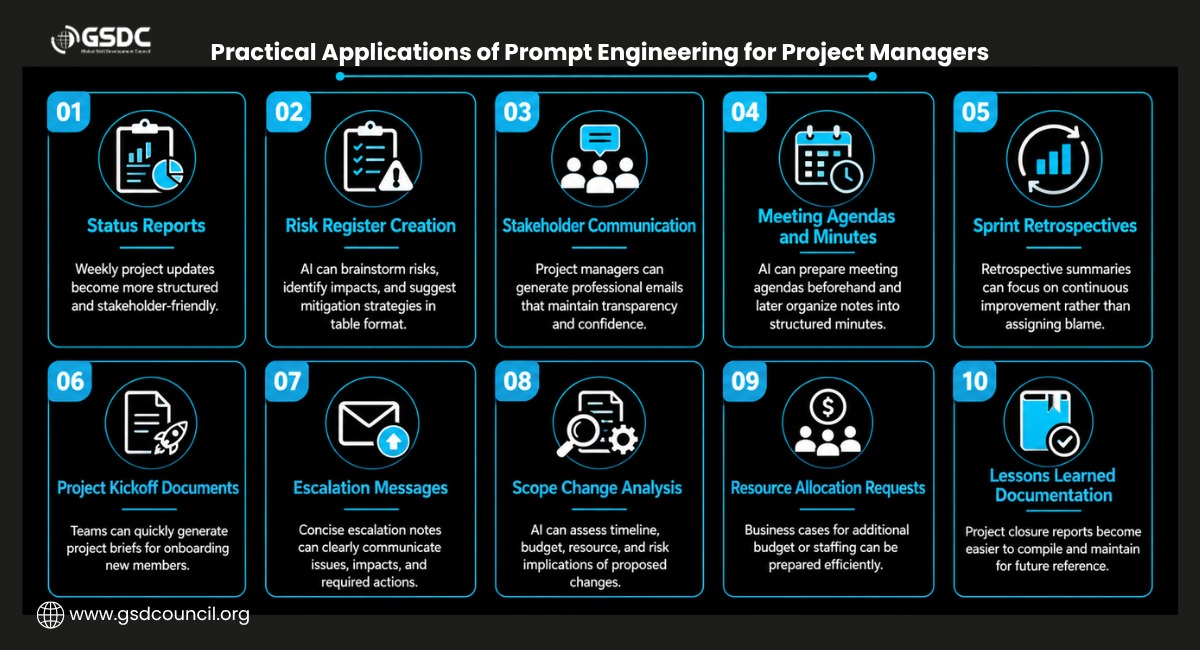
Artificial Intelligence (AI) is rapidly becoming a part of everyday project management. From drafting status reports and preparing meeting agendas to creating stakeholder communications and risk registers, AI tools such as ChatGPT, Microsoft Copilot, Gemini, and Claude are helping project managers save time and improve productivity.
However, many professionals face the same challenge: they ask an AI tool to perform a task and receive an output that is too generic, too long, off-topic, or simply unusable. This often leads to frustration and the belief that the AI tool is ineffective.
The reality is different. In most cases, the problem is not the AI; it is the prompt. What is prompt engineering in AI? Prompt engineering is the skill of communicating effectively with AI systems to receive high-quality, relevant, and actionable responses. For AI for project managers, this is not a technical skill but a communication skill that can significantly improve daily workflows.
This blog explores the fundamentals of prompt engineering in project management, introduces the CLEAR prompt engineering framework, and explains how to use AI for project management more effectively in real-world scenarios.
Why Project Managers Often Get Poor AI Results
Many users interact with AI by entering very short instructions such as:
"Write a project update."
While this may seem straightforward, the AI has very little information to work with. It does not know:
- What the project is about.
- Who the audience is.
- The preferred tone of communication.
- The required format or length.
- The level of technical detail expected.
As a result, the AI fills in these gaps by making assumptions. Those assumptions rarely match the user's actual expectations.
Think of it like assigning a new team member a task with almost no instructions. If you simply say, "Prepare a project update," they would have to guess the project details, stakeholders, priorities, and communication style. AI behaves in a very similar way.
This is why prompt engineering techniques are important. The more context and guidance you provide, the more accurate and useful the response becomes. Effective prompt engineering in project management helps professionals generate outputs that align more closely with their objectives.
Understanding the Common Prompting Mistakes
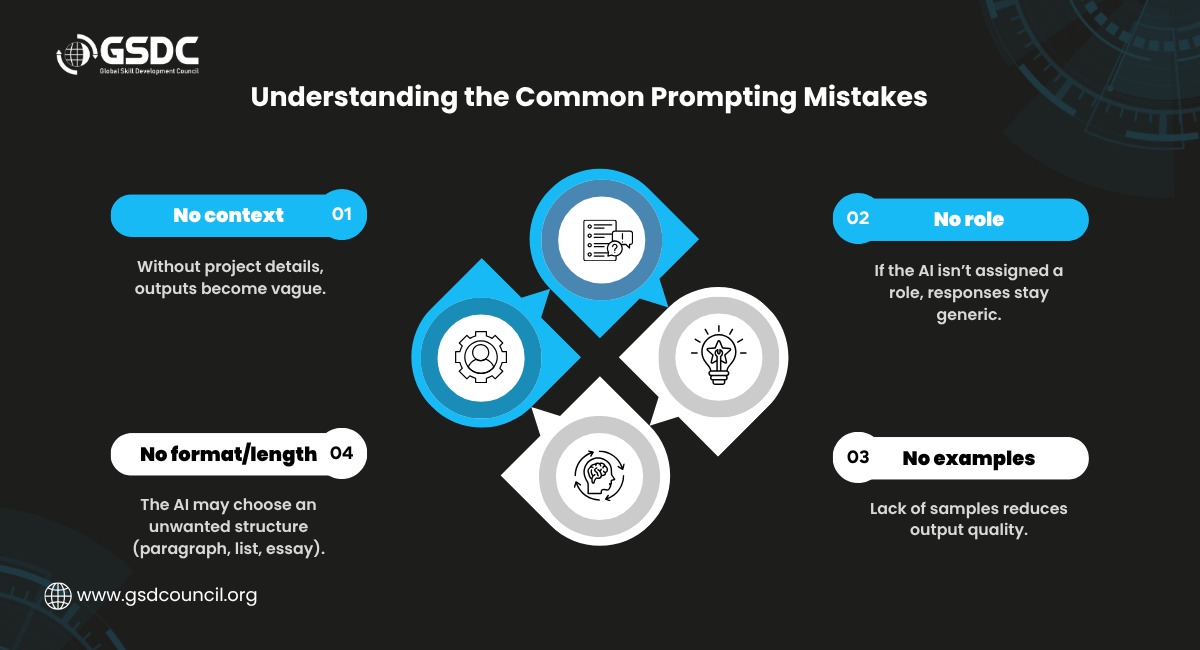
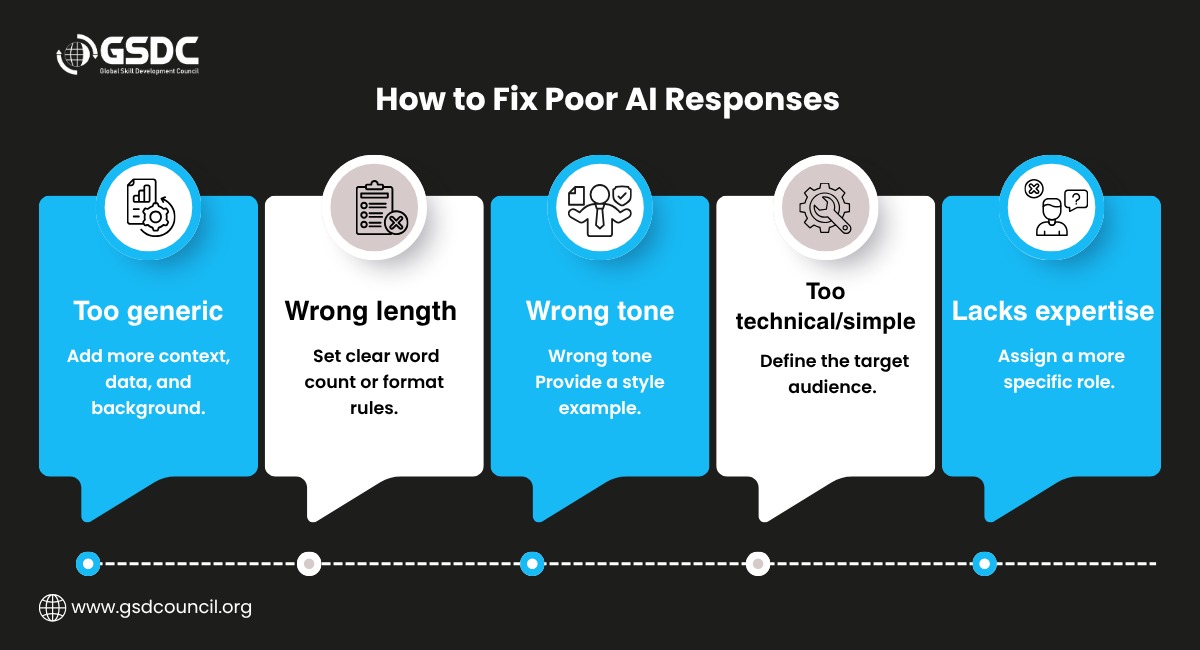
Many ineffective prompts have a few common issues.
1. Lack of Context
AI cannot understand your project environment unless you describe it. Missing project details lead to vague outputs and reduce the effectiveness of prompt engineering techniques.
2. No Defined Role
If the AI is not told who it should act as, it may produce a generic response. Assigning a role helps establish the right level of expertise and is considered one of the key advanced prompt engineering techniques.
3. Unclear Length or Format
Without instructions, AI decides whether to generate a paragraph, an essay, or a list. This often creates additional editing work and affects the quality of prompt engineering in project management.
4. Missing Style Examples
AI performs much better when it is shown what a good output looks like. Even a small sample can improve the quality significantly.
Understanding these mistakes is the first step toward mastering prompt engineering. Being aware of these Common Mistakes for prompt engineering can help professionals create more effective prompts and achieve better results.
The CLEAR Framework: A Simple Formula for Better Prompts
One of the most practical approaches discussed in the webinar was the CLEAR Framework, a five-element structure that helps create effective prompts.
CLEAR stands for:
C – Context
Context provides the background information the AI needs.
It answers questions such as:
- What is the project?
- What is the current situation?
- What challenges exist?
- What information should the AI consider?
For example, instead of saying:
"Write a project update."
You could write:
"We are in week three of a ten-week ERP migration project. Two workstreams are on schedule, while the data migration team is one week behind."
This helps the AI generate a much more relevant response.
L – Length
Length defines the structure and size of the output.
Project managers should specify:
- Word count
- Number of bullet points
- Number of paragraphs
- Character limits
- Preferred formatting
For example:
"Write exactly five bullet points, with each bullet containing no more than 15 words."
Being specific reduces editing time and ensures the output fits the intended purpose.
E – Examples
Examples are one of the most underutilized aspects of prompt engineering.
Providing a previous report, email, or sample sentence helps AI understand the desired style and tone.
For instance, attaching a previous stakeholder update allows AI to mimic the organization's communication style while maintaining consistency.
Rather than explaining what you want, examples show the AI what success looks like.
A – Audience
The audience determines the complexity and vocabulary of the response.
A report for a Chief Executive Officer will differ significantly from one intended for a technical engineering team.
Clearly identifying the reader helps AI adjust:
- Language
- Technical depth
- Business terminology
- Communication style
Examples include:
- Non-technical executives
- Project sponsors
- Operations teams
- Senior engineers
- External clients
Knowing the audience ensures that the message is appropriate and effective.
R – Role
Role tells AI who it should become while generating the response.
For example:
- You are a senior project manager.
- You are a PMO consultant.
- You are a risk management specialist.
- You are an Agile coach.
Adding experience levels can further improve results:
"You are a senior project manager with 15 years of experience managing enterprise technology projects."
This influences the quality, confidence, and professionalism of the output.
Before and After: The Power of a Better Prompt
Consider these two examples.
Weak Prompt
Write a project update.
The AI must guess everything.
Structured Prompt Using CLEAR
Role: You are a senior project manager at a global technology company.
Context: We are in week three of a ten-week ERP migration project. Two workstreams are on track, but the data migration team is delayed by one week.
Audience: The update is for the Vice President of Operations and other non-technical executives.
Length: Write exactly five bullet points.
Example/Tone: Use a professional and action-oriented tone. Example: "Risk mitigation activities are underway."
The difference is remarkable. The AI now has enough information to generate an executive-ready update with minimal revisions.
AI as a Thinking Partner, Not a Replacement
An important takeaway from the webinar was that AI should not be viewed as a replacement for project managers.
AI provides:
- Speed
- Drafting support
- Idea generation
- Content organization
Project managers contribute:
- Business judgment
- Leadership
- Risk assessment
- Stakeholder management
- Decision-making
The most effective approach is a partnership between human expertise and AI capabilities.
Human intelligence provides direction, while AI accelerates execution.
Best Practices for Learning Prompt Engineering
For beginners, trying to master every AI feature at once can be overwhelming.
A better strategy is to start with one recurring task.
For example:
- Weekly project status reports
- Meeting minutes
- Client update emails
Improve one prompt, test it repeatedly, refine it, and save the version that works.
Over time, the same principles can be applied to other project management activities.
Building a library of proven prompts can also help teams standardize communication and improve consistency across projects.
Enhance Your AI Skills with a Prompt Engineering Certification
GSDC’s Prompt Engineering Certification is designed for professionals who want to develop practical skills in creating effective prompts and maximizing the value of AI tools in business environments. The certification covers essential concepts such as prompt design, advanced prompt engineering techniques, AI-assisted decision-making, real-world use cases, and best practices for working with generative AI.
For project managers, mastering prompt engineering can significantly improve the quality of AI-generated outputs, streamline workflows, and support better communication across teams and stakeholders. By gaining structured knowledge and hands-on experience through Prompt Engineering Certification, professionals can confidently leverage AI tools to enhance productivity, optimize project outcomes, and succeed in an increasingly AI-driven workplace.
Conclusion
Prompt engineering is becoming an essential skill for modern AI for project managers. As AI adoption grows across organizations, the ability to communicate effectively with AI tools will become just as valuable as traditional project management techniques.
The CLEAR Framework—Context, Length, Examples, Audience, and Role—offers a simple yet powerful prompt engineering framework for creating high-quality prompts that generate better outputs with less effort.
Instead of blaming AI for poor responses, project managers should focus on improving the instructions they provide. Better prompts lead to better results, saving time, reducing rework, and increasing productivity when using AI for project management.
Ultimately, AI works best when it complements human expertise. Project managers who learn to combine their experience with effective prompt engineering in project management and advanced prompt engineering techniques will be better equipped to manage projects, communicate with stakeholders, and lead teams in an AI-driven workplace. Professionals looking to further develop these skills may also consider a prompt engineering certification to strengthen their expertise.

Related Certifications
Frequently Asked Questions
Prompt engineering is the practice of writing clear and structured instructions for AI tools to generate accurate, relevant, and useful outputs for project management tasks.
The CLEAR framework is a prompting model that stands for:
- C – Context
- L – Length
- E – Examples
- A – Audience
- R – Role
It helps users create more effective AI prompts.
Yes. Well-designed prompts can significantly reduce the effort required to create status reports, meeting minutes, stakeholder emails, project briefs, and other routine documents.
This usually happens because the prompt lacks sufficient context, audience details, role definition, examples, or formatting instructions. Improving the prompt often improves the output.
No. Prompt engineering is primarily a communication skill. Project managers, business analysts, HR professionals, marketers, and many other non-technical roles can benefit from learning how to interact effectively with AI tools.
Stay up-to-date with the latest news, trends, and resources in GSDC
If you like this read then make sure to check out our previous blogs: Cracking Onboarding Challenges: Fresher Success Unveiled
Not sure which certification to pursue? Our advisors will help you decide!