Why Certified AI Professionals Earn More and Get Promoted
Written by Matthew Hale
- Where Employers Are Struggling to Find AI Talent
- The Salary Picture: What AI Professionals Earn Right Now
- The Before-and-After: What Certification Actually Changes
- AI Certification ROI by Industry
- The Skills Driving These Numbers (Beyond the Technical)
- What Is Generative AI, and Why Does It Command Higher Pay?
- The Best AI Certifications Worth Your Time in 2026
- How to Earn Money with Generative AI: Beyond the Salary Route
- A Practical 4-Step Path to Your First AI Certification
- Why GSDC's AI Certification Stands Apart
- The Bottom Line
Here is a question worth sitting with for a minute. You and a colleague both apply for the same AI engineer role at the same company. Your skills are roughly equal. Your experience is similar. The difference? They hold a verified AI certification. They get the offer. You get the polite rejection email.
This is not a hypothetical. It is happening right now across every industry in America, and the salary gap that certification creates is larger - and faster to achieve - than most professionals realize.
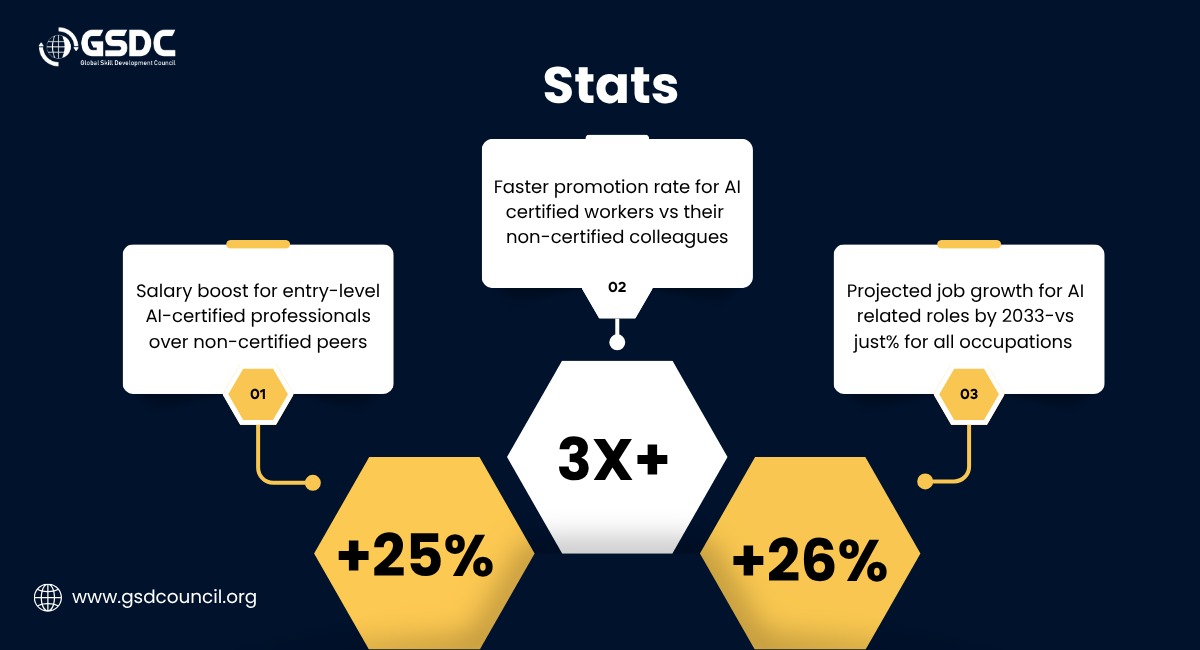
A 25 percent salary premium on a $90,000 base is an extra $22,500 a year - without a job change, without a new degree, without waiting for an annual review cycle. Being promoted more than three times faster means a career trajectory that would have taken four or five years can happen in just over one.
But before you enroll in anything, it is worth understanding why these premiums exist. The salary numbers are real, but the story behind them is more interesting - and more useful - than a simple before-and-after table.
Where Employers Are Struggling to Find AI Talent
The salary premiums for AI-certified professionals are not the result of credentials becoming fashionable. They reflect a supply problem that companies have not been able to solve through traditional hiring.
Senior AI leadership vacancy rates exceed 25 percent in key markets. Businesses spent heavily on AI tools over the past two years - the software, the infrastructure, the vendor contracts - but they systematically underinvested in the people who can govern, integrate, and extract real value from those tools.
"Businesses cannot unlock AI-driven growth by buying technology alone; the real bottleneck is the severe shortage of professionals capable of integrating, governing, and scaling these systems." - Sander van 't Noordende, CEO of Randstad, May 2026
The gap is widest in functions that most people would not immediately associate with technical AI work. Marketing teams have generative AI tools but no one who understands prompt governance or output quality control. HR departments are sitting on AI hiring tools they cannot evaluate. Operations teams are automating workflows without anyone who can diagnose when the automation breaks.
This is the structural reason certified professionals earn more: companies are not just paying for technical knowledge. They are paying to close a gap they cannot fill any other way.
The Salary Picture: What AI Professionals Earn Right Now
With that context in place, the salary baseline makes more sense. These are not niche technical roles that pay well in obscure specialties. They are functions that companies across every sector are actively trying to staff.
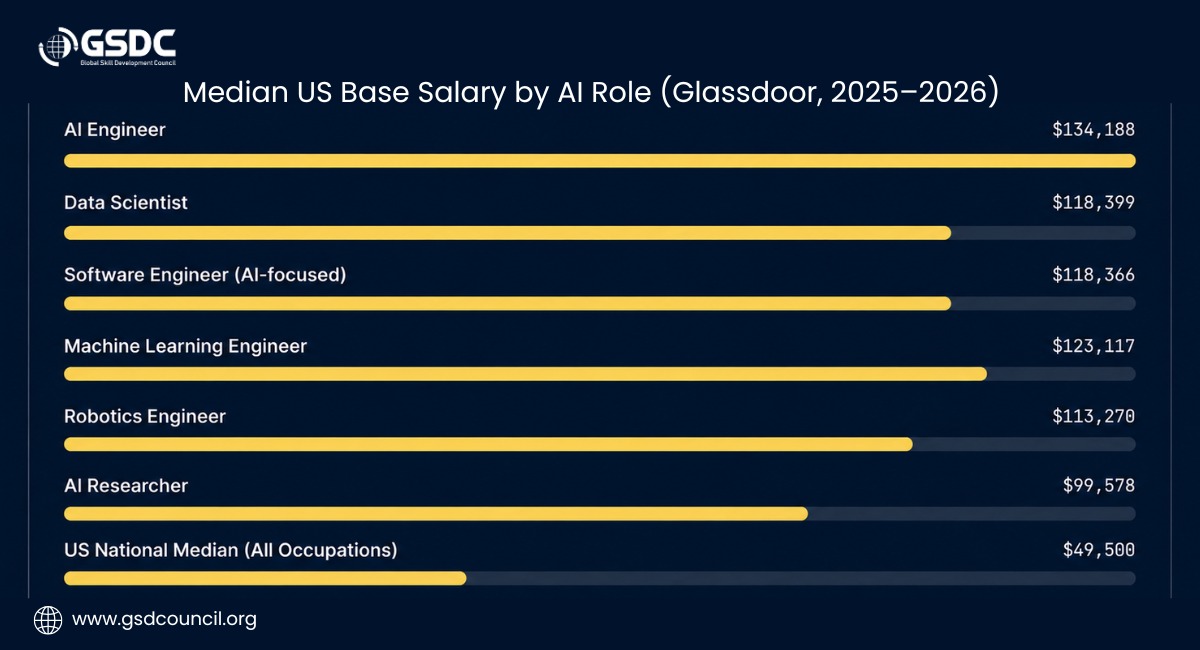
Even the lower end of this range runs roughly double the national median. The BLS projects 26 percent growth in computer and information research science roles between 2023 and 2033 - compared to 4 percent for the economy overall. High pay plus strong growth plus an unfilled talent pipeline: that is the environment in which your certification decision sits.
The Before-and-After: What Certification Actually Changes
Here is how salary and trajectory shift across different career stages when a credential enters the picture.
Profile | Before | After AI Certification | Lift |
Entry-Level Content Writer | ~$48,000/yr | ~$60,000/yr | +25% |
Customer Service Professional | ~$42,000/yr | ~$52,000/yr | +24% |
Mid-Level AI Engineer (4–6 yrs) | $103,140/yr | $138,301/yr | +34% |
AI Engineer (San Francisco vs Columbus, OH) | $103,974 | $164,499 | +58% location premium |
Machine Learning Engineer (career trajectory) | $98,798/yr | $153,286/yr | +55% over career |
Data Scientist (career trajectory) | $110,720/yr | $145,724/yr | +32% over career |
Source: Glassdoor (Feb 2025); for role/experience data; Randstad (May 2026) via HR Dive for entry-level premiums. Base pay only.
What stands out most here is the story for non-technical roles. Certified Generative AI Professionals earn measurable premiums in content writing and customer support - fields where many feared AI would eliminate jobs. The workers seeing the biggest gains are those who got certified, learned to work alongside these tools, and positioned themselves as the human layer that makes AI output reliable and trustworthy.
The workers who waited to see what would happen are earning the same salary they earned two years ago.
AI Certification ROI by Industry
Most people reading this are not AI engineers. They are professionals in specific fields wondering what any of this means for their career. The premiums look different by industry - and in several sectors, the gap between certified and uncertified workers is widening faster than in the core technical roles.
- Marketing
The premium here is not for knowing how the models work - it is for understanding prompt governance, output quality, and how to build repeatable AI workflows a whole team can use. Marketing managers who can lead that capability are being promoted into AI strategy roles that did not exist 18 months ago.
- Cybersecurity
AI is both a threat vector and a defense tool. Certified security professionals command premiums for threat detection, anomaly identification, and red-teaming AI systems - one of the fastest-moving intersections in the field right now.
- Project Management
A project manager who adds AI workflow skills does not become an AI engineer. They become the person responsible for deploying AI across departments - an implementation lead with director-level visibility and direct access to senior leadership on rollout decisions. In many organizations, that responsibility now comes with a meaningful title change to match.
- HR and Talent
Most HR teams are sitting on AI hiring and workforce planning tools they cannot critically evaluate. HR professionals with AI credentials are increasingly being asked to own the people-side of AI rollouts and sit on governance committees - a function that barely appeared in job descriptions three years ago. Bodies like the Global Skill Development Council (GSDC) have responded to this shift by developing role-specific AI certifications for non-technical functions, reflecting how broadly the credentialing need has spread beyond engineering.
- Operations and Data & Analytics
These are the sectors with the most direct line between AI certification and measurable business outcomes. Certified operations professionals are building automation business cases and managing human-AI workflows; their promotions are fast because the cost savings show up directly on leadership dashboards. Data professionals who add generative AI to existing analytical foundations are moving into ML-adjacent roles faster than traditional advancement would allow.
The Skills Driving These Numbers (Beyond the Technical)
The Randstad data surfaced something counterintuitive: the same period that produced explosive AI technical demand also produced a parallel surge in human skill premiums. Emotional intelligence demand rose 173 percent. Creativity rose 168 percent. Problem solving, critical thinking, and ethical judgment followed behind.
These are not soft skills added as an afterthought. They are the capabilities that determine what happens after the AI produces an output. As AI handles more routine work, employers pay an increasing premium for the human judgment that decides what to do with that output - whether to trust it, how to communicate it, and what to do when it is wrong. A certified AI professional who can also lead a skeptical team through an AI rollout, or flag an ethical problem before it becomes a legal one, is worth significantly more than one who can only run the tool.
Think of the certification as the entry ticket. These human skills are what determine how far you go once you are inside.
What Is Generative AI, and Why Does It Command Higher Pay?
Generative AI systems - the large language models, image generators, and code assistants now embedded in most professional workflows - are trained on massive datasets to create new content rather than simply classify or analyze existing data. Unlike earlier machine learning, they do not require a programmer to write explicit rules. They learn patterns and generate outputs that are novel, contextually appropriate, and genuinely useful.
That is exactly why they spread so fast - and why people who understand how to prompt, evaluate, and govern these systems are in such short supply. The global AI market is projected to approach $2 trillion by 2030. As these tools embed deeper into legal, healthcare, finance, and operations workflows, professionals who can bridge the gap between raw AI capability and real business output become structurally difficult to replace.
The Best AI Certifications Worth Your Time in 2026
Not every credential carries equal weight. The programs below consistently appear in hiring conversations and are tied directly to roles that are actively hard to fill.
- Google AI Professional Certificate (Google)
Applied AI for data analysis, research, and communication. Completable in ~8 hours. Strong employer recognition across non-technical functions.
- IBM AI Developer Professional Certificate (IBM)
Hands-on with chatbots, computer vision, and custom image classification. Project-based and verifiable. Best for developers adding AI to an existing technical foundation.
- Certified AI Professional (GSDC - Global Skill Development Council)
Designed for professionals in non-engineering roles - HR, operations, project management, marketing - who need to govern, evaluate, and work alongside AI systems rather than build them. One of the few credentials explicitly structured around the organizational deployment side of AI, which is where most hiring gaps actually sit.
- Certified Artificial Intelligence Scientist (CAIS) (USAII)
Covers AI strategy, ML engineering, and ethical deployment. The recognized credential for practitioners moving into AI leadership.
- Machine Learning Specialization (Stanford + DeepLearning.AI)
Andrew Ng's flagship program. Build and train neural networks; apply industry best practices. Globally respected at the mid-to-senior level.
One rule before enrolling: verify the role you are targeting is actively hiring in your market. A credential aimed at a stagnant function will not move your salary regardless of who issued it.
How to Earn Money with Generative AI: Beyond the Salary Route
The data above applies to traditional employment. But a growing number of professionals are building independent income through AI expertise: consulting on AI workflow implementation, freelance prompt engineering for marketing and legal teams, AI content strategy for publishers, and building AI-powered tools for licensing.
The certification matters here too - not because clients care about the badge, but because the underlying skills allow you to deliver results fast enough to justify premium rates. Clients are not buying credentials. They are buying the capability those credentials validate.
The answer to what AI program is everyone using right now varies significantly by industry. Legal and finance teams lean on document AI and reasoning models. Marketing teams default to generative content tools. Operations teams are deep in process automation. Your certification focus should follow your industry's actual use cases - not the general hype cycle.
A Practical 4-Step Path to Your First AI Certification
1. Pick the role, then pick the credential.
Find two or three AI-adjacent roles in your field that are actively hiring in your city or remote market. Map which certifications those job listings mention or reward. Work backward from the job to the program - not the other way around.
2. Set a 90-day deadline.
Most high-quality AI certifications can be completed within 6–12 weeks of consistent effort. Give yourself a firm date. The scarcity premium for certified professionals is highest now, while the pool of credentialed workers is still small - waiting carries a real cost.
3. Build a project, not just a transcript.
The employers paying the largest premiums are buying proof of capability, not proof of attendance. Build at least one project during your certification: a workflow you automated, a model you fine-tuned, a report you delivered faster using AI tools. This becomes your proof-of-work in every subsequent negotiation.
4. Lead with it on your resume, tied to outcomes.
Do not bury your certification in a footer. Place it in your summary if AI fluency is core to the role. Then reference it again next to a concrete result - a process that went from hours to minutes, a cost saved, a campaign that outperformed. A credential connected to a number is an argument. A credential by itself is a footnote.
Why GSDC's AI Certification Stands Apart
Most AI certifications are built for engineers. The Global Skill Development Council (GSDC) designed its Certified AI Professional credential for a different audience: the project managers, HR professionals, operations leads, and marketing teams who need to govern, evaluate, and deploy AI - not build it. These are precisely the roles where vacancy rates are highest and external hiring is failing.
The credential is industry-recognized, completable alongside a full-time role, and comes with a verifiable digital badge for LinkedIn and job applications. For non-engineering professionals who recognized themselves in the industry section above, it is the certification most directly mapped to the gaps employers are actively trying to close.
The Bottom Line
The salary data is clear, but the more important story is structural. Companies built AI capability faster than they built the human infrastructure to use it. Senior AI leadership seats are sitting empty. Certified workers are being promoted into gaps that external hiring cannot fill fast enough. And the human skills employers value most - judgment, creativity, ethical reasoning - are rising in value precisely because AI is handling more of the routine work.
The future of generative AI only deepens this dynamic. The professionals who will benefit most are not the ones waiting to see how things settle. They are the ones who identified a role their market is hungry to fill, earned the credential that documented their capability, and put themselves on the right side of the demand curve while the gap was still steep.
That window is open right now.

Related Certifications
Frequently Asked Questions
Honestly, the numbers make a pretty strong case. Certified professionals at the entry level are earning around 25% more than peers with the same experience but no credential. They're also moving up faster - more than three times faster, according to Randstad's latest workforce data. Whether that's "worth it" depends on your field, but in most industries right now, the gap is real and it's growing.
At the entry level, expect somewhere in the 24–25% range. For mid-career professionals, the lift compounds with experience - an AI engineer at four to six years can earn around $35,000 more than someone just starting out in the same role. Location plays a big role too; the same position in San Francisco pays nearly 60% more than in a mid-sized Midwestern city.
There's no single answer, and anyone who tells you otherwise is probably selling something. If you're non-technical, Google's AI Professional Certificate or GSDC's Certified AI Professional are the most practical starting points. Developers tend to do well with IBM's AI Developer certificate. If you're targeting ML engineering or senior roles, Stanford and DeepLearning.AI's Machine Learning Specialization is hard to beat. Start with the job description, not the brand name.
Unlike older AI systems that just classify or sort existing data, generative AI actually creates things - text, code, images, analysis. It doesn't need a programmer writing explicit rules; it learns patterns and produces outputs that are genuinely useful. That's why it's spread so fast across industries, and why people who know how to work with it, evaluate it, and keep it from going sideways are worth so much right now.
More of everything, faster. The global AI market is heading toward $2 trillion by 2030, and these tools are already inside legal, finance, healthcare, and operations workflows in ways that weren't true two years ago. The professionals who will matter most aren't necessarily the ones building the models - they're the ones who can make them work reliably inside real organizations.
It really depends on where you work. Marketing teams are deep in generative content tools. Legal and finance are leaning on document AI. Operations is all about process automation. There's no universal answer, which is actually useful information - it means you should look at what your specific industry is actually hiring for before committing to a program.
The employment route is the most straightforward - certified professionals are seeing real salary bumps across most industries. But a growing number of people are building independent income too: AI workflow consulting, prompt engineering for marketing or legal teams, content strategy for publishers, building tools and licensing them. The certification helps not because clients care about the badge, but because the skills behind it let you deliver fast enough to justify what you charge.
In most organizations, they're the person who makes AI actually work in practice - building workflows the team can use reliably, catching problems before they become expensive, and translating what the AI is doing into language that non-technical stakeholders can act on. It's less about running models and more about making sure the outputs are trustworthy and the processes around them make sense.
Most solid programs take six to twelve weeks if you're putting in consistent time alongside a regular job. Google's AI Professional Certificate is an outlier on the short end - around eight hours total. GSDC's Certified AI Professional is specifically designed to fit around full-time work, which makes the timeline more manageable for most people.
Not for most of the programs that are actually relevant right now. The credentials designed for engineers are a minority. GSDC's Certified AI Professional and Google's AI Professional Certificate are both built for people in roles like HR, marketing, operations, and project management - professionals who work with AI tools every day but aren't writing code. That's actually the majority of people the market is looking for.
Stay up-to-date with the latest news, trends, and resources in GSDC
If you like this read then make sure to check out our previous blogs: Cracking Onboarding Challenges: Fresher Success Unveiled
Not sure which certification to pursue? Our advisors will help you decide!