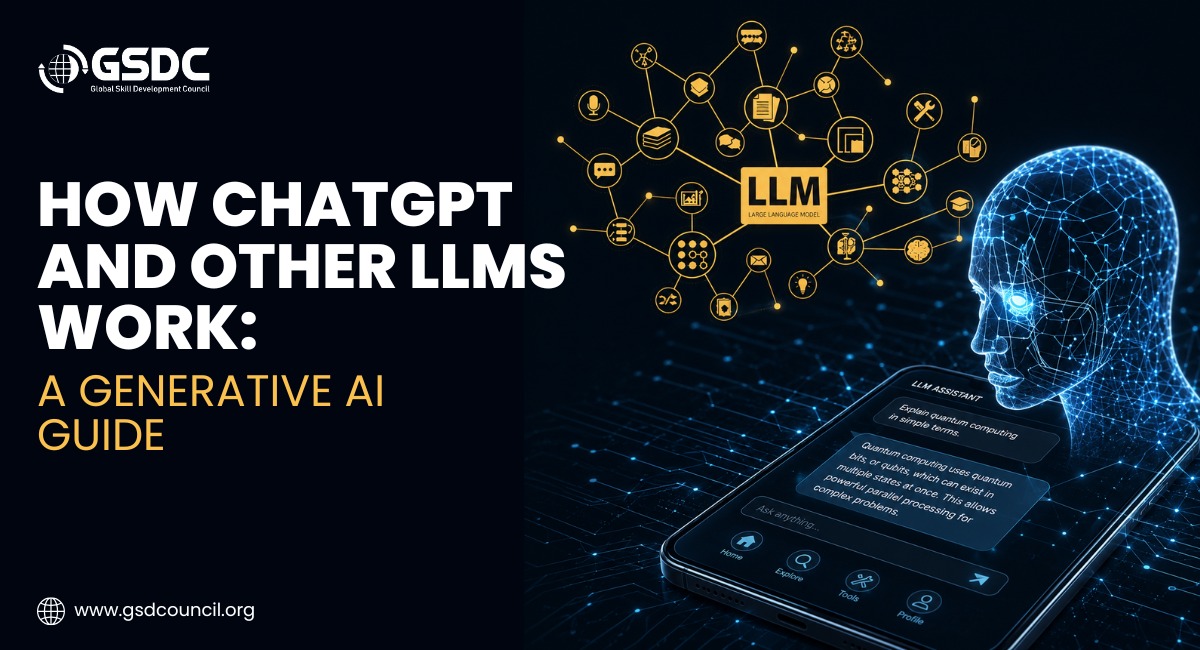
How ChatGPT and Other LLMs Work: A Generative AI Guide
Written by Emily Hilton
- First, What Is Generative AI-Really?
- What Is an LLM in Generative AI?
- The Difference Between LLM and Generative AI
- Transformers: The Architecture That Changed Everything
- How Generative AI Is Trained: The Three Phases
- Who Is Using Generative AI-And Where
- How Generative AI Is Changing Creative Work
- What Generative AI Still Can't Do (And Why It Matters)
- Why AI Literacy Is Becoming a Professional Baseline
- Putting It All Together: The Flow from Prompt to Response
- Where to Build That Fluency
- The Bottom Line
By now, you've heard the phrase "generative AI" more times than you can count. You've probably used ChatGPT, seen AI-generated images, or watched someone write an entire email in three seconds. But ask most people how it actually works under the hood, and you get a blank stare-or worse, a vague hand-wave about "machine learning." This post changes that. No equations. No PhD required. Just a clear, honest walk through what generative AI is, what an LLM really does, and why transformers changed everything.
Why this matters right now. According to McKinsey's 2025 State of AI report, 88% of organizations are now using AI in at least one business function-up from 55% just two years earlier. Generative AI sits at the center of that shift. Understanding how it works is no longer optional knowledge for professionals in any field.
First, What Is Generative AI-Really?
Most definitions of generative AI are either too vague ("AI that creates content") or too technical ("a probabilistic neural network that samples from a learned distribution"). Neither is especially useful if you're trying to understand what's actually happening.
Here's a definition that holds up: Generative AI is software that creates new content-text, images, audio, code-by learning statistical patterns from enormous amounts of existing data. Feed it billions of sentences from the internet, and it learns how language works well enough to write new sentences. Feed it millions of images, and it learns what objects look like well enough to generate new ones.
The word "generative" is doing important work here. It separates this new breed of AI from everything that came before it.
Traditional AI
Takes your data and makes a prediction. Is this email spam? Will this customer churn? What's the likelihood this loan defaults? It classifies. It scores. It flags. The output is a decision or a number.
Generative AI
Takes your prompt and creates something. A paragraph. An image. A piece of code. A summary of a 50-page document. The output is new content that didn't exist before the model produced it.
Both types are useful. Most serious enterprise systems today combine them: traditional AI flags the anomaly, generative AI drafts the response. But the distinction matters because it shapes what each technology is good for-and where each one breaks.
What Is an LLM in Generative AI?
When people talk about generative AI and language-ChatGPT, Claude, Gemini, Llama-they're talking specifically about a Large Language Model (LLM). Understanding what is LLM in generative AI is is the single most important piece of context you can have before using, building, or buying any AI-powered language tool.
An LLM is, at its core, a very large neural network trained on a very large amount of text. That's it. "Large" is doing two jobs in that sentence-the network itself has billions (sometimes hundreds of billions) of parameters, and the training dataset contains billions of words from books, websites, scientific papers, forums, and code repositories.
The model learns by doing one deceptively simple task over and over: predict the next word. Or more precisely, the next "token." Show it the beginning of a sentence, ask it what comes next, check if it's right, adjust when it's wrong. Do that enough times at enough scale, and something remarkable emerges-a system that understands context, follows instructions, reasons through problems, and produces fluent text.
Key Insight: GPT-3 (one of the earlier landmark models) has 175 billion parameters. GPT-4 is estimated to be even larger. Each parameter is a tiny adjustable weight in the network. The "training" process is just the job of finding the right values for all of them-so the model predicts text well.
A common point of confusion: Is ChatGPT the same as generative AI? No-and the distinction matters. ChatGPT is a product. Generative AI is the category. ChatGPT is built on GPT (Generative Pre-trained Transformer), which is one family of large language models, built by OpenAI. There are many others: Claude (Anthropic), Gemini (Google), Llama (Meta). ChatGPT is to generative AI what Gmail is to email-one very famous product within a much broader technology landscape.
The Difference Between LLM and Generative AI
This is one of the most searched questions in this space, and the answer is simpler than most articles make it: Generative AI is the broader category. An LLM is one type of generative AI-specifically, one that works with language.
Concept | Scope | What it creates | Examples |
Generative AI | Broad category | Text, images, audio, video, code | GPT-4, DALL-E, Stable Diffusion, Sora, MusicLM |
LLM (Large Language Model) | Subset of Generative AI | Text and code only | GPT-4, Claude, Gemini, Llama, Mistral |
Diffusion Model | Subset of Generative AI | Images and video | Stable Diffusion, DALL-E, Midjourney |
GAN (Generative Adversarial Network) | Subset of Generative AI | Images, synthetic data | StyleGAN, CycleGAN |
Think of it this way: every LLM is a generative AI, but not every generative AI is an LLM. When someone asks "what is generative AI and LLM," the honest answer is: one is the category, the other is the most commercially significant type within it.
For most people working in business, marketing, education, or knowledge work today, the practical difference between LLM and generative AI is mostly academic-because the language-based models are the ones you'll actually encounter day to day. But if you're evaluating AI tools or pursuing a generative AI certification, understanding this distinction is foundational.
Tokens: The Alphabet of AI
One of the first things people notice when working with LLMs is the word "token"-usually in pricing ("$X per 1,000 tokens") or context limits. A token is a chunk of text: roughly a word, part of a word, or a punctuation mark. Models don't read text the way you do. They break it into tokens, convert each token into a number, then process those numbers. As a practical rule: 1,000 tokens ≈ about 750 English words. Common short words like "cat" are one token; uncommon words like "unbelievable" might split into three.
After tokenization, each token gets mapped to an embedding-a point in a high-dimensional mathematical space where words with similar meanings land close together. "Doctor" and "physician" cluster near each other. "Invoice" and "payment" do too. The model understands language by measuring the distances and directions between these points, which is why it can make connections that feel almost intuitive.
The model doesn't read words. It reads coordinates in a mathematical space where meaning has geometry. "King" minus "man" plus "woman" famously points toward "queen"-not because anyone taught it that, but because the training data encoded it.
Transformers: The Architecture That Changed Everything
Before 2017, language models processed text one word at a time, sequentially-like reading a sentence left to right and forgetting earlier context as they went. They were slow, and they struggled with long-range dependencies (the way the word at the start of a paragraph might affect the meaning of something at the end).
Then a team of Google researchers published a paper called "Attention Is All You Need"-and the whole field shifted. The paper introduced the Transformer architecture, which is the engine powering every major LLM today: GPT, Claude, Gemini, Llama, and all of their successors.
What makes a transformer different? Two things:
1. Parallel Processing
Instead of reading one word at a time, a transformer processes the entire sequence at once. Every token in the input is considered simultaneously. This makes transformers dramatically faster to train and run than earlier architectures-and it's why models can handle thousands of tokens of context without grinding to a halt.
2. Self-Attention
This is the conceptual heart of the transformer. Self-attention lets every word in a sentence look at every other word and decide how relevant each one is to its own meaning.
Consider the sentence: "The bank by the river was steep." The word "bank" needs to know it means a riverbank, not a financial institution. Self-attention lets "bank" look at "river" and weight it heavily, updating its meaning accordingly. The word "bank" in "The bank refused my loan" would look at "loan" instead and arrive somewhere different.
Mental Model: Think of self-attention like a room where everyone (every token) talks to everyone else simultaneously and updates their understanding based on what they hear. No one waits for a turn. The result is richer, more contextual understanding than any sequential conversation could produce.
How Generative AI Is Trained: The Three Phases
Now that we have tokens and transformers in place, let's put it all together and trace how a model actually gets built. There are three phases, and understanding them helps explain both the power and the limitations of every AI system you'll ever use.
Phase 1: Pre-training
The model is shown enormous amounts of text and trained to predict the next token. It sees a partial sentence, guesses what comes next, gets feedback on whether it was right (a process called backpropagation adjusts the weights slightly in the right direction), and repeats-billions of times. After this phase, the model has internalized grammar, factual associations, reasoning patterns, and a vast amount of world knowledge. But it's raw-it doesn't yet know how to be helpful, follow instructions, or avoid harmful outputs.
Phase 2: Fine-tuning
The base model is further trained on a smaller, curated dataset. For a customer service assistant, this might include examples of good customer interactions. For a medical LLM, it might be clinical notes and medical literature. Fine-tuning doesn't rewrite the model's knowledge-it shapes how it applies that knowledge in a specific context.
Phase 3: RLHF (Reinforcement Learning from Human Feedback)
This is the phase that makes ChatGPT feel like ChatGPT rather than a raw language model. Human reviewers rate the model's outputs-"this response was helpful," "this one was harmful," "this one was confusing." Those ratings become a training signal. The model learns to produce outputs humans prefer. It's how OpenAI shaped GPT into something that follows instructions, declines harmful requests, and maintains a conversational tone. For enterprise deployments, this is the layer that determines whether a model behaves the way your business actually needs it to.
Who Is Using Generative AI-And Where
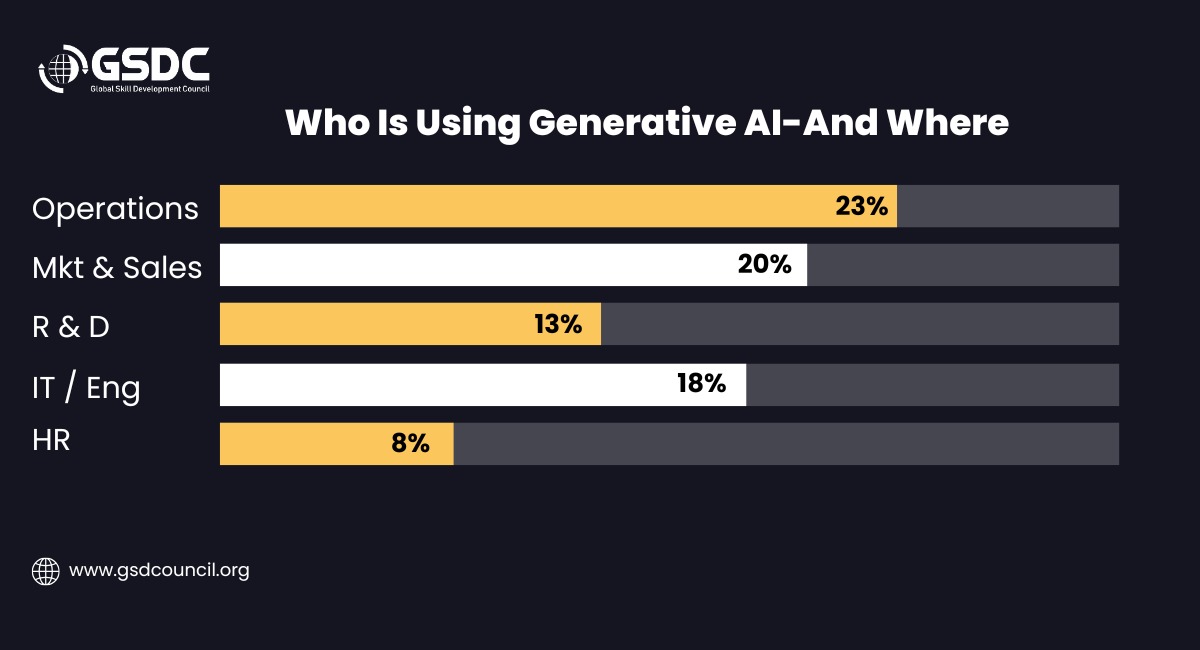
The numbers tell a clear story: generative AI isn't just a tech department experiment anymore. Operations leads adoption because repetitive, document-heavy workflows-drafting communications, summarizing reports, generating responses-map naturally onto what LLMs do well. Marketing follows closely because content creation is both time-intensive and well-suited to AI assistance.
How Generative AI Is Changing Creative Work
It would be intellectually dishonest to talk about how generative AI is changing creative work and pretend the answer is simple. It's complicated, contested, and evolving-but some things are becoming clear.
What's changing most visibly is the cost of a first draft. Writing an initial framework for a marketing brief, a research summary, a lesson plan, or a product description used to take hours. Now it takes minutes. This doesn't replace the human who shapes, refines, fact-checks, and adds judgment-but it dramatically shifts where that human's time goes.
In industries like advertising, content marketing, and publishing, generative AI is primarily functioning as a collaborator rather than a replacement-handling the first-draft, research-synthesis, and variation-generation tasks so that human creatives can spend more time on what still requires a human: originality, cultural resonance, ethical judgment, and the final editorial voice.
Data Point: A Salesforce survey of over 1,000 marketers found that 51% were already using generative AI at work-and of those actively using it, 76% were applying it to content creation and copywriting. Meanwhile, McKinsey data shows that 44% of workers across industries reported using GenAI tools for work tasks in 2024-up sharply from the prior year.
The concern that gets less attention than it deserves: quality homogenization. When millions of writers and designers start using the same handful of models, the risk is that creative output starts converging on the same patterns, the same rhythms, the same visual styles. The competitive advantage in creative work, going forward, increasingly belongs to people who know how to push these tools in unexpected directions-not the ones who use them on autopilot.
What Generative AI Still Can't Do (And Why It Matters)
Every honest explanation of how generative AI works has to include this: the model doesn't understand anything in the way you do. It has no beliefs, no experiences, no awareness of the world outside its training data. It generates text that's statistically likely to follow from the input-which produces outputs that feel intelligent, because human-written text is intelligent, and the model has learned its patterns deeply.
This is the source of hallucinations. When a model doesn't "know" something, it doesn't say "I don't know." It generates text that looks like a plausible answer-because plausible-looking text is literally what it was trained to produce. The fix isn't a smarter model. It's better system design: confidence thresholds, citation requirements, and human review for high-stakes outputs.
Other genuine limitations worth knowing:
1. Knowledge cutoff
Every LLM has a training cutoff date. Events after that date are invisible to the model unless it's given access to external search tools or updated documents.
2. No persistent memory
By default, a model starts fresh every conversation. It doesn't remember what you told it last Tuesday. Architectures like RAG (Retrieval-Augmented Generation) are often used to give models access to relevant context on demand.
3. Inconsistency at scale
A model might answer the same question differently in different sessions, or even within the same conversation if prompted differently. Determinism-consistently getting the same answer to the same question-requires careful system design.
4. No real-world grounding
The model has no sensory experience of the world. Its "knowledge" of what fire feels like, or how a surgical procedure is performed, is purely linguistic. This is why AI works best when human expertise remains in the loop for consequential decisions.
Why AI Literacy Is Becoming a Professional Baseline
In 2024, enterprise generative AI spending hit $13.8 billion-six times what it was the year before. Private global investment in AI overall reached $252 billion, with generative AI drawing nearly 19% more than in 2023. These are not signs of a technology still finding its footing. They're signs of broad deployment-which means the gap between people who understand these tools and people who don't is becoming a real professional differentiator.
You don't need to build models. But you do need to be fluent enough to use AI tools critically, recognize when an output is unreliable, make informed decisions about which tools fit which tasks, and communicate clearly with technical colleagues. That's not a niche skill anymore-it's a baseline.
For professionals who want to build that fluency systematically rather than piecing it together from YouTube videos and Reddit threads, a structured generative AI certification from a recognized institution offers something self-directed learning rarely does: a verified credential, a coherent curriculum that covers foundations through application, and the confidence that comes from actually completing something.
For US Professionals: According to IDC, 72% of enterprise leaders say AI will be the most significant business advantage of the next decade. The organizations positioning their teams with structured AI literacy training now are the ones that will be able to act on that advantage rather than scrambling to catch up when the window has already narrowed.
Putting It All Together: The Flow from Prompt to Response
Let's trace exactly what happens when you type a message into an LLM-based tool-from the moment you hit send to the moment text appears on your screen.
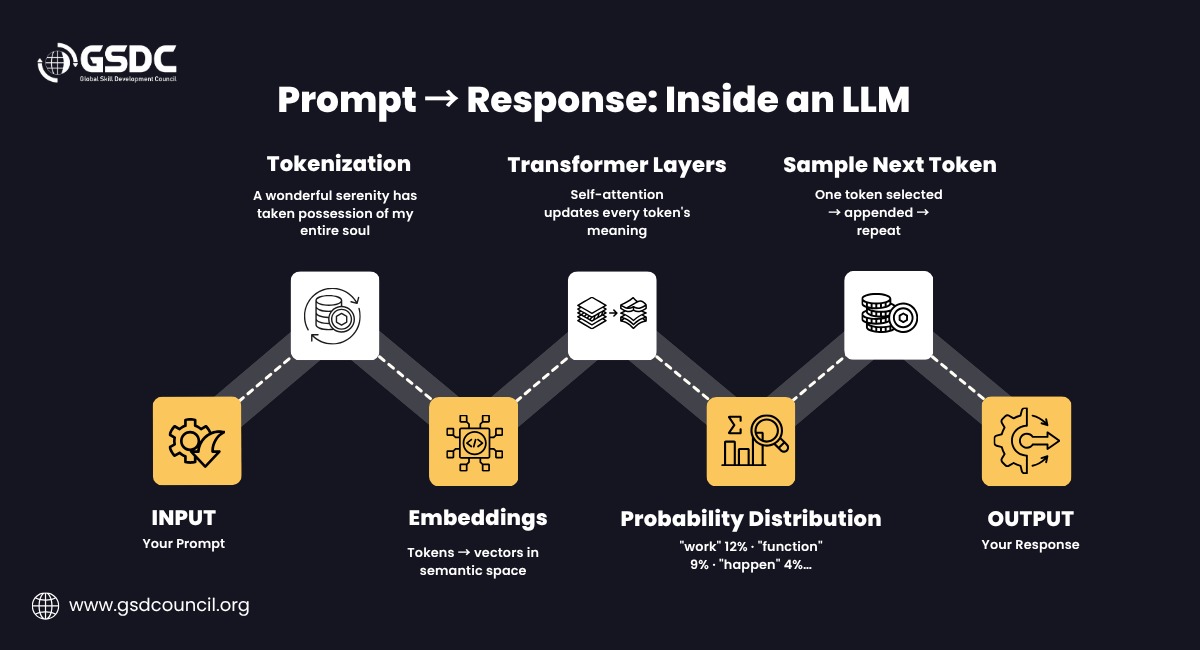
Each step builds on the last. Tokenization breaks language into numbers. Embeddings give those numbers spatial meaning. Transformer layers let meaning evolve based on context. The probability distribution translates all of that into a ranked guess about what comes next. One token gets selected, appended, and the whole cycle runs again-until the model decides the response is complete. That entire loop, across billions of parameters, typically finishes in under a second.
Where to Build That Fluency
Knowing about generative AI and being able to demonstrate that knowledge are two different things. For professionals who want the latter, the Global Skill Development Council (GSDC) offers the Certified Generative AI Professional credential-a structured, globally recognized program built for working professionals, not full-time students.
It covers the foundations this article introduces and takes them further: real-world application, responsible use, and the practical judgment that employers are increasingly hiring for. In a market where "I've used ChatGPT" is table stakes, a recognized certification is how you stand apart.

The Bottom Line
Generative AI is not magic, and it's not a threat from science fiction. It's a specific class of machine learning systems-primarily Large Language Models built on Transformer architecture-that have become remarkably capable at generating fluent, coherent, contextually relevant content because they've been trained on more text than any human could read in a thousand lifetimes.
Understanding how these systems work doesn't make you an AI engineer. But it does make you a sharper user, a more credible collaborator with technical teams, and a better evaluator of the AI tools and claims you'll encounter every day. It also puts you in a position to use these tools in ways that actually improve your work-rather than just offloading tasks to a system you don't trust and can't verify.
The people who thrive in an AI-augmented workplace won't necessarily be the ones who build the models. They'll be the ones who understand what the models can and cannot do-and design their work accordingly.

Related Certifications
Frequently Asked Questions
Generative AI is a type of artificial intelligence that creates new content such as text, images, audio, video, and code. Unlike traditional AI, which focuses on predictions and classifications, generative AI produces original outputs based on patterns learned from large datasets.
An LLM (Large Language Model) is a type of generative AI designed to understand and generate human language. Models such as ChatGPT, Claude, Gemini, and Llama use billions of parameters and vast training datasets to produce contextually relevant text and code.
The difference between LLM and generative AI is that generative AI is the broader category, while an LLM is a specific type of generative AI focused on language tasks. Generative AI can create text, images, audio, video, and code, whereas LLMs primarily generate text and programming code.
Generative AI refers to AI systems that create new content, while an LLM is a language-focused model within that category. Every LLM is a generative AI model, but not every generative AI system is an LLM.
Generative AI works by learning patterns from massive datasets during training. When a user enters a prompt, the model analyzes the input, predicts the most likely next tokens, and generates content using neural networks such as transformers.
Tokens are the basic units that an LLM processes. A token can be a word, part of a word, or a punctuation mark. Generative AI models convert text into tokens before analyzing and generating responses.
Transformers are the architecture behind modern generative AI models. They use self-attention mechanisms to understand relationships between words and context, enabling LLMs to generate coherent and accurate responses.
Generative AI is changing creative work by accelerating tasks such as content creation, brainstorming, design ideation, research summarization, and copywriting. Rather than replacing creativity, it often acts as a collaborator that helps professionals work more efficiently.
Generative AI and LLMs can produce inaccurate information, known as hallucinations. They also have knowledge cutoffs, lack real-world understanding, and may generate inconsistent responses. Human oversight remains essential for high-stakes decisions.
A generative AI certification can help professionals develop structured knowledge, validate their skills, and demonstrate AI literacy to employers. As AI adoption grows across industries, certification can support career growth and credibility in AI-related roles.
Stay up-to-date with the latest news, trends, and resources in GSDC
If you like this read then make sure to check out our previous blogs: Cracking Onboarding Challenges: Fresher Success Unveiled
Not sure which certification to pursue? Our advisors will help you decide!