How Much Do Generative AI Professionals Earn?

Written by Matthew Hale
- What generative AI actually is
- Generative AI salary snapshot: 2026
- AI engineer salary: the most lucrative track
- How experience moves the needle on AI engineer salary
- Top-paying cities for generative AI engineers
- Other generative AI roles: salary at a glance
- Which companies pay the most for AI talent?
- Generative AI certification ROI: does it actually pay off?
- Top generative AI certifications with verified salary data
- Most in-demand generative AI skills in 2026
- Positioning yourself for top pay in 2026
- The bottom line
A generative AI engineer with three years of experience now earns more than most professionals make after a decade in their field. At the top end - senior engineers at NVIDIA, Google, or Apple - total compensation clears $300,000. Even entry-level roles in this space routinely start above $90,000.
Those aren't outliers. They're the going rate for a talent market where demand is growing at 36.7% annually, and qualified candidates are still genuinely scarce. This guide maps exactly what that market pays in 2026 - broken down by role, city, years of experience, and employer - and gives you a straight answer on whether a generative AI certification is worth the investment.
The generative AI market is projected to grow from $20.9 billion in 2024 to $136.7 billion by 2030 - a compound annual growth rate of 36.7%. That's not a trend. That's a hiring mandate.
Those figures come from MarketsandMarkets, and they frame the entire conversation that follows. Growth at that pace doesn't just create generative AI jobs at the top of the engineering ladder - it pulls up salaries across every role that touches AI, from prompt engineers to content reviewers to research scientists.
What generative AI actually is
Generative AI models - built on large language models, diffusion networks, and transformer architectures - can create original text, images, audio, video, and code. Unlike earlier AI systems that classified or predicted, these models generate entirely new outputs by learning the deep patterns within massive training datasets. That technical depth is exactly what commands premium salaries: people who can fine-tune models, build RAG pipelines, or architect agentic systems are operating in a market where demand from finance, healthcare, manufacturing, and media far outpaces supply. That scarcity is salary leverage.
Generative AI salary snapshot: 2026
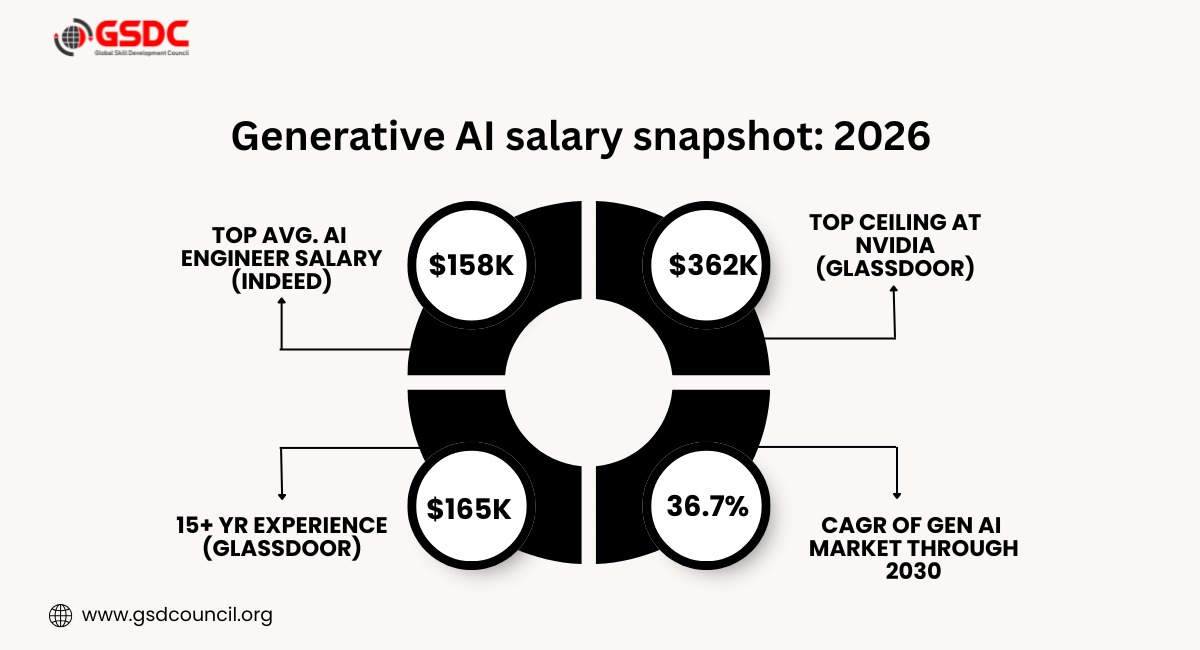
The numbers above set the ceiling. But what does the average person stepping into generative AI jobs actually earn? How much is the gen AI salary? The answer depends heavily on which of the three primary career tracks you're on. Let's go through each one in detail.
AI engineer salary: the most lucrative track
A generative AI engineer designs and builds AI-powered solutions - training pipelines, model integrations, inference optimisation, and increasingly, agentic AI systems that can operate with minimal human input. It's the highest-paid role in the generative AI ecosystem, and for good reason: the technical depth required is substantial.
Three major salary platforms put the average base between $113,939 (Glassdoor) and $158,492 (Indeed), with ZipRecruiter at $115,864. The spread reflects methodology differences - Indeed's figure skews toward senior postings - but the takeaway is consistent: mid-career generative AI engineers clear six figures comfortably, before bonuses or equity.
How experience moves the needle on AI engineer salary
The experience curve in generative AI is steep and rewarding. Glassdoor's salary data by years of experience tells the story clearly. Entry-level engineers with less than a year under their belt earn a median base of around $91,500 - not bad for a starting salary in any field. Those who hit the 15-year mark are clearing north of $165,000 in base pay alone.
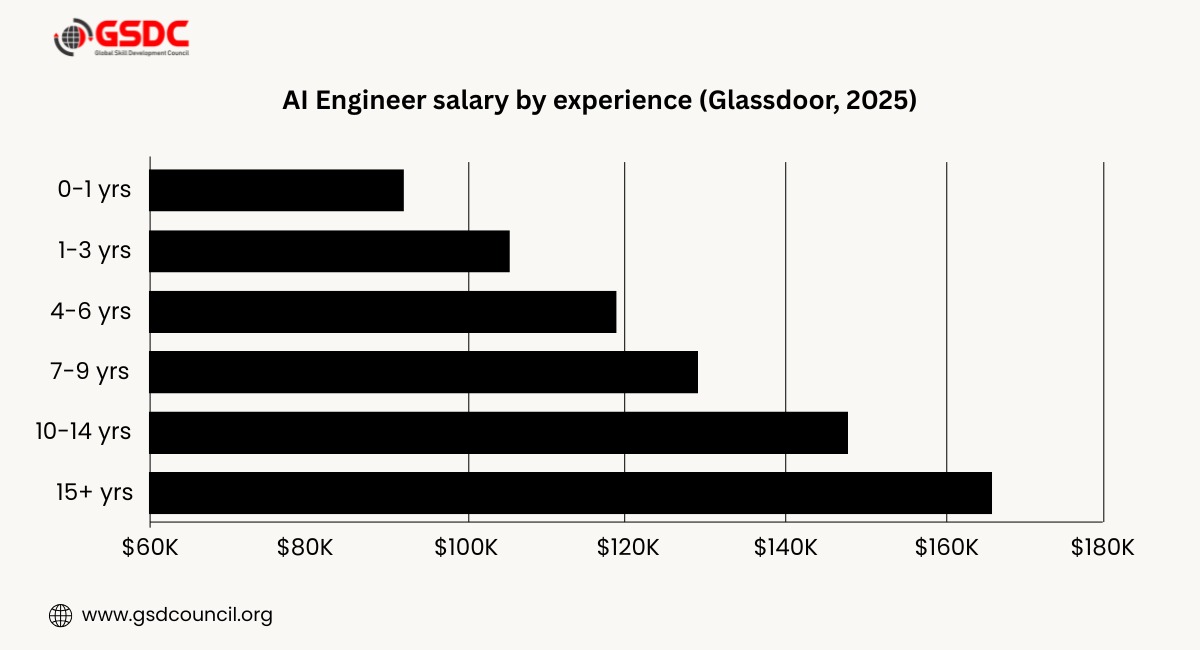
What stands out here is the jump between the 10–14 year band ($147,909) and the 15+ year band ($165,419) - a $17,500 leap. But arguably the most important transition is from 1–3 years to 4–6 years, where the jump of about $13,000 often coincides with moving from a junior or mid-level role into senior territory. That's usually the moment when engineers take on ownership of model pipelines and architecture decisions, which is where real compensation leverage begins.
Top-paying cities for generative AI engineers
Location remains one of the most powerful salary multipliers in tech. California dominates the top-paying cities for generative AI jobs, driven by the density of AI research labs, Big Tech headquarters, and well-funded startups. ZipRecruiter data highlights the cities where generative AI engineers can expect above-average compensation:
# | City | State | Avg. Annual Salary | Market Tier |
1 | Portola Valley | CA | $161,492 | Top Tier |
2 | Nome | AK | $143,729 | High Pay |
3 | Cupertino | CA | $142,947 | Top Tier |
4 | Sacramento | CA | $142,267 | Top Tier |
5 | Berkeley | CA | $141,869 | Top Tier |
6 | Sunnyvale | CA | $138,097 | Top Tier |
7 | Menlo Park | CA | $136,541 | High Pay |
8 | San Francisco | CA | $136,341 | Top Tier |
9 | Santa Clara | CA | $136,076 | Top Tier |
Source: ZipRecruiter, 2025. Base salary data for Generative AI Engineer role.
A note on cost of living: Bay Area salaries are high - but so is rent. San Francisco's $136,341 average buys significantly less housing than the same salary in, say, Austin or Phoenix. Factoring in remote work availability and cost-adjusted compensation is increasingly important when comparing generative AI jobs across locations.
Other generative AI roles: salary at a glance
- Prompt engineers - specialists who design input strategies that extract high-quality outputs from LLMs - earn between $62,977 and $136,573 depending on seniority, per Glassdoor and ZipRecruiter. Entry-level starts around $98,000 and climbs to $155,000+ at 15 years. Notably, Google's prompt engineering roles pay $230,000–$348,000, reflecting how senior this function sits at major AI labs.
- AI writers and content reviewers sit at the more accessible end of the spectrum - averaging $44,400 to $84,150 - though senior trust and safety roles at companies like X (formerly Twitter) reach $133,000–$207,000. Top cities for this role include Berkeley, CA ($103,000) and Sunnyvale, CA ($100,000).
Which companies pay the most for AI talent?
If you're targeting maximum compensation for generative AI jobs, the employer you choose matters enormously - sometimes more than your years of experience. The technology companies leading AI research and deployment are paying significant premiums to attract and retain top talent.
Company | Role | Salary Range (Base) | Standing |
NVIDIA | AI Engineer | $249,000 – $362,000 | #1 Payer |
AI Engineer | $240,000 – $360,000 | Top 3 | |
Apple | AI Engineer | $233,000 – $343,000 | Top 3 |
Meta | AI Engineer | $231,000 – $336,000 | High Pay |
X (Twitter) | AI Engineer | $221,000 – $319,000 | High Pay |
Prompt Engineer | $230,000 – $348,000 | Standout | |
Soul AI | Prompt Engineer | $145,000 – $217,000 | High Pay |
Source: Glassdoor, 2025. Ranges reflect base salary; total compensation including bonuses and equity will be higher.
One number that tends to surprise people: Google's prompt engineer range of $230,000–$348,000 is actually higher than its AI engineer range. This likely reflects the seniority level of the specific prompt engineering roles listed, which at major AI labs often sit at the intersection of research and product - closer to AI research scientist territory than the general "prompt engineer" job title implies.
Generative AI certification ROI: does it actually pay off?
This is the question we get asked most often, and it deserves a straight answer rather than a hedged "it depends."
Here's the honest picture: a generative AI certification on its own doesn't guarantee a salary bump. What it does do - when it's the right certification from a credible provider - is substantially accelerate your ability to land interviews, demonstrate structured knowledge to employers who can't evaluate your informal learning, and qualify you for roles that have explicit credential requirements.
The data behind that claim is now solid. PwC's 2025 Global AI Jobs Barometer - one of the most comprehensive labour market studies ever conducted on this topic, drawing on close to a billion job ads from six continents - found that workers with AI skills command a 56% wage premium over colleagues in similar roles without those skills. That figure has more than doubled in a single year, up from 25% in the prior year's study. The report specifically calls out generative AI proficiency and prompt engineering as among the most premium-generating skills in the current labour market.
For career changers, Certified Generative AI Professional certification is often the fastest credible path into that premium. Someone moving from a non-technical field into a generative AI role doesn't have years to build a portfolio from scratch - a rigorous certification program compresses that learning pathway and provides a signal that hiring managers can act on quickly.
For existing tech professionals, the numbers are similarly compelling. According to Skillsoft's 2024 IT Skills and Salary Survey of over 650 AWS-certified professionals, holders of the AWS Certified Machine Learning – Speciality credential earn an average of $171,725 annually - one of the highest single-certification salary outcomes in the entire IT industry. Industry compensation analyses suggest that recognised AI credentials can be associated with salary increases of approximately $18,000–$22,000 annually for mid-career professionals, though outcomes vary by employer, experience level, and role.
Top generative AI certifications with verified salary data
The generative AI certification landscape has matured considerably. These are the credentials that currently carry measurable weight with hiring managers, backed by published salary data:
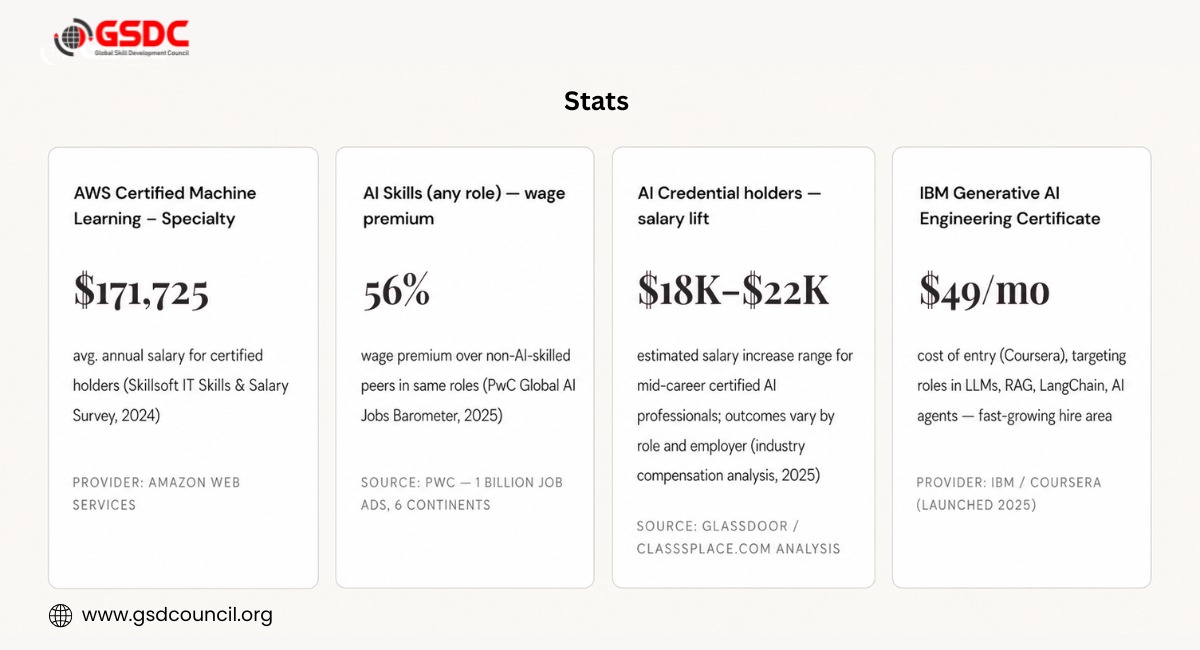
Workers with AI skills like prompt engineering command a 56% wage premium - up from 25% last year - suggesting the value these workers bring is accelerating, not stabilising. - PwC 2025 Global AI Jobs Barometer
The one caveat worth stating clearly: not all certifications carry equal weight. A generative AI certification from a well-established provider with employer recognition - AWS, Google, IBM, GSDC - will have more impact on your earning potential than a short course with a certificate of completion. The depth of the curriculum, the rigour of the assessment, and the brand recognition of the issuing organisation all factor into how much signal the credential sends to a hiring manager.
Most in-demand generative AI skills in 2026
Salary data tells you what the market pays. Skill demand data tells you why - and where to invest your learning time to stay ahead of the curve. These six technical competencies are appearing most frequently in high-paying generative AI job postings in 2026, and collectively represent the core of what employers are willing to pay a premium to hire.
Skill | Market Demand | Why It Matters in 2026 | Relevant Role(s) |
Prompt Engineering | High | Foundation of all LLM interaction; required across nearly every generative AI role | All Roles |
RAG Systems | Very High | Retrieval-Augmented Generation is now the dominant enterprise AI architecture; demand is surging as companies move from prototype to production | AI Engineer, ML Engineer |
AI Agents | Very High | Agentic AI systems that plan, act, and self-correct are the fastest-growing sub-field and command significant salary premiums | AI Engineer, Research Scientist |
LangChain / LlamaIndex | High | Industry-standard orchestration frameworks for building LLM-powered applications; increasingly mentioned in job listings | AI Engineer, Full-Stack AI Developer |
Fine-Tuning LLMs | Very High | Custom model adaptation for domain-specific use cases (legal, medical, finance) remains a high-value specialisation | ML Engineer, AI Research Scientist |
Vector Databases | High | Pinecone, Weaviate, and Chroma power semantic search and RAG pipelines, making them essential AI infrastructure skills | AI Engineer, Data Engineer |
Notice that RAG systems, AI agents, and fine-tuning LLMs all sit at "Very High" demand - and all three are technically non-trivial. That gap between what companies urgently need and what the market can supply is precisely what drives the salary premiums discussed throughout this guide. It's also what makes a structured generative AI certification program valuable right now: the best programs have already updated their curricula to cover these specific competencies, meaning you're not just earning a credential - you're building the exact skill set the market is currently paying the most to acquire.
Positioning yourself for top pay in 2026
The skills table above maps what employers are hiring for. What it doesn't show is how to package those skills into a profile that commands the highest offers.
At the engineering level, Python is table stakes. What separates mid-range candidates from the highest earners is hands-on fluency with cloud ML platforms (AWS SageMaker, Vertex AI, Azure ML) and production experience with agentic frameworks - LangChain, AutoGen, LlamaIndex. Employers can tell the difference between someone who has read about RAG and someone who has shipped it.
For career changers, the most realistic path in 2026 combines a recognised credential with a small portfolio of demonstrable projects - even simple LLM-powered tools built on open-source models carry weight in interviews when explained clearly. On the certification side, the Certified Generative AI Professional from the Global Skill Development Council (GSDC) is worth considering - it covers the applied competencies hiring managers are actively screening for, and carries enterprise recognition across the industries with the highest AI investment: finance, healthcare, enterprise software, and defence. A structured credential doesn't replace hands-on experience, but it shortens the gap considerably for professionals making the transition.

The bottom line
The numbers in this guide tell a consistent story: generative AI is one of the few fields where entry-level pay starts above $90,000, senior roles clear $300,000, and the market is still growing fast enough to absorb new talent at scale. The salary premiums are real, the skill gaps are real, and the window to build differentiated expertise before the market matures is still open - but not indefinitely. The best time to invest in your generative AI skills was last year. The second-best time is now.

Related Certifications
Frequently Asked Questions
Between $113,000 and $158,000 base, depending on seniority and platform. Mid-career engineers clear six figures comfortably. At the top - NVIDIA, Google, Apple - total comp passes $300,000. Entry-level rarely dips below $91,500.
A neural network trains on billions of examples - text, images, code - and learns the patterns. When you give it a prompt, it doesn't look anything up; it generates a response from scratch based on what it learned. Unlike older AI that classified things, generative AI creates. The architecture behind most of it is called a transformer.
The highest-paid: AI Engineer, ML Engineer, AI Research Scientist. Prompt Engineer is growing fast, especially at labs. Non-technical entry points include AI Content Reviewer and AI Writer - senior trust and safety roles at X pay $133K–$207K. Demand is growing at 36.7% annually and supply still can't keep up.
Depends on which one. A short course? Probably not. A rigorous credential from AWS, Google, IBM, or GSDC? PwC's 2025 AI Jobs Barometer found workers with AI skills earn a 56% wage premium - a figure that doubled in one year. For career changers, a recognised cert compresses years of portfolio-building into something a hiring manager can act on fast.
Building training pipelines, fine-tuning models for specific domains, setting up RAG architectures, and increasingly building agentic systems - AI that plans, acts, and self-corrects. Python is assumed. The premium goes to people who've shipped these in production, not just prototyped them in a notebook.
Content and code generation that took days now takes hours. Document processing, personalisation at scale, fraud detection, drug discovery - real productivity gains across industries. The caveat: companies with solid data infrastructure are seeing the benefits. Companies that bolted an AI tool onto a broken workflow are not.
Generally less - $63,000 to $155,000 - but at the top end it flips. Google's prompt engineering roles pay $230,000–$348,000, higher than its AI engineering range. At major labs, the role overlaps with research. The title can be misleading; pay attention to where it sits in the org.
Portola Valley, CA leads at $161,492, followed by Cupertino and San Francisco in the $136K–$143K range. California dominates - but Bay Area rent is brutal. A $136K SF salary and a $110K Austin salary can leave you better off in Austin. If remote is an option, compare cost-adjusted pay, not raw numbers.
Start with prompt engineering - it's the foundation, and you can practice it today. From there: RAG systems, AI agents, and fine-tuning LLMs are the skills commanding the biggest premiums. Python is assumed. LangChain and LlamaIndex are what employers actually use in production - learn those first.
For career changers: the GSDC Certified Generative AI Professional covers what hiring managers actually screen for - RAG, agents, fine-tuning, prompt engineering. For those already in tech: AWS Certified ML – Specialty holders average $171,725/year, the highest single-cert outcome in IT. Either way: the cert opens the door, a portfolio closes the interview.
Stay up-to-date with the latest news, trends, and resources in GSDC
If you like this read then make sure to check out our previous blogs: Cracking Onboarding Challenges: Fresher Success Unveiled
Not sure which certification to pursue? Our advisors will help you decide!