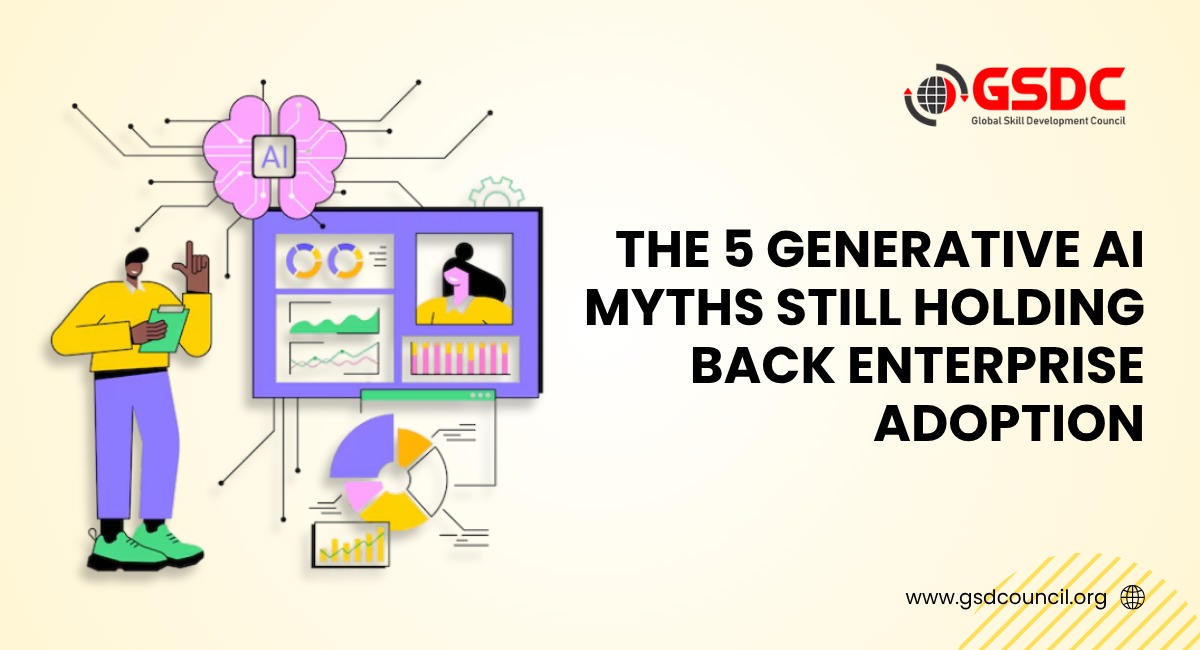
The 5 Generative AI Myths Still Holding Back Enterprise Adoption
Written by Matthew Hale
- 01 - The Myth: "AI is going to replace all our engineers. We should stop hiring."
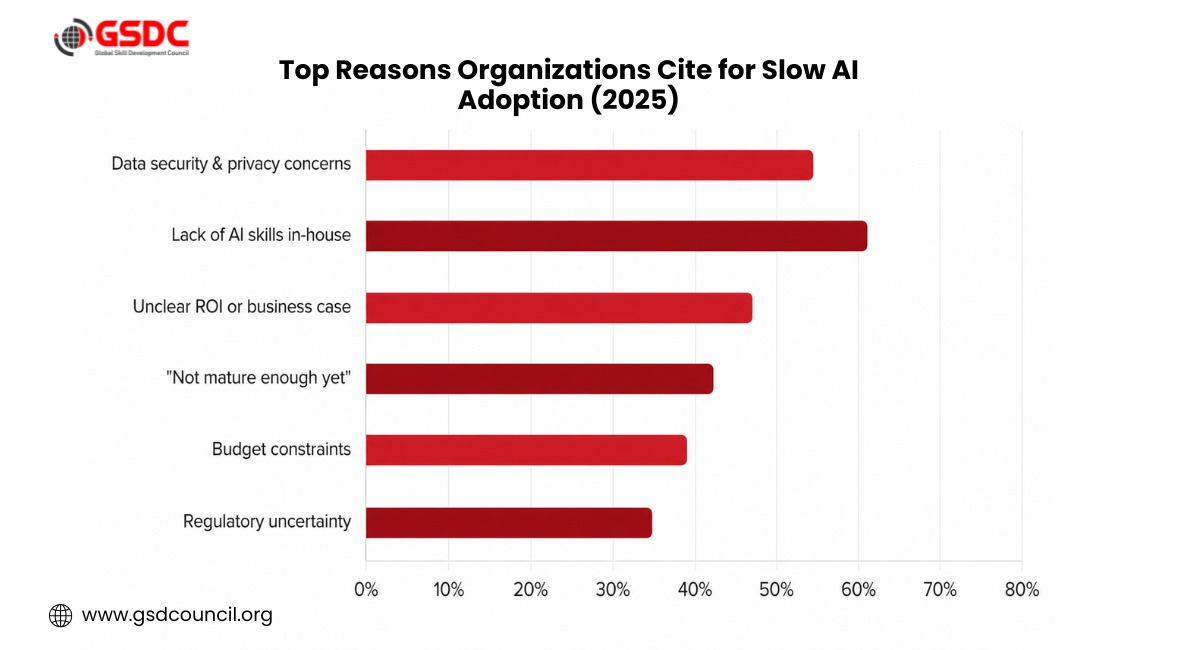
- 02 - The Myth: "We can't use generative AI - our data is confidential."
- 03 - The Myth: "You can't trust it - it just makes things up."
- 04 - The Myth: "AI is only for Big Tech. We don't have the budget or the data."
- 05 - The Myth: "Let's wait until the technology matures before we commit."
- Real-World Proof: A Common Enterprise AI Adoption Pattern
- The Quick-Reference Guide: Myth, Truth, and What to Say
- Closing the Knowledge Gap: GSDC's Certified Generative AI Professional
- What This Means for Your Career - and Why the Certification Gap Is Real
There's a specific kind of frustration that comes from sitting in a meeting where someone in a leadership position confidently states something about AI that you know isn't true. And then decisions get made around it. Budgets get cut. Pilots get killed. Talent leaves.
This isn't about leadership being uninformed - it's about a technology that has moved so fast that even experienced leaders are working from mental models two or three cycles out of date. The generative AI myths circulating in boardrooms in 2026 aren't malicious. They're just stale - and they're costing organizations real money and real competitive ground.
For every myth below, we'll give you the actual evidence, the nuance that matters, and a way to frame the correction that moves the room - not wins the argument, because the goal isn't to be right. It's to get the organization moving.
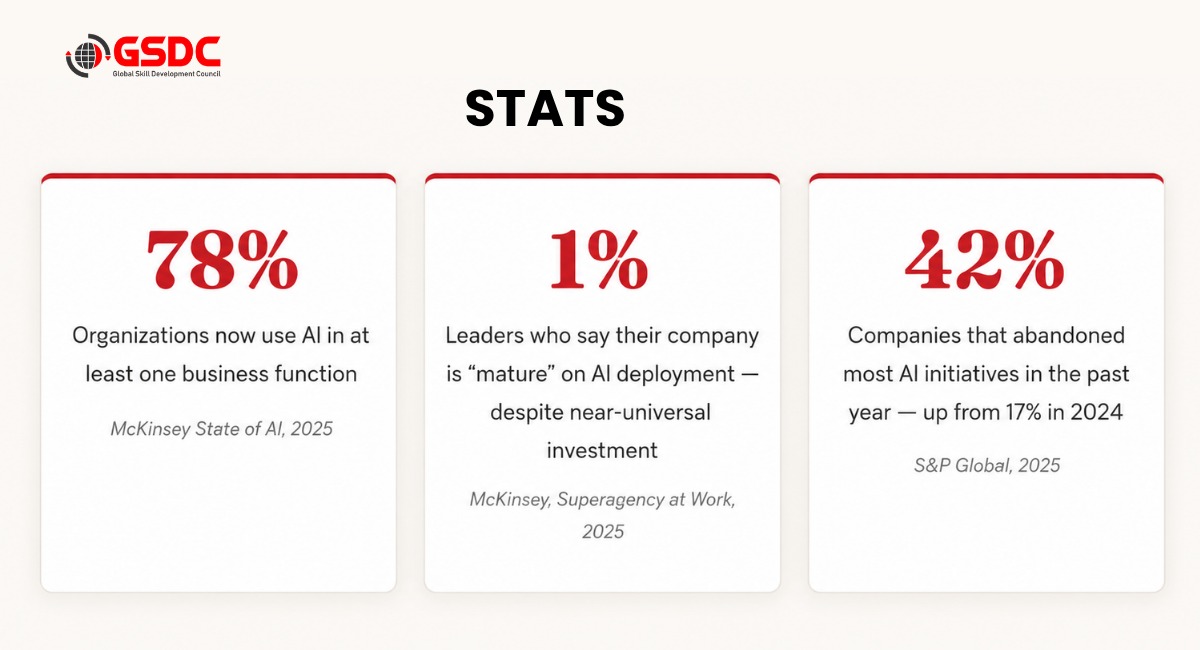
AI is near-universally adopted, yet almost no one feels they're doing it well. The gap between potential and reality isn't a technology problem. It's a belief problem. And beliefs live in the boardroom.
These myths don't exist in isolation. They influence hiring decisions, technology investments, governance policies, and ultimately an organization's ability to compete. Let's examine each one.
01 - The Myth: "AI is going to replace all our engineers. We should stop hiring."
GitHub Copilot writes code. OpenAI's Codex agent submits pull requests. Nervous cost-cutting makes a compelling case for reading those headlines literally.
The U.S. Bureau of Labor Statistics projects software developer employment will grow 17% between 2023 and 2033 - "much faster than average" and more than four times the growth rate for all occupations. AI is compressing certain tasks, not eliminating the role.
Stack Overflow's 2025 Developer Survey found 84% of developers are using or planning to use AI tools - yet engineering headcount has held steady or grown at most organizations. What has shrunk: junior and entry-level positions. What has grown: demand for engineers who can orchestrate AI systems, review AI outputs, and govern AI-assisted workflows. A 2025 ACM study on experienced open-source developers found AI tools actually increased implementation time by 18% on complex tasks - the opposite of the replacement narrative. System design, distributed debugging, and security architecture remain firmly human territory, and they're becoming more valuable, not less.
The Reality: AI transforms what engineers do, not whether organizations need them. Stop hiring and you'll have no one to design, govern, or maintain the AI systems you're betting the business on.
How to frame it: "The BLS projects 17% growth in software development roles through 2033. AI changes what engineers do, not whether we need them. Cutting junior hiring today means no senior engineers in five years."
02 - The Myth: "We can't use generative AI - our data is confidential."
The 2023 Samsung incident - where engineers pasted proprietary source code into ChatGPT, and it became training data - was real, got significant press, and lodged itself in leadership memory. In its early form, this concern wasn't entirely wrong.
That was three years ago. What exists now: enterprise agreements with OpenAI, Microsoft, Google, and Anthropic that contractually guarantee your data is not used for model training. Zero data retention modes. On-premises and private cloud options. Azure OpenAI, Amazon Bedrock, and Google Vertex AI all offer enterprise-grade data isolation as baseline features - not add-ons. A 2025 Elastic survey found 93% of C-suite executives have already deployed or are planning to invest in generative AI - many in financial services, healthcare, and legal, where confidentiality requirements are far more stringent than most enterprises.
Generative AI risks around data are real - but they're implementation risks, not inherent technology risks. The meaningful question isn't "can we use AI with our data?" It's "have we put the right governance guardrails in place?" That's a solvable organizational problem.
The Reality: Enterprise-grade deployments with contractual data protection and private cloud options are now standard. The risk isn't "we can't use AI." It's "we'll fall behind while competitors implement it properly."
How to frame it: "The concern was valid in 2023. Today, Azure OpenAI, Amazon Bedrock, and Google Vertex all offer data isolation and zero retention by contract. Would it help if I pulled together a one-pager on what our governance setup would look like?"
03 - The Myth: "You can't trust it - it just makes things up."
This one has the strongest factual foundation of any myth on this list. Hallucinations are real, and any honest person working with these tools has encountered them. The misconception isn't that hallucinations exist - it's the conclusion that generative AI therefore can't be trusted professionally.
Hallucination rates vary enormously by task type. Summarizing a document you've provided, drafting an email from clear instructions, or generating code from explicit requirements produces far more reliable results than asking a model to recall facts from memory. Matching task to tool strength is basic implementation discipline.
Enterprise deployments in 2026 use Retrieval-Augmented Generation (RAG) as standard practice - connecting the model to verified, organization-specific knowledge bases before generating outputs. This significantly reduces hallucination rates. And an NBER study by Brynjolfsson, Li & Raymond found that in a 5,179-agent customer service environment, generative AI increased issue resolution rates by 14% per hour and reduced handling time by 9% - in production, not a lab, with human review and output governance in place.
Every professional tool has failure modes. The question isn't "is this tool perfect?" - it's "does it produce better outcomes than the alternative, with appropriate verification processes?"
The Reality: Hallucinations require real mitigation - human review, RAG, task-appropriate use cases. But "it sometimes makes mistakes" describes every tool and every human.
How to frame it: “That's why responsible deployment always includes human review and RAG-based grounding. The Stanford/NBER research showed 14% better resolution rates at scale with those guardrails. The risk isn't the technology - it's deploying it without governance."
The boardroom myths about AI aren't stopping AI from advancing. They're just stopping your organization from advancing with it.
04 - The Myth: "AI is only for Big Tech. We don't have the budget or the data."
Training GPT-4 reportedly cost over $100 million. The AI press narrative has centered on Google, Microsoft, and OpenAI. "AI is not for us" follows naturally - from the wrong frame of reference.
Organizations don't train foundation models - they use them. Understanding what generative AI is and how it works clarifies the economics immediately. A ChatGPT Team subscription starts at $30 per user per month. GitHub Copilot costs $19 per developer per month. GPT-4o API access costs fractions of a cent per query at most enterprise usage volumes. McKinsey sizes the long-term AI opportunity at $4.4 trillion in productivity potential - captured not just by Big Tech, but by mid-market manufacturers, regional law firms, and healthcare networks that deployed without building anything from scratch.
The "we don't have the data" concern is similarly misaligned. Most generative AI applications that create business value don't require proprietary training data. They require clear task definitions, good prompts, and processes that integrate AI outputs with human judgment. What's expensive is doing nothing while competitors gain 18 months of operational learning you'll eventually have to close.
The Reality: The cost of using AI is dramatically different from building it. The barrier to entry has never been lower - the barrier to organizational change is the real challenge.
How to frame it: "We don't need to build anything. A GitHub Copilot seat costs less than a developer's hourly rate. The question isn't whether we can afford it - it's whether we have a deployment strategy that captures real value."
05 - The Myth: "Let's wait until the technology matures before we commit."
This is the most important myth because it sounds like prudence. Waiting for technology to mature is a sound strategy in many contexts. The problem is applying it to a technology already in production at 78% of organizations globally.
Waiting has a cost that "wait-and-see" framing consistently underweights. McKinsey found organizations reporting significant financial returns from AI are twice as likely to have redesigned end-to-end workflows first - organizational learning that takes 12 to 18 months of iteration and cannot be shortcut later. Gartner projects more than 80% of enterprises will have deployed GenAI-enabled applications by 2026, up from less than 5% in 2023. The organizations that built deployment capability and governance processes in 2023 and 2024 now have a structural advantage late movers will struggle to close.
There's also a talent dimension the waiting strategy consistently underestimates. The professionals who understand how to evaluate, deploy, and govern generative AI systems are being hired by competitors right now. Many of them hold credentials like the Certified Generative AI Professional that signal structured, cross-functional expertise - not just tool familiarity. The longer an organization waits, the more that gap widens - and the generative AI ethics and governance expertise that regulators increasingly require doesn't appear overnight.
The S&P Global finding that 42% of companies abandoned most AI projects in 2025 is a warning about implementation without strategy - not an argument for waiting. The answer to failed AI projects isn't waiting longer. It's planning better.
The Reality: "Waiting for maturity" now means waiting while competitors build 18 months of operational learning and talent capability you'll eventually need to close.
How to frame it: "I'm not proposing we rush - 42% of AI projects failed in 2025 because they lacked strategy. I'm proposing we start planning now so we're not 18 months behind in 12 months."
Real-World Proof: A Common Enterprise AI Adoption Pattern
Research statistics are compelling. Stories are what move rooms.
In 2024, a mid-sized regional bank in the U.S. Midwest faced a familiar bottleneck: commercial lending officers spent up to 40% of their time reviewing and summarizing loan documentation - a process that was slow, inconsistent, and expensive. IT leadership initially blocked any AI pilot citing data security concerns. Sound familiar?
After the compliance team reviewed enterprise contract terms with their cloud provider - specifically the zero-retention and private-instance options available through Azure OpenAI - the bank ran a 90-day pilot using a RAG-based document review system trained on nothing but the bank's own verified loan policy documents.
The result: document review time dropped by roughly 60%. More importantly, consistency improved - junior officers were flagging the same risk criteria as senior ones, reducing variability in credit decisions. The security concern that had blocked the initiative for 18 months turned out to be solvable in three weeks once someone sat down with the actual contract terms.
This is what "planning better" looks like in practice. Not a $10 million AI transformation. A scoped pilot, a solved governance question, and a measurable result that gave leadership something to point to. It's also the kind of deployment pattern - governed, scoped, and grounded in verified data - that the Global Skill Development Council (GSDC) trains professionals to design and execute through the Certified Generative AI Professional program.
The Quick-Reference Guide: Myth, Truth, and What to Say
The Myth | The Evidence | What to Say |
"AI will replace our engineers" | BLS projects 17% growth in dev roles through 2033; AI compresses junior tasks, not senior roles | AI changes what engineers do - we still need them to run what AI builds |
"Our data is too sensitive" | Enterprise contracts with Azure, Bedrock, Vertex provide zero-retention data isolation as standard | The 2023 risk was real; the 2026 enterprise tooling resolves it by contract |
"It just makes things up" | RAG deployments + human review = 14% productivity gain in production (McKinsey/Stanford) | Hallucinations are manageable with governance; every tool has failure modes |
"We can't afford it" | API access costs fractions of a cent per query; Copilot = $19/month per developer | We're not building AI - we're using it. The cost model is SaaS, not R&D |
"Let's wait until it matures" | 78% of orgs already deployed; McKinsey: early movers are 2x more likely to see ROI | Waiting isn't safe - it's a decision to fall behind while competitors learn |
Closing the Knowledge Gap: GSDC's Certified Generative AI Professional
The conversations in this article don't end in the boardroom. They end in hiring decisions, budget approvals, and - increasingly - regulatory filings.
The Global Skill Development Council (GSDC) built the Certified Generative AI Professional credential for exactly this moment: professionals who need structured, recognized expertise in AI adoption, generative AI ethics, governance frameworks, and business value - not just tool familiarity.
It's vendor-neutral, globally recognized, and designed for the practitioners who are already in these rooms, trying to move organizations forward.

What This Means for Your Career - and Why the Certification Gap Is Real
If you're the person in the room who knows how generative AI works, how its limitations are managed, and what responsible deployment looks like - you have a genuine organizational advantage. But it needs to be legible to the people making hiring and promotion decisions.
The roles emerging right now - AI Strategy Lead, Generative AI Product Manager, AI Governance & Ethics Officer, LLMOps Engineer - didn't exist five years ago. They're hard to fill because the skill combination is rare: technical enough to evaluate RAG implementations and LLM outputs, strategic enough to build a business case and navigate frameworks like the EU AI Act. Organizations are actively hiring for that intersection - and struggling to find it.
Why is generative AI important in 2026? Because it sits at the intersection of every major business function. The professionals who can bridge technical capability with strategic decision-making are among the most in-demand in the market - and a recognized credential is one of the clearest ways to signal you're one of them.

Related Certifications
Frequently Asked Questions
That AI will replace engineers, that it's too risky for confidential data, that hallucinations make it unusable, that only Big Tech can afford it, and that waiting is the safe move. All five are outdated - and all five are costing organizations competitive ground.
No. AI is compressing certain tasks - particularly junior-level work - but demand for engineers who can design, govern, and maintain AI systems is growing, not shrinking. The role is transforming, not disappearing.
The genuine risks are implementation risks: poor data governance, deploying without human review, mismatched use cases, and absence of organizational guardrails. These are solvable problems - not reasons to avoid the technology entirely.
Hallucinations are the most cited - confidently generated false information. Others include sensitivity to prompt quality, gaps in complex reasoning, and weaker performance on highly specialized domains. Most are manageable with RAG, human review, and task-appropriate deployment.
Not in any near-term, meaningful sense. The more relevant concern for organizations in 2026 is competitive: businesses that adopt AI thoughtfully will outperform those operating on outdated assumptions about what it can and can't do.
Generative AI refers to models that produce new content - text, code, images - based on patterns learned from large datasets. Enterprise deployments typically use Retrieval-Augmented Generation (RAG) to connect these models to verified internal knowledge bases, grounding outputs in organization-specific data.
Because AI outputs affect real decisions - hiring, lending, customer service, compliance. Without governance frameworks covering bias monitoring, data privacy, and output auditing, organizations expose themselves to regulatory and reputational risk. The EU AI Act and NIST framework are the two most referenced standards in enterprise contexts.
The near-term future is agentic AI - systems that take multi-step actions autonomously, not just generate responses. Organizations building governance infrastructure and deployment experience now will be far better positioned to adopt these more powerful systems safely.
It sits at the intersection of every major business function - operations, finance, legal, HR, product. The organizations treating it as a strategic capability rather than an IT experiment are pulling ahead. Those waiting are falling behind.
A generative AI certification - such as the Certified Generative AI Professional from the Global Skill Development Council (GSDC) - validates structured knowledge across AI deployment, ethics, governance, and business value. For professionals navigating AI strategy conversations, it's one of the clearest ways to signal that combination of technical and strategic fluency to employers.
Stay up-to-date with the latest news, trends, and resources in GSDC
If you like this read then make sure to check out our previous blogs: Cracking Onboarding Challenges: Fresher Success Unveiled
Not sure which certification to pursue? Our advisors will help you decide!