PMO Explained: How Project Offices Improve Business Results
Written by Matthew Hale
- What Is a PMO and Why It Matters in Modern Organizations
- Types of PMO in Organisations
- Why Companies Need A PMO
- How the Role of PMO Has Changed
- How PMOs Add Real Business Value
- Tools That Make PMOs More Powerful
- Why Building a Career in PMO Matters
- Strengthening PMO Leadership Capabilities with GSDC
- Final Thoughts
Projects fail quietly every day - not because teams lack talent, but because no one is steering the bigger picture. Recent industry research shows that organisations with a PMO achieve a higher project success rate - around 65% compared to 56% in organisations without one - proving that structured governance truly improves outcomes.
This blog explains what does PMO mean, what is PMO, and what does PMO stand for, and shows how a modern Project Management Officer connects strategy with execution. You’ll learn how today’s PMO sets priorities, validates every project management business case, and ensures that project investments are aligned with business goals - turning scattered project activity into measurable business growth.
What Is a PMO and Why It Matters in Modern Organizations
PMO stands for Project Management Office. It is a central organisational function that manages, prioritises, and governs projects so that all initiatives support business objectives and deliver measurable value.
A well-structured PMO ensures that projects are selected based on strategic relevance, teams apply consistent and proven methods, leadership receives clear visibility into progress, and outcomes stay aligned with business goals. This is the modern project management office description followed by high-performing organisations.
Types of PMO in Organisations
Different models of operation exist for PMOs, from organisational maturity and industry complexity down to the expectations of leadership.
Choosing the right PMO structure helps ensure the strength in governance matches the needs of the business, without creating unnecessary bureaucracy.
- Supportive PMO: At the centre of a supportive PMO is a repository of collective knowledge that includes a variety of templates, best practices, tools and advisory services, which teams can access freely to execute their projects.
Example: An up, and, coming information technology service company can benefit from a supportive PMO in that it can help disseminate project templates and learnings, even though each team chooses to work with their own delivery methods.
- Controlling PMO: A controlling PMO ensures that governance standards, reporting requirements, approval workflows, and compliance checkpoints are rigorously followed.
Example: A banking organisation may have a controlling PMO whose primary function is to handle the risk, audit, and regulatory parameters for each project.
- Directive PMO: A directive PMO takes control of project delivery by directly appointing project managers and taking ownership of delivery accountability.
Example: A large infrastructure company may have a directive PMO that centrally manages all high-value construction projects to tightly control cost, timelines, and quality.
Understanding these PMO models helps organisations choose the right governance approach.
GSDC supports PMO professionals in building the leadership and governance capabilities required for modern PMO roles.
Why Companies Need A PMO
Organisations adopt PMO as it directly solves some perennial issues that create an issue for project success.
Recent research shows that structured project governance significantly improves performance, making the case for a PMO stronger than ever.
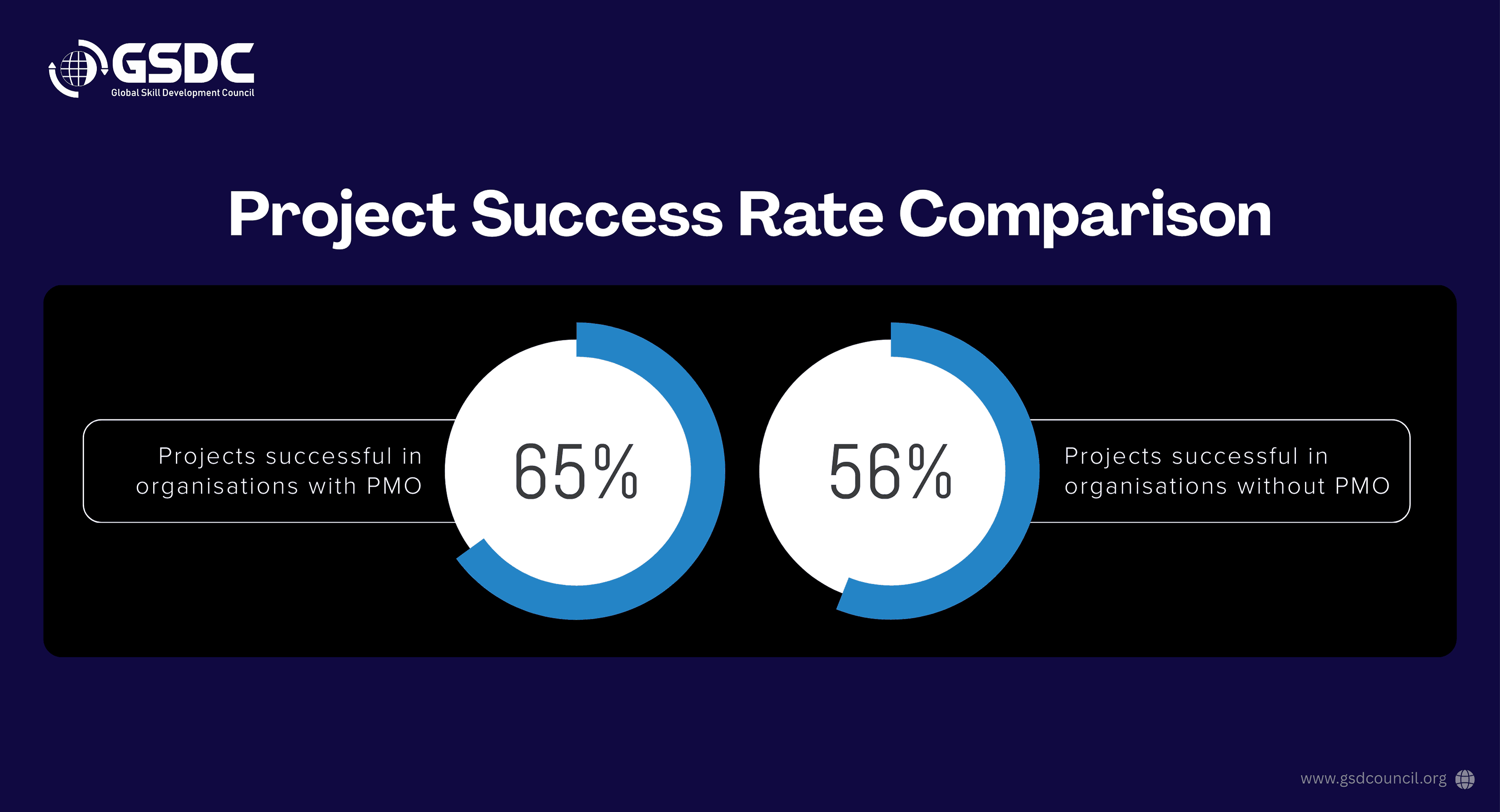
- Improves Project Success Rates: Organisations with a dedicated PMO achieve higher project success rates - about 65% compared to 56% for organisations without one - demonstrating that a structured approach directly contributes to better outcomes.
- Reduces Delays and Budget Overruns: A PMO standardises processes and monitoring, which leads to better delivery predictability.
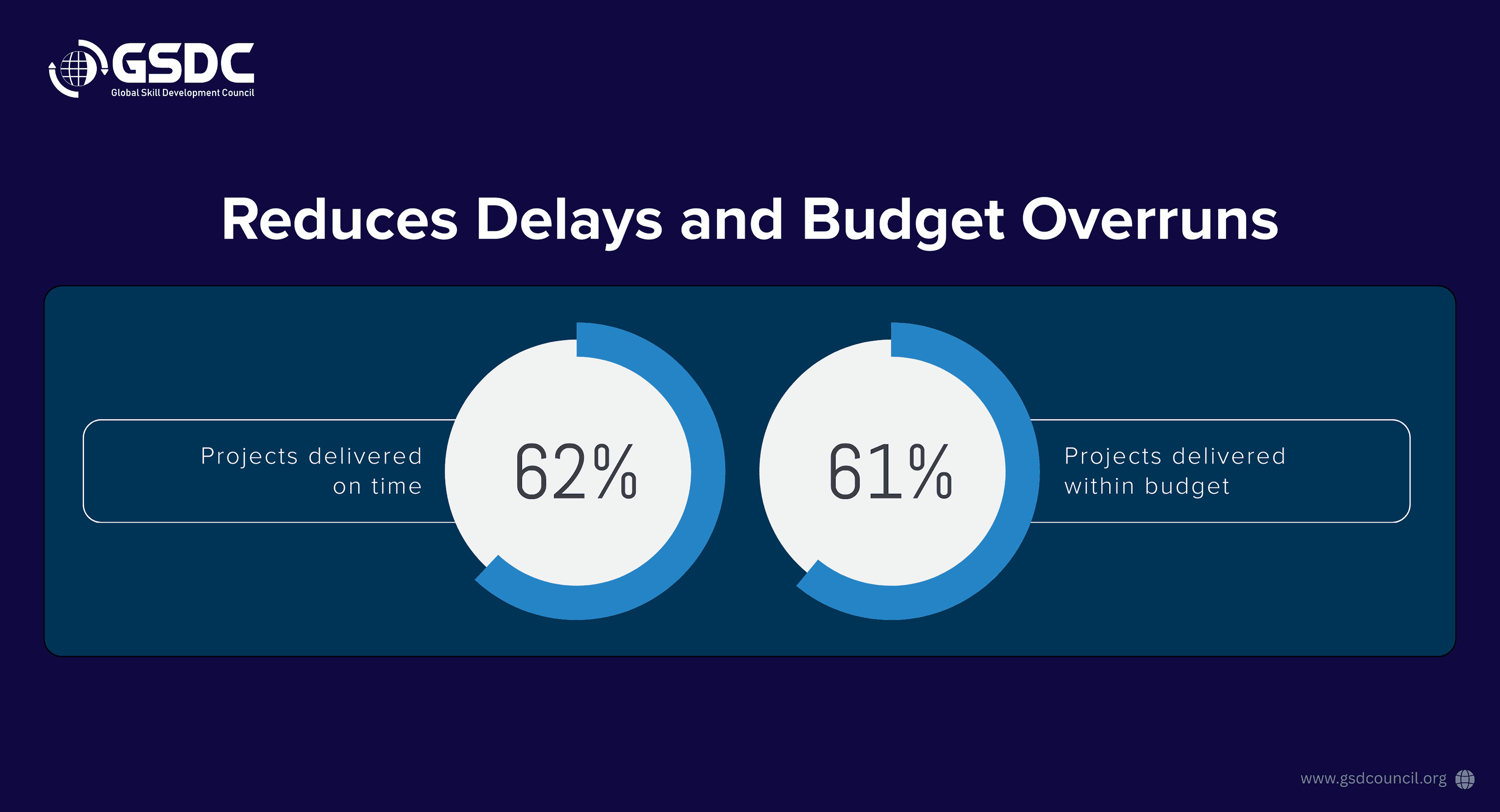
Research evidence indicates that well-governed projects in organisations deliver 62% on time and 61% in budget, thus demonstrating the impact of having a central point of control over project delivery.
- Clarifies Priorities and Direction: Without a PMO, organisations often struggle with unclear priorities, leading to wasted effort on low-value initiatives. A PMO helps align project work with strategic goals, reducing confusion and ensuring resources are focused on the most important work.
- Strengthens Control and Visibility: Unchecked projects are usually not transparent, so leaders have trouble figuring out progress or stepping in quickly.
A PMO provides structured reporting, enabling better decision-making and proactive risk management.
These benefits illustrate why project management in an organisation is not just an administrative team activity but an essential performance and strategy-forcing agent in any organisation.
Experts wanting to have specialisation in this area could add credibility through recognised PMO certification courses.
How the Role of PMO Has Changed
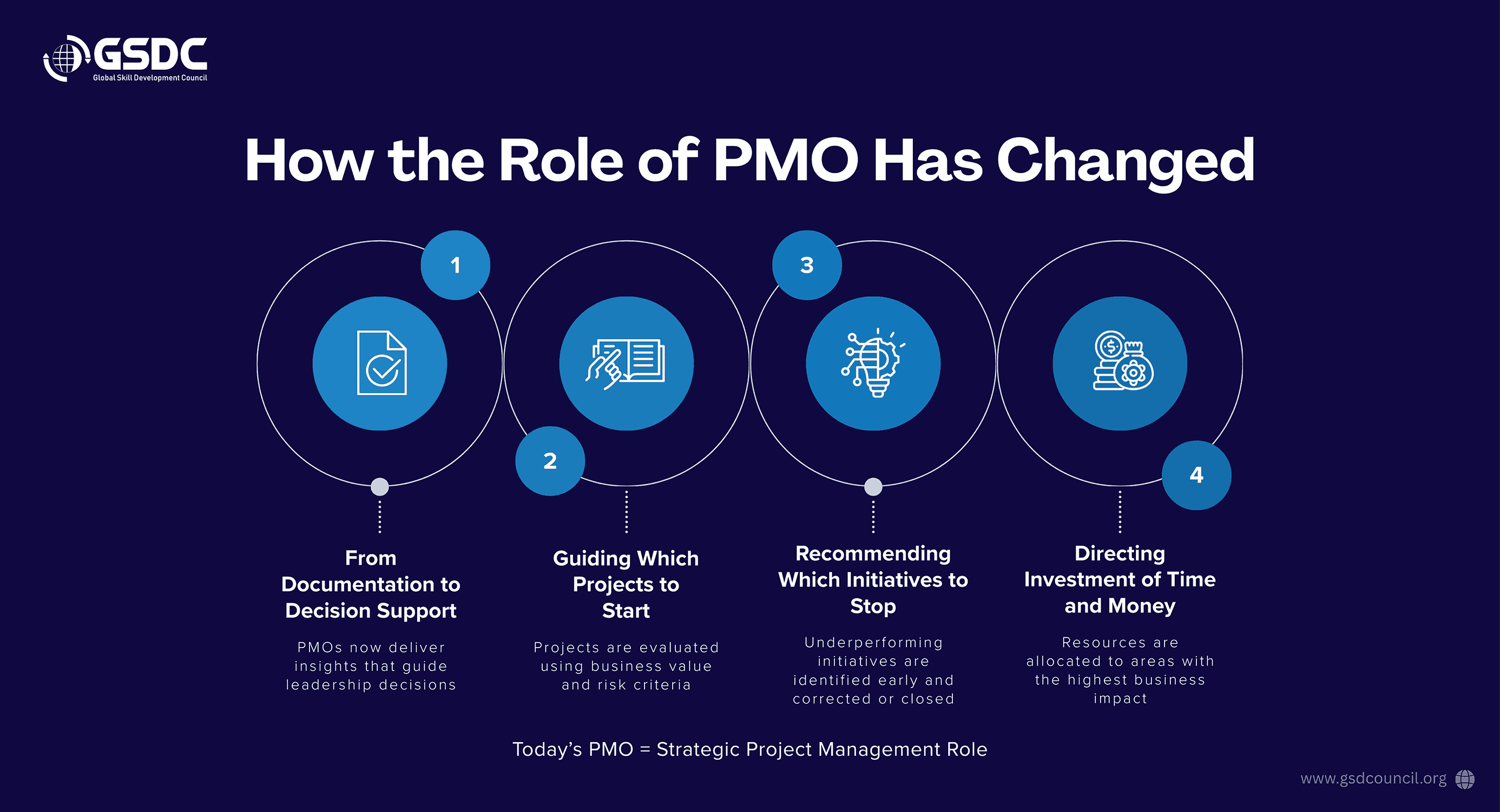
- From Documentation to Decision Support: Earlier PMOs mainly maintained project documents and tracked schedules. Today, they provide leadership with structured insights that support strategic decision-making.
- Guiding Which Projects to Start: A modern PMO evaluates the importance of a company and the risk of various projects, and hence, only the ones which are closely aligned with the strategy are allowed to proceed.
- Recommending Which Initiatives to Stop: In case a project is not able to meet the target, the PMO uses objective data gathered from the performance of the project to recommend changes and, if necessary, termination of the project.
- Investing in Time and Money: Performance trends and resource use data allow the PMO to provide a guide for management regarding where their highest business return has been achieved.
The paradigm change has reshaped the PMO into a strategic project management in buisness position rather than simply an administrative support role.
How PMOs Add Real Business Value
A high-performing PMO does far more than manage schedules - it acts as a strategic engine that converts organisational effort into measurable business outcomes. This value is delivered through four core capabilities.
- Linking Projects to Business Goals: Every initiative should be backed by a strong project management business case that clearly defines expected benefits, costs, risks, and alignment with business strategy. In practical terms, what is a business case in project management? It is the foundation for approving or rejecting a project and ensures that resources are committed only to initiatives that create measurable organisational value.
- Selecting the Right Projects: Not all projects require funding. The PMO is heavily involved in prioritisation activities with senior executives and the project management business analyst in order to avoid dilution of resources and maintain the organisation’s focus on high-value projects.
- Creating a Project Management Office Framework: A general project management office framework will outline the structures and forms of reporting and approval that will ensure that there is consistency throughout the project process.
- Improving Processes of Project Management Office: A well-structured process of a project management office helps to ensure efficient risk management, performance measurement, and an enhancement of delivery performance.
📘 Download the PMO Strategy Toolkit
Tools That Make PMOs More Powerful
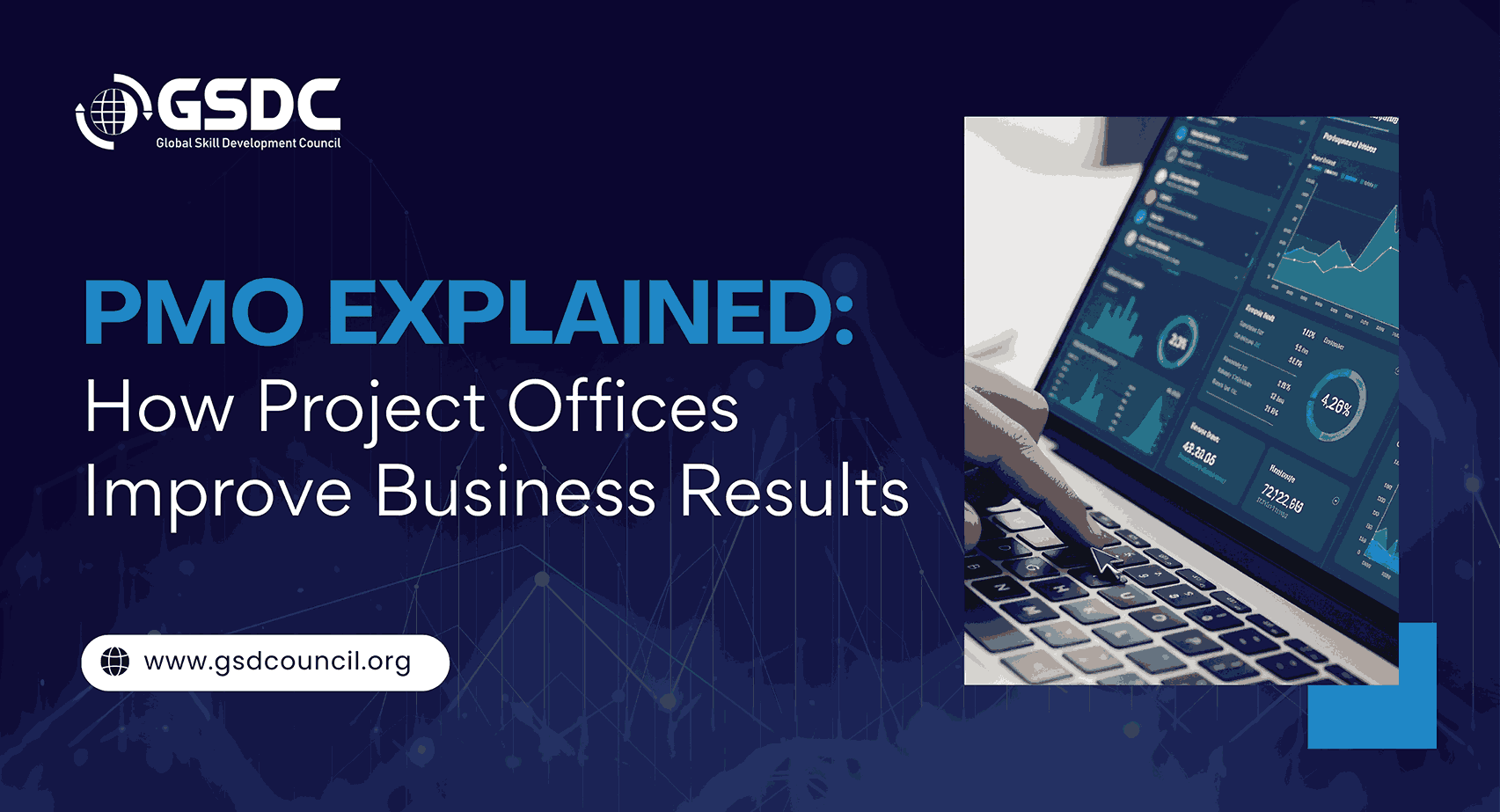
PMOs in today's world cannot do without digital technologies, which have made it possible for them to move away from paper-based reporting to real-time performance management.
- Project Performance Tracking: One of the advanced project management tools and techniques is the ability to track timelines and budgets. These projects give the PMO live data on project performance.
- Project Performance Tracking: One of the advanced project management tools and techniques is the ability to track timelines and budgets. These projects give the PMO live data on project performance.
- Providing Leadership Dashboards: These dashboards help the leaders to quickly and easily understand critical data by interactively and graphically presenting it, thus making the decision-making process fast and well-informed.
- Increasing Decision-Making Speed: Such tools bring together all the project-related data in one place, thus doing away with the need to guess, and consequently, the decision-making process gets faster.
These features collectively present a dossier of capabilities that make routine reporting a thing of the past, as PMOs can now generate actionable insights that are the direct support of business outcomes.
Why Building a Career in PMO Matters
As organisations invest more in structured project delivery, PMO roles are becoming essential to how businesses operate. Today’s PMO professionals work closely with leadership, influence investment decisions, and help convert organisational strategy into execution.
- Recognised Skills Create Trust: Globally recognised credentials play an important role in building professional credibility. Understanding what a project management professional certification is helps explain how these qualifications validate a professional’s ability to manage complex projects in real business environments and make sound decisions beyond basic process adherence.
- PMO Certification Builds Organisational Influence: A well-designed PMO certification strengthens capabilities in portfolio governance, risk oversight, and delivery optimisation, positioning professionals as key contributors to enterprise-wide performance rather than functional support resources.
- Clear Path to Senior Positions: With experience and proper credentials, individuals have the opportunity to advance to senior positions such as project management officer, PMO lead, or portfolio manager. Such roles define and inform how organisations view initiatives and pursue strategic goals.
Thus, PMO has proven not to be a support function, but rather a career path within the business world that has earned respect.
Strengthening PMO Leadership Capabilities with GSDC
With the growing use of digital tools in PMOs, the need for professionals to upskill and reskill to keep pace with the changing demands of the new world organisation has increased. The demands on the PMO, in terms of their deliverables, include much more than documentation and reporting.
The Global Skill Development Council (GSDC) is providing a Certified PMO Professional program for professionals enhance their skills in such crucial areas. The Certification will empower professionals to enhance their expert skills in the domains of PMO Leadership, Performance Management, and Project Management at the Enterprise Level, thus providing a strong Competitive Advantage in today's digital-enabled organisations.
Final Thoughts
When reflecting on what is PMO or what PMO mean, it becomes clear that PMO incorporates all things related to a business administration unit. This is because it serves as a strategic control centre, which exercises management control over investments, initiatives, and delivery processes within the business. Through the optimisation of all project management business cases, PMO helps the organisation achieve business success.
With growing complexity and the transformation of businesses in general, having a PMO that delivers visibility, accountability, and governance as a key differentiator in a competitive world becomes an important factor. At this stage, PMO maturity transitions its role from a point of project activity and execution into a leadership role that delivers long-term value.
In the case of those who are contemplating a career route in the PMO domain, personal experiences can often supply the guiding light on the correct path. This is why this in-depth learning experience of a PMO expert is so significant: My Learning Journey of Becoming a Certified PMO Professional: My Learning Journey of Becoming a Certified PMO Professional

Related Certifications
Stay up-to-date with the latest news, trends, and resources in GSDC
If you like this read then make sure to check out our previous blogs: Cracking Onboarding Challenges: Fresher Success Unveiled
Not sure which certification to pursue? Our advisors will help you decide!