How to Create a Learning Ecosystem that Accelerates Employee Performance?
Written by Dr Raman Kattri
In today’s fast-changing business environment, organizations are under constant pressure to improve productivity, close skill gaps, and help employees perform at their best faster than ever before. Traditional training methods alone are no longer enough to meet these expectations. While training remains important, organizations must recognize that true employee development happens through a broader and more integrated approach, one that blends a learning ecosystem, a corporate learning ecosystem, and a well-structured development ecosystem.
This is where the concept of a learning ecosystem becomes critical. A well-designed corporate learning ecosystem goes beyond classroom sessions and online courses. Supported by a robust enterprise learning platform, it creates an environment where employees continuously learn, receive support, collaborate, and develop the skills necessary to achieve consistent high performance.
The webinar, How to Create a Learning Ecosystem that Accelerates Employee Performance, explored how Learning and Development (L&D) leaders can design such ecosystems to shorten the time it takes employees to become fully proficient in their roles.
Why Accelerating Employee Performance Matters
One of the webinar’s core ideas was that time is the most valuable factor in employee development. Every organization wants employees to become productive quickly, whether they are new hires, internal transfers, or individuals transitioning into new responsibilities. Within a learning and development ecosystem, speed and efficiency are critical to ensuring employees deliver value as early as possible.
This journey from onboarding to becoming highly proficient is often referred to as time to proficiency, time to performance, or time to certification. A well-defined learning and development strategy plays a crucial role in optimizing this journey by aligning training, resources, and real-time support with business outcomes.
Reducing this timeline provides several business benefits:
- Faster achievement of business goals
- Reduced operational costs
- Improved workforce efficiency
- Better employee confidence and engagement
- Stronger return on training investments
An effective learning and development ecosystem also depends on understanding why producers are so important to an ecosystem. In this context, producers such as content creators, subject matter experts, and mentors continuously generate valuable knowledge and learning resources that fuel growth, collaboration, and performance across the organization.
Rather than focusing only on delivering training efficiently, L&D teams should prioritize cutting down the time employees need to perform effectively and consistently through a well-structured learning and development strategy.
What Is a Learning Ecosystem?
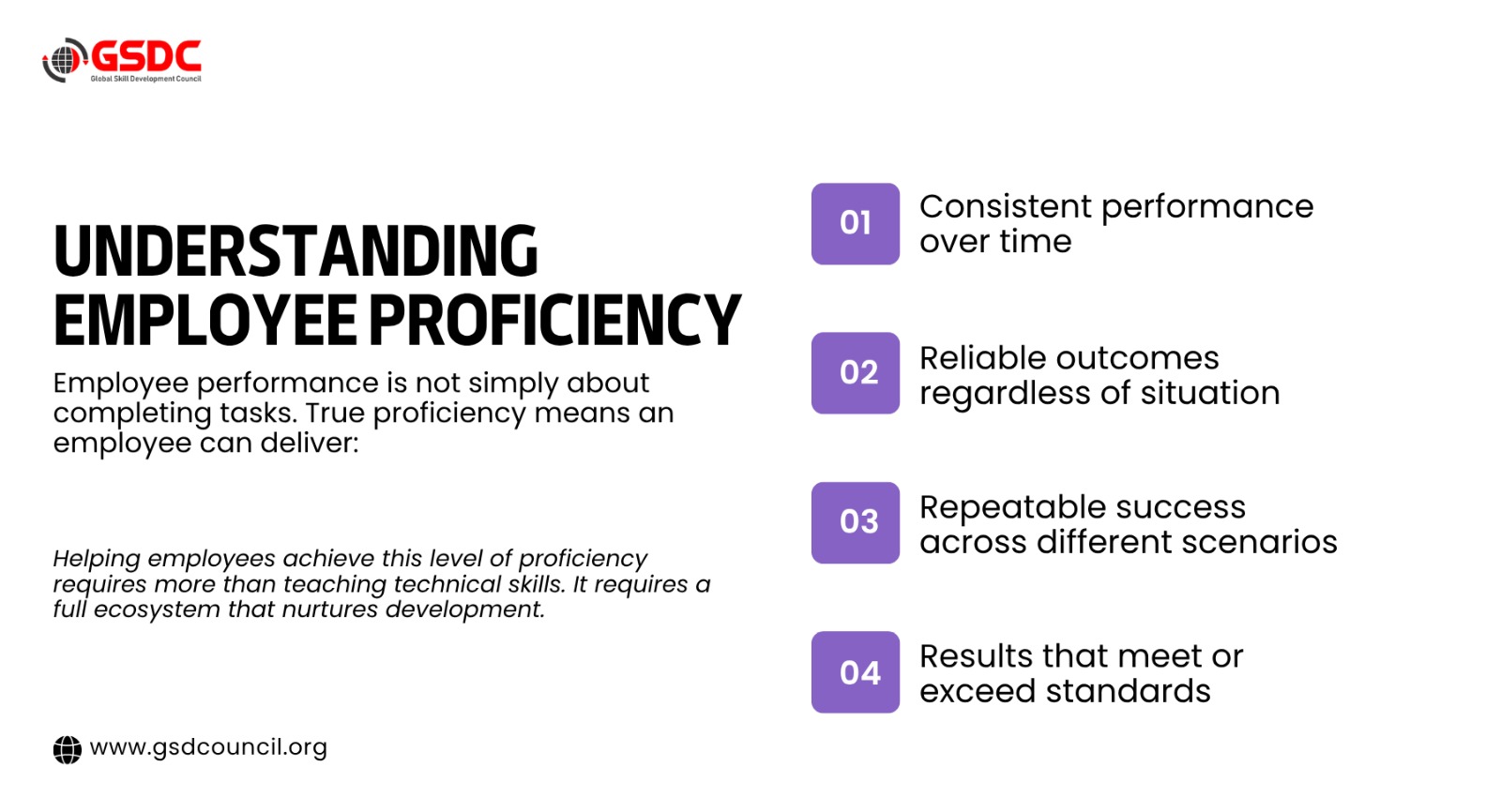
A learning ecosystem refers to the network of people, tools, systems, and environmental factors that influence how employees learn and perform.
The webinar emphasized that organizations should stop viewing employees as resources to manage and instead treat them as individuals to nurture, similar to how children are nurtured through family, teachers, peers, and supportive environments.
Just as children do not learn only through formal teaching, employees do not develop solely through training programs.
Instead, employee growth is influenced by six key components:
- Peers
- Coaches and Mentors
- Subject Matter Experts (SMEs)
- Performance Support Systems/Technology
- Work Environment
- Managers
Together, these elements form the learning ecosystem that drives faster and more sustainable performance development.
The Role of Peer Learning in Performance Growth
Employees rarely work in isolation. Much of workplace learning happens informally when employees interact with colleagues, ask questions, and solve problems together.
However, organizations often fail to structure this peer learning effectively.
L&D leaders can strengthen peer learning by encouraging purpose-driven social connectivity, where employees collaborate intentionally rather than casually.
Ways to enable peer learning include:
- Creating dedicated collaboration channels on platforms like Microsoft Teams or Slack
- Assigning buddy systems for new employees
- Designing group-based assignments and projects
- Hosting networking or peer-learning events
- Encouraging communities of practice
Structured peer learning helps employees build support networks while gaining practical insights from colleagues with real-world experience.
Why Structured Coaching and Mentorship Matter
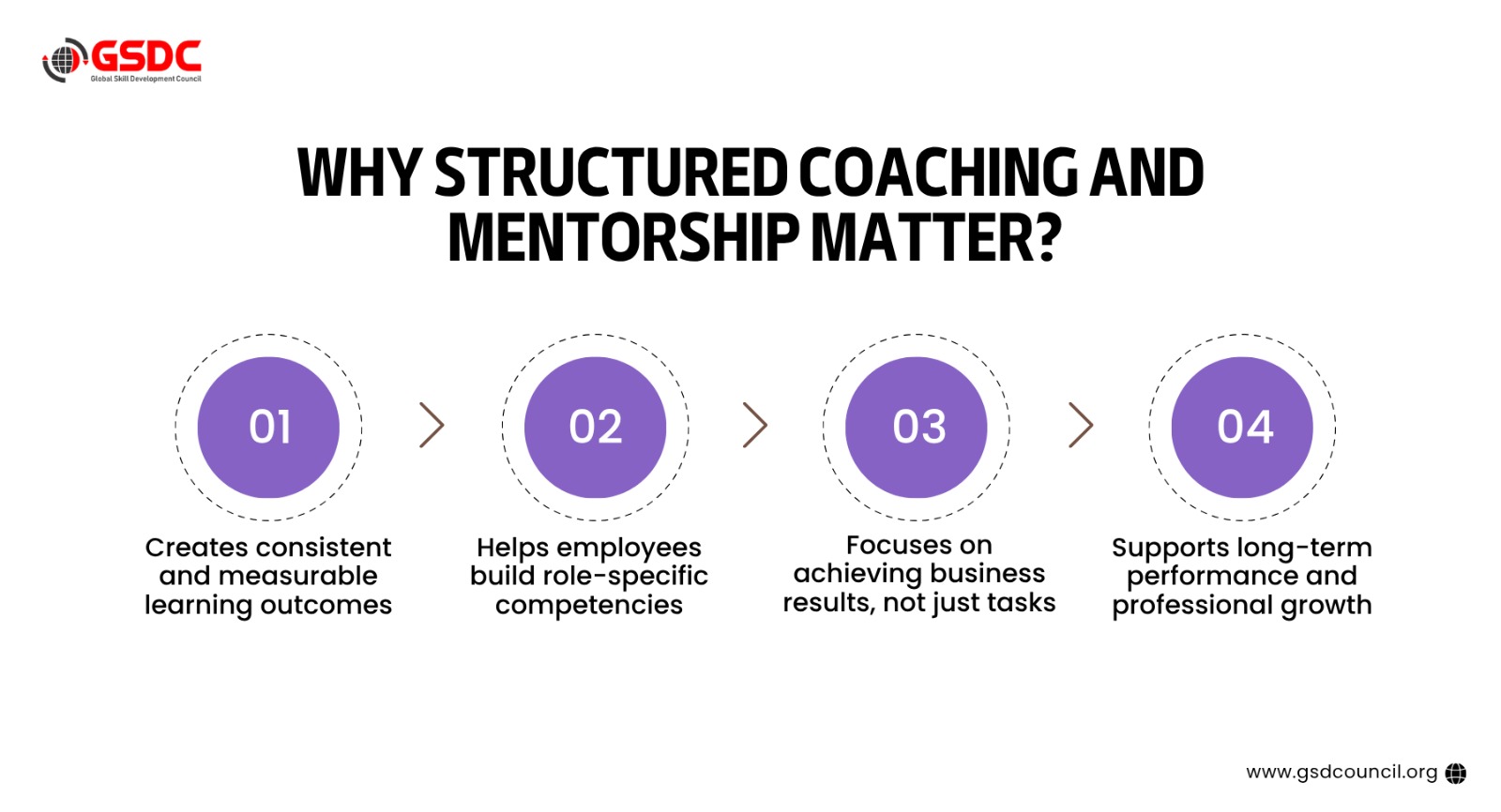
Coaching is another essential part of a successful learning ecosystem. Yet in many organizations, mentorship and coaching remain inconsistent and informal, limiting their overall impact within the broader learning and development strategy.
Often, employees are simply told to “shadow someone experienced” without clear expectations or structure. This creates inconsistent learning experiences, as different mentors coach in different ways, reducing the effectiveness of mentorship and coaching initiatives.
Organizations should implement structured coaching frameworks by:
- Defining coaching goals and expected outcomes
- Standardizing coaching processes
- Training coaches on effective mentoring techniques
- Matching employees with coaches based on development needs
- Providing coaching tools and checklists
By formalizing these practices, organizations can fully realize the benefits of coaching and mentoring in the workplace, such as improved performance, faster skill development, stronger employee engagement, and better knowledge transfer.
Effective coaching should focus on helping employees achieve business outcomes, not just complete isolated tasks. As part of a strong learning and development strategy, coaching must align with real-world responsibilities and measurable results.
For example, if an employee’s role involves selling to high-net-worth clients, coaching should focus on the complete sales process, not just presentation skills.
Leveraging Subject Matter Experts (SMEs)
Every organization has highly experienced professionals who possess deep expertise and valuable practical knowledge. However, many businesses fail to integrate these experts into learning initiatives.
SMEs can strengthen the learning ecosystem in several ways:
- Serving as guest speakers during training programs
- Reviewing training materials for relevance and accuracy
- Participating in assessments and curriculum design
- Creating knowledge-sharing videos and learning content
- Offering targeted mentoring sessions
When SMEs contribute strategically, training becomes more practical, credible, and aligned with real-world job requirements.
Integrating Technology and Performance Support Systems
Technology has become the center of modern workplace performance.
Employees rely on tools, dashboards, software platforms, AI assistants, mobile apps, and communication systems every day to complete their work. These are known as performance support systems.
A common mistake in training design is teaching concepts separately from the tools employees will actually use on the job.
To solve this, organizations should embed performance support systems directly into learning programs.
Examples include:
- Training employees on live software systems during learning sessions
- Using simulations with actual workplace tools
- Teaching employees how to leverage AI and automation platforms
- Including dashboards and business tools in scenario-based exercises
Training should replicate the real workflow employees will experience after completing the program.
Designing Realistic Learning Environments
Employees often struggle when training feels disconnected from real workplace challenges.
Many training programs are overly safe, theoretical, or simplified, which do not prepare learners for actual job pressures.
Instead, L&D professionals should create realistic simulations that reflect the true working environment.
This can involve:
- Time-sensitive exercises
- High-pressure decision-making scenarios
- Customer conflict simulations
- Team-based collaborative problem-solving
- Realistic case studies based on workplace challenges
When employees practice in realistic environments, they develop confidence and adaptability before facing real-world situations.
Why Managers Are the Most Critical Part of the Ecosystem
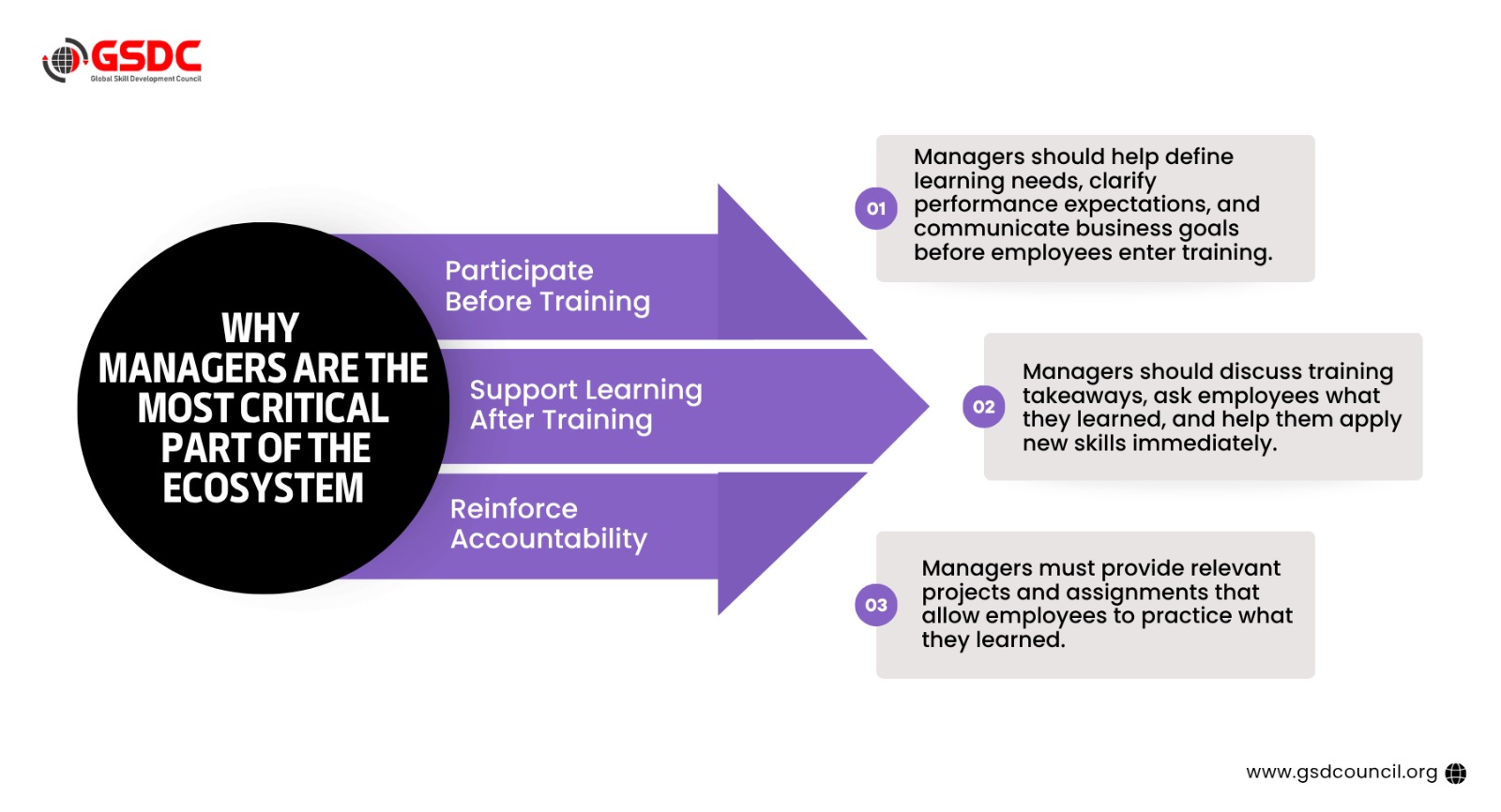
Perhaps the most important insight from the webinar was that managers are the centerpiece of the learning ecosystem.
Even with excellent training, coaching, technology, and support systems in place, poor managerial involvement can derail employee development.
Managers accelerate performance when they:
Participate Before Training
Managers should help define learning needs, clarify performance expectations, and communicate business goals before employees enter training.
Support Learning After Training
Managers should discuss training takeaways, ask employees what they learned, and help them apply new skills immediately.
Reinforce Accountability
Managers must provide relevant projects and assignments that allow employees to practice what they have learned.
Without this reinforcement, training quickly loses value.
How L&D Teams Can Better Involve Managers
To improve manager engagement, organizations can:
- Require managers to justify training requests thoroughly
- Conduct intake meetings before enrolling employees in programs
- Include managers in portions of training sessions
- Clarify manager responsibilities post-training
- Align training with employee performance objectives and KPIs
This ensures that managers become active participants in development rather than passive observers.
Accelerate Your Learning Strategy with GSDC CLDP Certification
The Certified Learning & Development Professional by Global Skill Development Council is designed for professionals who want to build impactful learning ecosystems that drive real business results. Aligned with modern L&D practices, the Certified Learning & Development Professional certification helps you move beyond traditional training and create a holistic learning ecosystem that accelerates employee performance.
This certification equips you with practical skills to design a strong learning and development strategy, integrate coaching and mentorship, and leverage technology to support continuous learning. You’ll learn how to reduce time to proficiency, improve workforce productivity, and align learning initiatives with organizational goals.

CLDP focuses on real-world application helping you implement structured coaching, enable peer learning, and embed performance support systems into daily workflows. It also emphasizes the critical role of managers in reinforcing learning.
If you want to transform your organization’s L&D approach and build a scalable corporate learning ecosystem, Certified Learning & Development Professional is your next step.
Conclusion
Creating a learning ecosystem that accelerates employee performance requires organizations to move beyond isolated training events and think holistically about development. A well-structured corporate learning ecosystem ensures that learning is not treated as a one-time activity but as an ongoing, integrated process.
Training alone cannot transform employees into high performers. Instead, organizations must build a strong development ecosystem where learning is continuously reinforced through collaboration, coaching, expert guidance, supportive technology, realistic practice environments, and active managerial involvement.
By strategically designing this learning ecosystem and integrating its core elements, organizations can reduce time to proficiency, improve workforce effectiveness, and create a culture of continuous growth.
For L&D leaders, the future lies not in simply delivering more training but in designing a corporate learning ecosystem that nurtures learning at every stage of the employee journey.
Subscribe to Our Newsletter
Stay up-to-date with the latest news, trends, and resources in GSDC

Related Certifications
Frequently Asked Questions
Stay up-to-date with the latest news, trends, and resources in GSDC
If you like this read then make sure to check out our previous blogs: Cracking Onboarding Challenges: Fresher Success Unveiled
Not sure which certification to pursue? Our advisors will help you decide!