What Is a PMO Analyst? Roles, Skills, Career Path & How to Start

Written by Matthew Hale
Projects are at the core of business development and innovation. To efficiently handle projects in an organization, a Project Management Office plays a crucial role. Among the roles in the PMO is the PMO analyst.
In fact, research indicates that organizations with a Project Management Office have a higher success rate in project management compared to those without a PMO. While organizations without a PMO have a project success rate of only 56%, those with a PMO have a project success rate of about 65%.
If you are interested in PMO analyst jobs or a project analyst career path, you might want to understand what a PMO analyst does.
In this guide, we’ll explain what is a PMO analyst, explore the roles and responsibilities of PMO analyst, look at the skills required for PMO analyst, and discuss how to become a PMO analyst.
What Is a PMO Analyst?
A PMO analyst is an essential part of any company’s Project Management Office. The main role of the PMO analyst is to support project management activities by keeping an eye on the performance of projects, maintaining documents and their organization, and analyzing project data to identify trends and problems. The role of the PMO analyst is also to make sure that projects within an organization follow standard processes and procedures.
The role of the PMO analyst is to work hand-in-hand with project managers and leaders to monitor project performance and enhance the way projects are being managed.
As organizations adopt structured project management practices, PMO analyst jobs are becoming more common across industries such as IT, consulting, finance, healthcare, and manufacturing.
Roles and Responsibilities of PMO Analyst
The roles and responsibilities of PMO analyst are intended to support project teams, improve awareness of how projects are actually conducted, and ensure projects are conducted in accordance with the set standards.
The main responsibilities of a PMO analyst include:
1. Project Monitoring and Reporting
PMO analysts oversee projects and provide reports on schedule, costs, and overall results. These reports are useful for executives to get information on work progress and to be aware of any problems that might arise.
2. Maintaining Project Documentation
PMO analysts keep templates, project records, governance documents, and project plans systematically so that the information is easy to find and use.
3. Supporting Project Governance
They make certain that projects adhere to PMO frameworks, processes, and the company's policies.
4. Data Analysis and Insights
PMO analysts analyze a series of project data to come up with trends, risks, performance, disclosures, and consequently, they assist companies in project planning and delivery aspects.
5. Risk and Issue Tracking
Tracking Another significant aspect of the roles and responsibilities of a PMO analyst is the continuous monitoring of project risks and the timely tracking of issues so that teams may take corrective measures before the problems have a negative impact on the project outcomes.
Those who wish to deepen their knowledge of PMO frameworks might find training and certification helpful. The Global Skill Development Council (GSDC), among other institutions, provides courses to assist professionals in gaining hands-on experience in PMO operations and project management.
Skills Required for PMO Analyst
A combination of skills is necessary for the position of PMO analyst. A professional needs to develop the skills that will enable them to perform their tasks. The skills required for PMO analyst include technical knowledge and the ability to work well with project teams.
The skills that a PMO analyst needs include:
1. Project Management Knowledge
Deep knowledge of project management principles, project lifecycle stages, and project management frameworks helps PMO analysts to assist project planning, monitoring, and reporting.
2. Data Analysis Skills
PMO analysts deal with project metrics, dashboards, and performance reports. Excellent data analysis skills enable them to spot trends and thus drive project improvement.
3. Communication and Coordination
PMO analysts regularly interact with project managers, team members, and executives. Well-articulated communication plays a big role in making sure that project updates, risks, and decision-making are communicated properly.
4. Organizational Skills
Monitoring several projects, preparing reports, and maintaining documentation call for the highest level of accuracy and organizational skills.
5. Tools and Software Knowledge
Most PMO analyst posts expect you to be aware of some of the following tools:
- Microsoft Project
- Jira
- Excel or other reporting tools
- Project portfolio management platforms
Having these capabilities necessary for the PMO analyst role can open up job opportunities and help in promotion through the career ladder in the project analyst field. Besides working on skills, many decide to take up certifications like Certified PMO Professional to get a deeper knowledge of PMO methodologies and best practices.
Project Analyst Career Path
The path to a PMO analyst position is part of a larger project analyst career path that starts at entry-level project support positions and ultimately leads to project management and PMO leadership positions.
Professionals begin as project coordinators or project assistants. They advance to PMO analyst positions that concentrate on project tracking, project governance, and project performance reports. In most markets worldwide, a PMO analyst's salary is between $80,000 and $100,000 annually.
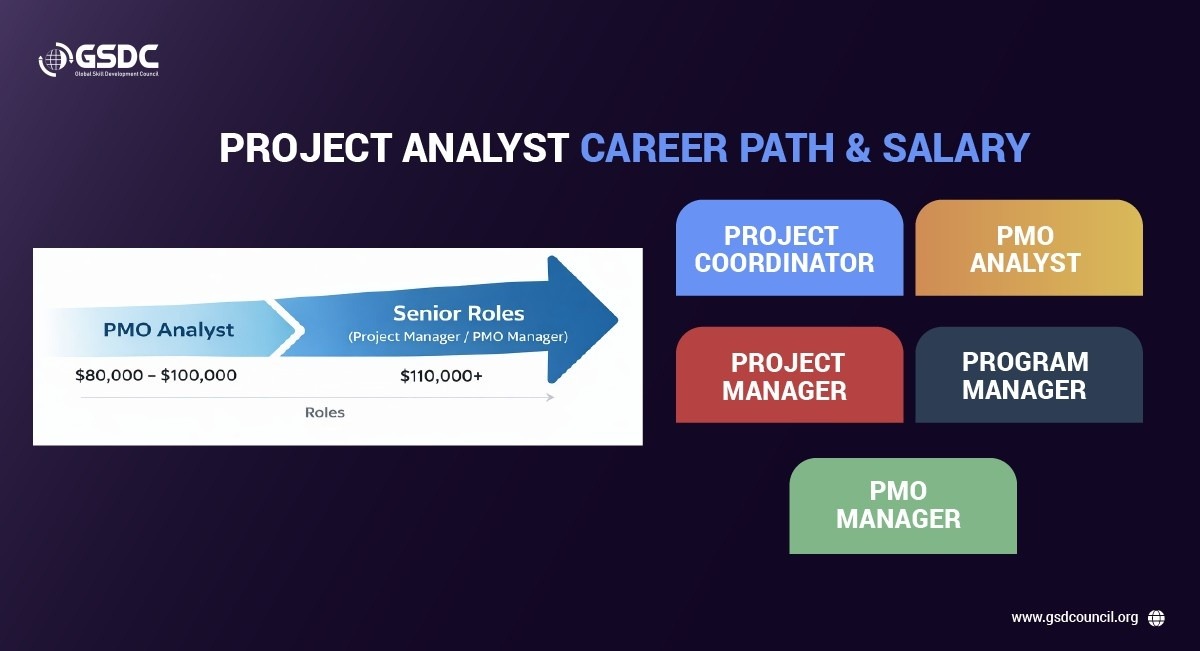
The visual shows how professionals can progress along the project analyst career path as responsibilities and earning potential grow over time.
Is a PMO Analyst a Good Career?
PMO analyst careers have gained popularity among those interested in PMO analyst jobs.
The career provides good opportunities as organizations face more complex projects. According to the U.S. Bureau of Labor Statistics, the employment of project management specialists is expected to grow at a rate of about 6% from 2024 to 2034, faster than the average rate of growth of many occupations.
The following are some of the good opportunities associated with the career:
1. Exposure to Multiple Projects
The nature of the role means PMO analysts will be going to several projects at once, learning experiences with different teams, processes, and business functions. This
2. Career Growth Opportunities
This job can be a gateway to advances like project manager, program manager, or PMO manager as one grows in experience and leadership skills.
3. Demand Across Industries
Companies in various sectors, such as technology, finance, healthcare, and consulting, keep announcing their PMO analyst vacancies as projects become pivotal to business operations.
4. Strategic Business Impact
PMO analysts are supporting roles for project tracking, reporting, and governance.
In general, this type of work provides good involvement with project settings and may improve your chances for a long-term career in project management.
How to Become a PMO Analyst
To become a PMO analyst, one would need to acquire the necessary education, project experience, and analytical/report writing skills. Most people have become PMO analysts after working in project support roles.

The visual highlights the key steps involved in how to become a PMO analyst, including education, project experience, skill development, and professional certifications.
Certifications such as Certified PMO Professional and other certified PMO programs can help strengthen PMO knowledge and improve opportunities in PMO analyst jobs.
Why Organizations Value PMO Analysts
Due to the complex nature of projects and digital transformation, businesses are increasingly dependent on PMOs to deliver successful projects.
The contributions of PMO analysts to an organization include:
- ensuring projects remain visible
- standardizing projects
- maximizing resource use
- early identification of potential risk
- enabling data-driven decision-making
Due to the importance of PMO analysts, the number of people interested in a project analyst career path is constantly on the increase.
Strengthen Your PMO Career with Professional Certification
Obtaining a professional certification is one of the best ways for project analysts to level up their careers. It also helps project analysts to understand the PMO framework and have an in-depth knowledge of project management office-related concepts. Besides that, credentialing is also one of the means for project analysts to manifest their expertise in the field of PMO and garner credibility.
The Global Skill Development Council (GSDC) offers the Certified PMO Professional certification, designed to help professionals understand PMO structures, governance models, project monitoring, and reporting practices used in modern organizations.
A certified PMO credential can help professionals strengthen their expertise, improve career opportunities, and stand out when applying for PMO analyst jobs.

Final Thoughts
As one comes to comprehend the role of a PMO analyst, it becomes easier to see the importance of the role in modern-day business. A PMO analyst creates the structure and analysis necessary to ensure that projects have the ability to bring true business value to an organization.
As an exciting and promising career option for any professional who is interested in project management and analysis, the role of the project analyst is an important and growing field.
With the skills and qualifications necessary to become a PMO analyst, as well as the experience and certifications that include the Certified PMO Professional and the Certified PMO, it becomes easier to comprehend the exciting and rewarding career path of the project analyst.

Related Certifications
Frequently Asked Questions
Stay up-to-date with the latest news, trends, and resources in GSDC
If you like this read then make sure to check out our previous blogs: Cracking Onboarding Challenges: Fresher Success Unveiled
Not sure which certification to pursue? Our advisors will help you decide!