How Competency-Based Performance Management Drives Growth and Employee Engagement
Written by Matthew Hale
- Why Competencies Are Important
- What Is Competency-Based Assessment?
- What Is Competency-Based Performance Management?
- Competency-Based vs Traditional Performance Management
- Benefits of Competency-Based Performance Management
- Why Competency-Based Systems Are the Future of Performance
- How GSDC’s Competency Certification Drives Professional Growth
- Conclusion
- FAQ’s
Imagine two employees who both meet their goals - but one mentors teammates, drives innovation, and adapts to change, while the other simply gets the job done. Under traditional performance systems, they’d often be rated the same.
Today, however, organizations recognize that how people perform matters just as much as what they achieve. Studies shows that companies focusing on developing their people’s potential are 4.2 times more likely to outperform competitors - proving that behavior-driven performance creates lasting business impact.
This shift has paved the way for competency-based performance management, a modern approach that blends performance management and competency mapping to evaluate not only outcomes but the capabilities that drive them.
For today’s HR, L&D, and mid-level leaders, understanding what is competency-based performance isn’t just another framework - it’s a roadmap for building credibility, improving engagement, and shaping future-ready teams.
Why Competencies Are Important
Competencies are the foundation of performance excellence. They define the knowledge, skills, and behaviors needed to deliver consistent, high-quality results. In today’s dynamic business landscape, understanding why competencies are important helps align individual performance with organizational vision - ensuring every role contributes strategically to long-term goals.
1. Clarity and Fairness
Competencies bring transparency and objectivity into performance management. They set clear standards for what success looks like - employees understand expectations, and managers can evaluate performance based on consistent benchmarks rather than personal bias.
Example: At Google, the inclusion of behavioral competencies such as “coaching,” “communication,” and “decision-making” in their “Project Oxygen” framework transformed how managers were assessed and developed. It reduced ambiguity, built trust, and improved leadership effectiveness across teams.
2. Growth and Engagement
Competency-based systems empower employees to identify their strengths and development areas, leading to personalized learning paths and sustained engagement. This drives better retention and career progression.
Example: IBM’s SkillsBuild program uses competency mapping to design personalized learning journeys for employees, ensuring continuous upskilling aligned with future job roles. As a result, IBM saw higher engagement and internal mobility, helping it remain agile competency amid industry disruptions.
3. Business Impact
Competencies directly influence organizational efficiency and performance outcomes. When people are equipped with the right skills and behaviors, projects are executed faster, collaboration improves, and innovation flourishes.
Example: Unilever introduced a global competency framework linking employee capabilities with business outcomes. This alignment resulted in higher productivity and faster leadership development, proving that competency-driven performance translates into measurable business impact.
4. Risk Reduction
Competent professionals anticipate challenges, make informed decisions, and uphold compliance - reducing costly mistakes and minimizing operational risks. Competency frameworks also strengthen leadership accountability and ethical decision-making.
Example: Deloitte applies a global competency model for its consultants, ensuring they adhere to high ethical and operational standards. This approach has helped the firm maintain consistency and reliability across international projects.
In essence, competencies are not just HR tools - they are strategic drivers of clarity, growth, and performance excellence. They enable organizations to stay competitive while empowering employees to build meaningful, future-ready careers.
What Is Competency-Based Assessment?
A competency-based assessment evaluates how effectively professionals apply their skills, knowledge, and behaviors in real-world situations. Unlike traditional reviews that measure only end results, this method focuses on how those results are achieved.
Key Characteristics
- Behavior-focused: Evaluates actions, decision-making, and collaboration.
- Data-driven: Uses measurable indicators like KPIs, 360° feedback, and peer reviews.
- Continuous: Encourages ongoing improvement instead of annual appraisals.
- Personalized: Identifies unique learning needs to close specific skill gaps.
Example: Instead of asking “Did you meet your sales target?”, a competency-based review also considers “How did you influence client decisions and strengthen relationships?”
Benefits of Competency-Based Assessment
- Accurate Skill Gap Identification: Pinpoints strengths and development areas.
- Evidence-Based Decisions: Ensures fair promotions and role fitment.
- Personalized Learning Paths: Aligns upskilling with business goals.
- Increased Accountability: Sets measurable performance standards.
When organizations understand what is competency-based assessment, they move beyond outdated evaluations toward transparent, data-driven growth systems.
Real-World Insight & Data
Research indicates that about 70% of companies using structured competency frameworks reported improved performance outcomes.
blogs.psico-smart.com
This statistic underscores the power of assessments that go beyond metrics to behaviors and capabilities.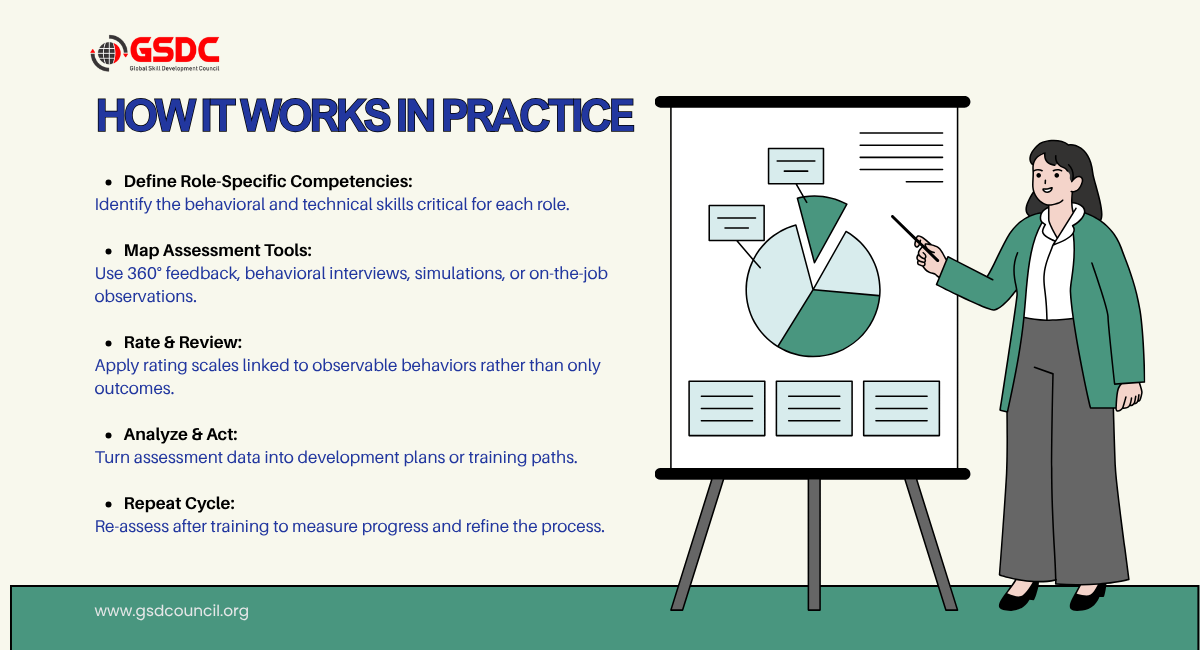
With this approach, performance management and competency mapping integrate smoothly into one system that links individual behaviors with business results
What Is Competency-Based Performance Management?
Competency-based performance management (CBPM) focuses on how employees achieve results, not just what they deliver. It integrates key competencies - such as leadership, collaboration, and problem-solving - into every stage of performance management.
Core Components
- Goal Alignment: Connects individual goals with organizational strategy.
- Behavioral Evaluation: Measures how goals are achieved, emphasizing teamwork and adaptability.
- Continuous Feedback: Encourages open, regular discussions instead of annual reviews.
- Data Insights: Tracks progress through analytics for smarter decision-making.
Competency-Based vs Traditional Performance Management
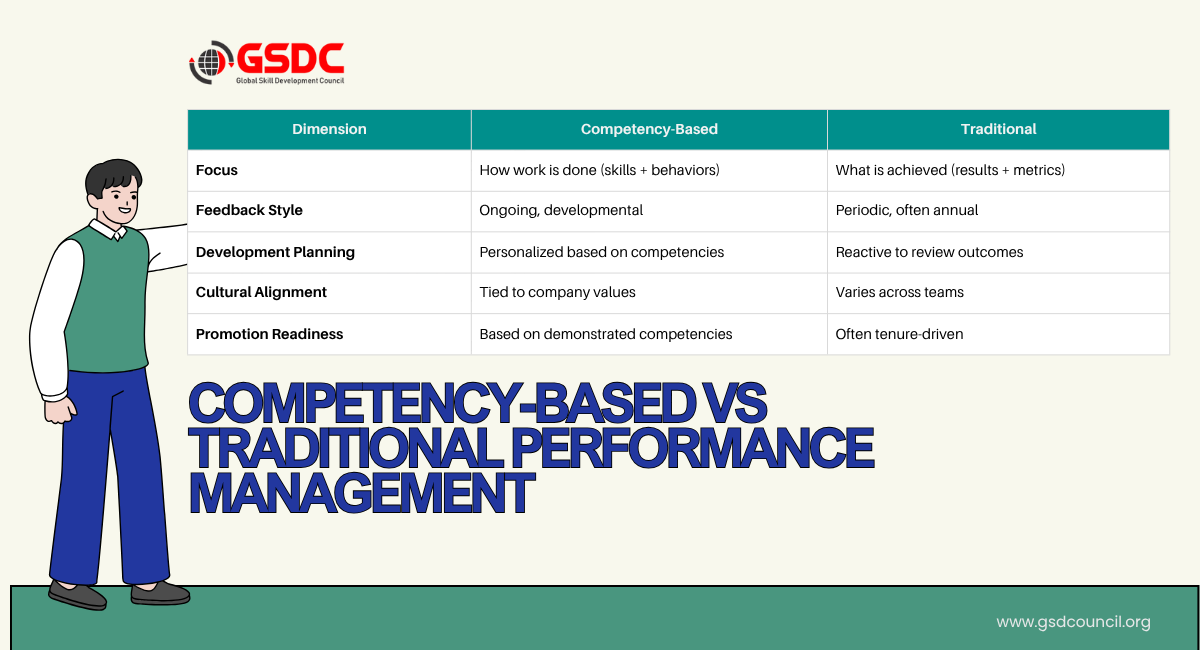
Example: A logistics firm introduced CBPM to evaluate teamwork and innovation. Within a year, project turnaround times improved by 25%, showing how behavior-based reviews translate into measurable results.
Benefits of Competency-Based Performance Management
- Fair Evaluation: Reduces bias through standardized competency criteria.
- Clear Growth Pathways: Employees understand what’s expected to move up.
- Better Engagement: Continuous feedback fosters accountability and trust.
- Improved Team Collaboration: Shared competencies strengthen communication and teamwork.
- Leadership Development: Helps identify future leaders through demonstrated behaviors.
When professionals understand what is competency-based performance management, they can align their skills with outcomes-building a stronger, more adaptive workforce.
Understanding what is competency-based performance management helps professionals link skills with outcomes - building a stronger, more adaptive workforce.
Download the checklist for the following benefits:
🚀 Learn how to align skills, behavior, and business success.
💡 Get your free guide today!
Why Competency-Based Systems Are the Future of Performance
Modern businesses demand agility and self-driven talent. Studies show that organizations actively measuring competencies are over four times more likely to maintain high performance in changing markets.
By linking skill development to tangible results, competency-based systems create alignment between personal growth and business strategy - driving resilience and innovation across industries.
Hello, World!
How GSDC’s Competency Certification Drives Professional Growth
Certification Advantage
Earning the Certified Performance & Competency Developer certification from GSDC (Global Skill Development Council) validates your ability to strategically align people, performance, and business outcomes. It demonstrates your expertise in designing and managing competency frameworks that enhance workforce potential and operational excellence.
Benefits of Certification
- Global Credibility: Gain international recognition as a certified performance management professional.
- Career Growth: Strengthen your profile and accelerate advancement in HR, L&D, or organizational development.
- Practical Application: Master frameworks that turn insights into measurable results.
- Continuous Learning: Stay updated with evolving performance and competency analytics.
The GSDC bridges theory and practice - empowering professionals to build performance cultures that drive long-term business success.
Conclusion
Competency-driven performance systems are reshaping how organizations define success. By integrating competency-based assessment into performance management, companies can ensure fairness, clarity, and measurable growth.
Professionals who understand and apply competency-based frameworks lay the foundation for sustainable talent development and organizational excellence.
With global skill councils like GSDC leading the way, professionals can confidently design, assess, and optimize performance systems - driving measurable success for both their organizations and careers.
FAQ’s
Q1: How are performance management and competency mapping connected?
They work together — performance management measures results, while competency mapping evaluates the skills and behaviors that drive those results.
Q2: How can I build performance drive and execution competency?
By setting clear goals, using feedback loops, and developing behaviors like accountability, adaptability, and follow-through.
Q3: Why use a competency framework instead of KPIs alone?
A competency framework ensures fairness, focuses on how goals are achieved, and promotes consistent growth across teams.
Q4: What is competency-based assessment in simple terms?
It measures how professionals apply skills, knowledge, and behavior to achieve results, not just whether goals are met.
Q5: Why are competencies important for future workforce success?
They help employees stay adaptable, innovative, and aligned with evolving business needs — key traits for the future of the workforce.
Q6: What makes a good performance competency framework?
It includes measurable behaviors, clear expectations, and alignment with organizational goals.
Q7: How does a competency development program help career growth?
It identifies skill gaps, builds targeted capabilities, and prepares professionals for leadership roles.
Q8: Why is competence important in the workplace?
Competence ensures quality work, reduces errors, and strengthens team performance.
Q9: How can I become a certified performance management professional?
By gaining practical knowledge in competency frameworks, assessments, and data-driven performance systems.
Q10: What’s the value of earning a certificate for skill competency?
It validates real-world expertise and builds credibility in performance and competency management.

Related Certifications
Stay up-to-date with the latest news, trends, and resources in GSDC
If you like this read then make sure to check out our previous blogs: Cracking Onboarding Challenges: Fresher Success Unveiled
Not sure which certification to pursue? Our advisors will help you decide!