Top Data Protection Officer Interview Questions & How to Ace Them
Written by Matthew Hale
- Growing Demand for Data Privacy Professionals
- Why Earning a Data Protection Certification Matters
- Common Interview Questions and Answers for Data Protection Officers
- Foundational Privacy Knowledge (Q6–Q10)
- Governance & Risk (Q11–Q15)
- Strategy & Decision-Making (Q16–Q20)
- Operations & Advanced Scenarios (Q21–Q25)
- Why This Data Protection Officer Interview Guide Matters for Your Career
- Why a Data Protection Certification Matters
- Conclusion
The global MOVEit data breach - where hackers exploited a widely used file-transfer tool and accessed data from over 2,600 organisations and 90 million people - showed how quickly one weakness can expose millions. Incidents like this are a reminder of why strong data protection and skilled Data Protection Officers (DPOs) are more important than ever.
With regulations like GDPR, CCPA, LGPD, PDPA and HIPAA organisations need professionals who can protect data, interpret privacy laws, and prevent risks before they spread.
To help you prepare, this guide covers the most essential data protection officer interview questions along with clear, common interview questions and answers used in real hiring processes.
Growing Demand for Data Privacy Professionals
Privacy risks are rising fast, and organisations need skilled experts to keep data safe. Recent trends show this clearly:
- The global data protection market will reach USD 235 Billion by 2032.
- 80% of consumers trust brands that protect their data.
- GDPR fines have increased by over 40%
This demand continues to push the growth of data privacy officer jobs, making privacy roles more relevant than ever.
Why Earning a Data Protection Certification Matters
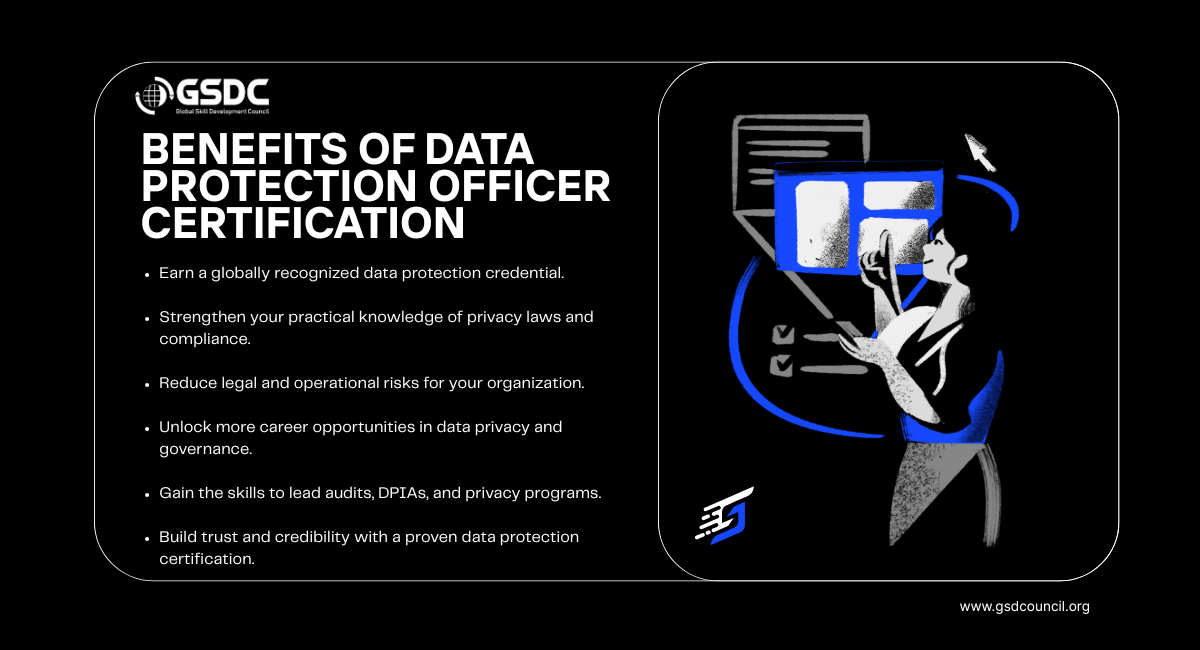 A recognised Data Protection Certification helps professionals strengthen their skills and prove expertise in:
- Privacy laws and Governance
- Risk Management
- DPIA and privacy-by-design
- Compliance and audit readiness
Along with certification, understanding why is it important to prepare for an interview is key-DPO interviews test real-world judgment, not just theory. With that in mind, here are the most common data protection officer interview questions and answers to help you get ready.
Common Interview Questions and Answers for Data Protection Officers
The following questions highlight the fundamental knowledge and practical judgement required to succeed in a DPO interview.
Core Role & Responsibilities (Q1–Q5)
Q1. What is DPO Role?
A DPO ensures an organisation follows data protection laws. Their job includes monitoring compliance, guiding teams, conducting assessments, supporting incident response, and acting as the contact for regulators. The role helps protect both the organisation and individuals’ rights.
Q2. How does a Data Privacy Officer differ from a Data Protection Officer?
A Data Privacy Officer focuses on policies, consent management, and user-rights processes.
A Data Protection Officer focuses on compliance, governance, and regulatory oversight.
Although the titles can overlap, the DPO carries specific legal responsibilities under certain regulations.
Q3. What kind of responsibilities does a typical DPO have?
It is quite usual that the DPO duties are roughly divided into the following categories:
- Designing policies
- Ensuring compliance
- Handling requests from users
- Preventing procedures
- Reviewing the partners'
- Preparation of the incident response
- Reporting to management
Q4. When is a DPO required under GDPR?
A DPO is required when an organisation processes large-scale sensitive data, monitors individuals regularly, or operates as a public authority. The DPO must be independent and free from conflicts of interest.
Q5. What skills are essential for a Data Protection Officer?
Essential skills include:
- Strong understanding of privacy laws
- Ability to interpret regulations
- Risk assessment and mitigation
- Clear communication
- Stakeholder management
- Analytical thinking
- A high level of independence and ethical judgment
With the basics of the DPO role covered, the next set of questions focuses on essential privacy concepts every candidate must understand.
These data protection officer interview questions also help employers understand how well a candidate can interpret regulations and apply them in real-world scenarios.
Foundational Privacy Knowledge (Q6–Q10)
Q6. What is a Data Protection Impact Assessment (DPIA)?
A data protection impact assessment (DPIA) identifies potential privacy risks and evaluates them, in the case of new or high-risk data processing activities. The DPIA allows companies to lower their risks, ensure that they are following the rules, and increase transparency.
Q7. What are the lawful bases for processing personal data?
The six lawful bases are:
- Consent
- Contract
- Legal Obligation
- Vital Interests
- Public Task
- Legitimate Interest.
The selection of the proper basis is the condition that processing is lawful, fair, and transparent.
Q8. How should a data breach be handled?
An effective structured response will have the following steps:
- Identification of the issue
- Stopping the breach
- Evaluation of the impact
- Notifying the authorities if necessary
- Informing the affected individuals
- Keeping a record of everything
- Reviewing lessons learned
Q9. What should a data retention policy include?
A retention policy outlines:
- What data is stored
- Why it is kept
- Retention duration
- Secure deletion procedures
- Legal justification
Q10. What is Privacy by Design?
Privacy by Design is about incorporating privacy into future products, services, or processes inherently from the very first intervention. Some of the most important principles of the system are minimisation, access control, transparency, and secure default settings.
Beyond foundational knowledge, interviewers want to test how well you understand governance, accountability, and risk management. These themes appear frequently in senior-level DPO interviews.
Grab the complete DPO interview Q&A PDF with clear, practical answers.📚 Get the Data Protection Q&A Pack
A simple way to boost your readiness for any data protection interview.
Governance & Risk (Q11–Q15)
Q11. What are Records of Processing Activities (RoPA)?
RoPA is a document that records how the data is collected, used, shared, and stored. It is an essential instrument for showing that one is accountable under data protection laws.
Q12. How are third-party privacy risks assessed?
To accomplish this, one must look into the vendor's privacy practices, assess the contract terms for security provision, verify their security controls, and make sure that they are handling the data in a trustworthy manner.
Q13. How can data protection awareness be built among employees?
This can be done by educating employees through training programs, providing clear regulations, giving regular reminders, establishing reporting avenues, and using simple examples to demonstrate to employees their role in data protection.
Q14. How do you manage cross-border data transfers?
You check whether the country to which the data is going has adequate data protection standards and then use the legal instruments that have been approved to ensure that the transfers are safe and lawful.
Q15. How can professionals stay updated on evolving data protection laws?
This involves keeping up with regulatory updates, training, and industry discussions. going to trainings, being a member of privacy communities, reading privacy-related court decisions, and following discussions in the industry.
As the conversation goes deeper, employers often explore your judgment, critical thinking, and ability to make informed decisions in complex situations.
Strategy & Decision-Making (Q16–Q20)
Q16. How can a basic data governance framework be designed?
The framework must have data ownership, well-defined policies, classification rules, retention schedules, and continuous monitoring of data usage.
Q17. How can business goals be balanced with privacy compliance?
This is done by engaging teams early on, assessing risks through structured methods, suggesting safer alternatives, and demonstrating how privacy can be a source of trust and thus, long-term value.
Q18. What should be done if leadership ignores privacy advice?
Document the advice, reassess risks, escalate when needed, and present clear, fact-based reasoning. Independence is essential in the DPO role.
Q19. How do you conduct an internal privacy audit?
An internal privacy audit is conducted through review of policies, interviewing teams, inspecting controls, documenting risks, and offering recommendations for compliance strengthening.
Q20. Give an example of a privacy failure and the key lesson.
An exemplary answer specifies the failure, the resulting impact, and what companies can learn, e.g. the critical nature of updates, monitoring, or training.
Finally, interviews often include scenario-based questions to understand how you handle real operational challenges in day-to-day privacy work.
Operations & Advanced Scenarios (Q21–Q25)
Q21. How are Data Subject Access Requests (DSARs) handled?
The procedure starts with the verification of the person's identity, after which the relevant data is collected. Any information referring to a third party is removed, and the reply is dispatched within the stipulated legal time limit. The organisation keeps a record of every step it takes to ensure accountability.
Q22. How can conflicting privacy regulations across regions be managed?
This is done by comparing the requirements for each jurisdiction, implementing the strictest standards, documenting the reasons for the decisions taken, and modifying the processes according to the obligations of each region.
Q23. What steps are involved in updating an outdated privacy policy?
The principal steps are changing the wording, explicitly stating the user data purposes, introducing the retention aspect, dealing with the data transfers across borders, and ensuring that the policy is consistent with the current laws and organisation’s practices.
Q24. How is transparency with users maintained?
Being transparent is supported by definite privacy notices, easy and understandable language, real choices, and communication being the same at all points of contact.
Q25. What practices help ensure smooth privacy operations?
Operational effectiveness is achieved through the use of standardized procedures, proper documentation, clearly defined access controls, uninterrupted supervision, and frequent evaluation of privacy-related risks.
Preparing for a DPO interview requires both technical knowledge and confidence. This guide is designed to help you build both.
Why This Data Protection Officer Interview Guide Matters for Your Career
This guide gives you a clear understanding of what modern DPO interviews focus on—practical decision-making, regulatory knowledge, and real-world privacy skills. With structured questions and concise explanations, it helps you build confidence and present yourself as an interview-ready data protection professional.
Want more expert-level interview questions?
Access our Data Protection Interview Toolkit, which includes additional practice questions, DPIA templates, governance checklists, and scenario-based exercises.
You’ll also get a data officer interview questions and answers PDF to help you prepare confidently for your next DPO or data privacy leadership interview.
Why a Data Protection Certification Matters
As organisations place greater focus on data protection, they look for professionals who can apply privacy laws confidently in real situations. A recognised Data Protection Certification helps demonstrate this capability.
Certifications like the Certified Data Protection Officer strengthen credibility and show that a professional understands governance, compliance, and privacy risks. Independent bodies such as GSDC offer globally aligned programs that help professionals stand out in a competitive privacy job market.
A certification not only enhances a résumé but also builds the confidence needed to support audits, guide compliance efforts, and take ownership of key data protection responsibilities.

Conclusion
The role of the Data Protection Officer is changing rapidly and the companies are now looking for a combination of the knowledge of the regulations, the ability to solve problems in a practical way, and good communication skills in the DPO. Getting ready for the DPO interview means understanding more than just the terms and knowing how to take the right decisions that both protect the data and the company.
Once you go through the questions and answers of this common interview, you will be able to face the data protection officer interview questions confidently and with a better grip of the real-world expectations. Proficient data protection specialists become a vital source of support for their organisations in the process of gaining trust, lessening the risk, and ensuring a safe way of working in a world that is increasingly digital.

Related Certifications
Stay up-to-date with the latest news, trends, and resources in GSDC
If you like this read then make sure to check out our previous blogs: Cracking Onboarding Challenges: Fresher Success Unveiled
Not sure which certification to pursue? Our advisors will help you decide!