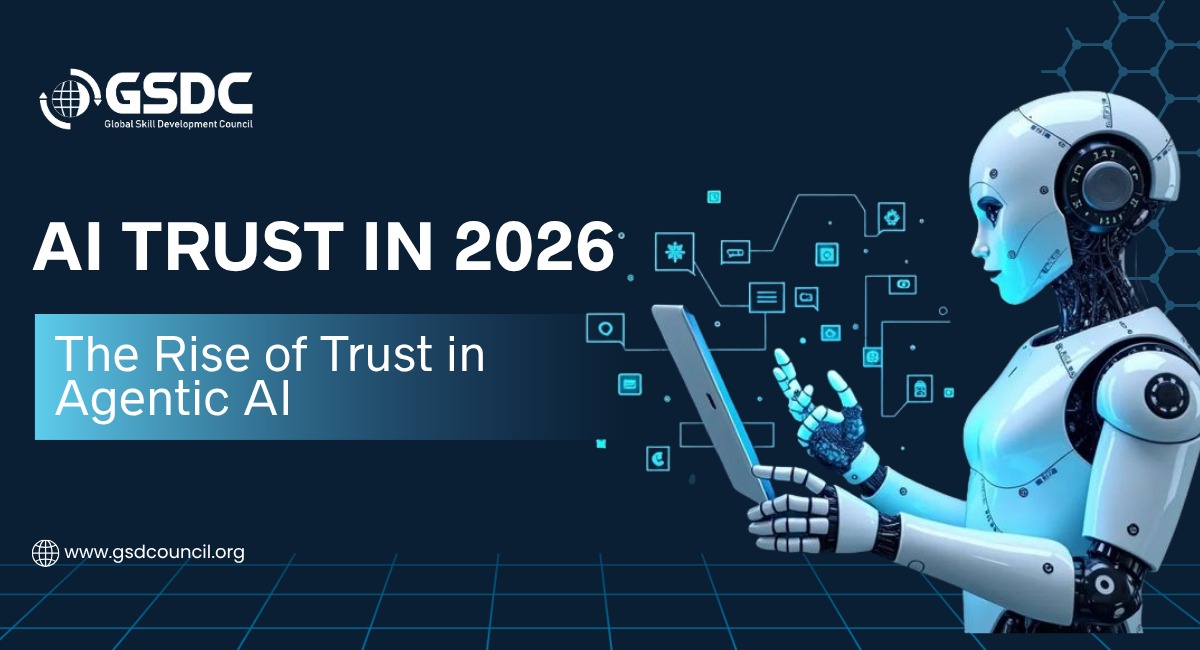
AI Trust in 2026: The Rise of Trust in Agentic AI
Written by Matthew Hale
- What Is Artificial Intelligence?
- How Does Artificial Intelligence Work?
- Artificial Intelligence Applications in Everyday Life
- What Is the Agentic Era in AI?
- AI Trust in 2026: What People Think
- How Organizations Can Build Trust in the Agentic Era
- Concept of Agentic Extraversion in AI
- Challenges in Building AI Trust
- The Future of AI Trust and Transparency
- Why Skills Matter for AI Trust
- Conclusion: Trust Will Define the Future of AI
Agentic artificial intelligence keeps progressing within various companies, contributing to the enhancement of numerous processes and decision-making.
However, as it becomes more sophisticated, it starts not only helping humans but also acting autonomously. Such an era is referred to as the agentic era.
With such advancement, one of the crucial questions comes into play: Can we trust AI to make the right decisions?
Although rapid growth in the use of AI can be observed, the development of trust still remains behind, especially when it comes to autonomous AI.
This gap makes AI trust in 2026 a critical priority for businesses, governments, and society.
What Is Artificial Intelligence?
To better understand trust in AI, the question arises of what is artificial intelligence.
The term artificial intelligence refers to technologies that enable machines to learn, think, and make decisions like human beings. AI examines data, finds patterns, and becomes smarter and more efficient over time.
How Does Artificial Intelligence Work?
If you’re wondering how does artificial intelligence work, here’s a simple explanation:
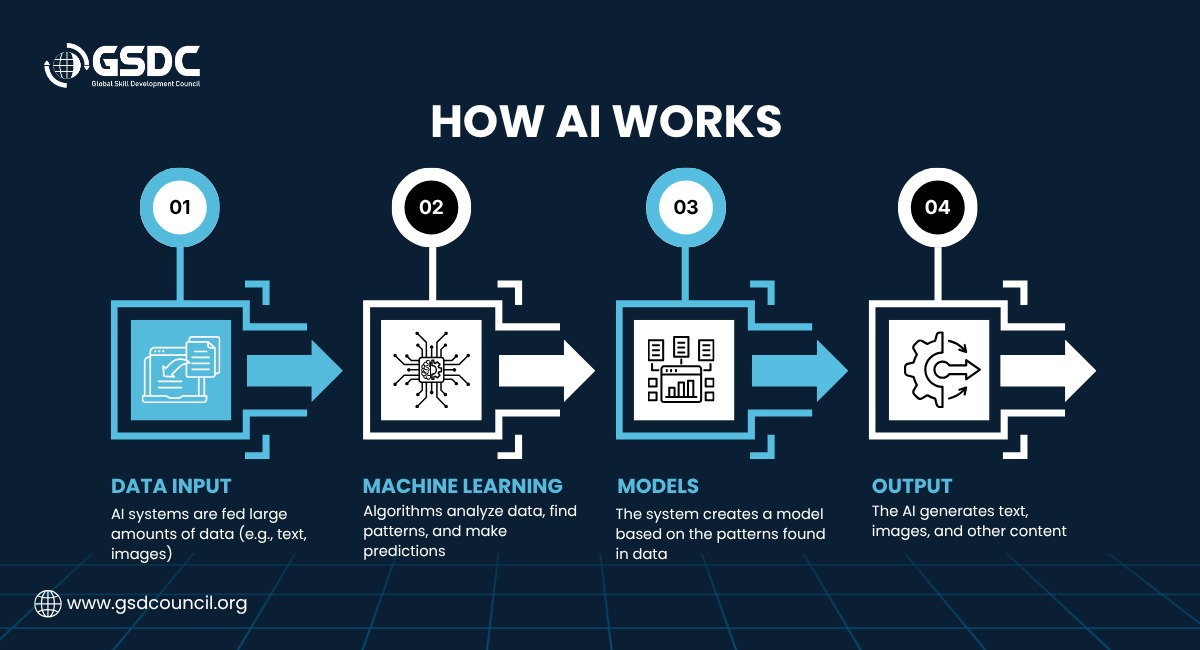
An AI system uses data to make sense of things, utilizes algorithms to make sense of that data, and employs machine learning to develop its capabilities. It processes vast volumes of data, identifies patterns, and makes decisions accordingly.
Artificial Intelligence Applications in Everyday Life
At present, AI has found various application areas, including:
- Chatbots and virtual assistants
- Recommendation algorithms
- Anti-fraud technology
- Medical solutions
These examples reveal how far AI has developed from automated processes to autonomous actions.
The next stage for the development of artificial intelligence will be the agentic age, which means that AI trust and transparency will be crucial in the future.
What Is the Agentic Era in AI?
Understanding the Agentic Era
The agentic era is an age where artificial intelligence is able to perform things independently with minimal human intervention.
In simple terms, artificial intelligence is no longer dependent on human beings for support; rather, it begins acting on its own.
Importance of Understanding It
Traditionally, AI used to help in making human decisions. However, now AI not only helps in decision-making, but also takes actions on those decisions.
This development enhances the effectiveness and efficiency of artificial intelligence. But it also poses various risks, such as:
- Human beings no longer can intervene in decision-making.
- There is always a probability of mistakes due to the absence of human oversight.
- Difficulty in understanding the process of decision-making.
In fact, while AI adoption is widespread, nearly 88% of organizations are using AI, but only about one-third have successfully scaled it.
This highlights a key challenge - AI capability is growing faster than trust and readiness.
As systems become more autonomous, it becomes important to ensure they behave safely, fairly, and in ways we can understand and trust.
AI Trust in 2026: What People Think
AI adoption is growing fast, but trust is still developing.
Recent research shows that over 80% of people have already used AI, yet confidence in these systems is still catching up. Around 16% of users say they have used AI systems that act on their behalf without human involvement.
This shows a clear shift - AI is no longer just a tool. It is starting to act independently.
However, concerns around safety, control, and reliability remain strong. In simple terms, adoption is moving faster than trust.
Moreover, people's trust in AI depends significantly on the particular region they live in.
What This Means
- AI will become common practice
- AI will be used to make decisions
- Trust in AI is developing
- Establishing trust in AI is crucial
How Organizations Can Build Trust in the Agentic Era
As AI becomes more autonomous, it becomes necessary for organizations to consciously strive toward creating trust.
This becomes particularly necessary in the agentic era because AI can operate and perform tasks almost completely autonomously. In the process, trust needs to be instilled at the design, usage, and oversight level.
1. Improve Transparency
AI technologies should be simple enough for all individuals to understand.
It is essential that an organization clearly explains the rationale behind its decision-making process and the results derived from these decisions.
2. Use Trust and Safety Tools
Several firms are now using sophisticated technologies to keep track of and control their AI systems.
These technologies enable the identification of any biases in the AI systems, monitoring their behavior, and ensuring that they don’t produce undesirable results.
3. Strengthen Governance and Regulation
AI regulation has become an increasingly significant trend across the world.
Various nations have been regulating the deployment of AI through multiple regulatory bodies. From the organizational perspective, compliance will remain paramount for all AI systems.
This indicates that trust does not simply rely on technological aspects but on solid governance as well.
4. Build Responsible AI Practices
Companies should be able to develop their AI systems responsibly.
They must be fair and minimize any biases while also being accountable. Responsible AI contributes to creating sustainable trust for organizations, thus enhancing widespread use.
To develop these competencies, it is necessary to possess the appropriate competencies. Companies have been spending more money on acquiring the relevant skills through certification from reputable organizations, like the Global Skill Development Council.
Concept of Agentic Extraversion in AI
A concept that is rapidly gaining ground in this field is agentic extraversion.
It denotes the degree of activity with which AI systems:
- Initiate actions
- Interact with users
- Complete tasks without requiring continuous prompting
The proactivity of AI makes it more efficient at completing tasks, but it also has a significant impact on decision-making and outcomes.
Therefore, it becomes increasingly important to make sure that such systems function reliably and safely. Gaining this knowledge begins with having an adequate foundation in the field, and the Certified Artificial Intelligence Foundation Program allows individuals to establish a thorough understanding of AI.
Challenges in Building AI Trust
Even with the development achieved, creating trust in AI proves to be a complex task.
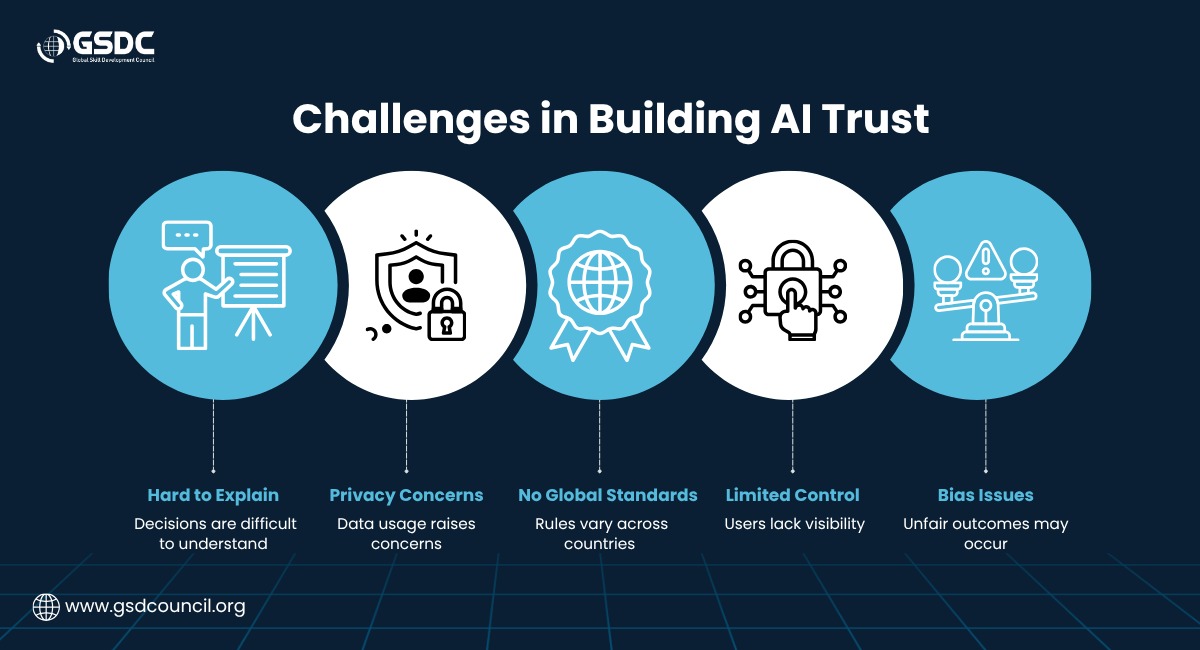
This list proves that trust in AI is continuously growing and should be dealt with as the technology develops.
The Future of AI Trust and Transparency
In the coming years, trust will play a vital role in the advancement of artificial intelligence.
This will include:
- More regulations are being enforced
- More effective monitoring of AI technology
- Greater emphasis on Explainable AI (XAI)
- Trust is becoming an important business priority
With AI technology becoming more sophisticated and more widely used, it will no longer be a choice. Rather, it will be necessary to be successful.
Why Skills Matter for AI Trust
With the development of AI becoming more sophisticated, trust-building for AI cannot be considered purely technical; it is also associated with individuals.
It becomes necessary for companies to employ qualified specialists who are aware of the working of AI and can operate it in an efficient manner. To achieve that, proper training is required, which is offered by the Global Skill Development Council (GSDC).
Some popular AI courses, including the Certified Artificial Intelligence Foundation, enable individuals to gain the required skills. With the progression of time, skills are going to play an important part in creating AI systems that can be trusted.

Conclusion: Trust Will Define the Future of AI
Artificial intelligence technology is moving into its next era, which can be termed the agentic era. AI is now more than just a means to an end; rather, it has begun to make decisions on behalf of humans.
To maximize the potential of artificial intelligence technologies, businesses should concentrate on fostering trust in AI-based solutions. In other words, as artificial intelligence technology evolves, trust will determine its success. This is because the success of the future of artificial intelligence depends on one thing only: Trust.

Related Certifications
Frequently Asked Questions
Stay up-to-date with the latest news, trends, and resources in GSDC
If you like this read then make sure to check out our previous blogs: Cracking Onboarding Challenges: Fresher Success Unveiled
Not sure which certification to pursue? Our advisors will help you decide!