The Anatomy of an HR Prompt: The RTCF Framework

Written by Emily Hilton
- What is the RTCF Framework?
- Why HR Teams Need Structured Prompting
- Breaking Down the Four Components of RTCF
- A Real HR Example of RTCF in Action
- Moving Beyond RTCF: Advanced Prompting Techniques for HR
- RTCF and the Future of AI-Driven HR Operations
- Measuring the Business Value of AI in L&D
- Responsible AI and Governance Considerations
- Conclusion: RTCF as the Foundation of Better HR AI
Have you ever wondered why most HR prompts fail despite using advanced AI tools? The growing adoption of generative AI in HR introduction strategies is transforming how recruiters, HR leaders, and L&D professionals handle onboarding, training, employee communication, and performance management.
Yet many teams still struggle with inconsistent AI-generated outputs because prompts are often vague, unclear, and poorly structured. Even the best AI systems fail when users cannot provide clear AI instructions that HR tools can understand effectively.
This is where the prompt framework for HR (RTCF) becomes essential. RTCF Role, Task, Context, and Format helps HR teams create structured prompts that improve output quality, consistency, and relevance. It also supports advanced techniques like few-shot prompting for HR, role prompting for L&D, and chain of thought prompting for HR.
In this blog, we are going to learn how RTCF works, why it matters for modern HR teams, and how it supports initiatives like prompt chaining course design, AI self-critique prompting HR, RAG for L&D content, AI agents for HR onboarding, HR prompt templates library development, and measuring AI ROI in L&D for scalable enterprise AI adoption.
What is the RTCF Framework?
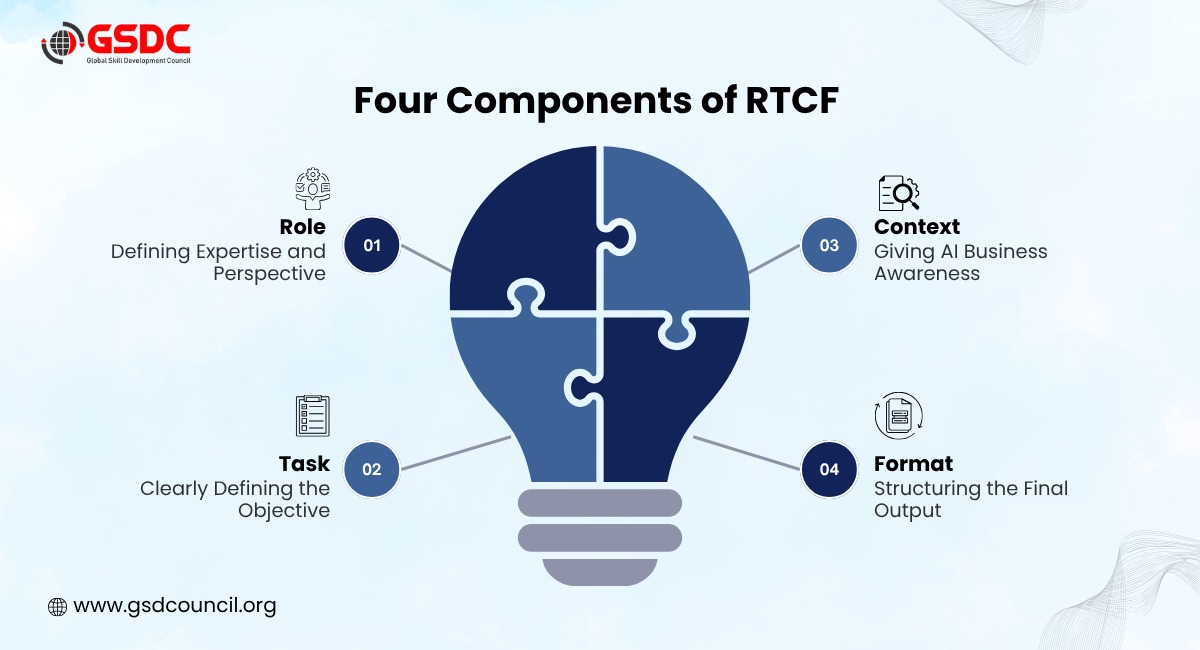
At its core, RTCF is built around four essential components that define a strong AI prompt:
- Role — Who the AI should behave as
- Task — What the AI should do
- Context — The business situation surrounding the request
- Format — How the final output should be structured
These four elements may appear simple, but together they solve the most common problems associated with AI-generated content in HR.
Most ineffective prompts fail because one or more of these components are missing. HR professionals often ask AI to “create onboarding training” or “write an employee communication” without clarifying audience, business goals, expertise level, or output expectations. As a result, the AI generates broad, generic responses that require significant editing.
RTCF removes that ambiguity.
Instead of giving AI incomplete instructions, the framework encourages HR teams to think intentionally about expertise, objectives, business constraints, and deliverable structure before generating content. In many ways, RTCF mirrors how experienced HR leaders delegate work to employees or consultants. Clear delegation produces better outcomes and AI operates the same way.
Why HR Teams Need Structured Prompting
As AI becomes increasingly integrated into HR functions such as onboarding, recruitment, learning management, and employee communication, organizations need a consistent way to interact with AI systems effectively. Without a structured approach, employees create prompts differently, leading to inconsistent outputs, confusion, and slower AI adoption across teams.
The RTCF framework addresses this challenge by providing a standardized method for AI communication through Role, Task, Context, and Format. This structure helps HR professionals generate clearer prompts and achieve more accurate, reliable, and scalable results.
Organizations using structured prompting frameworks benefit in several ways:
- Improved consistency in AI-generated HR content
- Faster prompt creation and fewer revisions
- Better collaboration across HR and L&D teams
- Higher-quality recruitment and training outputs
- Stronger organizational AI literacy
- Better governance and responsible AI usage
Structured prompting also helps employees learn how to provide clear AI instructions HR systems can process effectively. Instead of relying on trial-and-error prompting, teams develop repeatable workflows that improve productivity and confidence in using AI tools.
For organizations focused on digital transformation, RTCF becomes a foundational part of broader GenAI change management HR strategies, enabling scalable and efficient AI adoption across multiple HR functions.
Breaking Down the Four Components of RTCF
Role: Defining Expertise and Perspective
The first part of RTCF tells the AI who it should act as.
This is one of the most overlooked aspects of prompting, yet it has a major impact on output quality. AI systems respond differently depending on the expertise, seniority, and specialization assigned to them.
Consider the difference between these two prompts:
“You are an HR professional.”
versus:
“You are a senior L&D designer with 15 years of experience in B2B SaaS onboarding.”
The second example provides significantly more direction. It establishes expertise, industry context, and functional specialization. This improves the relevance of recommendations, tone, terminology, and instructional quality.
This approach is particularly important in role prompting for L&D, where the quality of generated learning content depends heavily on the instructional perspective assigned to the AI.
Strong role definitions help AI produce outputs that feel more aligned with real-world HR expertise rather than generic internet content.
Task: Clearly Defining the Objective
The Task section explains exactly what the AI should do.
Many weak prompts fail because the requested task is too broad or poorly defined. Asking AI to “help with onboarding” creates confusion because the system does not know whether the user wants a training plan, an email sequence, a facilitator guide, or a learner assessment.
A strong task statement removes that uncertainty.
For example:
“Draft a 30-minute onboarding microlearning module for new sales hires.”
This instruction clearly defines:
- the deliverable,
- the audience,
- and the scope of work.
The best task instructions usually contain an action verb and a tangible deliverable. Terms like create, design, analyze, summarize, compare, or draft help direct the AI toward a specific output type.
This clarity becomes even more important in large-scale prompt chaining course design workflows where multiple prompts build sequentially into a complete learning experience.
Context: Giving AI Business Awareness
Context is often the factor that separates average AI output from highly usable content.
Without context, AI relies on generic assumptions. It does not understand the company’s industry, employee background, learning environment, constraints, or operational realities unless those details are explicitly provided.
For example:
“The company sells HR analytics software to mid-market customers. New sales hires come from diverse selling backgrounds. This module is part of Day 1 in a five-day onboarding bootcamp.”
This short paragraph gives the AI critical information that shapes the entire response. It influences tone, complexity level, examples, and instructional recommendations.
Context also becomes extremely important in enterprise environments using RAG for L&D content systems. Retrieval-augmented generation tools pull internal documentation, policies, or knowledge repositories into prompts dynamically. When combined with RTCF, these systems can generate highly contextualized learning experiences tailored to organizational needs.
The broader lesson is simple: generic prompts create generic outputs. The more business reality you provide, the more relevant the AI response becomes.
Format: Structuring the Final Output
The final component of RTCF defines how the AI should present the information.
One of the most common mistakes HR professionals make is assuming AI automatically knows what structure they want. In reality, formatting instructions significantly improve usability and reduce editing time.
Instead of saying:
“Make it look professional,”
a better instruction would be:
“Provide the output as a markdown table with columns for Minute Range, Topic, Activity Type, and Learner Output.”
Specific formatting instructions help standardize outputs across teams. They also support the development of reusable HR prompt templates library systems that employees can apply repeatedly across different HR workflows.

A Real HR Example of RTCF in Action
To understand the RTCF framework more practically, consider the following onboarding use case.
An HR team wants AI to generate a 30-minute onboarding microlearning module for new sales hires.
Instead of writing a vague request, they structure the prompt using RTCF principles.
The Role establishes expertise:
“You are a senior L&D designer with 15 years of experience in B2B SaaS onboarding.”
The Task defines the objective:
“Draft a 30-minute onboarding microlearning module for new sales hires.”
The Context explains the business situation:
“The company sells HR analytics software to mid-market customers. New reps come from diverse selling backgrounds. This is Day 1 of a five-day onboarding bootcamp.”
Finally, the Format specifies structure:
“Present the output as a markdown table with columns for Minute Range, Topic, Activity Type, and Learner Output.”
The resulting AI output becomes dramatically more actionable because every element of the request is clearly defined.
Moving Beyond RTCF: Advanced Prompting Techniques for HR
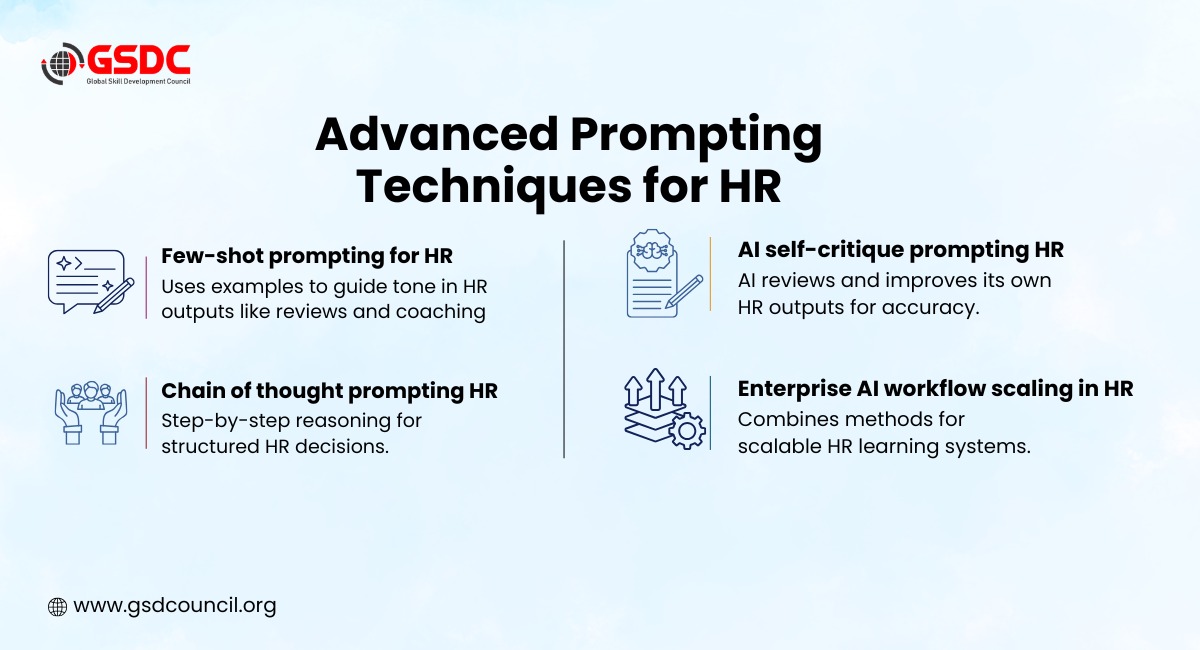
RTCF provides a strong foundation for effective prompting, but advanced HR teams enhance outcomes by combining it with other techniques to improve accuracy, tone, and depth.
Key Advanced HR Prompting Techniques:
- Few-shot prompting for HR: Improves output quality by giving examples before generating content. Ideal for performance reviews, coaching feedback, and leadership communication to set tone and style.
- Chain of thought prompting HR: Encourages step-by-step reasoning before conclusions. Useful in workforce planning, leadership assessments, and curriculum design for more structured insights.
- AI self-critique prompting HR: Enables AI to review and refine its own output before finalizing. Helps reduce errors, improve instructional quality, and minimize hallucinations.
- Enterprise AI workflow scaling in HR: Combines these techniques to support large-scale learning systems and AI-powered course development workflows.
RTCF and the Future of AI-Driven HR Operations
The future of HR AI extends beyond simple content generation tools. Organizations are increasingly experimenting with autonomous systems and intelligent assistants that can support employees throughout the talent lifecycle.
Examples include:
- AI agents for HR onboarding
- employee support assistants,
- learning recommendation engines,
- policy guidance systems,
- and internal career coaching agents.
Even these advanced systems depend heavily on structured prompting frameworks. AI agents still require clear roles, contextual awareness, task boundaries, and clear output expectations to operate effectively.
As organizations expand AI adoption, RTCF becomes increasingly important as a governance and operational standard rather than just a writing technique.
Measuring the Business Value of AI in L&D
One of the biggest questions organizations face today is how to justify AI investments. This is where measuring AI ROI in L&D becomes essential.
Structured prompting frameworks like RTCF help organizations achieve measurable outcomes because they improve consistency and reduce inefficiencies.
Companies using structured prompting often report:
- faster onboarding content creation,
- reduced instructional design effort,
- improved learning consistency,
- quicker employee ramp-up times,
- and lower revision cycles.
These improvements make it easier to quantify the business impact of AI adoption in HR environments.
Responsible AI and Governance Considerations
As AI adoption grows, HR leaders must also consider governance, compliance, and ethics.
Conversations around responsible AI in HR / EU AI Act compliance are becoming increasingly important, particularly in areas like hiring, promotion, performance management, and employee analytics.
Structured prompting frameworks support governance by improving transparency and repeatability. When prompts follow standardized structures, organizations can document workflows more effectively, audit outputs more easily, and reduce risks associated with inconsistent AI usage.
This is another reason RTCF is becoming valuable at the enterprise level. It supports not only productivity but also accountability.

Conclusion: RTCF as the Foundation of Better HR AI
The future of HR will not be defined solely by access to AI tools. It will be defined by how effectively organizations communicate with those tools.
RTCF offers a practical and scalable way to improve AI interactions across HR and L&D functions. By focusing on Role, Task, Context, and Format, HR professionals can move beyond vague prompting and begin generating outputs that are strategic, structured, and immediately usable.
Whether the goal is onboarding design, leadership development, learning content creation, or enterprise AI adoption, RTCF provides a reliable framework for producing better results with less rework.
It is also why the framework plays a central role in the GSDC GenAI L&D HR certification program, where professionals learn how to operationalize AI effectively within HR environments.

Related Certifications
Frequently Asked Questions
Stay up-to-date with the latest news, trends, and resources in GSDC
If you like this read then make sure to check out our previous blogs: Cracking Onboarding Challenges: Fresher Success Unveiled
Not sure which certification to pursue? Our advisors will help you decide!