Artificial Intelligence vs Machine Learning: What You Need to Know in 2026
Written by Matthew Hale
- What Is Artificial Intelligence (AI)?
- What Is Machine Learning (ML)?
- Artificial Intelligence vs Machine Learning: Key Differences
- Why the Difference Between AI and ML Matters for Businesses
- How AI and Machine Learning Are Used Across Industries
- Artificial Intelligence Career Paths and Salary Outlook
- Skills Needed for Careers in Artificial Intelligence and Machine Learning
- Building AI Foundations with GSDC
- The Future of Artificial Intelligence and Machine Learning
- Conclusion: Machine Learning vs AI - What Professionals Should Know
- FAQs: Artificial Intelligence vs Machine Learning
Artificial intelligence vs machine learning has been among the hottest topics being debated in the digitization journey of the world. AI-powered systems are changing the face of industries like healthcare, finance, marketing, and operations. However, many professionals are still wondering: what are artificial intelligence and machine learning, and in what way are they different?
The distinction between machine learning and AI is no longer in the domain of only tech teams. Executives, team leaders, and employees are increasingly getting involved in and deciding on technology, recruiting, and strategy by having a proper understanding of the differences and the similarities between artificial intelligence and machine learning.
This blog helps to clarify these two ideas straightforwardly, enumerates their connection, and demonstrates the importance of artificial intelligence and machine learning for the development of a career and a business.
What Is Artificial Intelligence (AI)?
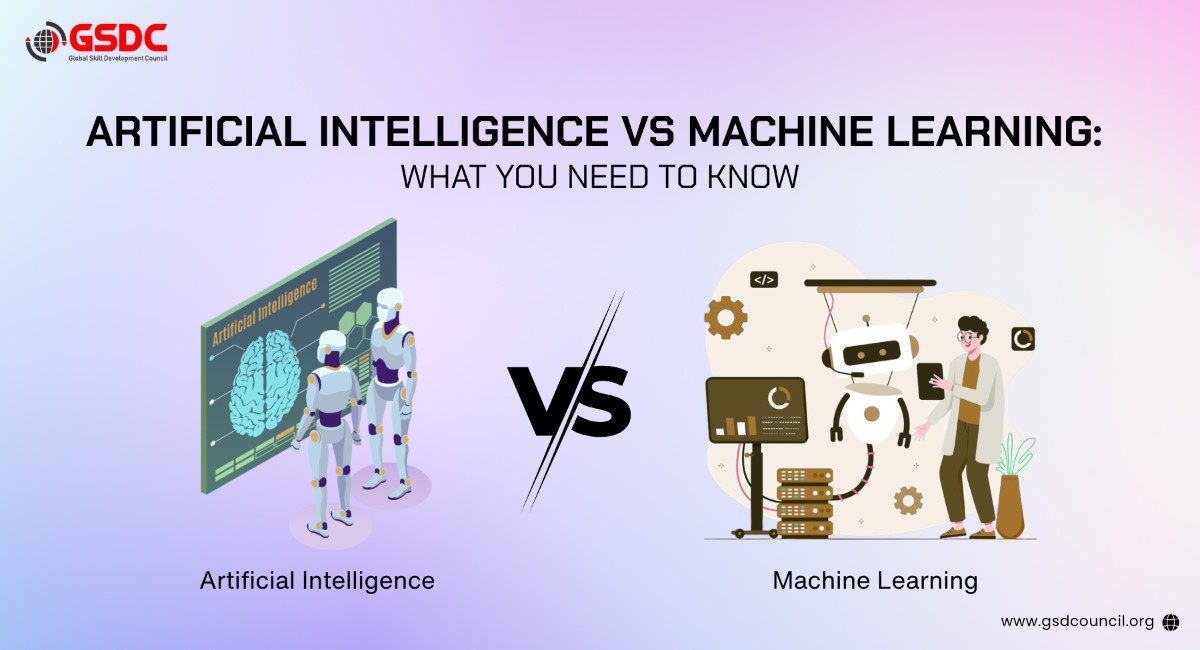
Artificial Intelligence (AI) refers to the technology that allows computers and machines to mimic human intelligence. In other words, AI systems are capable of performing tasks that usually require human thinking, such as learning, reasoning, decision-making, and data interpretation.
AI systems are programmed to comprehend their surroundings, recognize patterns, and respond to them in methods that assist humans in working more efficiently and effectively.
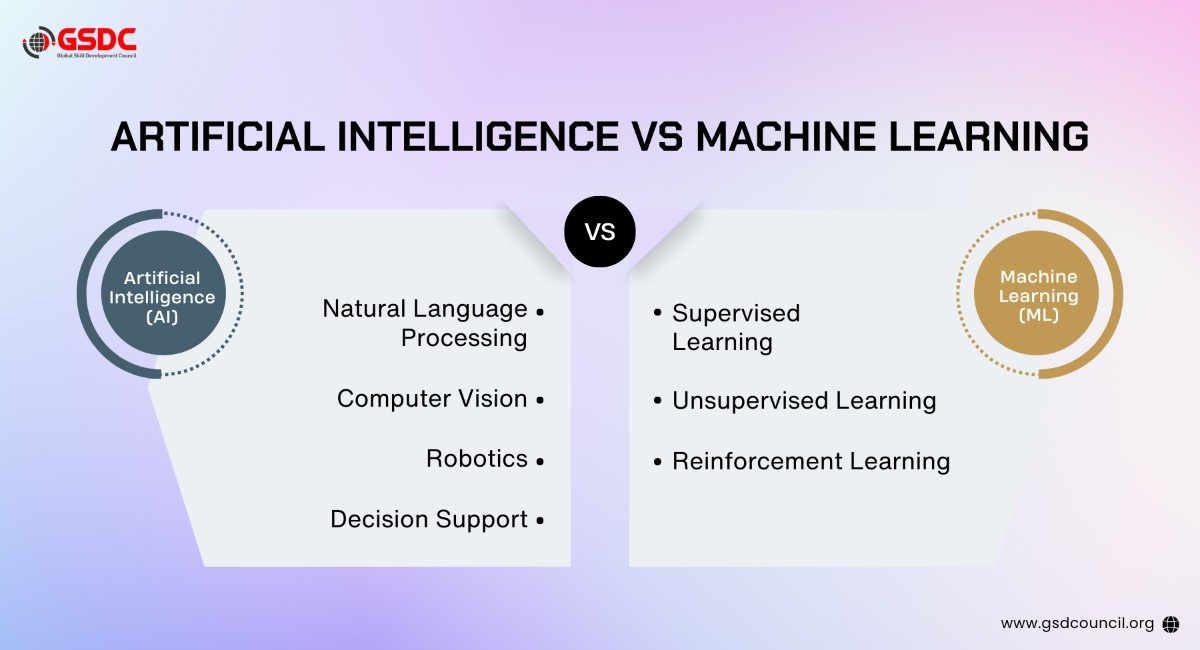
From a practical perspective, Artificial Intelligence (AI) is a range of abilities that allow machines to perform tasks that human beings were previously considered to be the only ones capable of:
- Natural language processing (NLP): enabling computers to comprehend and produce human language.
- Computer vision: granting machines the capability to see, understand, and evaluate visual information.
- Robotics: the physical equipment that can carry out tasks in the actual world.
- Knowledge reasoning and decision support: facilitating firms to understand data and make more effective decisions.
Artificial intelligence at a company level is beneficial as it helps businesses to automate mundane tasks, accelerate the process of data analysis, give customers better experiences, and improve decision-making. It is more than just substituting human labor; it is the enhancement of human labor so that personnel can dedicate their attention to more valuable work and innovation.
What Is Machine Learning (ML)?
For an artificial intelligence vs machine learning comparison, one of the initial things that is important to take note of is a simple definition of machine learning.
Machine Learning (ML) is a subset of AI that enables computers to learn from examples and modify their behavior accordingly without the need for being programmed step by step. Traditional computer programs run based on predefined rules, while ML models find patterns in past data from which they can make forecasts or take actions in new data.
Conceptually, machine learning systems are often trained by employing various learning methods, such as:
- Supervised learning: deriving knowledge based on labeled data
- Unsupervised learning: discovering patterns in unlabeled data
- Reinforcement learning: learning by trial, feedback, and reward
Nowadays, the meaning of machine learning has gone well beyond the walls of research laboratories to daily business use. Recommendation engines, fraud detection, predictive analytics, and personalization are just some areas where ML is the driving force of real-world applications. Therefore, the discussions about machine learning vs AI usually highlight how machine learning is the learning engine that drives broader AI systems.
Artificial Intelligence vs Machine Learning: Key Differences
People often use the terms interchangeably, but artificial intelligence vs machine learning identifies two different levels of intelligent systems. To put it simply, AI is the general idea of making machines "smart, " and machine learning is one of the main ways those machines get the knowledge from data.
|
Aspect |
Artificial Intelligence |
Machine Learning |
|
Scope |
Broad field of intelligent systems |
A subset of AI focused on learning from data |
|
Goal |
Mimic human intelligence and decision-making |
Learn patterns and improve with experience |
|
Data dependence |
May or may not rely heavily on data |
Heavily dependent on high-quality data |
|
Example |
Virtual assistants, autonomous robots |
Recommendation engines, spam filters |
In summary, all machine learning is AI, but not all AI is machine learning. This difference is crucial when one makes a comparison between machine learning and AI for the purposes of actual business cases, technology investments, and digital transformation initiatives.
For those professionals who want to get a solid grasp of these concepts, educational courses like the Certified Artificial Intelligence Foundation can be highly helpful to understand the interaction of AI and machine learning in everyday, real scenarios.Why the Difference Between AI and ML Matters for Businesses
Understanding the difference between AI and ML is not merely a technical matter, it fundamentally affects how companies strategize, recruit, and allocate their IT budget. Team confusion over machine learning vs AI often leads to the selection of inappropriate solutions or to the setting of expectations that are not met.
- Clearer strategy: For example, a bank may say it wants to “use AI to reduce fraud.” In practice, fraud detection relies on machine learning models trained on transaction data, while AI systems manage the overall decision workflow. Knowing the difference between artificial intelligence vs machine learning helps teams define the right approach from the start.
- Smarter hiring: A startup building an AI-powered support platform needs more than application developers. It also needs ML engineers, data scientists, and product leaders who understand how machine learning vs AI works in production. This clarity leads to better team design and faster execution.
- Better investment decisions: Organizations sometimes buy “AI platforms” that offer automation and dashboards but lack strong ML capabilities for forecasting or prediction. Understanding artificial intelligence vs machine learning helps leaders invest in tools that deliver real predictive value, not just surface-level automation.
How AI and Machine Learning Are Used Across Industries
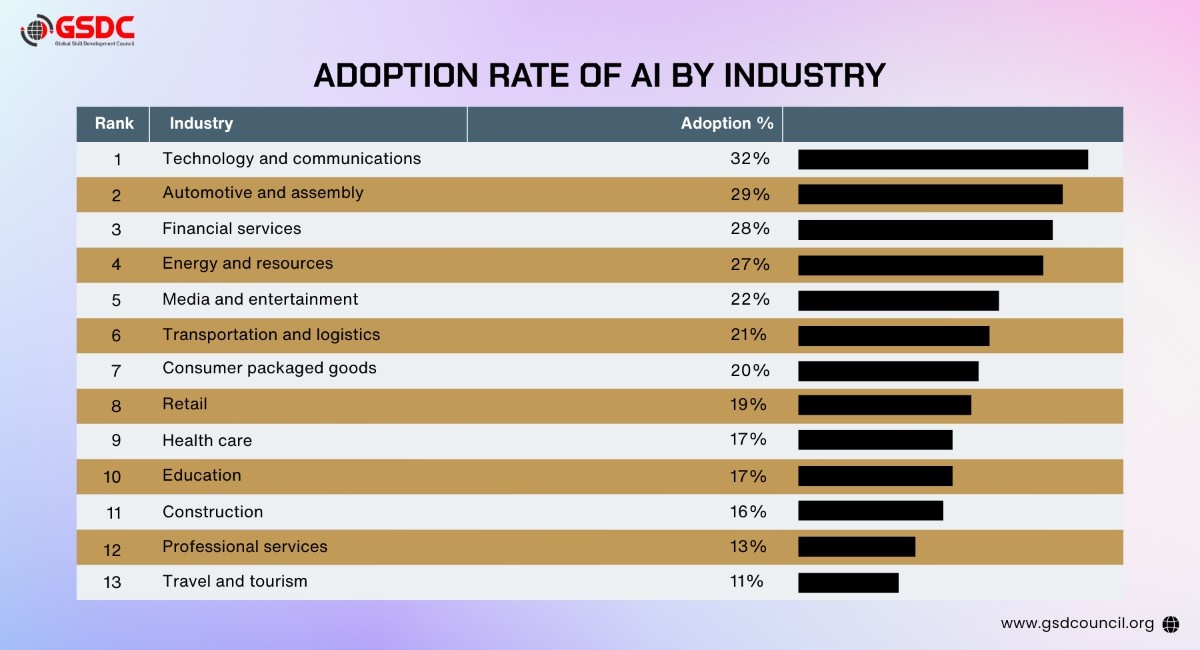
Across industries, artificial intelligence vs machine learning shows up in practical ways: AI handles decision-making and automation, while ML provides the data-driven predictions that power those decisions. This is a simple way to think about machine learning vs AI in real-world use.
|
Industry |
AI Use Case |
ML Contribution |
|
Healthcare |
AI-powered diagnostic tools |
ML models analyzing medical images |
|
Finance |
Fraud detection systems |
Predictive risk scoring |
|
Retail |
Personalized recommendations |
ML forecasts for inventory |
|
Manufacturing |
Intelligent automation |
Predictive maintenance models |
Artificial Intelligence Career Paths and Salary Outlook
With the rapid adoption of AI, there is an increasing number of career options in this area. The present AI industry includes:
- Professionals in AI strategy and governance
- Data scientists and machine learning engineers
- AI product managers
- AI ethics and compliance experts
- Business analysts using AI-enabled systems
Search interest in artificial intelligence jobs salary continues to rise as organizations compete for skilled talent. Similarly, demand for ML specialists has driven strong growth in machine learning engineer salary benchmarks globally.
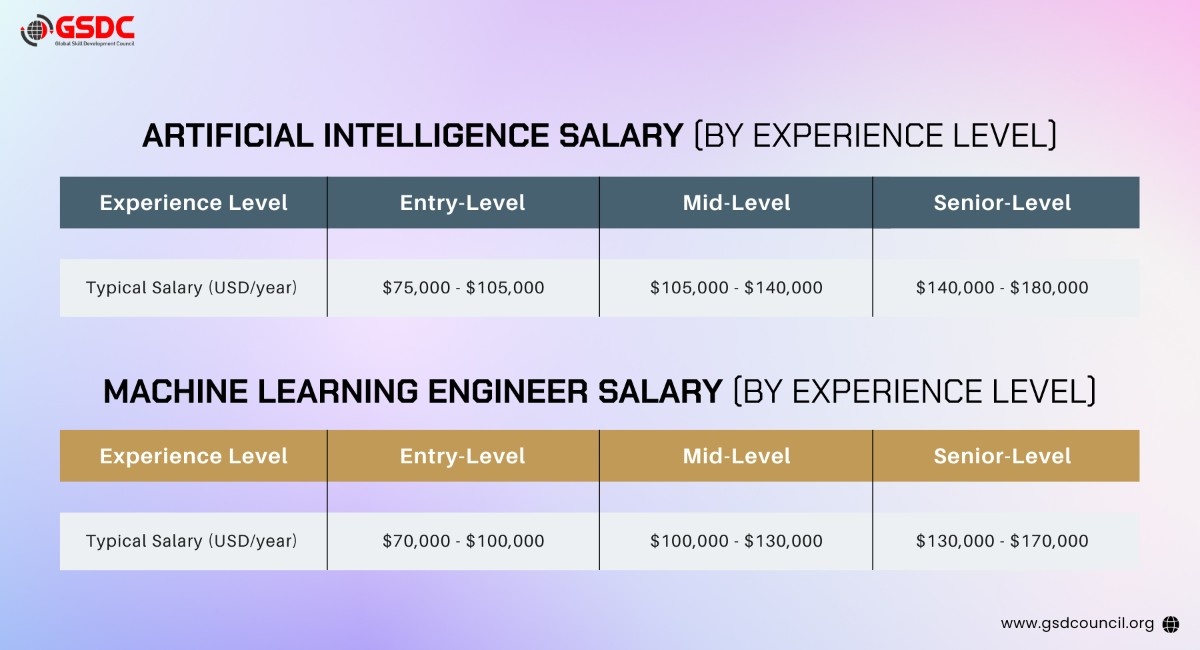
Understanding machine learning vs AI helps professionals position themselves effectively - whether they pursue broad artificial intelligence career paths or specialize in machine learning engineering roles.
Skills Needed for Careers in Artificial Intelligence and Machine Learning
If your target is AI-related jobs, your focus should be on matching your skills with AI planning and the application of ML. The main skills should be:
- Understanding AI frameworks and overall strategy
- Human and AI collaboration
- Applying ethical AI
If your target is ML-related jobs, your focus should be on the overall ML pipeline:
- Data preparation and feature development
- Model training and performance assessment
- Application and monitoring of ML systems in production
Blending technical depth with business understanding strengthens long-term growth across artificial intelligence career paths.
Building AI Foundations with GSDC
As discussions about artificial intelligence and machine learning change from theory to actual application, experts require a formal method of developing their practical skills. Global Skill Development Council (GSDC) is geared towards industry, aligned learning frameworks that help tie the machine learning vs AI concepts to real business use cases.
Programs like the Certified Artificial Intelligence Foundation help participants build a solid foundation in AI and understand the function of machine learning as part of bigger AI systems, which is very important for the students' future development in new AI, related areas.

The Future of Artificial Intelligence and Machine Learning
Enterprise technology in the future will be focused on AI and ML convergence. Smart decision machines, self-governing systems, and predictive analytics tools are increasingly merging both technologies.
Professionals who clearly understand what is artificial intelligence vs machine learning will be better prepared to lead transformation initiatives, evaluate emerging tools, and shape competitive strategy.
Conclusion: Machine Learning vs AI - What Professionals Should Know
The debate of artificial intelligence vs machine learning goes beyond semantics; it is about the realization of value through modern intelligent systems. AI is a term that covers the grand idea of intelligence in machines, whereas ML offers the actual learning methods that drive these smart machines.
In terms of businesses, understanding the difference between machine learning and AI leads to wiser decision-making in the allocation of resources. As for workers, it helps them in charting their career paths, setting their salary goals, and identifying their potential for growth in a fast-changing employment market.
FAQs: Artificial Intelligence vs Machine Learning
1) What is artificial intelligence vs machine learning in practical business terms?
In practice, what is artificial intelligence vs machine learning comes down to scope: AI manages decision workflows and automation, while machine learning trains models on data to improve accuracy over time.
2) Can companies use machine learning without a full AI strategy?
Yes. Organizations can deploy machine learning vs AI for specific use cases like forecasting or recommendations, but results scale better when ML is part of a broader AI roadmap.
3) Why is artificial intelligence good beyond automation?
Artificial intelligence being good goes beyond just automation or speed of work; it is also a great decision-making tool as it can process and analyze huge amounts of data to give us useful insights.
4) How do artificial intelligence career paths differ from machine learning roles?
Artificial intelligence career paths offer a wide range of opportunities (strategy, product, governance), whereas ML roles are heavily centered around the technical part of building and deploying models.
5) How should professionals compare artificial intelligence jobs salary vs machine learning engineer salary?
In a comparison between salaries of artificial intelligence jobs and machine learning engineers, one should also look at the position's responsibilities and potential for growth besides the salary alone.

Related Certifications
Stay up-to-date with the latest news, trends, and resources in GSDC
If you like this read then make sure to check out our previous blogs: Cracking Onboarding Challenges: Fresher Success Unveiled
Not sure which certification to pursue? Our advisors will help you decide!