Prompting as Organizational Design: Building AI for Company Frameworks
Written by Ken Sapp
- From Tools to Decision Infrastructure
- The Master Blueprint
- Strategic Dilemmas: Where Intelligence Is Proven
- Two Modes of Decision-Making
- Why “Good” Systems Still Fail
- The Power of Consistency
- Building a System That Thinks Like You
- Become an AI Leader: GSDC Certified AI Expert Certification
- Conclusion
AI is not just changing how companies work.
It’s redefining how decisions are made.
The real advantage isn’t access to AI tools. It’s the ability to build Growth Infrastructure: systems that think, decide, and execute in alignment with your company’s best judgment.
This is an Architectural Prompt: Design a structured prompt design approach embedded within the organization design process.
Instead of writing isolated prompts, a prompt designer enables leading companies to encode their Hard-Won Playbooks, decision standards, and strategic logic into structured systems aligned with an AI governance framework. These systems don’t just generate output. They replicate how the company thinks.
From Tools to Decision Infrastructure
Most teams start with AI as a tool. Of course, it is fast, flexible, and immediately useful. Unfortunately, by default, AI operates on average thinking. The AI engine is built on large databases of content that in themselves are decidedly average, often surfaced through prompting engineering. It gives you the most statistically popular answer but does not have a way to filter superior quality content. To do that, it needs your company’s proven standards and experience, supported by the right AI governance tools and AI governance software within a strong enterprise AI strategy.
In addition, companies often have competing priorities. Without guidance, AI cannot distinguish between fundamentally different strategies:
- A discount retailer optimizing for volume
- A premium brand protecting perception and pricing power
- Both are valid, but they require completely different decision logic.
If your AI doesn’t understand that logic, it will produce work that erodes your positioning.
Growth Infrastructure solves this.
It transforms AI from a tool into a Decision Engine that operates within your strategic boundaries.
The Master Blueprint
A well-designed system does more than answer questions. It encodes how your company operates:
- Your Playbooks (what works, and why)
- Your Decision Logic (how trade-offs are evaluated)
- Your Standards (what is acceptable - and what is not)
This becomes your Master Blueprint - the structural foundation behind every output.
At that point, prompts are no longer requested.
They are execution protocols.
Strategic Dilemmas: Where Intelligence Is Proven
Real strategy emerges in moments of tension.
Consider a simple messaging decision:
Option 1: Efficiency
“This saves you time.”
Easy to understand. Common. Low differentiation.
Option 2: Authority
“This eliminates blind spots that create costly mistakes.”
More complex. Higher perceived value. Stronger positioning.
Most systems default to Option 1 because it performs well in the short term.
But premium brands consistently choose Option 2.
Why?
Because they operate on rules, not reactions.
They tend to prioritize long-term positioning over short-term gains.
Your AI must be capable of making the same distinction.
Two Modes of Decision-Making
Effective systems integrate complementary ways of thinking:
1. Outcome Tracker (Result-Oriented)
- Optimizes for performance
- Measures success through metrics (clicks, conversions, revenue)
- Continuously tests and improves outputs
2. Principle Guard (Standard-Oriented)
- Enforces brand integrity and professional standards
- Rejects actions that compromise positioning - even if they perform well
- Protects long-term trust and perception
Most AI systems are naturally biased toward the Outcome Tracker.
But without the Principle Guard, performance comes at the cost of brand erosion.
Excellence requires both.
Why “Good” Systems Still Fail
A system that only optimizes outcomes will drift toward:
- Commoditized messaging
- Short-term tactics
- Inconsistent brand expression
A system that only enforces rules will become:
- Rigid
- Slow to adapt
- Blind to performance signals
The advantage comes from structured balance - a system that knows:
- When to optimize
- When to protect
- When to do both
This is what we call Decision Infrastructure.
The Power of Consistency
Mastery is not creativity alone - it is repeatability at a high standard.
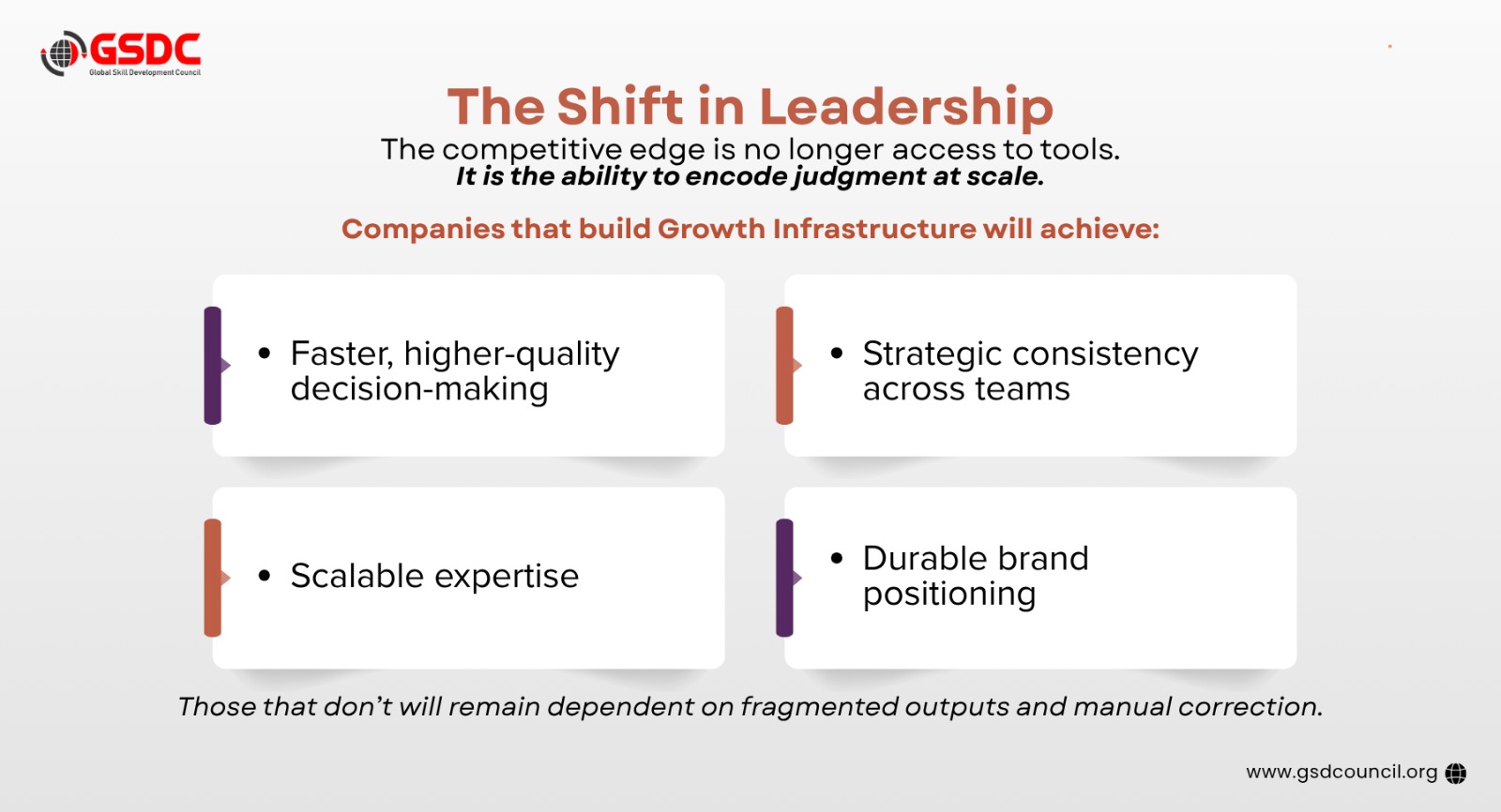
Growth Infrastructure enables:
- Consistent strategic decisions
- Reduced time spent correcting low-quality work
- Junior teams producing expert-level outputs
- Clear differentiation in crowded markets
It replaces variability with engineered excellence.
Building a System That Thinks Like You
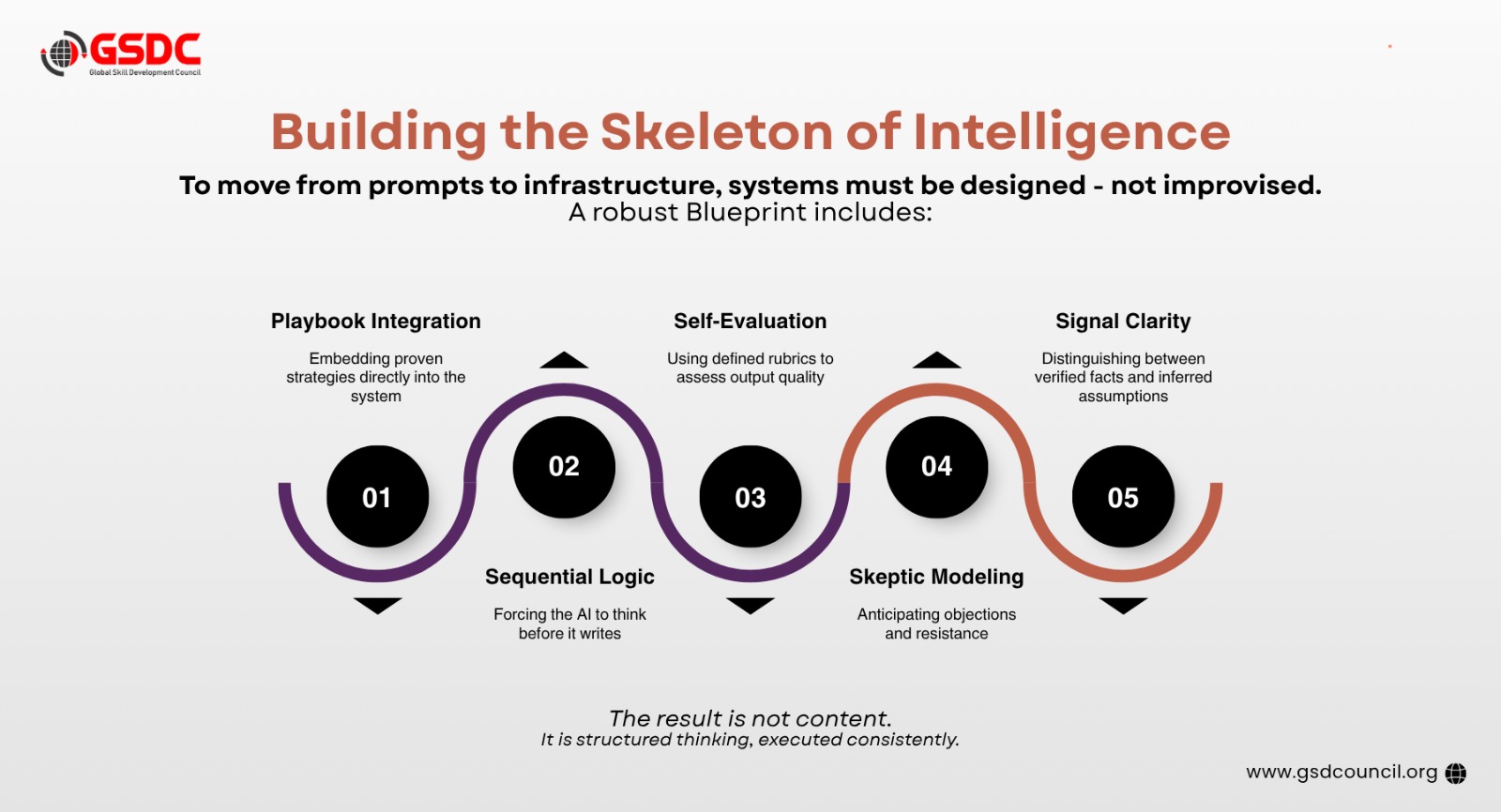
High-performing AI Prompts are built across five layers:
- Behavior Layer: Defines how the system communicates (peer-level, not subservient)
- Authority Layer: Embeds the frameworks and principles it must follow
- Sequential Engine: Structures the thinking process step-by-step
- Evaluation Layer: Applies internal scoring against your standards
- Refinement Loop: Continuously improves based on feedback and outcomes
Together, these layers transform AI from reactive to architected intelligence.
Become an AI Leader: GSDC Certified AI Expert Certification
GSDC’s Certified AI Tool Expert Certification is designed for professionals aiming to build practical, future-ready expertise in artificial intelligence and its real-world applications. This globally recognized program empowers learners to move beyond theory and develop hands-on skills in AI tools, generative AI, and intelligent automation used across modern enterprises.
The AI Tool Expert Certification combines expert-led sessions, structured learning paths, and real-world case studies to help participants apply AI concepts effectively. It focuses on enabling data-driven decision-making, improving operational efficiency, and driving innovation within organizations. Learners also gain exposure to emerging AI trends, ensuring they stay relevant in a rapidly evolving digital landscape.
Conclusion
The future belongs to companies that design how decisions are made, not just how work is produced.
By building structured systems through prompt design within the organization design process, you embed your standards, logic, and experience into scalable frameworks guided by an AI governance framework.
This enables a prompt designer to create a Decision Engine that scales your expertise as part of a strong enterprise AI strategy.
The advantage is not in asking better questions.
It is in architecting better thinking through prompting engineering supported by AI governance tools and AI governance software.

Related Certifications
Frequently Asked Questions
Stay up-to-date with the latest news, trends, and resources in GSDC
If you like this read then make sure to check out our previous blogs: Cracking Onboarding Challenges: Fresher Success Unveiled
Not sure which certification to pursue? Our advisors will help you decide!