From Workforce Transformation to AI-Ready Workforce Systems Design
Written by Nicole C. Jackson
The modern workplace is undergoing a structural transformation driven by artificial intelligence (AI), automation, and increasingly interconnected digital ecosystems. This era of AI workforce transformation is reshaping how organizations approach workforce design, workforce planning, and long-term organizational adaptability. As emerging workplace design trends continue to evolve, businesses are increasingly adopting intelligent AI workforce strategies and integrated workforce AI systems to remain competitive in rapidly changing markets.
For decades, organizations approached workforce planning primarily through the lens of headcount, job roles, and operational efficiency. However, this traditional paradigm is proving insufficient in an environment characterized by constant technological disruption, accelerated skill obsolescence, and shifting organizational boundaries. The growing AI impact on workforce structures, employee capabilities, and organizational models is forcing enterprises to rethink how work is designed, managed, and continuously optimized.
From a theoretical perspective, this shift reflects a movement away from static organizational design models toward systems thinking and complex adaptive systems theory, where organizations are viewed as dynamic, evolving networks rather than fixed hierarchies.
The central question is no longer:
“How many people do we need?”
But rather:
“How do we continuously sense, build, redeploy, and renew capabilities in response to change?”
This transition significantly expands the role of the Chief Learning Officer (CLO). CLOs are no longer responsible solely for training delivery or leadership development. Increasingly, they are becoming enterprise capability architects responsible for designing learning ecosystems, workforce intelligence systems, and adaptive organizational structures that support continuous evolution.
The Evolution of Workforce Strategy
Workforce strategy has evolved considerably over the last century alongside broader developments in management and organizational theory. Modern enterprises are increasingly embracing digital workforce transformation, intelligent workforce systems, and advanced AI transformation initiatives to remain competitive in rapidly changing business environments.
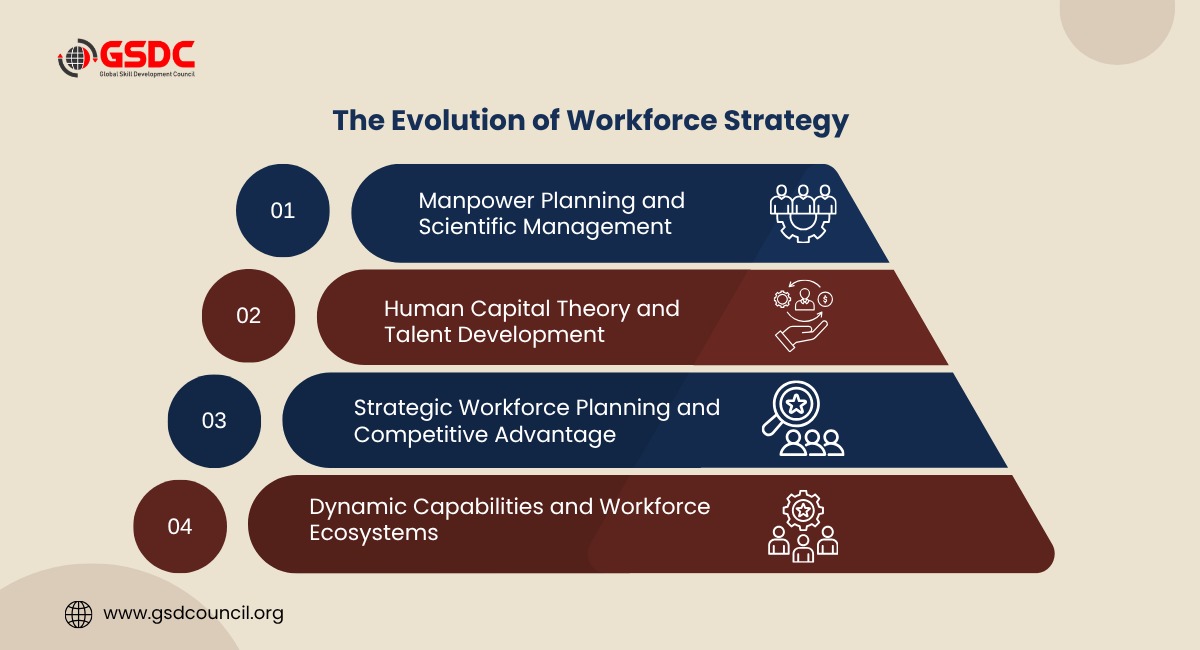
1. Manpower Planning and Scientific Management
Early workforce planning approaches were heavily influenced by Frederick Taylor’s Scientific Management principles in the early 20th century. These models emphasized efficiency, standardization, labor optimization, and task specialization. Employees were largely viewed as operational resources designed to maximize productivity and predictability. These early models also laid the foundation for what is workforce management in modern organizations, where operational coordination and workforce efficiency remain essential.
2. Human Capital Theory and Talent Development
In the postwar economy, Human Capital Theory, particularly through the work of Gary Becker in the 1960s, shifted attention toward employee knowledge, education, and skills as economic assets. While Becker did not create modern talent management itself, his theories strongly influenced the emergence of talent development frameworks that treated workforce capability as a driver of organizational value creation. These ideas continue to influence modern AI workforce management systems focused on capability development, learning agility, and talent optimization.
3. Strategic Workforce Planning and Competitive Advantage
During the 1990s, the Resource-Based View of the Firm, advanced by scholars such as Jay Barney, positioned workforce capabilities as a source of sustainable competitive advantage. Organizations increasingly recognized that unique skills, institutional knowledge, and organizational learning could differentiate firms in highly competitive markets. This period significantly advanced the importance of strategic workforce planning as organizations began aligning workforce capabilities with long-term business objectives.
4. Dynamic Capabilities and Workforce Ecosystems
Later, David Teece and colleagues introduced the concept of dynamic capabilities, emphasizing the ability of organizations to continuously sense, seize, and transform capabilities in rapidly changing environments. This perspective aligns closely with today’s AI-driven economy, where organizations must continuously renew workforce skills, technologies, and operational models. Modern workforce systems increasingly depend on adaptability, intelligent automation, and integrated AI transformation strategies.
At the same time, theories surrounding complex adaptive systems and organizational learning began to influence workforce thinking. Scholars such as Chris Argyris and Donald Schön emphasized continuous learning, feedback loops, and organizational adaptation as essential for long-term performance.
Despite these theoretical advances, many organizations remain anchored in industrial-era workforce models. Others have rushed into AI adoption and digital workforce transformation initiatives without sufficiently redesigning capability systems, governance structures, or workforce readiness strategies. These tensions often contribute to what is commonly referred to as the productivity paradox.
The Productivity Paradox of Digital Work
The productivity paradox, originally associated with economist Robert Solow, observed that large investments in information technology did not always produce immediately measurable productivity gains. Solow’s argument was not that technology inherently reduces productivity. Rather, the paradox highlighted several challenges:
- delayed returns on technology investments,
- difficulties in measuring knowledge work productivity,
- uneven technology adoption across organizations,
- and organizational lag in adapting processes and capabilities.
In modern knowledge work environments, these challenges have become more complex. Organizations now face additional digital-era pressures including:
- cognitive overload,
- fragmented attention,
- meeting fatigue,
- excessive digital communication,
- and constant connectivity.
These are not components of Solow’s original productivity paradox. Instead, they are contemporary workforce challenges emerging from digital work ecosystems and poorly integrated operating models.
The issue becomes even more significant because traditional industrial-era performance metrics often fail to capture the true value created by modern knowledge work.
Knowledge work frequently produces nonlinear value. Innovation, strategic insight, collaboration, and problem-solving do not always correlate directly with hours worked or visible activity levels. As a result, organizations that rely heavily on time-based productivity metrics may underestimate high-value cognitive and creative contributions.
Similarly, innovation and learning cannot be adequately measured through efficiency metrics alone. While output and execution remain important, organizations increasingly need to evaluate:
- strategic impact,
- capability growth,
- innovation outcomes,
- learning velocity,
- and organizational responsiveness.
To address these challenges, organizations may need to adopt principles from the Knowledge-Based Theory of the Firm, which views knowledge as the organization’s most strategically significant resource. From this perspective, competitive advantage depends less on static assets and more on how effectively organizations create, integrate, transfer, and apply knowledge.
This shift requires greater emphasis on:
- knowledge integration,
- collaborative problem-solving capability,
- innovation networks,
- organizational learning,
- and workforce intelligence.
As a result, CLOs and organizational leaders are increasingly moving beyond traditional KPIs toward capability-oriented measures such as:
Skill Velocity
The speed at which employees acquire, apply, and update critical skills in response to changing business demands.
Talent Liquidity
The organization’s ability to rapidly redeploy talent across projects, teams, and strategic priorities.
Innovation Output
The measurable business impact is generated through experimentation, new ideas, process improvements, and capability development.
These metrics differ substantially from industrial-era KPIs focused primarily on utilization rates, task completion, or labor efficiency.
Importantly, these productivity tensions reflect a broader organizational challenge: balancing operational stability with continuous adaptation.
The Tension Between Stability and Adaptability
Organizational theory has historically emphasized stability through hierarchy, control, specialization, and process standardization. These principles remain essential for operational reliability and scalable execution.
However, AI-driven environments increasingly demand agility, experimentation, resilience, and continuous capability renewal.
This tension is central to the theory of organizational ambidexterity, popularized by James March, which distinguishes between:
Exploitation
Focused on efficiency, execution, refinement, and optimization of existing capabilities.
Exploration
Focused on experimentation, innovation, learning, and discovery of new opportunities.
High-performing organizations must increasingly pursue both simultaneously.
However, scholars continue to debate whether organizations can fully optimize exploration and exploitation at the same time. Several models of ambidexterity have emerged, which ambidexterity scholars have argued and reviewed including:
- Structural Ambidexterity: separating innovation and operational activities into distinct organizational units,
- Contextual Ambidexterity: enabling employees to balance both activities within the same environment as part of the culture of the organization,
- Sequential Ambidexterity: shifting organizational focus over time between exploration and exploitation priorities.
For many organizations, the challenge is not replacing stability with adaptability, but embedding continuous learning and responsiveness within stable operational systems.
This is where the role of the CLO becomes increasingly strategic.
The Ambidextrous Workforce Architecture: An Operating Model for CLOs
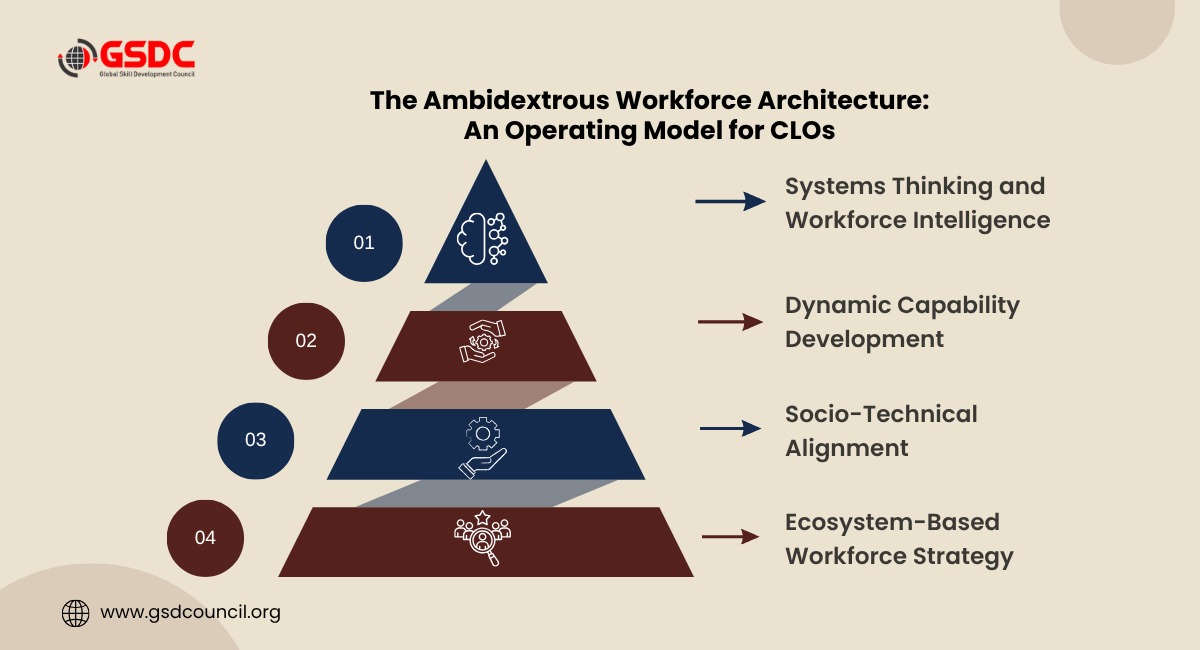
To operationalize these theoretical foundations, CLOs, therefore, must move beyond isolated learning initiatives toward integrated workforce systems design.
An ambidextrous workforce architecture should incorporate several interconnected capabilities:
1. Systems Thinking and Workforce Intelligence
Organizations need integrated workforce intelligence systems capable of continuously monitoring skills, learning trends, capability gaps, and strategic workforce risks.
Examples include:
- AI-enabled skills mapping platforms,
- capability dashboards,
- predictive workforce analytics,
- and real-time workforce planning systems.
These tools enable leaders to identify emerging skill needs before capability gaps become critical.
2. Dynamic Capability Development
Drawing from dynamic capabilities theory, organizations must build mechanisms that support continuous capability renewal.
This includes:
- rapid reskilling programs,
- adaptive learning ecosystems,
- internal gig marketplaces,
- project-based talent mobility,
- and cross-functional workforce deployment.
Internal talent marketplaces, for example, allow employees to move fluidly across strategic initiatives while improving organizational responsiveness and skill utilization.
3. Socio-Technical Alignment
Socio-technical systems theory emphasizes that organizational performance depends upon effective alignment between human systems and technological systems.
As AI adoption accelerates, CLOs must ensure that organizations do not focus exclusively on technological implementation while neglecting:
- employee adaptability,
- trust,
- collaboration,
- ethical governance,
- and human-centered change management.
AI systems alone do not create transformation. Sustainable transformation occurs when technology, culture, leadership, and workforce capability evolve together.
4. Ecosystem-Based Workforce Strategy
Modern organizations increasingly operate within broader workforce ecosystems that include:
- contractors,
- freelancers,
- strategic partners,
- external learning providers,
- and AI-enabled collaboration networks.
As organizational boundaries become more fluid, workforce systems design must account for both internal and external capability networks.
This requires governance models that support:
- knowledge sharing,
- workforce interoperability,
- capability transparency,
- and ecosystem collaboration.
Advance Leadership Excellence with Chief Learning Officer Certification
GSDC’s Chief Learning Officer Certification is designed for professionals who want to lead organizational learning, workforce development, and talent transformation initiatives with confidence.
Chief Learning Officer Certification helps learners build strategic leadership skills, align learning programs with business goals, drive employee growth, and create future-ready learning ecosystems. Ideal for HR leaders, L&D professionals, and business executives, it empowers professionals to make a lasting impact in today’s evolving workplace.
Conclusion
The future of work will not only be defined by technology alone, but by how effectively organizations integrate human capability, intelligent systems, and adaptive organizational structures into their organizational cultures and systems.
Theoretical foundations ranging from Human Capital Theory and Dynamic Capabilities Theory to Organizational Learning Theory, Socio-Technical Systems Theory, and Organizational Ambidexterity collectively point toward the same conclusion:
Long-term organizational success depends upon continuous capability renewal while also maintaining operational excellence in an increasingly AI-driven environment shaped by evolving workplace design trends and the growing AI impact on workforce structures.
This represents a fundamental shift from workforce transformation to workforce systems design supported by intelligent AI workforce and workforce AI strategies.
For CLOs, the implications are substantial. The role is evolving from learning leadership toward enterprise capability architecture. CLOs are increasingly responsible for designing integrated systems that connect workforce intelligence, learning ecosystems, talent mobility, AI adoption, governance, and organizational resilience within broader digital workforce transformation initiatives.
In the age of AI, organizations that succeed will not simply automate work more efficiently, rather, they will build systems capable of continuously evolving alongside technological, economic, and human change.

Related Certifications
Frequently Asked Questions
Stay up-to-date with the latest news, trends, and resources in GSDC
If you like this read then make sure to check out our previous blogs: Cracking Onboarding Challenges: Fresher Success Unveiled
Not sure which certification to pursue? Our advisors will help you decide!