AI Agent for Application Availability Monitoring
Written by Jinal Shah
- Understanding Application Availability Monitoring
- What Is an AI Agent in Application Monitoring?
- How AI Agents Improve Application Availability
- Why Businesses Are Adopting AI-Based Monitoring
- The Role of Ethics and Decision-Making in AI Systems
- Challenges in Implementing AI Monitoring
- Advance Your AI Expertise with GSDC’s Certified Agentic AI Professional Certification
- The Future of AI Agents in Application Monitoring
- Conclusion
In today’s always-connected digital environment, application availability has become a critical business priority rather than just a technical metric. From online shopping platforms and banking apps to customer support portals and SaaS tools, organizations depend heavily on their applications to deliver seamless user experiences.
Even a short outage can lead to lost revenue, frustrated customers, and long-term reputational damage. As modern applications become more distributed across cloud, microservices, and hybrid environments, traditional monitoring methods often struggle to detect issues quickly and maintain consistent performance. This has increased the need for advanced availability monitoring, cloud application monitoring, and intelligent operational strategies that can adapt to dynamic IT ecosystems.
This is where AI agents for application availability monitoring are transforming the landscape. Powered by advanced AI observability capabilities, these intelligent systems go beyond conventional monitoring by continuously analyzing telemetry data, detecting anomalies, identifying root causes, and predicting potential failures before they impact users. Modern AI observability platforms and AI monitoring tools enable organizations to gain deeper visibility into application performance while reducing the complexity of managing distributed environments.
Unlike traditional monitoring approaches that rely on manual checks, reactive alerts, or rigid monitoring rules, an AI monitoring system leverages AI-powered automation and machine learning to provide proactive insights and faster incident response. By combining observability and AIOps practices, organizations can improve uptime, streamline operations, and enhance overall system resilience.
In this blog, we’ll explore how AI agents work in application monitoring, why they are becoming essential for modern organizations, and how they help strengthen uptime monitoring, improve system reliability, and drive greater operational efficiency through intelligent automation.
Understanding Application Availability Monitoring
Application availability monitoring refers to the continuous tracking of an application's uptime, performance, and responsiveness. The goal is simple: ensure that applications remain accessible and functional for users at all times. In today's complex digital environments, uptime monitoring and cloud application monitoring have become essential for maintaining business continuity and user satisfaction.
Traditional monitoring tools typically rely on predefined thresholds and alerts. For example, if CPU usage exceeds a certain percentage or response time becomes too slow, the system sends a notification to the operations team. While this approach works in simple environments, modern IT ecosystems especially those built on microservices, containers, and cloud infrastructure generate enormous volumes of monitoring data.
As a result, IT teams often face issues such as:
- Alert fatigue due to excessive notifications
- Difficulty identifying root causes of failures
- Delayed responses to incidents
- Limited predictive capabilities
AI agents address these challenges by bringing AI-powered automation, intelligent analysis, and predictive insights into monitoring workflows. Leveraging AI observability and advanced AI monitoring tools, organizations can detect anomalies faster, improve decision-making, and enhance overall application reliability.
What Is an AI Agent in Application Monitoring?
An AI agent is an intelligent system designed to observe, analyze, and take actions within a digital environment. In the context of application availability monitoring, AI agents operate as autonomous assistants that monitor system health, detect anomalies, and recommend or initiate corrective actions.
Unlike traditional monitoring tools, AI agents can:
- Analyze large volumes of operational data in real time
- Identify patterns and anomalies that humans might miss
- Predict potential failures before they occur
- Automate troubleshooting and response actions
These capabilities allow organizations to move from reactive monitoring to predictive and autonomous operations.
How AI Agents Improve Application Availability
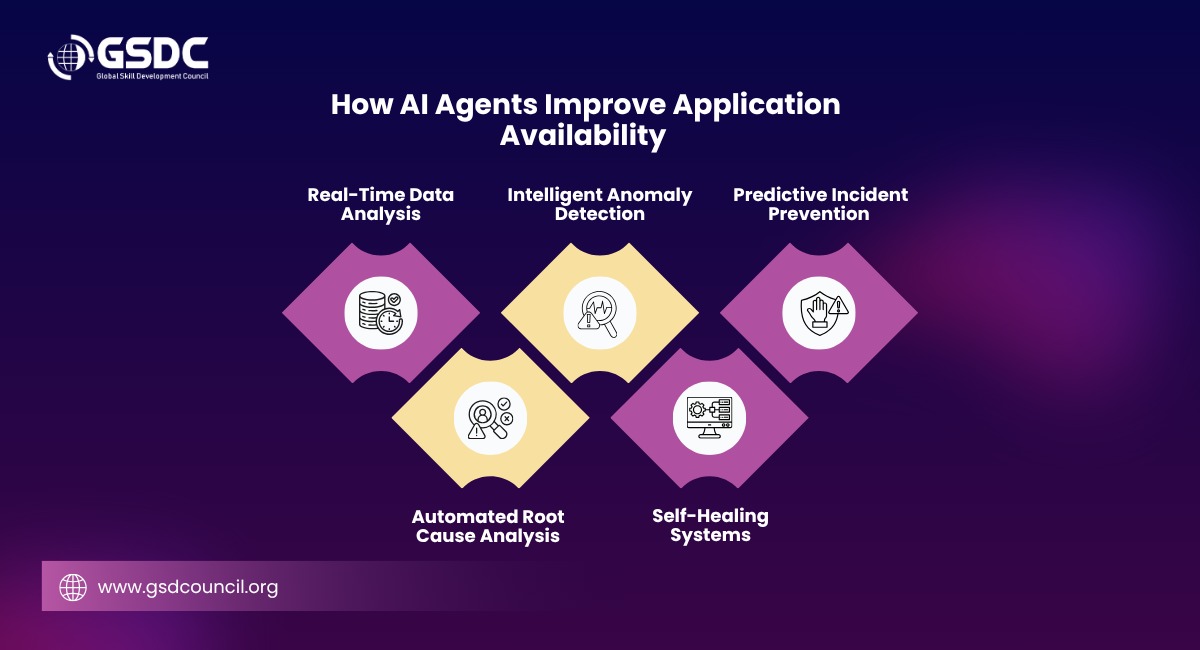
AI-driven monitoring introduces several improvements over traditional systems. By combining AI agents, AI observability, and AI-powered automation, organizations can maintain consistent application performance, strengthen uptime monitoring, and minimize downtime.
1. Real-Time Data Analysis
Modern applications generate telemetry data from multiple sources, including logs, metrics, and traces. AI monitoring systems continuously analyze this data in real time to identify unusual patterns.
For example, an AI agent might detect subtle performance degradation across multiple microservices. Instead of waiting for a full outage, the system alerts engineers early so they can address the issue before users are affected.
2. Intelligent Anomaly Detection
One of the key advantages of AI monitoring is its ability to detect anomalies without relying solely on static thresholds.
For instance, if an application usually processes 500 requests per minute but suddenly drops to 200 during peak hours, the AI intelligent agent can recognize this as abnormal even if it doesn't trigger a predefined rule.
This adaptive approach significantly improves the accuracy of AI monitoring tools and modern observability platforms.
3. Predictive Incident Prevention
AI agents can use historical data to forecast potential failures. By analyzing past incidents and performance trends, the system can identify early warning signs of system degradation.
For example, if a server shows recurring memory leaks during specific workloads, the AI agent can predict a future crash and recommend preventive actions such as restarting services or allocating additional resources.
Predictive monitoring reduces downtime and improves overall system resilience, making it a key capability of advanced AIOps platforms.
4. Automated Root Cause Analysis
When an incident occurs, determining the root cause can be time-consuming. Engineers often need to analyze multiple systems and logs to understand what went wrong.
AI agents can automatically correlate events across systems and identify likely causes. For example, if a database slowdown affects several services simultaneously, the AI observability platform can quickly pinpoint the database as the root issue.
This dramatically reduces Mean Time to Resolution (MTTR) and enhances AI DevOps operations.
5. Self-Healing Systems
Some advanced AI monitoring systems go beyond detection and analysis—they also trigger automated remediation actions.
Examples include:
- Restarting failing services
- Scaling infrastructure automatically
- Reconfiguring network routing
- Rolling back faulty deployments
These self-healing capabilities, powered by automation AI and observability and AIOps practices, ensure that applications recover quickly without requiring manual intervention.
Why Businesses Are Adopting AI-Based Monitoring
Organizations are rapidly adopting AI-powered monitoring solutions because they offer clear advantages in modern IT environments.
Reduced Downtime
AI-driven predictive monitoring helps detect issues early, preventing outages that could affect customers and revenue.
Improved Operational Efficiency
Automation reduces the manual workload for IT teams, allowing engineers to focus on strategic improvements rather than repetitive troubleshooting tasks.
Faster Incident Response
AI-assisted root cause analysis and automated remediation accelerate incident resolution.
Scalability for Complex Systems
AI agents can monitor thousands of microservices and distributed components simultaneously, making them ideal for cloud-native architectures.
The Role of Ethics and Decision-Making in AI Systems
While discussing intelligent systems, it's also important to consider how decisions are made. In many fields, including AI decision-making balancing outcomes and ethical principles is often involved.
For example, a famous philosophical thought experiment known as the “trolley problem” asks whether sacrificing one life to save five is morally acceptable. This scenario highlights two types of reasoning:
- Consequentialist reasoning – Decisions are judged by their outcomes.
- Categorical reasoning – Certain actions are inherently right or wrong regardless of consequences.
These philosophical perspectives influence how modern AI systems are designed. When AI agents make decisions such as prioritizing system recovery actions, they must balance outcomes, fairness, and predefined ethical guidelines.
Understanding these principles helps organizations design responsible AI-driven systems.
Challenges in Implementing AI Monitoring
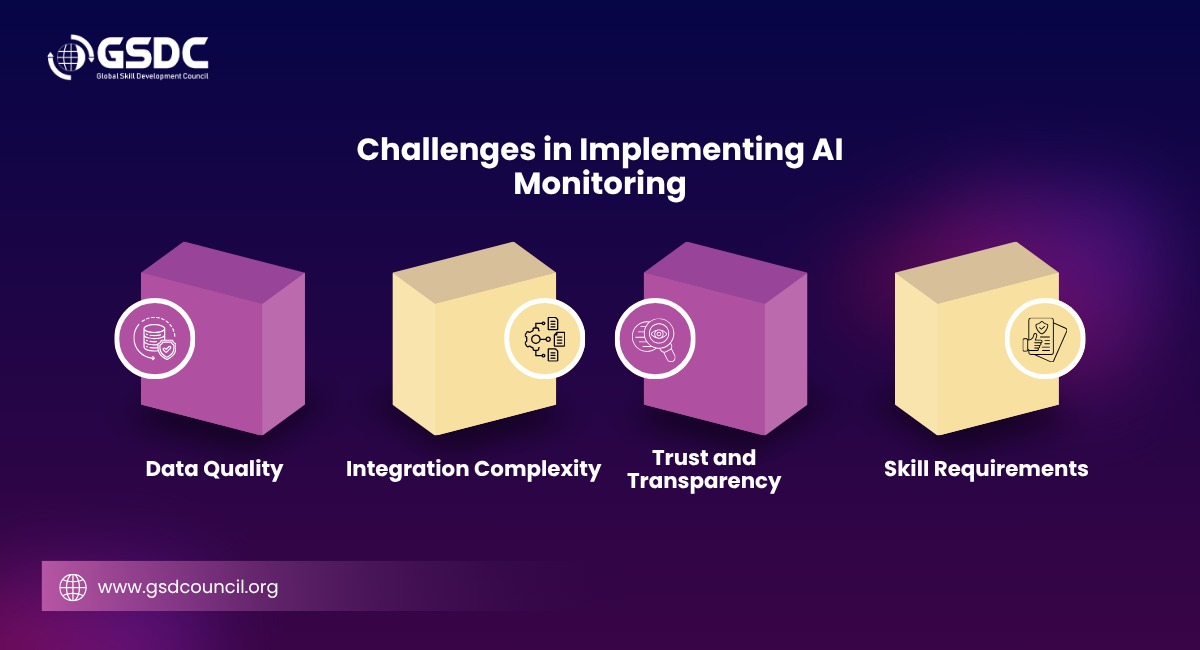
Despite its advantages, implementing AI-based monitoring comes with certain challenges.
Data Quality
AI systems rely heavily on high-quality data. Incomplete or inconsistent monitoring data can lead to inaccurate insights.
Integration Complexity
Organizations must integrate AI tools with existing monitoring platforms, cloud services, and DevOps pipelines.
Trust and Transparency
Teams must trust AI-driven recommendations. Transparent decision-making processes help build confidence in automated systems.
Skill Requirements
Implementing AI monitoring requires expertise in data science, cloud infrastructure, and AI operations.
Advance Your AI Expertise with GSDC’s Certified Agentic AI Professional Certification
As organizations increasingly adopt autonomous and intelligent systems, professionals need the skills to design, deploy, and manage AI agents effectively. GSDC’s Certified Agentic AI Professional certification equips learners with comprehensive knowledge of AI agent architectures, autonomous decision-making, multi-agent systems, AI orchestration, and real-world implementation strategies.
The Certified Agentic AI Professional certification helps professionals understand how AI agents can automate complex workflows, enhance operational efficiency, and drive business innovation across industries. By earning this certification, individuals can validate their expertise in one of the fastest-growing areas of artificial intelligence and position themselves for emerging opportunities in AI-driven enterprises.
The Future of AI Agents in Application Monitoring
AI-powered monitoring is evolving rapidly, and its role in IT operations will continue to grow.
Future developments may include:
- Autonomous IT operations (AIOps), where systems manage themselves with minimal human oversight.
- Context-aware monitoring that understands business impact, not just technical metrics.
- Cross-platform intelligence capable of monitoring hybrid and multi-cloud environments seamlessly.
- Human-AI collaboration models where engineers and AI agents work together to manage complex systems.
As digital transformation accelerates, organizations will increasingly rely on AI agents to ensure continuous application availability.
Conclusion
Application availability monitoring has become a critical component of modern IT operations. Traditional monitoring approaches, while useful, often struggle to keep pace with the complexity of cloud-native applications, distributed architectures, and evolving cloud application monitoring requirements.
AI agents bring a new level of intelligence to monitoring systems. Leveraging AI observability, AI monitoring tools, and advanced analytics, they can analyze real-time data, detect anomalies, predict failures, and automate responses. These capabilities help organizations strengthen uptime monitoring, improve operational efficiency, and maintain reliable, resilient applications.
However, as AI monitoring systems become more powerful, organizations must also consider ethical decision-making, transparency, and responsible implementation. Ensuring trust, accountability, and governance within AI-powered automation initiatives is essential for long-term success.
By combining technological innovation with effective observability and AIOps practices, businesses can fully harness the potential of AI-driven monitoring while maintaining control over critical operations.
Ultimately, AI agents are not replacing human engineers—they are empowering them to manage increasingly complex environments more effectively. Through intelligent automation, predictive insights, and enhanced AI DevOps capabilities, organizations can ensure applications remain available, performant, and responsive when users need them most.

Related Certifications
Frequently Asked Questions
Stay up-to-date with the latest news, trends, and resources in GSDC
If you like this read then make sure to check out our previous blogs: Cracking Onboarding Challenges: Fresher Success Unveiled
Not sure which certification to pursue? Our advisors will help you decide!