Why the ADDIE Model Remains the Gold Standard in Instructional Design

Written by Matthew Hale
- The Training Industry: Why Getting Design Right Matters
- What Is the ADDIE Model in Instructional Design?
- The 5 Phases of ADDIE Model Explained
- ADDIE Model Examples in the Real World
- Why ADDIE Model Is Important in Instructional Design
- Benefits of ADDIE Instructional Design Model
- Modern Use of ADDIE Model: Is It Still Relevant?
- ADDIE vs. Other Instructional Design Models
- Who Should Learn the ADDIE Model?
- Getting Certified in Instructional Design
- Conclusion: Why ADDIE Endures
In a world where new learning technologies emerge almost every year, it is easy to assume that older frameworks have been replaced. But if you work in training, education, or corporate learning, you already know that one model keeps showing up - the ADDIE model.
So, what is the ADDIE model in instructional design, and why does it continue to dominate how learning programs are designed today? Whether you are a seasoned learning professional or someone just stepping into the world of eLearning instructional design, this guide breaks it all down in plain, simple language - and backs it up with real data.
The Training Industry: Why Getting Design Right Matters
Before diving into the ADDIE methodology itself, it is worth understanding the scale of the industry it serves - and the very real cost of getting training design wrong.
U.S. companies spend $98 billion annually on corporate training - yet studies show only 10% of that training drives tangible results. Sources: Training Magazine 2024 Industry Report; Harvard Business Review |
Ineffective training costs organizations $13.5 million per 1,000 employees every year. Source: TeamStage Employee Training Statistics, 2024 |
The global corporate eLearning market was valued at $104.32 billion in 2024 and is projected to reach $334.96 billion by 2030 - growing at a CAGR of 21.7%. Source: Grand View Research, 2024 |
These numbers make one thing clear: instructional design frameworks that actually work are not a nice-to-have. They are a business-critical necessity. That is exactly the gap the ADDIE instructional design model was built to fill.
What Is the ADDIE Model in Instructional Design?
ADDIE model is one of the most popular instructional design models worldwide. The name is an abbreviation that consists of five stages: analysis, design, development, implementation, and evaluation. This approach to designing educational programs was created in the 1970s by Florida State University to develop military training courses. Now ADDIE learning model became the universal model of creating training courses.
In general, ADDIE model in instructional design can be described as a set of steps that should be followed by instructional designer to create a useful learning program. It is not a concept or just a theory, but rather a specific instructional design process that allows designing efficient training courses.
Nowadays, ADDIE is one of the first approaches to instruction design mentioned by professionals in the field.
The 5 Phases of ADDIE Model Explained
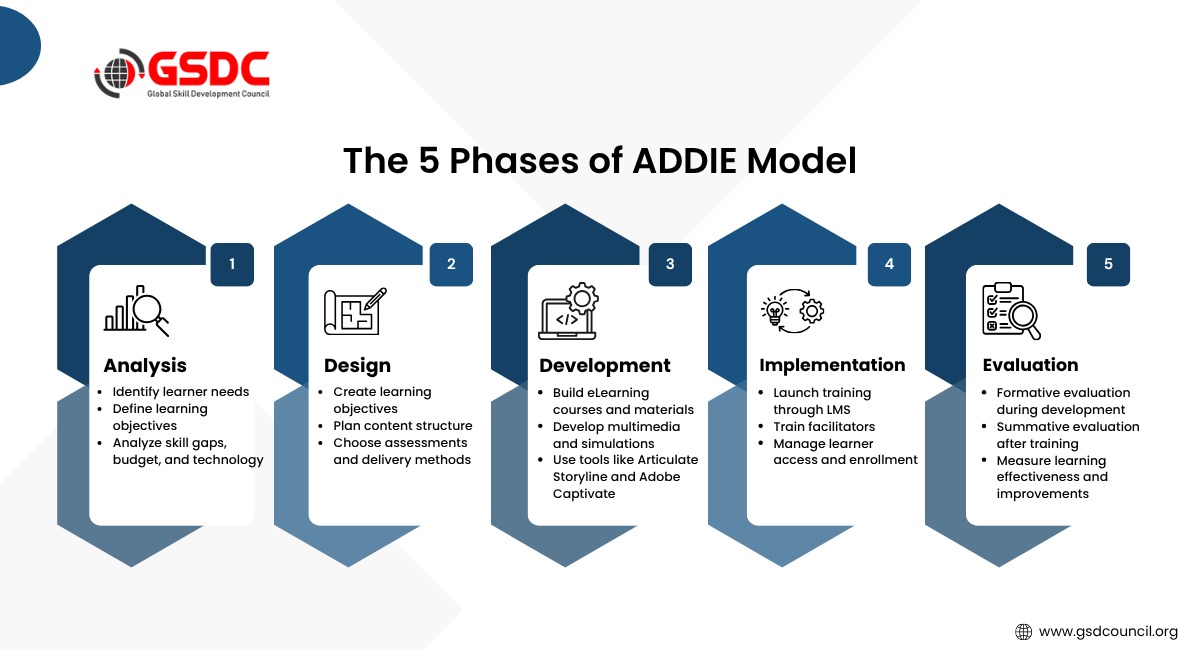
It is important to understand the phases of ADDIE model explained clearly in order to be able to understand how the ADDIE model works. The following is a description of the phases.
Phase 1: Analysis
This is where the process starts. Instructional designers ask themselves crucial questions before starting any design work.
- Who are the learners and what do they know?
- What knowledge/skill deficiencies are there?
- What are the learning and business objectives?
- What are the limitations? Time? Budget? Technology?
The analysis phase guarantees that the training is need-based, which is not always the case. This is one of the reasons why many training programs fail.
Phase 2: Design
After you have identified the problem, you then plan for the solution to the problem. This entails specifying the learning objectives, identifying the appropriate instructional methods, planning the organization of the content, choosing the assessment techniques, and deciding on the mode of delivery, which can be e-learning, classroom, etc.
Phase 3: Development
The development phase is where content creation takes place – development of course content, multimedia elements, eLearning courses, simulations, and facilitator guides. During the eLearning instructional design process, the development phase includes use of authoring tools such as Articulate Storyline or Adobe Captivate.
Phase 4: Implementation
Implementation is when the training becomes live – deployment of content via the LMS, facilitator training, and learner enrollment. Proper implementation will ensure that learners have no problems accessing the training.
Phase 5: Evaluation
This is the last and arguably the most significant phase – assessing the effectiveness of the training. According to the ADDIE instructional design model, evaluation is done on two stages:
- Formative evaluation: Feedback collected during design and development stages for improvement of the course
- Summative evaluation: Assessment of outcomes post-delivery of training using theories such as the Kirkpatrick Model
This phase involves looping back into analysis, thus making the ADDIE instructional design model a continuous process and not just an individual event.
Those individuals seeking to develop their competencies in these five phases can do so by undertaking the Certified Instructional Designer Certification program, which tests their skills in instructional design, eLearning, engagement, and assessment.
ADDIE Model Examples in the Real World
The best way to learn how the ADDIE model works is by observing ADDIE model examples. These include:
Corporate Onboarding Program:
A corporation has the challenge of training hundreds of new hires annually. With the ADDIE approach, the learning and development team first analyzes the areas in which the new hires lack knowledge. They then design a blended learning curriculum, create eLearning courses, implement them using an LMS, and evaluate their success by conducting 90-day performance assessments. Studies have shown that having a structured onboarding process helps increase productivity and raises retention rates. This is especially important since one-third of all new hires begin to look for other jobs because of bad onboarding experiences.
Compliance Training:
There is a need for a financial services organization to train its employees regarding changes in data privacy laws. With the use of the ADDIE model in instructional design, the organization will be able to create a relevant and accurate training program on compliance, from analysis to evaluation.
Sales Training:
A technology firm requires its sales personnel to be trained. The instructional design approach assists in developing scenario-based e-learning courses, product manuals, and role-playing exercises aligned to the sales objectives. This is the proper way of doing corporate training design. Sales and safety training programs developed with an organized process have been known to deliver an ROI of 300-600%.
Why ADDIE Model Is Important in Instructional Design
Considering the various instructional design models that exist today, what makes ADDIE stand out? Here is a straightforward reason why ADDIE model is important in instructional design:
1. It Reduces Guesswork
The ADDIE methodology is based on facts. Each of the decisions made is rooted in data that was collected in the analysis phase. This solution is directly linked to the industry’s major problem, which is that only 8% of companies regularly compute their training ROI.
2. It Is Scalable
No matter whether you are designing a micro-learning session for 20 minutes or a six-month-long leadership development program, ADDIE will scale up to suit your needs. American businesses have been spending an average of $1,254 per person on learning in 2024 - ADDIE ensures that money does not go to waste.
3. It Encourages Collaboration
The ADDIE process establishes a common language among the designer, subject matter expert, stakeholders, and developers. All parties know where the project stands and what steps will follow.
4. It Supports Quality Assurance
Since there is already an evaluation stage included within the ADDIE model, the issue of quality will not be overlooked. This is critical because firms that have training programs see a profit margin that is 24% higher than those firms that do not have training programs.
5. It Integrates with Modern Tools
ADDIE can easily fit into the concept of using agile methods and contemporary tools for eLearning instructional design. The new ADDIE process incorporates the use of agile ADDIE methodology, where iterations are shorter.
Benefits of ADDIE Instructional Design Model
Here are the specific benefits of ADDIE instructional design model that keep it at the top of the field:
- Structured yet flexible:
ADDIE provides a clear process without locking you into a rigid sequence. Phases can overlap, and feedback loops are built in.
- Learner-centered:
By starting with analysis, ADDIE keeps the focus on what learners actually need. This matters more than ever - 94% of employees say they would stay at a company longer if it invested in their learning. (Source: LinkedIn, 2024)
- Measurable outcomes:
The evaluation phase ties every program to measurable results. On average, organizations see $4.53 returned for every $1 spent on well-designed training.
- Widely understood:
Because ADDIE is so broadly adopted, collaboration with stakeholders who already know the model is smoother. In fact, a 2024 report found that 71.3% of hiring professionals consider the ability to apply instructional design theory a top-three skill, above proficiency with specific tools.
- Reduces costly rework:
Catching issues early through formative evaluation is far less expensive than overhauling a course post-launch. This matters given that direct learning costs hit $165 per hour in 2024 - up 34% year-on-year.
- Supports all delivery formats:
Whether designing instructor-led training, self-paced eLearning, virtual classrooms, or blended learning, ADDIE supports them all.
Organizations and professionals looking to build expertise in structured learning design often turn to the Global Skill Development Council (GSDC) for globally recognized certifications in instructional design and learning development.
Modern Use of ADDIE Model: Is It Still Relevant?
Among learning and development professionals, one popular concern regarding the modern use of ADDIE model is whether it is still relevant amid fast technological advancements. The straightforward answer to that is definitely yes – and statistics prove it.
83% of organizations say they will maintain or increase career-driven learning investment in 2025, signaling continued demand for structured instructional design processes. Source: Training Magazine 2024 Industry Report |
Agile ADDIE:
Modern teams conduct parallel activities and apply rapid prototyping during the development stage of ADDIE model. Thus, ADDIE remains effective but adapted to the current needs of businesses.
ADDIE + Design Thinking:
Numerous organizations implement a combination of ADDIE and design thinking – including empathy research during the analysis stage and prototyping during the development stage.
ADDIE in AI-Powered Learning:
While AI changes the way content is created, ADDIE remains the framework of choice. AI is well-suited for development, whereas analysis and evaluation help ensure that the AI-created content achieves its intended purpose. The AI-based education market worldwide is experiencing a CAGR growth of more than 45%.
ADDIE for Performance Consulting:
Within corporate training design, ADDIE has grown to include performance consulting, where it is used to determine whether training is even necessary or whether there should be changes in processes or management.
The contemporary application of ADDIE model does not involve adhering to a strict textbook approach. Rather, it involves using an instructional design framework as a strategic thinking process that ensures that the learning programs stay focused on business objectives.
ADDIE vs. Other Instructional Design Models
ADDIE is not the only instructional design model available. Others are SAM, Dick and Carey, Bloom’s Taxonomy, and Merrill’s Principles of Instruction. Below is a comparison of the models:
Model | Strength | Best For |
ADDIE | Comprehensive, widely understood | Most training projects |
SAM | Faster, more iterative | Rapid development projects |
Dick & Carey | Very detailed, systems-based | Complex, high-stakes learning |
Bloom's Taxonomy | Focuses on learning objectives | Curriculum planning |
ADDIE is better suited for most cases since it strikes a balance between detail and flexibility while being generally well understood by all stakeholders involved.
Who Should Learn the ADDIE Model?
The ADDIE instructional design model explained as discussed above, can be applied in a variety of Learning & Development positions. According to the United States Bureau of Labor Statistics, there will be an estimated 232,600 jobs for instructional coordinators in the United States by the year 2024, with 21,900 new jobs opening annually until 2034.
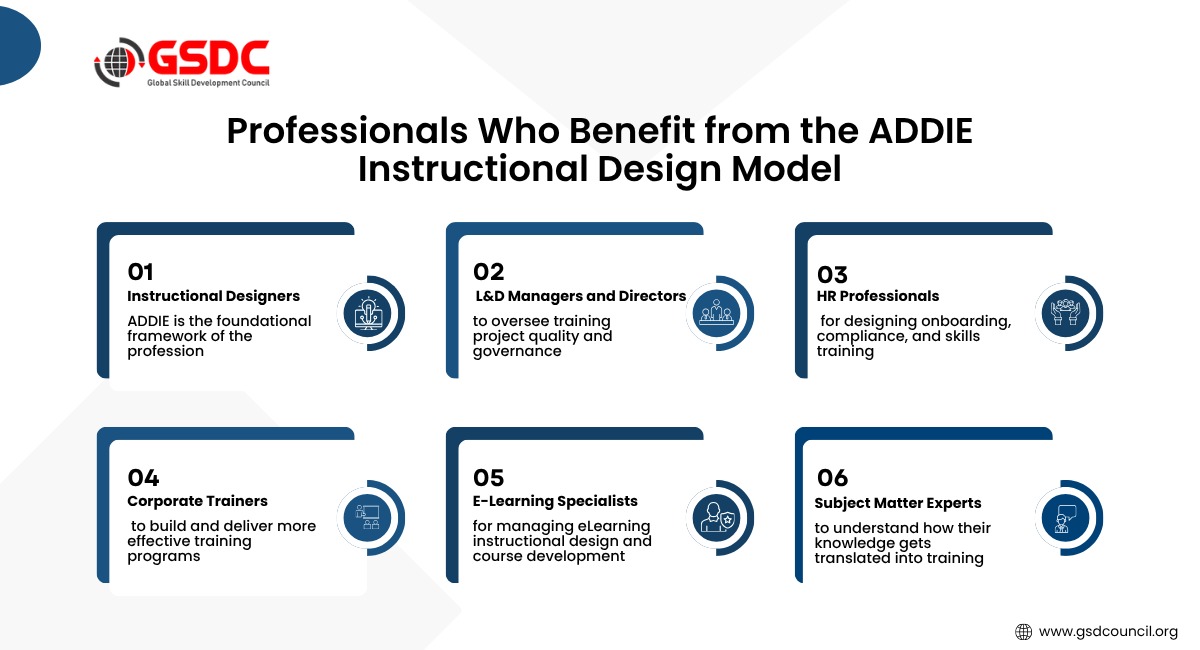
If you hold one of the following positions, learning about ADDIE methodology is a must!
Getting Certified in Instructional Design
Achieving a professional certification will be an excellent way for you to gain more insight into the ADDIE model of instructional design and build your career in L&D. The Global Skill Development Council (GSDC) provides global certifications in instructional design that will help you put ADDIE into practice in practical learning situations.
An instructional design certification is proof of your ability to design effective training programs and will show potential employers that you can develop successful learning experiences.

Conclusion: Why ADDIE Endures
The ADDIE learning model has been around for decades, but it has never been more relevant. U.S. organizations spend $98 billion on corporate training annually - yet only 10% of that training produces real results. The difference between training that works and training that wastes budget almost always comes down to design.
ADDIE instructional design model explained in simple terms: it is a thoughtful, evidence-based approach to solving learning problems. It starts with understanding the learner, designs with clear goals, builds content with purpose, delivers with care, and always asks whether it worked.
That is why ADDIE model is important in instructional design - and why it will continue to dominate for years to come.
Subscribe to Our Newsletter
Stay up-to-date with the latest news, trends, and resources in GSDC

Related Certifications
Frequently Asked Questions
Stay up-to-date with the latest news, trends, and resources in GSDC
If you like this read then make sure to check out our previous blogs: Cracking Onboarding Challenges: Fresher Success Unveiled
Not sure which certification to pursue? Our advisors will help you decide!