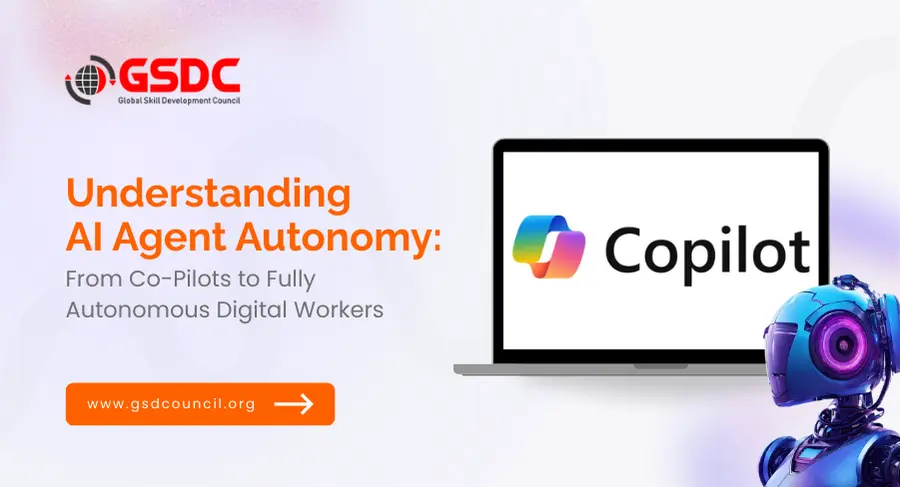
Understanding AI Agent Autonomy: From Co-Pilots to Fully Autonomous Digital Workers
Written by Matthew Hale
- What Is AI Autonomy?
- AI Co-Pilots vs AI Agents: A Strategic Shift
- The Five Levels of AI Autonomy in Business
- Why AI Autonomy Matters
- Governance Frameworks for AI Agent Autonomy
- Impact on Workforce and Culture
- Developing Agent-Ready Talent with GSDC
- Conclusion: The Journey Toward Autonomous Organizations
Most organizations still rely on AI as a support layer, a tool that answers questions or recommends next steps. Real transformation begins when AI agents stop assisting and start acting. As autonomous AI agents take ownership of workflows, organisations must understand how independently their systems operate across the AI agent autonomy spectrum.
This shift from traditional AI co-pilots to advanced agentic AI systems is redefining organisational automation. In this article, we explore how the five levels of autonomy in process automation help organizations assess maturity and build a future where autonomous digital workers drive scalable, outcome-focused operations.
What Is AI Autonomy?
AI autonomy refers to the degree of independence of the artificial intelligence process without human control or intervention. When it is at the lower levels, it might follow some predetermined rules or scripts. When it is at the higher levels, artificial intelligence systems are in a position to perform some autonomous tasks.
With increased autonomy of AI agents, organizations are able to achieve greater speed, consistency, and scalability. However, they need to adjust governance models, accountability mechanisms, and prepare the workforce to ensure the responsible functioning of autonomous AI agents in the organisation.
AI Co-Pilots vs AI Agents: A Strategic Shift
A clear understanding of the distinction between AI co-pilots and AI agents is essential in designing an organization-wide adoption plan for AI use.
|
AI Co-Pilots |
AI Agents |
|
Assist users with specific tasks |
Act independently within workflows |
|
Suggest actions or recommendations |
Execute multi-step actions autonomously |
|
Requires frequent human input |
Require minimal human direction |
|
Improve individual productivity |
Transform end-to-end business processes |
While AI co-pilots help people work smarter, agentic AI systems take ownership of outcomes - marking the transition toward truly autonomous AI agents in the organisation.
The Five Levels of AI Autonomy in Business
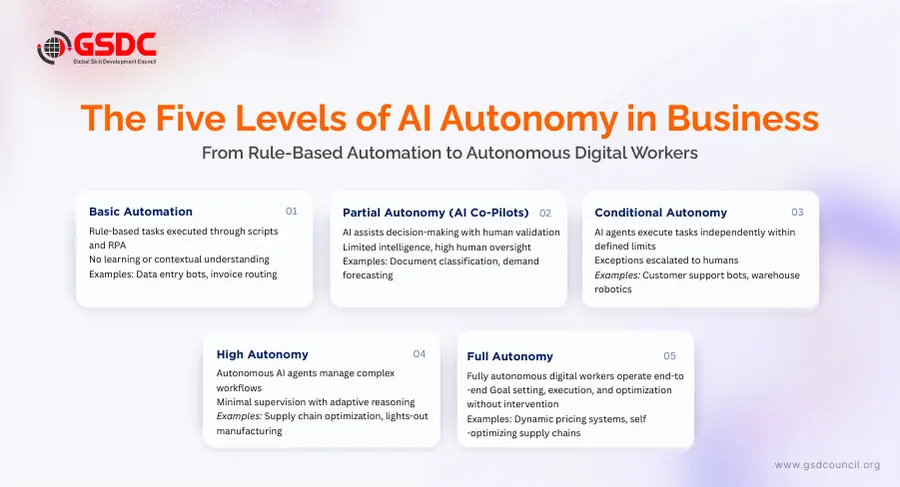
These five levels of autonomy in the context of process automation help to systematize the assessment of the maturity level of autonomy in AI agents and the state of agentic AI systems.
-
Level 1 – Basic AI automation
Within this phase, systems are able to perform work entirely by rule-bound processes and scripted operations with no learning or context. Classic examples of such systems include RPA bots that undertake heavy data entry, rule-governed processes that direct invoices, or workflow-activated processes within finance functions. This phase sets the basic operations bar for when more evolved AI agents can be introduced.
-
Level 2 – Partial Autonomy (Co-Pilot Stage)
The concept of limited intelligence is introduced, but the model is still reliant on regular validation from a human. For example, a document-classification software that utilizes a learning machine and a demand forecasting software that creates recommendations that must be reviewed and approved by the manager, like AI co-pilots.
-
Level 3 – Conditional Autonomy
At this stage, AI-based agents can perform end-to-end tasks independently within certain defined constraints, delegating exceptions as uncertainty emerges. These involve AI consumer service tools, as well as order fulfillment robots in a warehouse, that deal with the routine tasks, but human input is required for cases that are non-routine/unstructured.
-
Level 4 – High Autonomy
These self-governant autonomous AI agents independently handle complex and dynamic workflow processes while evincing awareness of context and adaptability of reasoning. The supply chain optimization platforms and the lights-out manufacturing domains represent such levels of autonomy, where human involvement mainly involves oversight.
-
Level 5 – Full Autonomy
This level represents the achievement of fully autonomous digital workers with the ability to set objectives and optimize their execution strategies. For example, AI systems are handling dynamic pricing around the world, along with self-optimized supply chains that adjust in real-time. While it remains more of an aspiration right now, pilot projects are already revealing the potential of full AI agent autonomy on a scale that applies to organisations.
As organizations move ahead in these five levels of autonomy in process automation, more professionals with expertise in AI agent autonomy and agentic AI systems will be required. The Global Skill Development Council (GSDC) meets this requirement with certifications to equip professionals to handle AI agents responsibly and work with digital workers in an autonomous environment.
Why AI Autonomy Matters
-
Increased Efficiency
AI agent autonomy enables autonomous AI agents to operate continuously without fatigue, reducing reliance on human intervention for routine processes.
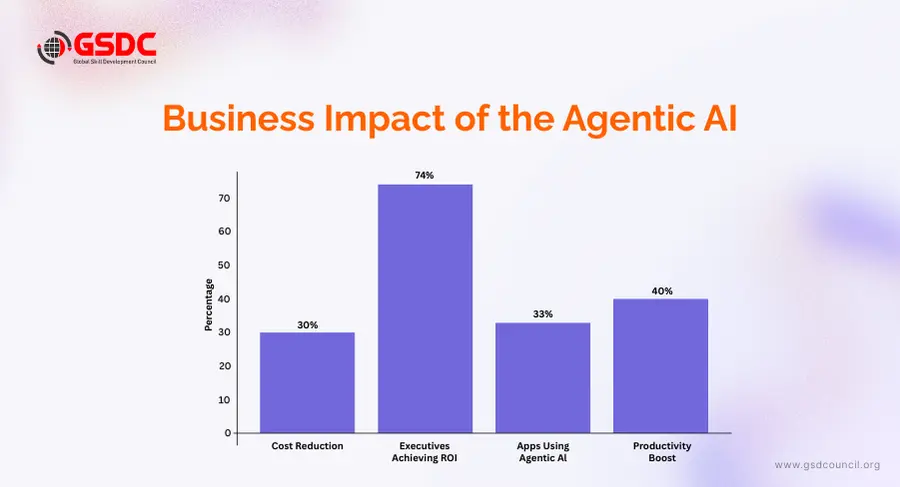
Research shows that businesses using AI agents have reduced manual work and operational costs by at least 30% while increasing speed and productivity.
-
Accelerated Decision-Making
Higher levels of AI autonomy remove bottlenecks caused by traditional approval chains. According to industry reports, 74% of executives report achieving measurable ROI within the first year of deploying AI agents, with many organizations deploying more than ten agents to drive real-time decision support and execution.
-
Enhanced Insight Discovery
Advanced AI agents process and analyze large volumes of data that exceed the human scale, offering predictive insights to inform strategic decisions.
By 2028, advanced AI agents will be embedded in about 33% of software applications in organisations; these will then enable up to 15% of routine work decisions to be done autonomously.
-
Improved Productivity and Workforce Augmentation
In addition, apart from automation, AI enhances worker productivity by alleviating most of the workload, allowing them to focus on more important matters.
In fact, research has also found that when workers used AI applications, there was an estimated potential increase of up to 40% in their performance.
To facilitate this shift towards AI agent autonomy and organisation-level agentic AI systems, the Agentic AI Foundation Certification provides professionals with the know-how to effectively design, govern, and manage responsible autonomy for AI agents.
Governance Frameworks for AI Agent Autonomy
-
Clear Accountability Structures
With the growth of AI agent autonomy, it becomes necessary for organizations to assign ownership of the decisions made by autonomous AI agents, thus ensuring that the responsibility for the outcomes is traceable throughout the business functions.
-
Ethical AI Frameworks
Agentic AI systems should be consistent with the values of the organization and the expectations of the regulators so that bias, misuse, or unintended consequences are avoided.
-
Transparent Auditing and Explainability
In order to preserve trust, the operations of AI agents need to be recorded and explained, thus allowing stakeholders to comprehend how decisions are made.
-
Robust Fallback and Safety Mechanisms
Organizations are obligated to deploy safety measures that facilitate easy human intervention in situations where autonomous AI agents are uncertain or face abnormal scenarios.
These governance principles, when combined, provide a framework in which the increasing autonomy of AI agents can be a source of innovation without the risk of losing trust or violating compliance regulations.
Download the checklist for the following benefits:
Governance Frameworks for AI Agent Autonomy
-
Clear Accountability Structures
With the growth of AI agent autonomy, it becomes necessary for organizations to assign ownership of the decisions made by autonomous AI agents, thus ensuring that the responsibility for the outcomes is traceable throughout the business functions.
-
Ethical AI Frameworks
Agentic AI systems should be consistent with the values of the organization and the expectations of the regulators so that bias, misuse, or unintended consequences are avoided.
-
Transparent Auditing and Explainability
In order to preserve trust, the operations of AI agents need to be recorded and explained, thus allowing stakeholders to comprehend how decisions are made.
-
Robust Fallback and Safety Mechanisms
Organizations are obligated to deploy safety measures that facilitate easy human intervention in situations where autonomous AI agents are uncertain or face abnormal scenarios.
These governance principles, when combined, provide a framework in which the increasing autonomy of AI agents can be a source of innovation without the risk of losing trust or violating compliance regulations.
Impact on Workforce and Culture
- Transition from task completion to strategic guidance for self-governing AI agents.
- Transition from manual operations to orchestration of agentic AI systems.
- Evolution from Reactive Problem-solving to Proactive Design of Autonomy Frameworks in AI Agents.
- Increased emphasis on governance, ethics, and accountability in managing AI agents.
- This increases the need for a talent pool with cross-functional skills to integrate autonomous digital workers.
- Redefining leadership roles for the supervision of organisation-wide AI agent autonomy initiatives.
Developing Agent-Ready Talent with GSDC
As organisations move forward to higher levels of autonomy for AI agents, capability-readiness becomes an imperative. Experts should be ready to develop, handle, and control autonomous AI agents with AI ethics.
GSDC achieves this through offering programs such as the Agentic AI Foundation Certification, which empowers learners with the necessary knowledge of how to apply agentic AI systems, thus filling the gap that exists between theory and application.

Conclusion: The Journey Toward Autonomous Organizations
Autonomy in an AI agent can never be attained in one technological jump but rather signifies an ongoing maturity model. Those organizations that comprehend and also implement the five levels of autonomy in the context of process automation are likely to perform scalable automation with the help of autonomous AI agents, Operational Bottlenecks with the aid of Agentic AI systems, Sustainable human-AI collaboration, and Resilient future-proof organizations with the support of autonomous digital workers with each level of autonomy, ranging from basic automation to completely autonomous systems.

Related Certifications
Stay up-to-date with the latest news, trends, and resources in GSDC
If you like this read then make sure to check out our previous blogs: Cracking Onboarding Challenges: Fresher Success Unveiled
Not sure which certification to pursue? Our advisors will help you decide!